
Disclaimer: This article is for general information only and is not financial, tax or investment advice. PublishIQHub is not a SEBI-registered investment adviser. Loan rates differ by lender and borrower profile, so check with your bank before acting.
Quick Answer: How does a Fed rate hike and an RBI repo rate hike affect you?
A Fed rate hike makes the dollar stronger and pulls foreign money out of India, which weakens the rupee and pushes up imported inflation. The RBI repo rate hike of 25 basis points to 5.50% on 7 October 2026 is a response to that pressure. On a ₹50 lakh, 20-year floating home loan, each 25 bps adds roughly ₹780 to the monthly EMI.
For almost two years, Indian borrowers got used to good news. EMIs fell, banks sent cheerful SMS alerts about lower rates, and nobody thought much about the US Federal Reserve. That phase is over.
On 16 September 2026 the Fed raised rates for the first time since 2023. Three weeks later, on 7 October, the Reserve Bank of India followed with its own hike. If your home loan is linked to the repo rate, your EMI is set to rise within the next few months.
This guide explains why a Fed rate hike in Washington ends up in your bank statement in Pune or Patna. It covers the exact EMI appreciation on common loan sizes, the impact on Indian economy and the impact on world economy, and the steps worth taking before your bank resets the rate.
Related reading: if you are already tracking salary changes this year, see how the new EPFO rules affect your take-home salary. A smaller in-hand salary plus a bigger EMI is a squeeze worth planning for.
What Exactly Did the Fed and the RBI Do in 2026?
Both central banks raised rates by 25 basis points within three weeks, ending a long easing cycle. The order matters, so here is the sequence.
The Fed rate hike (16 September 2026). The Federal Open Market Committee voted 12-0 to lift the federal funds target range from 3.50–3.75% to 3.75–4.00%. It was the first Fed rate hike since July 2023, after five straight meetings of no change this year. In his post-meeting press conference, Chair Kevin Warsh said the median Fed official now expects the funds rate at 4.1% by the end of 2026. In plain words, one more hike is pencilled in.
The RBI repo rate hike (7 October 2026). The Monetary Policy Committee unanimously raised the repo rate from 5.25% to 5.50% and changed its stance to “calibrated tightening”. According to CNBC’s report on the decision, retail inflation had risen for 10 straight months and the RBI now projects headline inflation of 5.2% for FY27. This is the first RBI repo rate hike since February 2023, and it comes after a cumulative 125 bps of cuts in 2025 that took the repo rate from 6.50% to 5.25%.
The RBI also raised its FY27 GDP growth forecast to 7.1%, up from 6.7% in its August policy, according to the MPC resolution of 7 October 2026. Real GDP grew 7.8% in April–June. So this is not a hike to rescue a falling economy. Growth is strong, and the central bank feels it has room to fight prices.
| US Federal Reserve | Reserve Bank of India | |
| Latest decision | +25 bps on 16 Sep 2026 | +25 bps on 7 Oct 2026 |
| Policy rate now | 3.75–4.00% (fed funds range) | 5.50% (repo rate) |
| Previous level | 3.50–3.75% | 5.25% |
| Vote | 12-0 | 6-0 on the hike; 4-2 on the new stance |
| Last hike before this | July 2023 | February 2023 |
| Stated reason | Inflation not falling fast enough | Rising inflation, weak monsoon, crude, global tightening |
| Signal for next move | Median sees 4.1% by end-2026 | Only a hike or a pause from here |
| Inflation target | 2% (PCE) | 4% CPI, band of 2–6% |
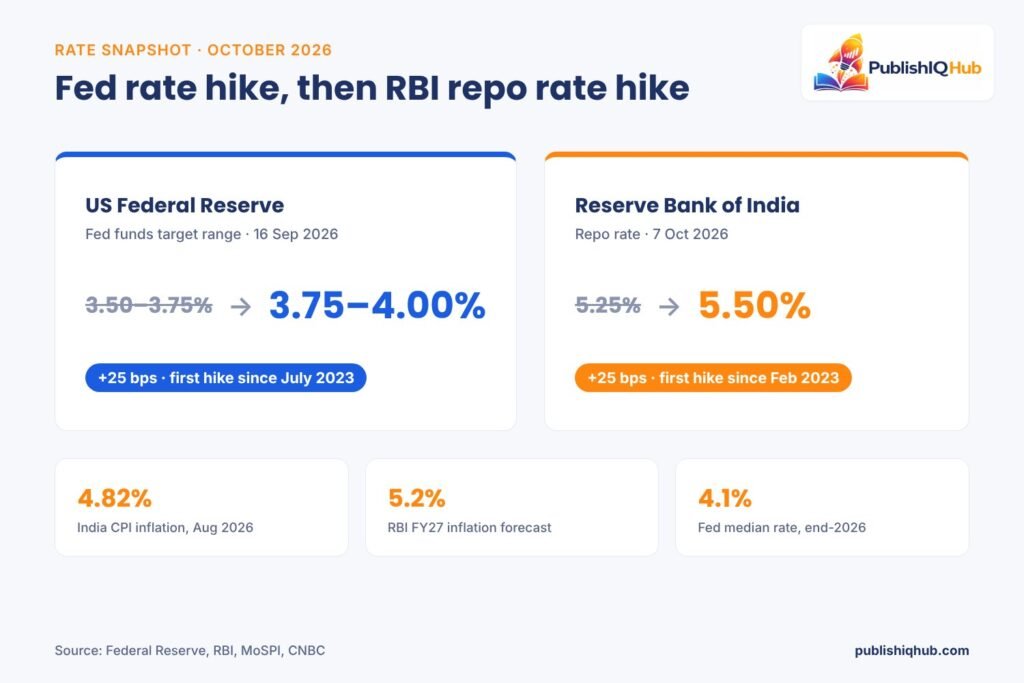
So, what is the repo rate today after the RBI repo rate hike? It is 5.50%, effective 7 October 2026. The Standing Deposit Facility and Marginal Standing Facility rates move up in step, so short-term money in the banking system costs more from this week.
How Does a Fed Rate Hike Affect India?
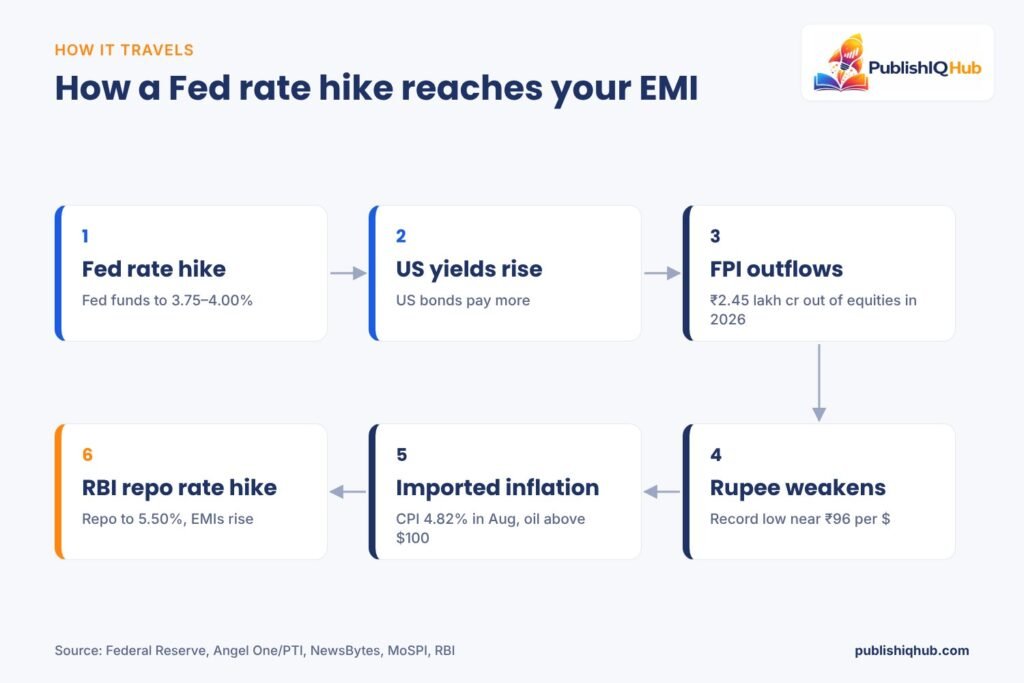
A Fed rate hike reaches India through four links: the dollar, foreign investor money, the rupee, and imported inflation. The RBI does not copy the Fed. But it cannot ignore it either, because each link puts pressure on Indian prices.
- Higher US yields pull money home. After a Fed rate hike, US Treasury bonds pay more, and a fund manager in New York has less reason to hold Indian shares. Foreign portfolio investors (FPIs) pulled out ₹20,974 crore from Indian equities in September 2026 up to the 20th. That took total FPI outflows for 2026 to ₹2.45 lakh crore, already above the ₹1.66 lakh crore that left in all of 2025.
- FPI outflows weaken the rupee. Every rupee sold for dollars adds pressure on the currency. In the same week, the rupee vs dollar rate touched a record low near 95.96 and breached 96 intraday.
- A weak rupee imports inflation. India buys most of its crude oil abroad, and oil has been trading above $100 a barrel because of disruption around the Strait of Hormuz. Pricier dollars plus pricier oil means costlier diesel, freight, fertiliser and electronics.
- The RBI responds with a repo rate hike. Retail inflation climbed to 4.82% in August 2026, with food inflation at 5.95%, according to MoSPI. That is above the RBI’s 4% target. A higher repo rate makes holding rupees more attractive and cools demand.
One analyst quoted by NewsBytes put it neatly: the September selling was a crude-and-dollar story, not an India story. That is the key point about inflation and interest rates in 2026. India’s own economy is growing well. The pressure is coming from outside, and the Fed rate hike is a big part of it.
If you invest in US stocks directly, the same Fed decision affects your returns too. Our guide to the best trading platforms for US stock investors covers how currency moves change what you earn in rupees.
Will My Home Loan EMI Increase After the RBI Repo Rate Hike?
Yes, if your home loan is on a floating rate linked to the repo rate. Since October 2019, banks have had to link new floating-rate retail loans to an external benchmark, and most chose the RBI repo rate. These EBLR loans reset at least once every three months, so the RBI repo rate hike usually shows up in your EMI within one quarter.
Older loans on MCLR or base rate move more slowly. Fixed-rate loans, common for cars and personal loans, do not change at all. New borrowers, though, will face hiked loan interest rates from the day they sign.
How much will the EMI appreciation be?
The table below uses a ₹50 lakh home loan over 20 years and assumes a starting rate of 8.00%. Your bank’s actual rate may be higher or lower; the size of the increase is what matters.
| Home loan rate | Monthly EMI | Increase per month | Total interest over 20 years |
| 8.00% (before hike) | ₹41,822 | – | ₹50.37 lakh |
| 8.25% (+25 bps) | ₹42,603 | +₹781 | ₹52.25 lakh |
| 8.50% (+50 bps) | ₹43,391 | +₹1,569 | ₹54.14 lakh |
| 8.75% (+75 bps) | ₹44,186 | +₹2,364 | ₹56.05 lakh |
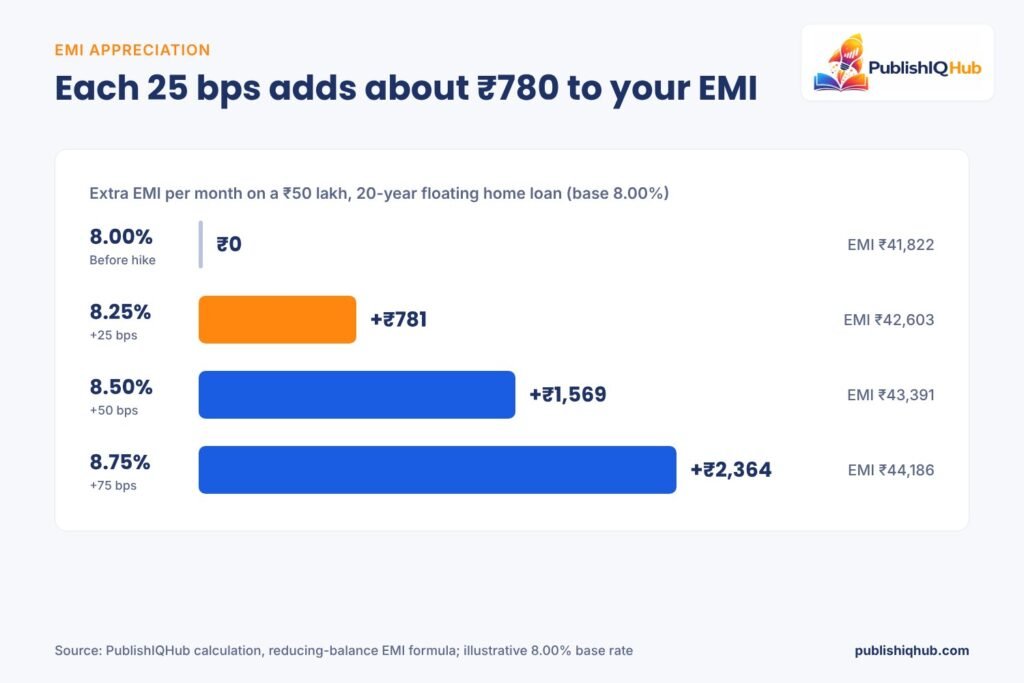
The EMI appreciation from the first 25 bps is about ₹781 a month. That sounds small, but brokerages are not expecting just one move. Nomura expects another 25 bps in December, which would take the repo rate to 5.75% by the end of 2026. At +50 bps, a typical Bengaluru IT couple with this loan pays nearly ₹19,000 more a year.
For a car loan of ₹8 lakh over 5 years, a 25 bps rise from 9.00% to 9.25% adds only about ₹97 a month. Home loans feel rate hikes far more because the amount and the tenure are both large.
Is it better to increase EMI or loan tenure after a rate hike?
Choosing a higher EMI is almost always cheaper than a longer tenure. Many banks quietly extend the tenure by default because the EMI stays the same and the customer does not complain. That convenience is expensive.
On the same ₹50 lakh loan, if hiked loan interest rates take you to 8.25% and you keep the old EMI of ₹41,822, the loan runs about 12 months longer. Total interest goes up to roughly ₹55.33 lakh. Paying the higher EMI instead keeps total interest near ₹52.25 lakh. That is a saving of about ₹3 lakh for paying ₹781 more a month. At 8.50%, keeping the old EMI stretches the loan by about 26 months.
Call your bank and ask which option they have applied. If you can afford it, ask them to raise the EMI and keep the original end date.
What Is the Impact on Indian Economy?
The short-term impact on Indian economy is slower credit growth and costlier borrowing, in exchange for steadier prices and a firmer rupee. Here is how it plays out across sectors.
Growth. The RBI repo rate hike comes from a position of strength. Its upgraded 7.1% growth forecast for FY27 suggests the central bank expects only a mild drag from one or two hikes. Consumption could cool a little in the festive months, but a sharp slowdown is not the base case.
Inflation. This is where the impact on Indian economy matters most. With retail inflation at 4.82% and rising for 10 months, the RBI wants to stop price expectations from settling higher. The RBI expects CPI inflation to peak at 6.0% in the October–December quarter before easing to 5.7%. Food and fuel are driving the numbers, helped along by a deficient monsoon, and those respond only partly to interest rates. So the hike works mostly by protecting the rupee and limiting second-round effects, such as companies passing on higher costs.
The rupee and FPI flows. A wider gap between Indian and US rates makes rupee assets a little more attractive. It will not reverse FPI outflows overnight, but it can slow the bleeding. A stable rupee also keeps the import bill for oil and gold in check.
Banks and depositors. Hiked loan interest rates usually come with better fixed deposit rates, though deposit rates tend to rise more slowly than loan rates. Savers who were about to lock into a five-year FD may want to wait or ladder their deposits. If your money sits in a bank account, it is also worth knowing your rights during disruptions, as covered in our explainer on the September 2026 bank strike.
Real estate. Affordable and mid-income housing is the most rate-sensitive segment. A buyer whose loan eligibility is tied to EMI-to-income ratios will qualify for a slightly smaller loan after each RBI repo rate hike. Luxury housing, often bought with less leverage, feels it less.
Stock markets. Rate-sensitive sectors such as banks, NBFCs, real estate and auto usually react first to a Fed rate hike or an RBI repo rate hike. Companies with steady cash flows and dividends tend to hold up better when rates rise. Our list of the highest dividend-yield private sector stocks in India is a starting point if you are reviewing your portfolio, not a recommendation to buy.
Government and businesses. Higher rates raise bond yields, which increases the government’s borrowing cost and the cost of working capital for MSMEs. Small exporters face a mixed picture: a weaker rupee helps their prices abroad, while costlier credit hurts their cash flow at home.
What Is the Impact on Indian Economy?
A Fed rate hike tightens money everywhere, because much of the world borrows, trades and saves in dollars. The impact on world economy in 2026 is sharper than usual because it lands on top of an energy shock.
The IMF’s July 2026 World Economic Outlook Update projects global growth of 3.0% in 2026 and 3.4% in 2027. It also warns that global disinflation has stalled. In its accompanying briefing, the Fund revised its 2026 global headline inflation forecast up to 4.7%. Central banks are therefore being pushed toward tighter policy at the same time, which is exactly what is happening.
Three effects stand out:
- A stronger dollar squeezes emerging markets. Countries and companies with dollar loans need more of their own currency to repay. Energy importers without a strong export sector are hit hardest, and the IMF has said as much.
- Capital moves back to the US. After a Fed rate hike, higher US yields attract global money, which explains the FPI outflows seen across Asia, not just in India.
- Commodity and trade costs rise. Oil above $100, combined with a strong dollar, raises shipping and input costs for factories worldwide. That feeds back into inflation and keeps rates higher for longer.
The impact on world economy is not all negative. The IMF also points to AI-driven investment lifting countries plugged into the global technology supply chain. India’s IT services and electronics exporters sit partly in that group, which is one reason its growth outlook stays among the strongest of large economies.
What Should Borrowers Do When Interest Rates Rise?
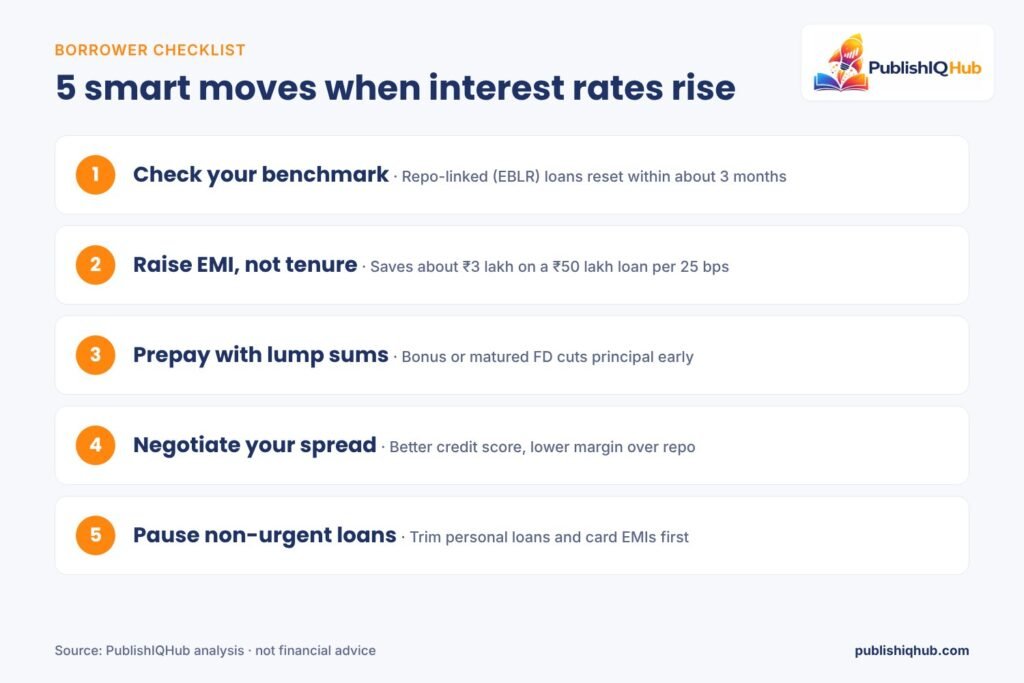
Act before your next reset date, not after the higher EMI hits your account. Five practical moves:
- Find your benchmark and reset date. Your loan sanction letter or bank app shows whether the loan is linked to the repo rate (EBLR), MCLR or a fixed rate. EBLR loans pass on the RBI repo rate hike fastest.
- Pick a higher EMI over a longer tenure. As the table above shows, extending tenure on a ₹50 lakh loan can cost about ₹3 lakh more in interest for the same 25 bps rise.
- Prepay with lump sums. A Diwali bonus or a matured FD used to prepay principal early in the loan saves the most interest. Floating-rate home loans taken by individuals do not carry prepayment penalties at most banks, but confirm with yours.
- Negotiate or switch. Your rate is the repo rate plus a spread set by the bank. If your credit score has improved, ask for a lower spread. If the bank refuses, compare a balance transfer, keeping processing fees and legal charges in mind.
- Stop and review new borrowing. For a personal loan or credit card EMI that is not urgent, waiting a few months costs nothing. Hiked loan interest rates make discretionary debt the first thing to trim.
What does it cost to switch your home loan to another bank?
Switching lenders after an RBI repo rate hike can cost tens of thousands of rupees in one-time charges, so it pays only when the rate gap is large enough. A balance transfer means the new bank pays off your old loan and opens a fresh one. Most of the cost sits with the new lender.
| Cost | Who charges it | What to expect |
| Foreclosure or prepayment charge | Old bank | Nil on floating-rate loans to individuals, as per RBI rules |
| Processing fee | New bank | A percentage of the loan or a flat fee; often negotiable or waived in offers |
| Legal and technical (valuation) fees | New bank | Charged for title search and property valuation |
| Stamp duty on the new mortgage | State government | Varies by state; paid again because a new mortgage is created |
| Documentation, CERSAI and franking charges | New bank | Smaller fees, but they add up |
| Loan insurance | Insurer | An old loan-linked policy may not carry over; a new cover may be pushed |
The good news is the old bank cannot penalise you for leaving. RBI’s prepayment charges directions, effective 1 January 2026, bar such charges on floating-rate loans to individuals. This applies whatever the source of the money and with no minimum lock-in period.
How much is stamp duty on an equitable mortgage?
Stamp duty on an equitable mortgage is often the biggest single cost of a balance transfer, at roughly 0.3% to 0.6% of the loan in most large states. Home loans in India are usually secured by an equitable mortgage, created through a Memorandum of Deposit of Title Deeds (MODT). When you switch banks, the new lender creates a fresh mortgage, so you pay this duty again.
| State | Stamp duty on MODT | Registration fee | Approx. cost on a ₹45 lakh loan |
| Karnataka | 0.5% of loan, no upper cap above ₹10 lakh | About 0.1% | About ₹27,000 |
| Tamil Nadu | 0.5% of loan, capped at ₹30,000 | 1%, capped at ₹6,000 | About ₹28,500 |
| Telangana | About 0.6% combined | Included | About ₹27,000 |
| Maharashtra | About 0.3% of loan | As per state rate | About ₹13,500 plus registration |
Karnataka is the one to watch. It raised MODT stamp duty from 0.1% to 0.5% in February 2024 and removed the earlier ceiling for loans above ₹10 lakh. On an ₹80 lakh loan, that works out to roughly ₹48,000 in duty and registration together. Tamil Nadu’s caps keep the bill near ₹36,000 even on large loans.
Stamp duty rules change often, so check the current rate on your state’s registration (IGR) portal before you compare offers. Ask the new bank whether its quote includes MODT charges, because many offers advertise only the processing fee.
Which clauses matter when you change banks?
Read these clauses in your current loan agreement and the new sanction letter before signing:
- Prepayment clause. It must say clearly whether prepayment charges apply. Under the 2026 rules, lenders have to state this in both the sanction letter and the loan agreement.
- Return of original documents. The old bank must hand back your original property papers within 30 days of full repayment. If it delays, it must pay ₹5,000 for each day of delay. If papers are lost, it must help get certified copies and bear the cost.
- Rate reset clause. RBI’s floating-rate reset framework lets you choose a higher EMI, a longer tenure or prepayment at each reset. It also lets you switch to a fixed rate under the bank’s policy, with all charges disclosed upfront.
- Spread and benchmark. Check the spread over the repo rate in the new offer, and whether the bank can change it later. A low teaser rate with a revisable spread can erase your saving.
- Conversion fee with your own bank. Many banks will cut your spread for a one-time conversion fee. Ask for this before you start paperwork elsewhere.
- Top-up and insurance conditions. Some offers tie the lower rate to a top-up loan or a bundled insurance policy. Read what you are agreeing to.
Does a balance transfer make sense? A quick check
Take a ₹45 lakh outstanding loan with 18 years left. If the rate drops from 8.75% to 8.25%, the EMI falls from ₹41,440 to ₹40,057. That saves ₹1,383 a month, or roughly ₹3 lakh over the remaining tenure. Assuming one-time costs of ₹40,000 to ₹60,000 (get the exact figure from the new bank’s Key Facts Statement), you break even in about 29 to 43 months.
A simple rule: if the rate gap is under 0.25% or fewer than five years remain, ask your own bank for a lower spread first. Hiked loan interest rates make switching tempting, but the paperwork only pays off on a long, large loan.
Fixed vs floating home loan: which is better when rates rise?
For most long home loans, floating still works out better over the full tenure. Fixed home loan rates in India are usually set noticeably higher than floating rates and often convert to floating after a few years. You pay extra for certainty. A fixed rate makes sense mainly if your budget cannot absorb even a ₹2,000 swing in EMI. For car and personal loans, which are mostly fixed already, nothing changes for existing borrowers.
What about savers?
Rising rates are good news for depositors. If more hikes come, as some brokerages expect, locking a large sum into a long FD today may mean missing better rates in a few months. A ladder of shorter deposits keeps options open. Senior citizens who depend on interest income should watch bank announcements over the next two quarters.
The Bottom Line
The Fed rate hike and the RBI repo rate hike of 2026 mark a clear turn. Cheap money is gone for now, and both central banks are signalling that inflation comes first. For a household, the impact on Indian economy shows up in one place before anywhere else: the monthly EMI.
The EMI appreciation from one 25 bps move is manageable. Two or three moves add up, especially if your bank quietly stretches your tenure. Check your loan terms this month, choose a higher EMI over a longer loan where you can, and keep an eye on the RBI’s December review.
The RBI’s reach goes well beyond rates, too. Its recent decision that made the Tata Sons IPO mandatory shows how much one regulator can move markets. For more plain-language finance explainers, keep following PublishIQHub.
Frequently Asked Questions
What is the repo rate today in 2026?
The RBI repo rate is 5.50% as of 7 October 2026, after a 25 bps hike by the Monetary Policy Committee. It had stayed at 5.25% for four meetings before that. The stance is now “calibrated tightening”, which means the next move is either another hike or a pause.
Why did the RBI hike the repo rate in October 2026?
Retail inflation rose for 10 straight months to 4.82% in August, crude oil traded above $100, the monsoon fell short and the rupee hit record lows. The Fed rate hike in September added pressure by pulling foreign money out of India. With growth strong, the RBI chose to act early on prices.
How does a Fed rate hike affect the Indian rupee and the Sensex?
A Fed rate hike makes US bonds more attractive, so foreign investors sell Indian shares and convert rupees into dollars. That weakens the rupee and often drags rate-sensitive stocks lower. The effect is usually strongest in the weeks around the decision and fades if India’s growth story stays intact.
How much will my EMI increase after a 25 bps RBI repo rate hike?
On a ₹50 lakh, 20-year floating home loan at 8.00%, a 25 bps rise lifts the EMI by about ₹781 a month. On a ₹30 lakh loan, the increase is roughly ₹470. The exact figure depends on your outstanding balance, remaining tenure and bank’s spread.
Does the RBI repo rate hike affect existing loans or only new ones?
It affects existing floating-rate loans linked to the repo rate at their next reset, usually within three months. MCLR-linked loans adjust more slowly. Fixed-rate loans do not change. New loans of every type will be priced at the higher rates immediately.
Should I prepay my home loan when interest rates rise?
When EMI appreciation kicks in, prepaying makes the most sense in the early years of a loan, when most of the EMI goes toward interest. Keep an emergency fund of six months’ expenses first. If your loan rate is higher than what your savings earn after tax, prepayment is usually a sound use of surplus money.
Should I prepay my home loan when interest rates rise?
The Fed’s own projections released on 16 September 2026 show the median official expecting the funds rate at 4.1% by the end of the year. That implies one more 25 bps hike. The final call depends on US inflation and jobs data before the remaining meetings.