
Disclaimer: PublishIQHub is not a registered investment adviser or broker-dealer and is not registered with the SEC, FINRA, or any other financial regulatory authority. Nothing in this article is investment, legal, or tax advice. This piece is published for educational purposes only. It does not recommend buying, selling, or holding any specific stock, fund, or security, and any broker mentioned should be independently verified before you open an account. Always do your own research or speak with a licensed financial professional before making investment decisions.
Quick answer: For most US investors in 2026, Charles Schwab is the best overall trading platform — it pairs a beginner-friendly app with the professional-grade thinkorswim platform and topped StockBrokers.com’s 2026 rankings. Fidelity is the strongest pick for beginners and retirement savers thanks to its research tools and $0 account minimum, while Interactive Brokers remains the top choice for active and international traders who need access to 150+ global markets. All three, along with the rest of the list below, offer commission-free US stock and ETF trades.
Why Your Broker Choice Still Matters in 2026
Commission-free trading is now the industry standard, so the real differences between brokers show up in research depth, platform design, account types, and customer support rather than price. Whether you’re opening your first Roth IRA, building a long-term ETF portfolio, or trading options actively, the “best” platform depends on your experience level and goals. To make that decision easier, we compared ten of the most established US brokerages on fees, tools, account minimums, and what independent reviewers found when they tested each one with real money. If you’re also weighing where AI is changing how investors research trades, our breakdown of AI in Financial Services is a useful companion read.
What’s Changing in US Trading Platforms in 2026
A few shifts are worth understanding before you compare brokers directly. First, nearly every major platform now offers 24-hour or extended trading sessions on at least a subset of securities, letting investors react to overnight news instead of waiting for the opening bell. Second, brokers are racing to bundle AI-assisted research directly into their apps — plain-language chart explanations, digestible earnings summaries, and natural-language trade search are now common rather than novel. Third, fractional shares have become close to universal, which matters if you’re building a diversified portfolio with a smaller starting balance. None of these trends change the fundamentals of picking a broker, but they do explain why fee schedules alone no longer tell the full story.
Best 10 Trading Platforms for US Stock Investors: Comparison Table
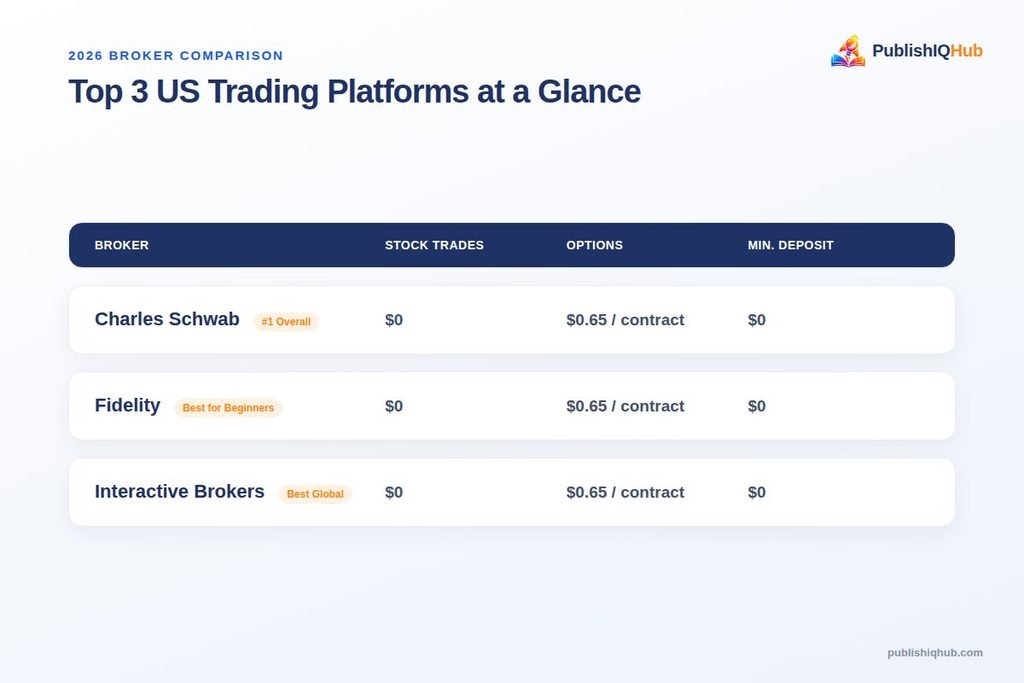
| Broker | Best For | Stock Trades | Options (Per Contract) | Account Minimum |
| Charles Schwab | Overall / active traders | $0 | $0.65 | $0 |
| Fidelity | Beginners & retirement | $0 | $0.65 | $0 |
| Interactive Brokers | Professional & global traders | $0 | $0.65 | $0 |
| E*TRADE (Morgan Stanley) | Advanced web platform | $0 | $0.65 | $0 |
| Merrill Edge | Bank of America customers | $0 | $0.65 | $0 |
| Webull | Community & paper trading | $0 | $0.00 | $0 |
| Robinhood | Simplicity & mobile-first traders | $0 | $0.00 | $0 |
| TradeStation | Active & algorithmic traders | $0 | $0.80 | $0 |
| Firstrade | Deep-discount, broad asset access | $0 | $0.00 | $0 |
| J.P. Morgan Self-Directed | Chase customers, all-in-one banking | $0 | $0.65 | $0 |
1. Charles Schwab — Best Overall Trading Platform
Charles Schwab held onto the #1 Overall Broker ranking in StockBrokers.com’s 2026 annual awards, which evaluated 14 US brokerages across more than 300 variables. Since fully integrating TD Ameritrade, Schwab now runs a dual-platform approach: a simplified app and website for everyday investors, and the veteran thinkorswim (TOS) platform for active traders who want to overlay economic data — like Fed rate probabilities — directly onto price charts. Schwab also earned Best for Advanced Trading, Best for Mobile Trading Apps, and Best for High Net Worth Investors in the same awards cycle.
Pros: Thinkorswim is widely considered the industry benchmark for charting; strong in-platform education; 24/7 customer support.
Cons: No spot crypto trading (ETFs and futures only); “Stock Slices” fractional shares are limited to S&P 500 companies; margin rates run higher than discount-focused competitors.
Schwab’s daily “Schwab Market Update” podcast is also worth flagging for investors who want a quick macro briefing before the market opens, and the broker supports 24/5 trading on hundreds of securities for those who want to react outside standard market hours.
2. Fidelity — Best for Beginners and Retirement Accounts
Fidelity is built to be a financial hub rather than just a trading app. Its proprietary “Equity Summary Score” condenses conflicting analyst ratings into a single sentiment score, which simplifies research for newer investors, and its economic calendar explains why each data release matters rather than just listing it. Fidelity charges $0 for online US stock and ETF trades and requires no account minimum. In 2026, it won NerdWallet’s Best-Of Awards for Best Investing App and Best Broker for Beginners, and StockBrokers.com named it Best for Research, Education, Beginners, and Retirement Accounts.
Pros: Deep, beginner-friendly research; strong bond and CD tools; automated recurring investing.
Cons: No dedicated mobile app built specifically for active, high-frequency trading.
Fidelity also gives retail investors access to primary bond auctions, a feature rarely offered outside institutional platforms, plus an intuitive CD ladder tool for generating yield without constant manual reinvestment.
3. Interactive Brokers — Best for Professional and Global Traders
Interactive Brokers (IBKR) is the choice for investors who need more than a domestic-only broker. Its Trader Workstation (TWS) platform aggregates world market snapshots, analyst upgrades, and AI-generated news summaries, and its “Connections” research tool visually maps a stock to its competitors, suppliers, and ETF exposure. IBKR gives access to more than 150 global markets alongside institutional-grade tools like PortfolioAnalyst for running what-if risk scenarios.
Pros: Unmatched market access; competitive margin rates; deep portfolio-analytics tools. Cons: Steep learning curve; educational content assumes prior investing knowledge.
IBKR also gives investors access to more than a million bonds globally and roughly 50,000 mutual funds, a scale of inventory that few competitors can match, which is part of why it remains the top pick for professionals graduating from a simpler retail app.
4. E*TRADE from Morgan Stanley — Best Advanced Web Platform
ETRADE splits its offering into a clean dashboard for passive, long-term investors and Power ETRADE, a browser-based platform built for active traders that turns complex options strategies into visual “risk slides.” NerdWallet named E*TRADE Best for Educational Content in 2026, citing its webinar program and weekly live webcasts, and StockBrokers.com gave it a 4.5-star overall rating alongside #1 Active Trading Web Platform.
Pros: No download required for professional-grade tools; strong automated investing options for ETFs; solid educational library.
Cons: Base margin rates run above 12%, higher than several competitors; website navigation can feel dated.
E*TRADE also runs live webcasts on charting, options, and market fundamentals multiple times a week, which makes it a reasonable stop for investors who have the basics down and want structured, ongoing education rather than a one-time course.
5. Merrill Edge — Best for Bank of America Customers
Merrill Edge’s biggest advantage isn’t a trading feature — it’s the Preferred Rewards integration with Bank of America. Linking your Merrill investing account to BofA checking can unlock tiered boosts on credit card rewards, savings rates, and mortgage discounts. Merrill’s “Stock Story” feature also turns dense company financials into an interactive, question-and-answer format aimed at newer investors, and StockBrokers.com awarded it Best Bank Brokerage for 2026.
Pros: Deep BofA ecosystem integration; solid research for a bank-affiliated broker; reliable customer service.
Cons: No cryptocurrency, futures, or fractional shares; the MarketPro active-trading platform trails competitors like thinkorswim or Power E*TRADE.
For investors already using Bank of America for day-to-day banking, the ability to view checking, savings, and brokerage balances in one login is often a bigger convenience factor than any single trading tool.
6. Webull — Best for Community and Paper Trading
Webull has moved beyond its low-cost roots to target the mobile-first, community-driven trader. A social “Comments” feed sits directly on stock quote pages, and its paper-trading platform — which won #1 Paper Trading at the 2026 StockBrokers.com awards — lets new traders test strategies with simulated funds before risking real capital. Options contracts trade at $0 per contract.
Pros: Zero-commission options; strong charting tools including a historical “Replay Mode”; award-winning paper trading.
Cons: No custodial or trust accounts; multi-leg options strategies can feel clunky to build; education can be disorganized for true beginners.
Webull’s paper-trading environment ships with roughly $1 million in simulated funds and mirrors the live app’s news feeds, charting, and order tickets, making it one of the more realistic practice environments for traders who want to test a strategy before committing real money.
7. Robinhood — Best for Simplicity and Mobile-First Investors
Robinhood remains the benchmark for a frictionless mobile investing experience. Its newer “Robinhood Legend” desktop platform adds drag-and-drop technical indicators for more active users, while AI-powered “Digests” explain why a stock is moving in plain language. NerdWallet rated Robinhood 4.5 out of 5 for basic stock trading, and StockBrokers.com highlighted its IRA match of up to 3% for Gold members.
Pros: Extremely intuitive interface; commission-free options and 24-hour trading on select securities; competitive IRA match.
Cons: No mutual funds, individual bonds, or trust accounts; limited fundamental research data compared with legacy brokers.
Robinhood’s “Investor’s Guild” content series also aims to explain more complex strategies in plain language, which fits the platform’s broader focus on removing friction for people opening their very first brokerage account.
8. TradeStation — Best for Active and Algorithmic Traders
TradeStation is built for traders who lean on technical analysis and automated strategies. Its newer Titan X platform adds a drag-and-drop interface, while the “Portfolio Maestro” tool runs Monte Carlo simulations and correlation analysis across an entire portfolio — useful for stress-testing risk before a volatile earnings season. Options run $0.80 per contract, the highest among the brokers on this list, reflecting its focus on serious active traders rather than casual investors.
Pros: Institutional-grade charting and backtesting; strong scanner tools for pre-market movers; robust automation support.
Cons: Options pricing is above competitors; less depth in fundamental research; not designed with beginners in mind.
TradeStation’s “Hot Lists” scanner is particularly useful for traders who build strategies around volume and volatility rather than fundamentals, and the platform’s scripting tools allow experienced users to automate entries and exits rather than monitoring positions manually.
9. Firstrade — Best Deep-Discount, Full-Menu Broker
Firstrade combines a true discount-broker cost structure with a fuller investment menu than many low-cost apps offer, including fee-free mutual funds and options trading with no per-contract fee. It also stands out for international accessibility, accepting accounts from more than 60 countries with a fully translated interface, and for research depth on fixed-income holdings within balanced funds.
Pros: Free options and mutual fund trading; strong fixed-income research; broad international account access.
Cons: Smaller brand recognition than legacy brokers; fewer proprietary trading tools for advanced strategies.
Firstrade’s fund-composition data goes deep enough to show effective duration and credit quality within a balanced fund, a level of transparency that’s more commonly reserved for institutional research terminals than retail discount brokers.
10. J.P. Morgan Self-Directed Investing — Best for Chase Customers
If you already bank with Chase, J.P. Morgan Self-Directed Investing consolidates checking, savings, and investing into a single app with instant transfers between them. It lacks the advanced charting tools of Schwab or IBKR, but its Markets page offers clean, widget-based index tracking, and StockBrokers.com named it Best in Class for Customer Service, Education, and Retirement Accounts in 2026.
Pros: Seamless Chase banking integration; clear fixed-income yield visualizations; strong customer support.
Cons: Limited advanced trading tools; better suited to “set it and forget it” investors than active traders.
For Chase-based households already managing a checking account, savings account, and credit card in one app, adding a self-directed brokerage account to that same login can meaningfully simplify how you track overall net worth.
Which Platform Fits Which Type of Investor
- New to investing and want hand-holding: Fidelity or Charles Schwab, both of which pair $0 minimums with structured education and clear research summaries.
- Want the simplest possible app: Robinhood, for its streamlined mobile-first design and plain-language trade explanations.
- Trade options frequently: Webull, Robinhood, or Firstrade, all of which charge $0 per options contract, versus $0.65–$0.80 elsewhere.
- Trade internationally or need advanced tools: Interactive Brokers, given its access to 150+ global markets and institutional-grade risk analytics.
- Already bank with a major institution: Merrill Edge (Bank of America) or J.P. Morgan Self-Directed Investing (Chase), both of which reward existing banking relationships.
- Build and test automated strategies: TradeStation, for its Monte Carlo simulation tools and algorithmic trading support.
How to Choose the Right Trading Platform
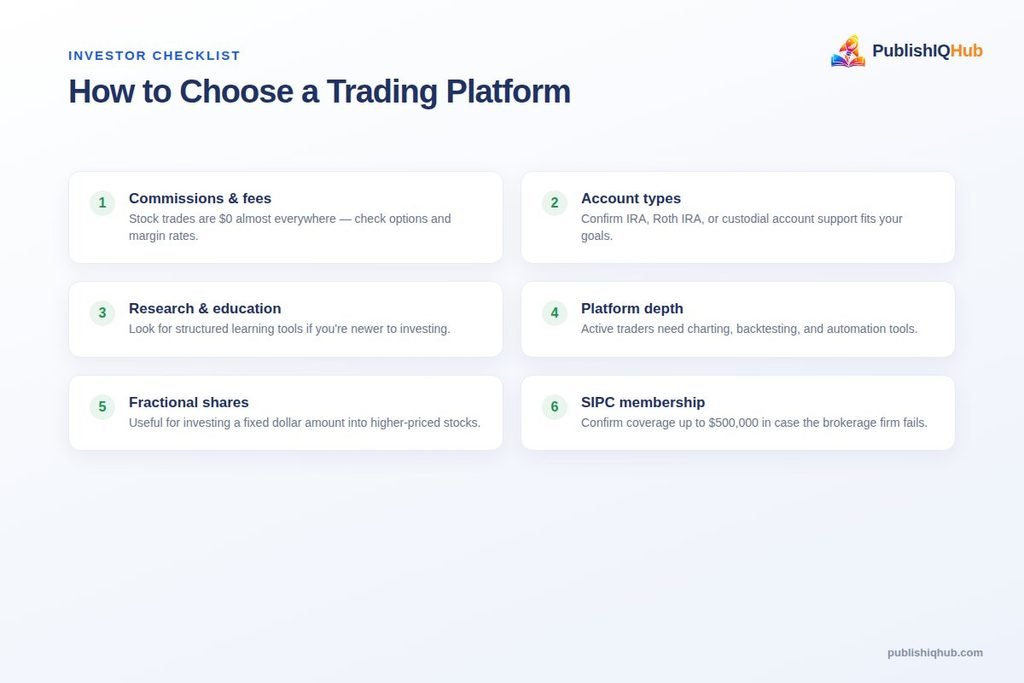
With commissions at or near $0 across nearly every major broker, the decision comes down to a handful of practical factors:
- Commissions and per-contract fees: Stock and ETF trades are commission-free industry-wide, but options contracts can still run $0 to $0.80 depending on the broker.
- Account types: Confirm the broker supports the accounts you need — individual, joint, custodial, traditional IRA, or Roth IRA.
- Research and education: Newer investors benefit from brokers with strong built-in research and structured learning tools, like Fidelity’s Equity Summary Score or Schwab’s contextual education.
- Platform depth: Active and options traders should weigh advanced charting, backtesting, and automation tools more heavily than casual long-term investors.
- Fractional shares: Useful if you want to invest a fixed dollar amount into higher-priced stocks rather than buying whole shares.
- Customer support and reliability: Confirm the broker is a member of the Securities Investor Protection Corporation (SIPC), which protects up to $500,000 in securities and cash per customer (including a $250,000 cash sublimit) if a brokerage fails — though it does not protect against market losses.
- Uninvested cash yield: Some brokers pay meaningfully more interest on cash sitting in your account before it’s invested; this can add up over time for investors who keep a cash buffer.
For readers exploring outsourced research or analytics support alongside their own investing process, PublishIQHub’s guide to Data Enrichment Companies covers how firms structure and clean large datasets — a similar discipline to how brokers build their own research tools.
Final Thoughts
There isn’t a single “best” trading platform for every investor — the right choice depends on whether you’re prioritizing research depth, a mobile-first experience, active trading tools, or integration with your existing bank. Charles Schwab and Fidelity remain strong all-around picks for most US investors in 2026, while Interactive Brokers and TradeStation better suit traders who need global market access or advanced automation. Whichever platform you choose, confirm its SIPC membership, compare its fee schedule against your trading habits, and take advantage of any paper-trading tools before committing real capital.
It’s also worth remembering that switching brokers later isn’t difficult. Most transfers can be initiated online through an Automated Customer Account Transfer (ACAT) and typically complete within about a week, so choosing a broker today doesn’t have to be a permanent decision. Many experienced investors end up holding accounts at more than one platform — for example, a long-term retirement account at Fidelity alongside a more active trading account at a broker like Webull or TradeStation — to get the strengths of each without compromising on either.
For more on how AI tools are reshaping research and decision-making across finance, see PublishIQHub’s coverage of AI and Financial Services and our broader look at outsourcing trends in financial operations.
Frequently Asked Questions
Which trading platform is best for beginners in the US?
Fidelity and Charles Schwab are generally considered the strongest choices for beginners, based on their combination of $0 account minimums, structured educational content, and highly rated mobile apps. Robinhood is also a common pick for investors who want the simplest possible interface. If you’re brand new to investing, prioritize a broker with clear in-app education and a low-friction account-opening process over one with advanced charting tools you likely won’t use right away.
What is the best stock broker for long-term investors in 2026?
Fidelity and Charles Schwab both suit long-term, buy-and-hold investors well, offering broad index fund access, retirement account support, and automated recurring investing tools.
Which broker has the lowest fees for stock trading?
Nearly all major US brokers now charge $0 for online stock and ETF trades. The differences show up in options pricing, where Webull, Robinhood, and Firstrade charge $0 per contract, while others charge $0.65 to $0.80.
Is Robinhood or Fidelity better for beginners?
Robinhood offers a simpler, more streamlined interface, while Fidelity provides deeper research, more account types, and stronger retirement planning tools. Investors who want an easy first step often start with Robinhood; those planning for retirement or wanting more research tend to prefer Fidelity.
Which US stock broker is best for retirement accounts like an IRA or Roth IRA?
Fidelity and J.P. Morgan Self-Directed Investing were both recognized for retirement account support in 2026 industry awards, and Schwab offers a wide range of no-transaction-fee funds suited to long-term retirement portfolios.
Is my money safe with an online broker?
Most US brokers are SIPC members, which protects up to $500,000 in securities and cash per customer (including $250,000 for cash) if the brokerage firm fails. SIPC does not cover losses from normal market movements, only losses from a firm’s failure. Some brokers also carry supplemental insurance above the standard SIPC limits, so it’s worth checking a broker’s coverage details before funding a large account.
How much money do I need to open a brokerage account?
Most brokers on this list have no minimum deposit requirement, so you can technically open an account with $0. In practice, you’ll need at least enough to buy a single share — or a fractional share, if your broker supports it — of whatever you want to invest in first.
Sources
- StockBrokers.com, “7 Best Brokerage Accounts for 2026: Tested by Experts” — https://www.stockbrokers.com/guides/online-stock-brokers
- NerdWallet, “Best Brokerage Accounts for Online Investing and Stock Trading in 2026” — https://www.nerdwallet.com/investing/best/online-brokers-for-stock-trading
- Bankrate, “Best Online Brokers for 2026” — https://www.bankrate.com/investing/best-online-brokers-for-stock-trading
- NerdWallet, “SIPC Insurance: What It Does and Does Not Protect” — https://www.nerdwallet.com/investing/learn/sipc-insurance-what-it-does-and-does-not-protect
- U.S. Securities Investor Protection Corporation — https://www.sipc.org/
- FINRA BrokerCheck — https://brokercheck.finra.org/