
The listing question is settled. A contested chairmanship vote means the timeline still isn’t. An update to our Tata Group stock coverage.
| This article is for general information and educational purposes only. It does not constitute investment advice, and past stock performance is not a guarantee of future returns. Readers should consult a SEBI-registered investment advisor before making any investment decisions. |
Quick Answer
| On September 11, 2026, RBI rejected Tata Sons’ application to exit NBFC registration, making a stock market listing mandatory for the first time with regulatory finality. Tata Group stocks first rallied sharply — Tata Chemicals surged 20% — but gave back some of that gain days later as a separate dispute took over the headlines: on September 17, the same board also voted 4-1 to reappoint N. Chandrasekaran chairman for a third term, a move Tata Trusts calls “void ab initio” and is now evaluating a formal legal challenge over. As of September 22, no court case has been filed on either the listing question or the chairmanship vote, though both sides say one is likely. No new listing deadline has been set, and Tata Chemicals and Tata Investment Corporation, the stocks with the most direct Tata Sons cross-holding, remain the ones most likely to move on further headlines. |
What’s New Since Our Last Update
Our earlier coverage of Tata Group stocks amid the Tata Sons IPO uncertainty left the listing question open, pending an RBI decision on Tata Sons’ request to exit the regulatory category that requires it. That decision has now arrived, and it didn’t go Tata Sons’ way. This piece covers what changed, why it happened, and what it does — and doesn’t — settle for retail investors watching these stocks.
The RBI Decision, Explained
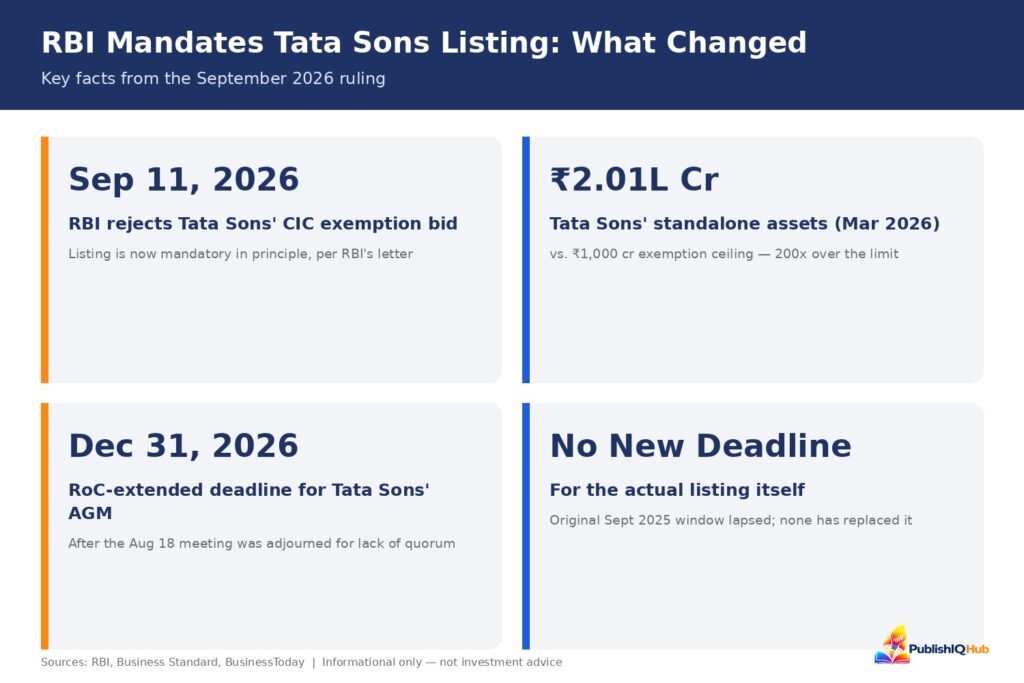
In a letter dated September 11, 2026, RBI rejected Tata Sons’ application to surrender its Core Investment Company (CIC) registration, telling the company the request “cannot be acceded to.” Tata Sons had filed that application back in March 2024, arguing that since it had become debt-free, it no longer needed the CIC registration that keeps it inside RBI’s Upper-Layer NBFC framework — and, by extension, inside the listing requirement that framework carries.
The rejection turns on eligibility criteria, not on Tata Sons’ specific circumstances: voluntary CIC deregistration is reserved for companies with no public funds, no customer interface, and total assets under ₹1,000 crore. Tata Sons’ standalone assets stood above ₹2.01 lakh crore as of March 31, 2026 — more than 200 times that ceiling — which made the exemption a legal non-starter regardless of the company’s debt position.
What the letter does not do is set a new listing deadline. The original three-year window from Tata Sons’ September 2022 Upper-Layer classification lapsed in September 2025 without RBI clarifying the company’s status, and the September 11 letter closes off the exemption route without replacing that lapsed deadline with a new one. In practical terms: listing is no longer optional, but there’s no public date by which it must happen.
Timeline: How We Got Here
The regulatory question and a separate leadership crisis have been running on parallel tracks for most of 2026. Here’s the sequence:
| Date | Event |
| Sep 2022 | RBI classifies Tata Sons as an Upper-Layer NBFC, triggering a 3-year listing requirement. |
| Mar 2024 | Tata Sons formally applies to RBI to surrender its CIC registration and avoid the listing mandate. |
| Sep 2025 | Original 3-year listing deadline lapses with no resolution from RBI. |
| Aug 12, 2026 | Chandrasekaran tells the board he won’t seek a third term as chairman beyond Feb 2027. |
| Aug 18, 2026 | Tata Sons AGM adjourned for lack of quorum — the first time in the company’s 100+ year history. |
| Aug 29, 2026 | RoC grants Tata Sons a 3-month AGM extension, to December 31, 2026. |
| Sep 11, 2026 | RBI formally rejects the CIC deregistration application, making listing mandatory.Sep 15, 2026 |
| Sep 15, 2026 | Markets reopen after Ganesh Chaturthi; Tata Chemicals surges 20%, Tata Investment Corp up 15.24%; RBI files a caveat in the Bombay High Court. |
| Sep 17, 2026 | Board votes 4-1 to reappoint Chandrasekaran chairman for a third term — reversing his August 12 statement — and separately approves steps toward a listing; Noel Tata, who had proposed a Trusts-led buyback of Shapoorji Pallonji’s stake instead, is the sole dissenting vote on both. |
| Sep 18, 2026 | Initial rally fades: TCS falls 3% and Tata Motors Passenger Vehicles drops 2.91% as disputed reports about the board’s decisions circulate; Shapoor Mistry of SP Group publicly welcomes the listing push. |
| Sep 20, 2026 | Abhishek Manu Singhvi confirms he has “entered the fray” for Tata Trusts; Sir Dorabji Tata Trust is reported to be evaluating an NCLT petition against the reappointment under Companies Act Sections 241-242. |
| Sep 22, 2026 | No formal court filing yet on either the chairmanship vote or the RBI ruling; Singhvi says “a legal fight now appears likely,” and both sides continue pressing their case in public statements. |
The Boardroom Rift Behind the Timing
The RBI’s rejection lands in the middle of Tata Sons’ most disruptive governance episode in years, and the two issues are tangled together rather than running independently.
Chandrasekaran’s decision not to seek a third term traces back to a February 2026 Tata Sons board meeting, where Tata Trusts chairman Noel Tata raised concerns about the financial performance of specific businesses — including Air India and Tata Digital — as his reappointment came up for discussion. Four of six directors supported extending his term; Noel Tata did not, and Chandrasekaran did not participate in that discussion due to the conflict of interest.
Noel Tata has separately opposed Tata Sons ever going public, consistent with a resolution Tata Trusts — whose two principal entities, Sir Dorabji Tata Trust (about 27.98%) and Sir Ratan Tata Trust (about 23.56%), together hold roughly 66% of Tata Sons — passed against listing last year. Shapoorji Pallonji Group, the roughly 18.37% minority shareholder, has pushed the opposite way, favouring a listing that would let it dilute its stake to fund its own debt-laden business — the kind of liquidity motive covered in PublishIQHub’s guide to venture capital funding, risks and exit options in India.
The AGM chaos stems from a different thread entirely: the Sir Ratan Tata Trust (SRTT) has been barred from convening its own board since May 2026 under a Maharashtra Charity Commissioner order, which stopped it from jointly nominating a representative to Tata Sons’ AGM alongside Sir Dorabji Tata Trust. That procedural freeze is what caused the August 18 adjournment and is why the Registrar of Companies granted a rare three-month extension. If the SRTT restriction is still in place by year-end, the matter could move to the National Company Law Appellate Tribunal (NCLAT) for a ruling.
September 17: The Reappointment That Reopened the Fight
Chandrasekaran’s August 12 exit statement didn’t hold. On September 17, 2026, the same board meeting that took up the RBI ruling also voted 4-1 to reappoint him chairman for a third term — Venu Srinivasan, group CFO Saurabh Agrawal, and independent directors Harish Manwani and Anita Marangoly George voted in favour; Noel Tata was the sole dissenter; Chandrasekaran abstained due to his personal interest in the outcome.
Tata Trusts has called the resolution “void ab initio,” arguing that Tata Sons’ Articles of Association require the affirmative support of both of its two nominee directors on the board, not just one. “Majority amongst two is two and not one,” the Trusts said in a formal rebuttal, adding that a chairman’s casting vote “is available only where there is equality of votes at the overall board level” and cannot substitute for that missing nominee-director support. Noel Tata has separately called the reappointment “legally invalid.”
The dispute turns partly on which Article of Tata Sons’ Articles of Association governs a reappointment: Tata Trusts, backed by a legal opinion from former Chief Justice of India D.Y. Chandrachud, says Article 118 applies and requires majority nominee-director support even for a reappointment. Tata Sons’ own legal opinions take the opposite view — that Article 118 covers only new appointments, and that Article 121’s casting-vote mechanism was correctly used to resolve the board’s internal split. Senior advocate Harish Salve is representing the board’s position; Tata Trusts has retained Abhishek Manu Singhvi.
The listing decision and the chairmanship vote were made in the same meeting, and Noel Tata opposed both. Alongside the reappointment, the board also approved initial steps toward pursuing a public listing — directly following from RBI’s September 11 ruling — with Noel Tata again the sole dissenting vote. That timing means the two open questions from earlier in this piece — whether Tata Sons lists, and who runs it while it does — are no longer separable: both are now being contested by the same 66% shareholder against the same board majority.
The Shapoorji Pallonji Buyback: Noel Tata’s Alternative to Listing
At the same September 17 meeting, Noel Tata put forward a different way out of the RBI mandate: rather than listing Tata Sons, he proposed that Tata Trusts buy out Shapoorji Pallonji Group’s roughly 18.4% stake — held through Sterling Investment Corporation and Cyrus Investments — for a minimum of ₹25,000 crore (about $2.6 billion), in two tranches over 18 months, funded through some combination of internal cashflows, sales of listed shares, outside investors, or a listing of newer Tata businesses short of Tata Sons itself. The board did not adopt this path; it proceeded with the listing steps instead, which is a large part of why Noel Tata dissented on that vote too.
SP Group’s own chairman, Shapoor Mistry, has taken the opposite position publicly, welcoming RBI’s ruling and calling a Tata Sons listing a “social and moral imperative” that would strengthen “transparency, governance and philanthropy” at the holding company level. That leaves the three cross-holding blocs with three different preferences on record: Tata Trusts (~66%) opposed to listing and open to buying SP Group out instead; Shapoorji Pallonji (~18.4%) actively backing a listing; and the seven listed operating companies with direct stakes (~12.1% combined) exposed to whichever way the dispute resolves, without a formal position of their own.
The market’s initial reaction to the RBI ruling didn’t hold once the boardroom dispute took over the headlines. TCS fell 3% and Tata Motors Passenger Vehicles dropped 2.91% on September 18, as disputed reports about the board’s decisions circulated — a reminder that a governance fight between a company’s two largest shareholder blocs is its own source of volatility, separate from whatever the listing question itself does to sentiment.
Why Tata Chemicals and Tata Investment Corporation React Hardest
Every time Tata Sons’ listing status makes headlines, the same two stocks move the most — and the pattern is now well-established enough to be predictable, if not the direction.
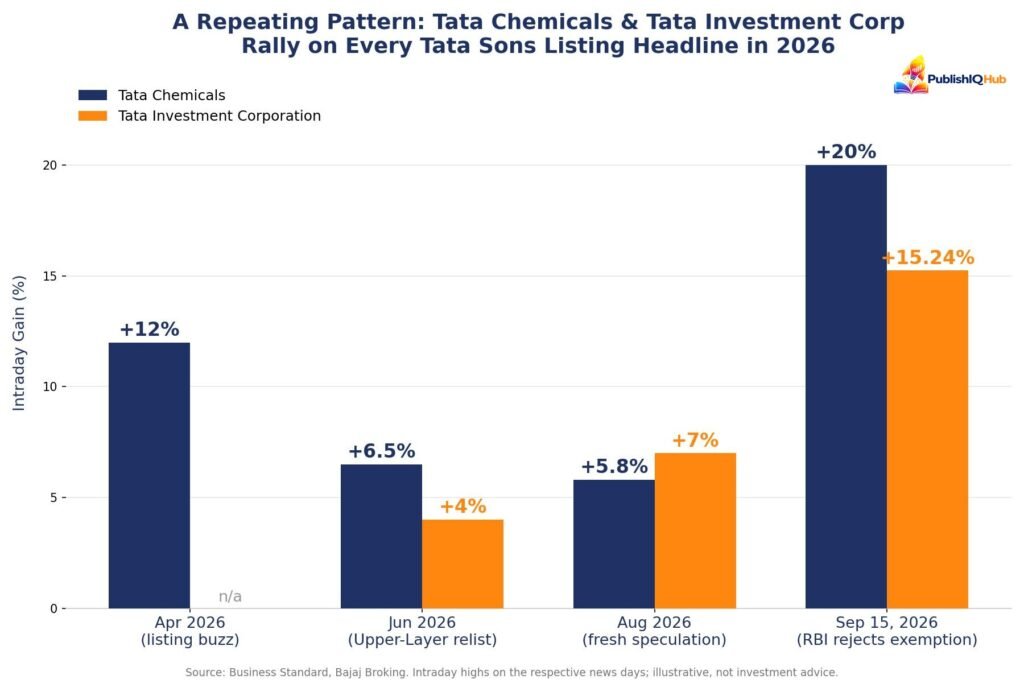
Tata Chemicals holds roughly a 3% direct equity stake in Tata Sons, making it a proxy for Tata Sons’ unlisted value. It rallied up to 12% in April 2026, gained 6.5% in June 2026 when RBI’s revised NBFC rules first put Tata Sons back in the Upper-Layer list, and rose another 5.8% in early August 2026 on renewed listing speculation.
Tata Investment Corporation, an NBFC investment vehicle promoted by Tata Sons, has shown the same rhythm — up 4% in June and as much as 7% in August 2026 on comparable headlines.
Tata Capital, the group’s financial-services NBFC that completed its own mandatory listing in October 2025, is increasingly cited by analysts as a working template for how a Tata Sons listing could eventually be structured, and moved 5.3% higher alongside the other two in June 2026.
None of these moves reflect a change in the underlying companies’ earnings — they’re sentiment trades on Tata Sons’ unlisted equity value, which one 2024 analyst estimate placed as high as ₹8 lakh crore (roughly $96 billion) in a hypothetical IPO scenario, over 25 times the size of LIC’s record-setting ₹21,000 crore listing. That figure is speculative and dates from before this year’s developments, but it explains why even a procedural regulatory letter moves these particular stocks more than it moves Tata Motors, TCS, or Tata Power.
Update: How the Market Actually Reacted
The rally was bigger than the historical pattern suggested. When markets reopened on September 15, 2026, Tata Chemicals surged 20% to hit its upper circuit at ₹734.50 — its steepest single-day move since 2009 — while Tata Investment Corporation climbed as much as 15.24% to ₹750.30.
TCS gained up to 5.5% intraday, aided partly by a broader Nifty IT rally; Tata Motors Passenger Vehicles (TMPV) rose around 5-6%; Tata Technologies gained about 4%.
Smaller moves followed across the rest of the group — Tata Steel, Indian Hotels, Tata Power, Voltas, and Tata Consumer Products all traded higher, and Afcons Infrastructure, part of the Shapoorji Pallonji Group, jumped over 13% on the same optimism.
New shareholding data surfaced alongside the rally, and it is the structural reason these particular stocks move on Tata Sons news at all: Tata Steel and TMPV each hold about 3.06% of Tata Sons, Tata Chemicals about 2.53%, Tata Power about 1.65%, Indian Hotels about 1.11%, Tata Consumer about 0.43%, and Tata Investment Corporation just 0.25% — together, these seven listed companies hold roughly 12.1% of Tata Sons directly, on top of Tata Trusts’ ~66% and Shapoorji Pallonji’s ~18.4%.
For context, Tata Chemicals’ 20% move dwarfs the 5.8% and 6.5% reactions to earlier, less conclusive headlines this year — consistent with this being the most definitive regulatory statement on Tata Sons’ listing status since 2022, rather than another round of speculation.
RBI Has Also Moved to Defend Its Decision in Court
The same day markets rallied, RBI took a step signalling it expects its rejection to be legally contested: the central bank filed a caveat petition in the Bombay High Court, asking to be heard before any court passes an order if Tata Sons — or any other party — challenges the CIC deregistration rejection.
A caveat doesn’t mean litigation has actually begun; it’s a pre-emptive filing that ensures RBI can present its side immediately if and when someone does go to court, rather than having an interim order passed without its input. It signals that RBI itself sees a legal challenge as a real possibility, not a remote one — and it’s worth keeping distinct from the separate NCLAT risk discussed earlier: that one concerns the SRTT governance freeze and AGM deadlock, while the Bombay High Court caveat is specifically about the CIC/listing rejection itself. Both are live legal tracks running in parallel to the market and boardroom stories, and a third track — a possible challenge to the chairmanship vote itself — now sits alongside them.
What Happens Next
The September 17 board meeting has already happened, and it resolved the succession question in the opposite direction most observers expected. Rather than opening a search for a new chairman, the board kept Chandrasekaran in place for a third term — an outcome that is itself now the dispute, rather than a resolution to it. As of September 22, 2026, neither side has filed a formal court case.
Sir Dorabji Tata Trust is reported to be evaluating a petition to the National Company Law Tribunal (NCLT) under Companies Act Sections 241-242 — the same oppression-and-mismanagement provisions used in the 2016-2021 Cyrus Mistry litigation — while senior advocate Abhishek Manu Singhvi has publicly confirmed he has “entered the fray” for Tata Trusts and said “a legal fight now appears likely.” Nothing has been filed yet, and no forum has been formally confirmed.
The listing question remains separately gated. Sir Dorabji Tata Trust and Sir Ratan Tata Trust still need to resolve the SRTT governance freeze described above before the AGM originally scheduled for August can be validly held by the December 31, 2026 deadline the RoC granted. Beyond the board’s newly approved intent to pursue a listing, nothing about the mechanics has been announced: no timeline, no confirmation of an IPO versus a simpler listing of existing shares, and no word on how the SRTT-related AGM extension interacts with any future listing process, or with Noel Tata’s separate SP Group buyback proposal. Investors should expect this to remain a multi-quarter story on all three fronts — chairmanship, the SP Group stake, and listing itself — with a formal legal filing now a realistic near-term catalyst.
What This Means for Retail Investors
The practical position hasn’t changed from our last update: Tata Sons shares still cannot be bought on any exchange, and that remains true even with listing now mandatory in principle and formally under way. Investors wanting Tata Group exposure still have to go through Tata Motors, TCS, Tata Power, Tata Chemicals, or Tata Investment Corporation — via a demat account with a SEBI-registered stockbroker — each carrying its own business fundamentals that matter far more day-to-day than Tata Sons headlines. What’s changed is that the “will it ever list” question is now answered, and a second, unrelated question — who chairs the company while it does — has opened up alongside it. Neither changes the operating businesses of the seven listed companies with direct Tata Sons cross-holdings, which is the gap likely to keep Tata Chemicals and Tata Investment Corporation volatile on group-level news for the foreseeable future.
What Would a Tata Sons Listing Actually Look Like?
Nobody has confirmed a structure yet, but Tata Sons already has a working template inside its own group: Tata Capital.
Tata Capital, the group’s financial-services NBFC, faced the identical Upper-Layer NBFC listing requirement and completed its own mandatory listing in October 2025 through a combination of a fresh share issue and an offer for sale, with Tata Sons — its roughly 88.6% owner at the time — offloading a portion of its holding into the IPO rather than exiting entirely. That structure let Tata Sons retain majority control of Tata Capital while satisfying RBI’s listing rule.
A similar approach for Tata Sons itself would be a far larger undertaking. Tata Sons is not a single-business NBFC like Tata Capital — it’s a holding company whose main assets are equity stakes across the group’s operating companies, from TCS and Tata Motors to Tata Steel and Titan. Structuring a listing means deciding how much of that holding company Tata Trusts, Shapoorji Pallonji, and the seven cross-holding listed companies are willing to see move into public hands, and at what valuation. The ₹8 lakh crore figure some analysts have floated is a back-of-envelope estimate based on the market value of Tata Sons’ underlying stakes, not a number that’s been through any formal valuation exercise tied to this year’s developments.
Worth noting: even Tata Capital’s listing took roughly three years from its own Upper-Layer classification to actual market debut, and that was without the kind of leadership dispute and trust-level litigation risk Tata Sons is currently navigating. A comparable or longer runway for Tata Sons would not be unusual, whatever pressure the September 11 letter and the September 17 board vote add together.
The Bottom Line
RBI’s September 11 rejection of Tata Sons’ CIC exemption request closes a chapter that’s been open since 2022: Tata Sons will have to list, eventually, in some form — and the market’s initial 20% single-day reaction in Tata Chemicals confirmed investors were treating this as the real thing, not another round of speculation. That reaction has since been complicated rather than reversed: the September 17 board meeting that should have clarified the path instead added a second dispute on top of the first, a contested 4-1 vote reappointing Chandrasekaran chairman that Tata Trusts — the group’s 66% shareholder — has called legally void, alongside Noel Tata’s separate, unadopted proposal to buy out Shapoorji Pallonji’s stake instead of listing at all.
As of September 22, no court has been asked to rule on either the chairmanship vote or the RBI decision, though senior counsel on both sides now expect that to change. For now, the practical investment picture is unchanged: Tata Sons itself remains unbuyable, and the listed operating companies continue to trade on their own fundamentals, with Tata Chemicals and Tata Investment Corporation carrying the most Tata Sons-linked volatility across the listing, chairmanship, and SP Group stories. As with any decision involving these stocks, that’s a call best made with a SEBI-registered investment advisor rather than on the strength of a single regulatory or boardroom headline
Frequently Asked Questions
Has RBI approved a Tata Sons IPO?
Not exactly. RBI rejected Tata Sons’ request to be exempted from listing — it didn’t approve or schedule an IPO. Listing is now mandatory in principle, and Tata Sons’ board has separately approved steps toward pursuing one, but no new deadline, timeline, or listing structure has been announced.
Why didn’t RBI set a new listing deadline?
The original three-year deadline from Tata Sons’ 2022 Upper-Layer NBFC classification lapsed in September 2025 without RBI acting on it. The September 2026 letter closes off Tata Sons’ exemption request but doesn’t reopen or replace that lapsed deadline with a new one.
Why was the Tata Sons AGM adjourned and then extended?
The AGM scheduled for August 18, 2026 lacked quorum because the Sir Ratan Tata Trust has been barred from convening its own board since May 2026 under a Maharashtra Charity Commissioner order, preventing it from jointly nominating an AGM representative with Sir Dorabji Tata Trust. The Registrar of Companies subsequently granted a three-month extension, to December 31, 2026, to hold the meeting.
Does this affect Chandrasekaran’s position as chairman?
Yes, directly, as of September 17, 2026. Despite an August 12 statement that he would step aside, Tata Sons’ board voted 4-1 to reappoint Chandrasekaran chairman for a third term, with Noel Tata as the sole dissenting vote and Chandrasekaran himself abstaining. Tata Trusts has called the resolution void and referred the matter to senior counsel, so the position remains contested even though Chandrasekaran continues to hold the chair.
Could this dispute end up in court?
Three separate legal tracks are now in play, and as of September 22, 2026, none has produced a formal filing on the chairmanship question. If the SRTT governance freeze remains unresolved by year-end, the AGM deadlock could go before the National Company Law Appellate Tribunal (NCLAT). RBI itself filed a caveat in the Bombay High Court on September 15, 2026, over the CIC rejection. And Sir Dorabji Tata Trust is reported to be evaluating a petition to the National Company Law Tribunal (NCLT) over the September 17 chairmanship vote, under the same Companies Act provisions used in the Cyrus Mistry case; senior advocate Abhishek Manu Singhvi has said a legal fight “now appears likely,” but nothing has been filed yet.
What is Noel Tata’s alternative to listing Tata Sons?
At the September 17 board meeting, Noel Tata proposed that Tata Trusts buy out Shapoorji Pallonji Group’s roughly 18.4% stake for a minimum of ₹25,000 crore (about $2.6 billion) over 18 months, removing the shareholder that has pushed hardest for a listing. The board did not adopt this path and proceeded toward listing instead; SP Group’s own chairman has publicly welcomed the listing push rather than the buyback.
Which Tata stocks react most to Tata Sons listing news?
Tata Chemicals and Tata Investment Corporation have shown the strongest, most repeated reactions across 2026’s various Tata Sons headlines, given their direct equity stakes in Tata Sons — 2.53% and 0.25% respectively. Tata Chemicals surged 20% on September 15, 2026 alone, its biggest single-day move since 2009, though TCS and Tata Motors Passenger Vehicles gave back gains a few days later as the chairmanship dispute took over the headlines. Tata Capital, already listed since October 2025, is often cited as a template for how a Tata Sons listing might be structured.
How long might a Tata Sons listing take once it actually begins?
There’s no official timeline, but Tata Capital’s own Upper-Layer listing took about three years from classification to market debut, and Tata Sons is a considerably larger and more complex holding structure to prepare for a public listing, now further complicated by an unresolved chairmanship dispute and an unresolved SP Group stake negotiation. A multi-year process from here would not be unusual.