
A plain-English guide to Tata Motors, TCS, Tata Power, Tata Chemicals and Tata Investment Corporation while Tata Sons stays unlisted
Disclaimer: This article is for general information and educational purposes only. It does not constitute investment advice, and past stock performance is not a guarantee of future returns. Readers should consult a SEBI-registered investment advisor before making any investment decisions.
Quick Answer
Tata Sons itself is not listed on any stock exchange, and it is unlikely to list soon: its application to surrender NBFC registration with the Reserve Bank of India is still pending. Investors seeking Tata Group exposure must instead choose among listed operating companies — Tata Motors, TCS, Tata Power, Tata Chemicals — or Tata Investment Corporation, a partial proxy. Recent one-year returns have been flat to negative across the group, and an August 2026 leadership exit at Tata Sons — followed by a deferred annual shareholder meeting on August 18 — has added fresh uncertainty to the picture.
Why Tata Sons’ Listing Question Is Back in the News
Every year, the Reserve Bank of India (RBI) updates its list of “Upper Layer” Non-Banking Financial Companies (NBFC-UL) — large, systemically important NBFCs that face tighter oversight and, under RBI rules, must eventually get listed on a stock exchange. Tata Sons, the privately held holding company that sits atop the Tata Group, has been caught in this classification since 2022.
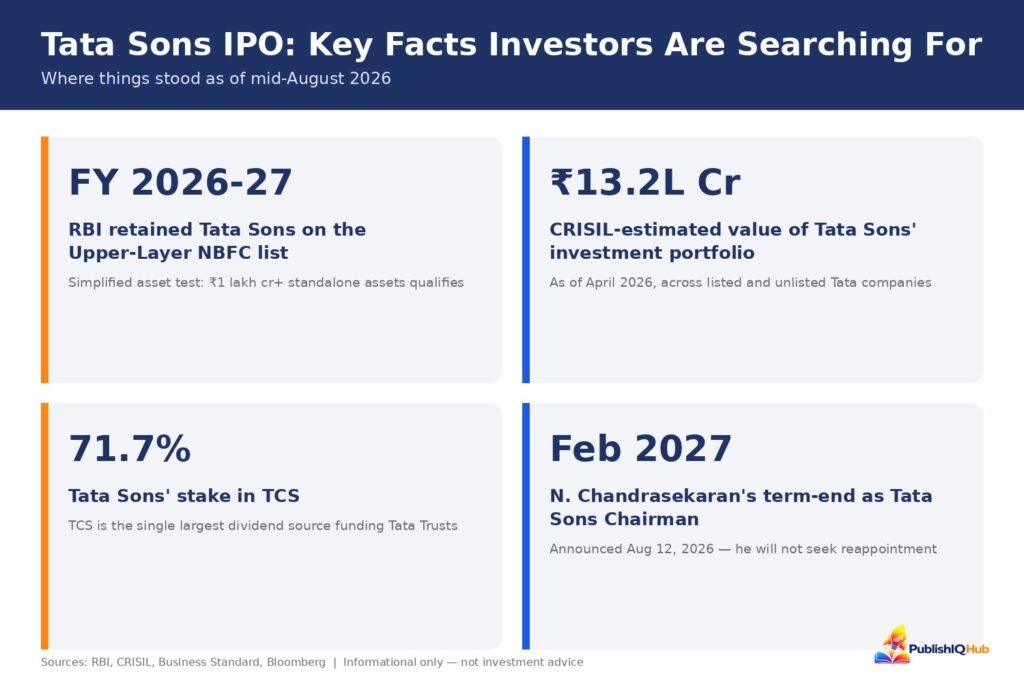
In August 2026, RBI retained Tata Sons on the FY 2026-27 upper-layer list, now applying a simplified, asset-based threshold: any NBFC with standalone assets of ₹1 lakh crore or more qualifies. Tata Sons’ standalone assets, reported in the ₹1.75-2 lakh crore range, clear that bar comfortably.
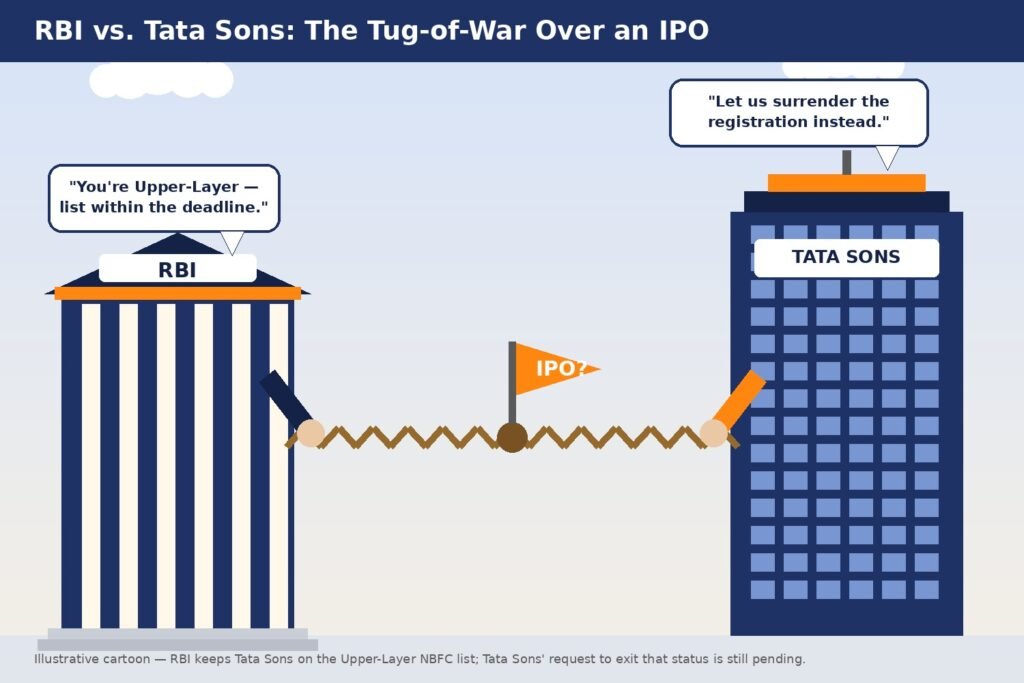
What keeps the listing question open, though, is a separate, older application: Tata Sons has asked RBI for permission to surrender its NBFC registration entirely and continue purely as an unregistered Core Investment Company (CIC). That request is still under review. RBI’s decision to include Tata Sons in this year’s list was explicitly framed as “without prejudice” to the outcome of that pending application — in plain terms, being on the list this year doesn’t settle whether Tata Sons will eventually have to list.
Tata Sons’ scale is part of why this matters to the whole group: ratings agency CRISIL estimated the market value of its investment portfolio at around ₹13.2 lakh crore as of April 2026 — a portfolio built primarily from its stakes in listed and unlisted Tata Group companies.
Two other companies from the original 2022 upper-layer batch — Tata Capital and HDB Financial Services — completed their mandatory listings within the three-year deadline RBI set at the time. Tata Sons is now the only one from that group that hasn’t.
A Fresh Complication: Leadership Uncertainty at the Top
The listing debate collided with a governance shock in mid-August 2026. On August 12, Tata Sons Chairman N. Chandrasekaran announced he would not seek reappointment beyond February 2027, saying the matter had sat unresolved for six months: two of the three Tata Trusts — Sir Dorabji Tata Trust and Sir Ratan Tata Trust — had unanimously recommended extending his term by five years, but one Tata Sons board member did not support the proposal. Reports point to a deeper disagreement with Tata Trusts over capital allocation to loss-making bets, including Air India, semiconductors, and electronics manufacturing.
The market reaction was immediate and group-wide. An index tracking Tata Group stocks fell around 1.7% on the day, with TCS — the group’s largest listed company — dropping close to 5% intraday before recovering some ground, and the National Stock Exchange seeking formal clarification from TCS on the news. Tata Motors, Titan, Tata Power, Tata Steel, and Tata Consumer Products all traded lower the same session.
Tata Sons had scheduled its annual shareholder meeting for August 18, 2026, expecting the board to take up succession planning directly — making it one of the most closely watched Tata Group events of the year for anyone tracking these stocks.
Update: The August 18 AGM Was Postponed
The meeting didn’t go ahead as planned. Tata Sons deferred the AGM on August 18, 2026, after the Sir Ratan Tata Trust (SRTT) — one of the two key Tata Trusts — could not participate.
Tata Sons’ Articles of Association require a jointly nominated representative from both SRTT and Sir Dorabji Tata Trust (SDTT) for the trusts to exercise their combined voting rights and for the meeting to have quorum. SRTT has been under a Maharashtra Charity Commissioner inquiry since May 2026 that has restricted its internal decision-making, including its ability to appoint that joint nominee — the same procedural block that forced the postponement.
Chandrasekaran’s position is unaffected by the deferral; he remains chairman until February 2027 as already announced. SDTT has separately approved forming a selection committee to search for his successor, but that committee also needs SRTT’s participation to proceed, so it faces the identical bottleneck. No new AGM date had been announced as of this writing. For investors, the postponement adds a third open question — alongside the RBI listing decision and the chairman succession itself — rather than resolving any of them.
Together, the pending CIC deregistration decision, the leadership succession question, and now the deferred AGM mean Tata Sons enters the rest of 2026 with several unresolved threads at once, rather than one — a combination that matters for anyone trying to read “the Tata Group” as a single investment story.
Is Tata Sons Going Public in 2026?
No confirmed IPO date exists for Tata Sons as of mid-August 2026, and the company continues to resist a public listing while its RBI exemption request remains pending.
Whether Tata Sons must eventually list depends on a regulatory decision, not a business choice. If RBI approves the CIC de-registration application, Tata Sons could continue operating privately, much as it does today. If RBI rejects it, Tata Sons would likely face a mandatory listing window, similar to the timeline Tata Capital worked under before its own 2025 IPO. For a broader look at how Indian companies typically move from private funding to a public listing, see PublishIQHub’s startup funding-to-IPO roadmap.
Why Is Tata Sons Not Launching an IPO?
- Control: Tata Trusts, which hold roughly 66% of Tata Sons, have historically resisted a listing that would introduce public shareholders, independent scrutiny, and reduced boardroom control.
- Dividend dependency: A large share of Tata Trusts’ philanthropic funding flows from dividends on Tata Sons’ holdings, particularly its 71.7% stake in TCS — a structure some analysts argue a public listing, and any resulting “holding company discount,” could complicate.
- Shareholder pressure: Shapoorji Pallonji (SP) Group, which holds about 18.5% of Tata Sons, has repeatedly pushed for a listing so it can monetise an otherwise illiquid stake and manage its own debt obligations — the kind of liquidity crunch covered in PublishIQHub’s guide to venture capital funding, risks and exit options in India. Tata Sons has publicly ruled out an IPO on these terms.
What the Tata Sons Uncertainty Means for the Stocks You Can Actually Buy
Retail investors in India cannot buy Tata Sons shares directly — it isn’t listed, and there’s no confirmed date on which that will change. What they can buy is shares in the operating companies Tata Sons controls, or shares in Tata Investment Corporation, a listed entity that holds part of the same portfolio. Doing so starts with a demat and trading account with a SEBI-registered stockbroker — see PublishIQHub’s comparison of India’s top brokers if that account isn’t set up yet. The sections below cover the five companies most searched alongside “Tata Group” right now.
Tata Motors: Watching JLR and the New Demerged Structure
Tata Motors has underperformed over the past year, and the reasons are mostly about the auto business itself rather than Tata Sons news.
- Tata Motors demerged in 2025 into two separately listed companies: Tata Motors Passenger Vehicles (TMPV) and Tata Motors Commercial Vehicles (TMCV). Anyone researching “Tata Motors share” in 2026 should check which of the two entities a given price quote refers to.
- TMPV traded near ₹350 in mid-August 2026 — down roughly 8.8% over six months and about 12% over one year, against a 52-week range of ₹294 to ₹448.
- TMCV, the commercial vehicle arm, has fared better recently: brokerages flagged a strong Q1 FY27 performance with an 11.3% EBITDA margin, and the stock gained after those results.
- Link to the Tata Sons story: limited and mostly sentiment-driven — Tata Motors moved lower with the rest of the group on the Chandrasekaran resignation news, but its underlying returns track vehicle demand and JLR’s performance far more than the holding-company listing debate.
TCS: The Stock Most Tied to Tata Sons’ Cash Flow
TCS, the Tata Group’s most valuable listed company, has had a difficult year on the market despite steady underlying profitability.
TCS carries a market capitalisation of roughly ₹8.55 lakh crore and the stock is down about 21.9% over the past year, as IT services stocks broadly de-rated on softer global technology spending.
- Tata Sons owns approximately 71.7% of TCS, making it the single largest source of dividend income flowing up to Tata Sons and, in turn, to Tata Trusts.
- That ownership structure is precisely why TCS reacts sharply to Tata Sons governance news — it was the most exchange-flagged stock after the August 2026 chairman resignation, with the NSE formally seeking clarification from the company.
Tata Power: Comparatively Steady, but Priced for Growth
Tata Power has held up better than most of its group peers, trading roughly flat over the past year while carrying a demanding valuation.
- The stock traded near ₹384.6 in mid-August 2026 — down about 1.8% over one year but up nearly 3% over the past six months.
- Its price-to-earnings ratio sits close to 138, a level that reflects investor optimism about its renewable energy and EV-charging infrastructure expansion rather than anything tied to Tata Sons’ listing status.
- Tata Power held investor roadshows across Singapore, Hong Kong, and Mumbai in mid-August 2026 — a sign that institutional interest in the stock is being driven by its own growth story, separate from the group’s holding-company overhang.
Tata Chemicals: The Weakest Performer in This Group
Tata Chemicals has been the weakest of the five companies covered here, down roughly 30% over the past year.
- The stock traded in the ₹673-680 range in early-to-mid August 2026, against a 52-week range of ₹580 to ₹1,027.
- The decline is largely attributed to global soda ash pricing pressure rather than the Tata Sons IPO debate.
- Notably, Tata Chemicals and Tata Investment Corporation both jumped as much as 7% on the single trading day RBI’s upper-layer NBFC classification news broke — markets read the update as raising the odds of eventual Tata Sons-related monetisation events, even though the direct financial link for Tata Chemicals shareholders is indirect at best.
Tata Investment Corporation: The Closest Listed Proxy — With a Catch
Tata Investment Corporation is the listed company most directly tied to Tata Sons sentiment, but owning its shares is not the same as owning a piece of Tata Sons.
Tata Investment Corporation is an NBFC investment company promoted by Tata Sons, registered with RBI as an Investment Company. It holds a diversified portfolio of listed and unlisted equity, debt instruments, and mutual funds across sectors, including stakes in several Tata Group companies.
- The stock traded near ₹680-690 in mid-August 2026, with a market capitalisation around ₹34,800 crore — down roughly 1-3% over one year.
- It trades at a striking premium: a price-to-earnings ratio near 80-93, even as Q1 FY27 profit actually fell close to 2% year-on-year. The market is pricing in optimism about the underlying portfolio’s long-term value, not current earnings — a classic “holding company” dynamic.
- Search-driven readers frequently conflate this stock with owning Tata Sons directly. They are not equivalent: buying Tata Investment Corporation shares gives economic exposure to its own investment portfolio, under its own balance sheet — not a legal claim on Tata Sons itself. Its shares often move on Tata Sons headlines largely because of sentiment, not because shareholders gain any direct interest in Tata Sons.
Tata Group Stocks at a Glance: Quick Comparison
The table below summarises where each of the five companies stood in mid-August 2026, alongside how closely each one’s fortunes are actually tied to the Tata Sons listing question.
| Company | Sector | Market Cap Tier | ~1-Yr Return | Tata Sons Exposure |
| Tata Motors (TMPV / TMCV) | Automobiles (PV & CV) | Large-cap (~₹1.3 lakh cr, TMPV) | ~ -12% | Indirect — operating subsidiary |
| TCS | IT Services | Mega-cap (~₹8.5 lakh cr) | ~ -22% | Indirect — 71.7% Tata Sons-owned; key dividend source |
| Tata Power | Power & Utilities | Large-cap (~₹1.2 lakh cr) | ~ -2% | Indirect — operating subsidiary |
| Tata Chemicals | Chemicals | Mid-cap | ~ -31% | Indirect — operating subsidiary |
| Tata Investment Corporation | Investment / NBFC | Small/mid-cap (~₹34,800 cr) | ~ -3% | Closest listed proxy — Tata Sons-promoted portfolio holder |
Which Tata Company Gives the Highest Return on Investment?
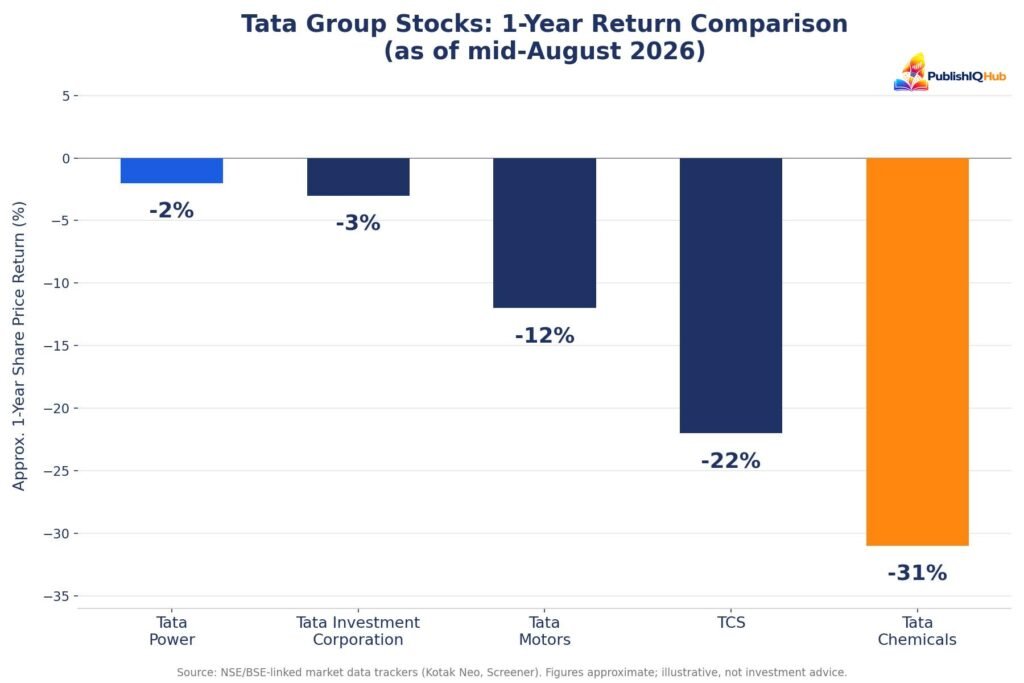
No single Tata Group stock led on returns over the past year — all five companies covered here posted flat-to-negative one-year returns amid company-specific headwinds and a broader market pause.
Tata Power came closest to holding its value; Tata Chemicals fell the furthest, largely on commodity pricing; TCS’s decline stands out given its size and its outsized role in funding Tata Trusts through dividends; Tata Motors and Tata Investment Corporation sit in between, each shaped by its own sector cycle rather than the Tata Sons headline of the week.
Longer stretches tell a different story for some of these names — TCS, for instance, has historically outpaced the Nifty 50 over ten-year windows, and Tata Power has had multi-year periods of sharp outperformance in the past. None of that is a guarantee of what comes next; it’s simply a reminder that a single year of returns, especially one shaped by a leadership transition and an unresolved regulatory question, may not reflect a company’s longer-run trajectory.
The Bottom Line
Tata Sons’ path to a public listing remains undecided, sitting on a pending RBI ruling rather than a fixed timeline. That uncertainty widened in August 2026 with N. Chandrasekaran’s decision not to seek reappointment as chairman, adding a leadership-succession question to the regulatory one — and widened further when Tata Sons deferred its August 18, 2026 annual shareholder meeting after a key trust couldn’t participate, leaving succession planning stuck without a new date announced.
For investors, the practical takeaway is that Tata Sons itself cannot be bought — exposure to the Tata Group runs through individual listed companies like Tata Motors, TCS, Tata Power, and Tata Chemicals, or through Tata Investment Corporation as an imperfect proxy, each with its own return profile shaped far more by its own business than by headlines about the parent company. These governance threads are worth watching, but they are a separate question from whether any individual Tata Group stock suits a given portfolio — a decision best made with a SEBI-registered investment advisor, based on individual goals and risk tolerance.
Frequently Asked Questions
Is Tata Sons going public in 2026?
There is no confirmed IPO date. Tata Sons remains on RBI’s Upper Layer NBFC list for FY 2026-27, but its application to surrender that registration and avoid a mandatory listing is still under RBI review.
Why is Tata Sons not launching an IPO?
Tata Trusts, which hold about 66% of Tata Sons, have resisted a listing that would dilute board control and introduce public shareholder scrutiny, partly because dividend income from Tata Sons’ holdings, especially TCS, funds their philanthropic activities. Minority shareholder Shapoorji Pallonji Group has pushed the other way, seeking a listing to monetise its stake.
What happens if Tata Sons gets an RBI upper-layer NBFC exemption?
If RBI approves Tata Sons’ request to surrender its NBFC registration, the company could continue operating privately without a mandatory listing requirement. This would not directly change the fundamentals of listed Tata Group companies, though it would remove one source of market uncertainty around the group.
Is Tata Investment Corporation a good proxy for Tata Sons stock?
It is the closest listed option, since Tata Sons promotes it and it holds Tata Group-related investments, but it is not equivalent to owning Tata Sons shares. Its own portfolio, earnings, and valuation drive its price, and its high price-to-earnings ratio reflects a holding-company premium rather than Tata Sons ownership.
Which Tata company gives the highest return on investment?
Over the past year, none of the five companies covered here — Tata Motors, TCS, Tata Power, Tata Chemicals, and Tata Investment Corporation — delivered a positive return; performance ranged from roughly flat (Tata Power) to a decline of about 31% (Tata Chemicals). Longer-term performance varies significantly by company and shouldn’t be assumed to repeat.
How does the Tata Sons IPO delay affect Tata Group stock prices?
Mostly through short, sentiment-driven moves on specific news days — such as the RBI classification announcement or the August 2026 chairman resignation — rather than through sustained price trends. Day-to-day and month-to-month performance for each listed company is driven primarily by its own sector fundamentals.