
India listed over 365 IPOs in 2025, raising close to ₹1.95 lakh crore — more than every European exchange combined. Demat accounts have crossed 224 million. And in 2026, the pipeline is even fatter: nearly 200 companies are queuing up to raise over ₹2.6 lakh crore, with names like Zepto, Flipkart and OYO in the mix.
If you’re a founder or CFO, this changes your maths. The startup funding IPO journey — from your first angel cheque to ringing the bell at BSE or NSE — is no longer a ten-year fantasy reserved for unicorns. Zomato proved the model in 2021. Mamaearth showed a D2C brand could do it in 2023. Ixigo pulled it off in 2024 with a modest ₹740 crore issue. And in April 2026, Zepto received SEBI approval for an ₹11,000 crore offering barely five years after incorporation.
But here’s what we’ve seen founders consistently underestimate: the road from startup funding to IPO in India is paved with regulatory checkpoints. SEBI listing guidelines were overhauled twice between December 2024 and March 2026. Government approvals — from RBI to MCA to sectoral regulators — can add six months to your timeline if you start late. This guide walks you through the entire roadmap, stage by stage, so you know exactly what to prepare and when to bring in professional help.
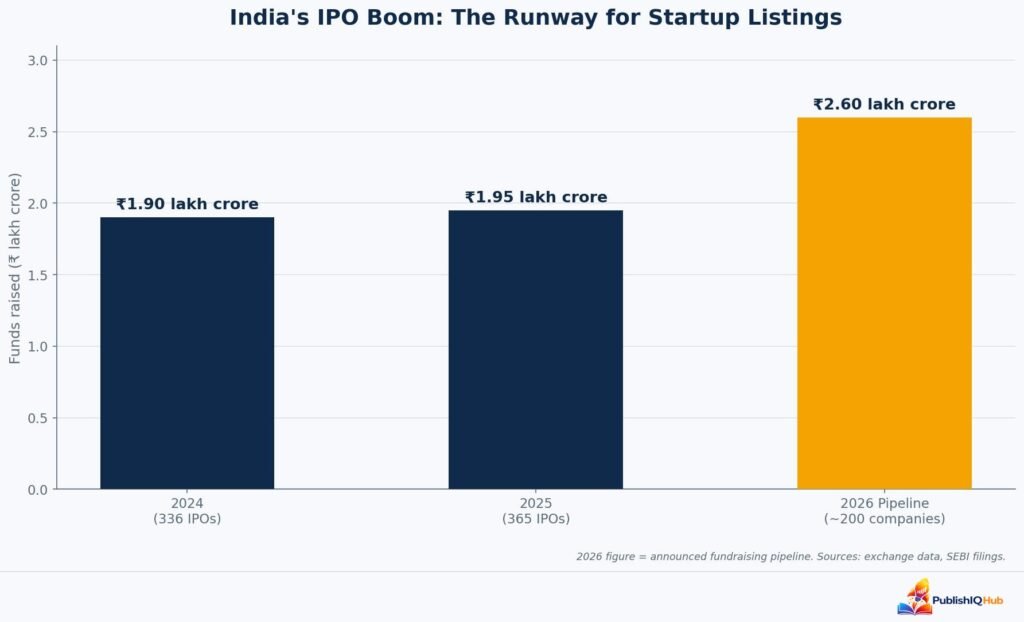
Why 2026 Is a Turning Point for Startup Funding IPO Plans in India
Three things changed the game.
First, regulatory speed. The mandatory T+3 listing cycle means shares trade within three working days of issue closure — matching New York and London. SEBI’s March 2026 ICDR amendments standardised the DRHP process, cutting down the back-and-forth of regulator queries that used to stall filings for months.
Second, founder-friendly reforms. Under SEBI’s September 2025 reforms, promoters can now retain ESOPs granted at least one year before the DRHP filing. Earlier, founders classified as promoters had to give up their stock options — a genuine deterrent for startup listings. That’s gone.
Third, deeper institutional money. Anchor investor allocations have been expanded to 40% of the QIB portion, and pension and insurance funds now participate. Your book gets built with patient capital, not just momentum traders.
Put simply: the pipes connecting startup funding to IPO exits have never been wider. But the entry gate has also become more selective — which brings us to the funding stages themselves.
How Can a Startup Raise Funding Before IPO in India?
Every listed startup you admire climbed the same ladder. The rungs look like this.
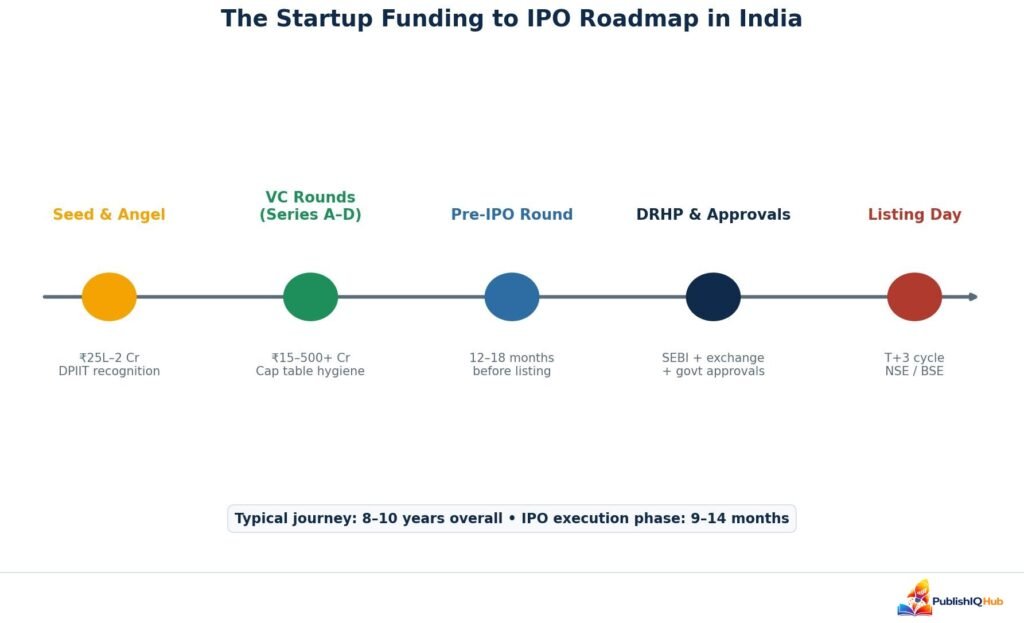
Stage 1: Bootstrapping, Angels and Seed Capital
Most Indian startups begin with founder capital, friends-and-family money, or angel investors writing cheques between ₹25 lakh and ₹2 crore. DPIIT startup recognition matters enormously at this stage — it exempts eligible startups from angel tax scrutiny under Section 56(2)(viib) considerations, opens access to the Fund of Funds for Startups, and simplifies compliance for the first ten years. Register on the Startup India portal before you raise; retrofitting is painful.
Stage 2: Venture Capital — Series A to Growth Rounds
Series A cheques in India typically range from ₹15 crore to ₹80 crore, scaling into the hundreds of crores by Series C and D. Two structural decisions made here echo all the way to your IPO:
Cap table hygiene. Convertible notes, CCPS terms, liquidation preferences and anti-dilution clauses must all be cleanly documented. Merchant bankers will comb through every share allotment during due diligence, and messy ROC filings from your Series A can delay your DRHP by months.
Domicile. If your holding company sits in Singapore or Delaware, you cannot list in India without redomiciling — more on the reverse-flipping wave below.
Stage 3: Pre-IPO Placements and Late-Stage Rounds
Twelve to eighteen months before listing, most startups raise a pre-IPO round from crossover funds, family offices and HNIs. This round sets a valuation benchmark, brings in institutional names that lend credibility to the red herring prospectus, and often provides partial exits to early VCs so the IPO offer-for-sale component stays manageable. Remember that pre-IPO investors face lock-in requirements under SEBI ICDR regulations, so structure timing carefully.
Honestly, this is the stage where we’d urge every founder to appoint advisors. A SEBI-registered merchant banker engaged 18 months out — rather than 6 — routinely saves companies a full listing cycle.
SEBI Listing Guidelines for Startups 2026: What Changed and What It Means
SEBI’s ICDR (Issue of Capital and Disclosure Requirements) Regulations govern every public issue in India. Between late 2024 and early 2026, the framework was substantially rewritten. If your knowledge is from 2023, discard it.
The December 2024 SME IPO Overhaul
Following its 208th board meeting, SEBI tightened SME listing guidelines significantly:
Profitability filter: Operating profit (EBITDA) of at least ₹1 crore in any two of the last three financial years before filing the DRHP.
OFS cap: Promoters can sell only up to 20% of the issue size via offer for sale, and selling shareholders cannot offload more than 50% of their holdings.
Fund-use restrictions: IPO proceeds cannot repay loans from promoters or related parties. General corporate purposes are capped at 15% of the issue or ₹10 crore, whichever is lower.
Public scrutiny: SME DRHPs must now sit open for public comments for 21 days, announced in newspapers with QR-code access.
Phased promoter lock-in: Holdings above minimum promoter contribution unlock 50% after one year and the balance after two years.
The September 2025 Mainboard Reforms
For larger startups, the headline changes were recalibrated minimum public offer norms (large-cap issuers get extended timelines to meet public shareholding requirements), the expanded 40% anchor allocation, and the promoter ESOP relaxation discussed earlier.
The March 2026 ICDR Amendments
The newest layer standardises DRHP documentation, mandates draft abridged prospectuses with QR codes linking to full documents, and defines review timelines — reducing regulatory ambiguity that previously stretched approval cycles unpredictably.
The practical takeaway? SEBI’s listing guidelines now reward preparation. Companies that arrive with audited restated financials, clean related-party disclosures and a monitoring agency already appointed sail through. Companies that treat compliance as an afterthought get stuck in query loops.
Government Approvals Required for Startup IPO in India
SEBI approval is necessary but not sufficient. Here’s the full stack of government approvals a startup typically needs, and this is where foreign-funded startups face the heaviest lifting.
RBI and FEMA Compliance for Foreign-Funded Startups
If you’ve raised from foreign VCs — and most funded Indian startups have — every inbound investment must be squared away under FEMA. That means verified FC-GPR filings for each foreign allotment, FLA returns filed annually, and pricing compliance for all past share issues.
Startups in sectors with FDI caps or approval-route requirements (fintech touching payments, insurance, defence-adjacent tech) may need specific RBI or government sign-offs before listing. An unreported foreign remittance from your 2019 seed round can surface during due diligence and require compounding with RBI — budget three to six months for cleanup if your filings are patchy.
MCA and Companies Act Requirements
You must convert from a private limited to a public limited company, adopt new articles of association, reconstitute the board with independent directors, form audit and nomination committees, and appoint a company secretary and CFO meeting listed-company standards. Note SEBI’s cooling-off expectation: recently converted companies face a full financial year’s gap before certain SME filings.
Sectoral and Tax Clearances
Fintechs need their RBI licences (PA/PG authorisation, NBFC registration) in good standing. Healthtech and pharma startups need CDSCO clearances documented. Pending income-tax disputes must be disclosed in the DRHP with litigation schedules. None of these government approvals are exotic — but each one is a document the merchant banker will demand, and each missing paper is a week of delay.
Stock Exchange In-Principle Approval
Finally, NSE and/or BSE grant in-principle listing approval after their own scrutiny of the draft offer document — a separate gate from SEBI’s observations.
Eligibility Criteria for Startup IPO on NSE Emerge and BSE SME
For startups with post-issue paid-up capital up to ₹25 crore, the SME platforms — NSE Emerge and BSE SME — are the realistic first listing venue. Current eligibility essentials:
- Post-issue paid-up capital not exceeding ₹25 crore
- Operating profit (EBITDA) of ₹1 crore in at least 2 of the last 3 financial years
- NSE Emerge additionally looks for positive free cash flow to equity (FCFE) in 2 of 3 years
- Track record of at least three years (or predecessor entity history)
- Promoter shares fully dematerialised before filing
- No disciplinary actions, winding-up petitions or promoter debarments
- Minimum application size of ₹2 lakh and at least 200 public allottees
The SME route has produced genuine success stories — over 240 companies listed on these platforms in 2024 alone — and companies can now remain on the SME board without forced migration to the mainboard, provided they follow mainboard-grade LODR compliance.
Difference Between Mainboard IPO and SME IPO for Startups
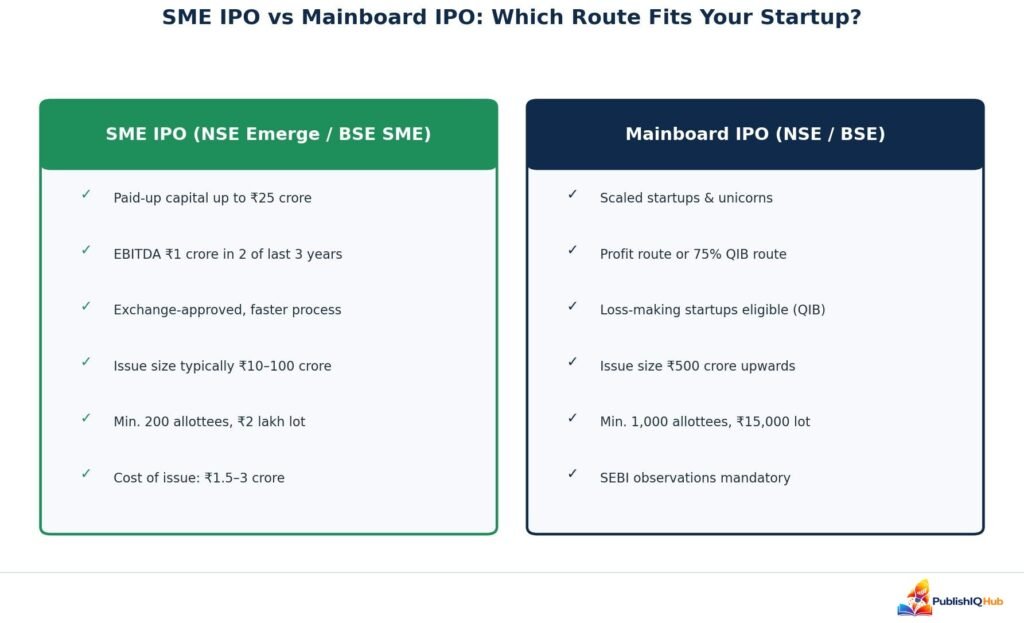
| Parameter | SME IPO (NSE Emerge / BSE SME) | Mainboard IPO (NSE / BSE) |
| Post-issue paid-up capital | Up to ₹25 crore | Above ₹10 crore, typically much larger |
| Profitability route | EBITDA ₹1 crore in 2 of last 3 years | Net tangible assets ₹3 crore/year, avg. operating profit ₹15 crore in 3 of 5 years |
| Loss-making startups | Not eligible | Possible via QIB route (75% to institutions, retail capped at 10%) |
| Approval authority | Stock exchange (SEBI framework) | SEBI observations mandatory |
| DRHP public comment | 21 days | 21 days with SEBI review |
| Minimum allottees | 200 | 1,000 |
| Application size | ₹2 lakh minimum | ₹15,000 retail lot |
| Typical issue size | ₹10–100 crore | ₹500 crore upwards |
| Cost of issue | ₹1.5–3 crore | ₹15 crore+ |
| Best suited for | Profitable, capital-light startups | Scaled consumer tech, fintech, unicorns |
DRHP Filing Process for Indian Startups: Step by Step
The Draft Red Herring Prospectus is your company’s biography, balance sheet and confession booth rolled into one document. The process runs roughly like this:
1. Issue, allotment, listing (T+3): Issue opens for three days; listing follows within three working days of closure.
2. Appoint intermediaries (Month 0): SEBI-registered merchant banker (BRLM), legal counsel, statutory auditors for restated financials, and a registrar.
3. Due diligence and restatement (Months 1–4): Three years of financials restated under ICDR norms; every material contract, litigation and related-party transaction documented.
4. Corporate restructuring (parallel): Public company conversion, board reconstitution, ESOP scheme ratification.
5. DRHP drafting and filing (Months 4–6): Filed with SEBI (mainboard) or the exchange (SME), then opened for the 21-day public comment window.
6. Regulator queries and observations (Months 6–9): Respond to SEBI/exchange queries; receive observations valid for twelve months.
7. RHP, roadshows and pricing (Months 9–11): File the Red Herring Prospectus with dates and price band; conduct anchor book and investor roadshows.
The Reverse-Flipping Wave: Coming Home Before Listing
One distinctly Indian phenomenon deserves its own section. Dozens of startups incorporated holding companies in Singapore or the US during 2015–2020 for investor convenience. To list in India, they’ve had to “reverse flip” — redomicile the parent entity to India. PhonePe did it from Singapore at a reported tax cost exceeding ₹8,000 crore.
Groww, Zepto, Meesho, Razorpay and Pine Labs followed, and Groww and Meesho converted their flips into successful Indian listings in late 2025. Flipkart’s redomiciliation ahead of its anticipated mega-IPO is the trend’s crowning example.
The government has eased the path — NCLT-route inbound mergers have been streamlined and GIFT City offers intermediate structures — but reverse flipping still involves capital gains exposure, valuation reports, RBI clearances and shareholder consents. If your holding company is offshore and you’re eyeing an Indian listing within three years, start this conversation with your advisors now. It is the single longest-lead item on the entire roadmap.
How Long Does It Take for a Startup to Go from Funding to IPO in India?
Zooming out, the full arc from first institutional funding to listing has averaged 8–10 years for Indian startups — Zomato took 13, Mamaearth about 7, Ixigo 17, while Zepto is set to do it in around 5. The IPO execution phase itself, from appointing a merchant banker to listing day, typically takes 9 to 14 months for a well-prepared company. Add 6–12 months if you need a reverse flip, FEMA cleanup, or a public-company conversion cooling-off period.
Conclusion: Start Your Startup Funding IPO Journey Before You Feel Ready
The gap between India’s best-run private startups and its listed companies has never been narrower. SEBI’s listing guidelines now actively accommodate founders. Government approvals, while numerous, are predictable if sequenced early. And public-market investors — 224 million demat accounts strong — are hungry for quality paper.
The startup funding IPO roadmap rewards those who prepare in years, not quarters. Whether you’re two rounds away from a listing or just closed your Series B, the smartest money you’ll spend this year is on a readiness assessment. Consult a SEBI-registered merchant banker and a capital-markets law firm, get an honest gap analysis on your financials, cap table and compliance, and put a dated plan on the wall. In this market, the founders who treat their IPO as a project — not an event — are the ones who list on their own terms.
Frequently Asked Questions
1. How can a startup raise funding before IPO in India?
Through a laddered mix: angel/seed capital (aided by DPIIT recognition), venture capital Series A–D rounds, venture debt, and a pre-IPO placement 12–18 months before listing to set a valuation benchmark and bring in anchor-quality institutional investors.
2. What are the SEBI listing guidelines for startups in 2026?
The current framework combines the December 2024 SME reforms (₹1 crore EBITDA filter, 20% OFS cap, fund-use restrictions), the September 2025 mainboard reforms (promoter ESOP retention, 40% anchor allocation), and the March 2026 ICDR amendments standardising DRHP documentation with T+3 listing timelines.
3. What government approvals are required for a startup IPO in India?
SEBI observations, stock exchange in-principle approval, MCA compliance for public-company conversion, RBI/FEMA clearances for foreign investment history, sectoral licences (RBI for fintech, CDSCO for pharma), and clean tax and litigation disclosures.
4. What are the eligibility criteria for a startup IPO on NSE Emerge and BSE SME?
Post-issue paid-up capital up to ₹25 crore, EBITDA of ₹1 crore in two of the last three years, positive FCFE (NSE Emerge), a three-year track record, dematerialised promoter holdings, minimum 200 allottees and a ₹2 lakh application size.4. What are the eligibility criteria for a startup IPO on NSE Emerge and BSE SME?
5. What is the difference between a mainboard IPO and an SME IPO for startups?
SME IPOs suit profitable smaller companies (capital under ₹25 crore, exchange-approved, lower cost). Mainboard IPOs suit scaled startups, require SEBI observations and larger issue sizes — but uniquely allow loss-making companies to list through the 75% QIB route.