
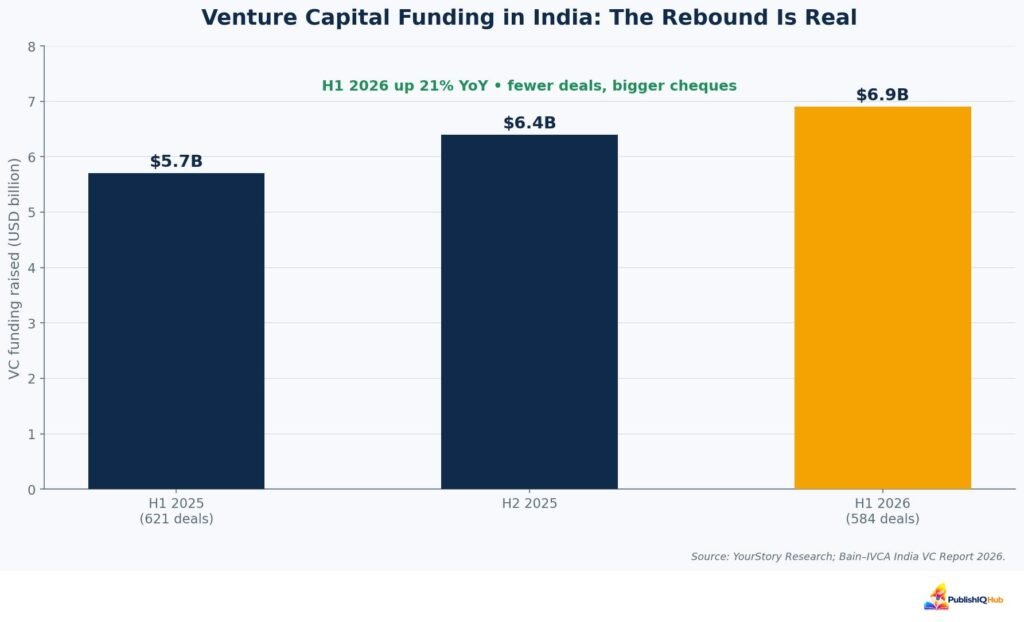
India’s venture capital and growth equity market touched roughly ₹1.4 lakh crore (about $16 billion) in 2025, its second straight year of growth, even as private capital slowed almost everywhere else in the world. The first half of 2026 has kept the momentum going: startups raised $6.9 billion between January and June, up 21% over the same period last year, with June alone crossing $2 billion.
If you’re a founder preparing a raise or an investor weighing your first fund commitment, venture capital funding is no longer a Bengaluru insider’s game. Domestic funds now account for nearly 45% of all startup capital, up from 28% in 2020. Family offices are writing direct cheques. And the exits — Groww, Zepto, Meesho — have moved from PowerPoint promises to listed reality.
But venture capital funding comes with fine print that most founders read too late. Liquidation preferences that eat your exit. FEMA filings that stall your next round. AIF structures that decide your investor’s tax bill. This guide covers the full picture for 2026 — how to raise, which government approvals apply, the honest risk-reward equation, and the exit options that ultimately determine who makes money.
The State of Venture Capital Funding in India in 2026
The funding winter is over, but the money that returned is choosier. In 2025, deal volumes (around 1,400 deals) and average deal sizes (around $11.5 million) rose in parallel — a healthier pattern than the volume-led bounce of 2024. Rounds above $250 million doubled year on year. Fund-raising by VC and growth funds itself doubled to roughly $5.4 billion, so there’s fresh dry powder waiting.
Where is it going? AI and generative AI, fintech, consumer tech and SaaS dominate. Sarvam AI’s $234 million round made it a unicorn; Neysa raised $600 million; CRED closed a large round in June 2026. Pre-Series A remains the busiest stage by deal count — 167 deals worth $297 million in Q1 2026 alone — which tells you investors are still planting seeds, not just watering trees.
One observation from watching this cycle: the two-tier market is real. Startups with clean unit economics raise at healthy valuations in weeks. Everyone else faces bridge rounds, structure-heavy term sheets, or silence.
How to Get Venture Capital Funding for a Startup in India
There’s no secret handshake, but there is a sequence. Founders who respect it raise faster.
Step 1: Get Your House in Order Before the First Pitch
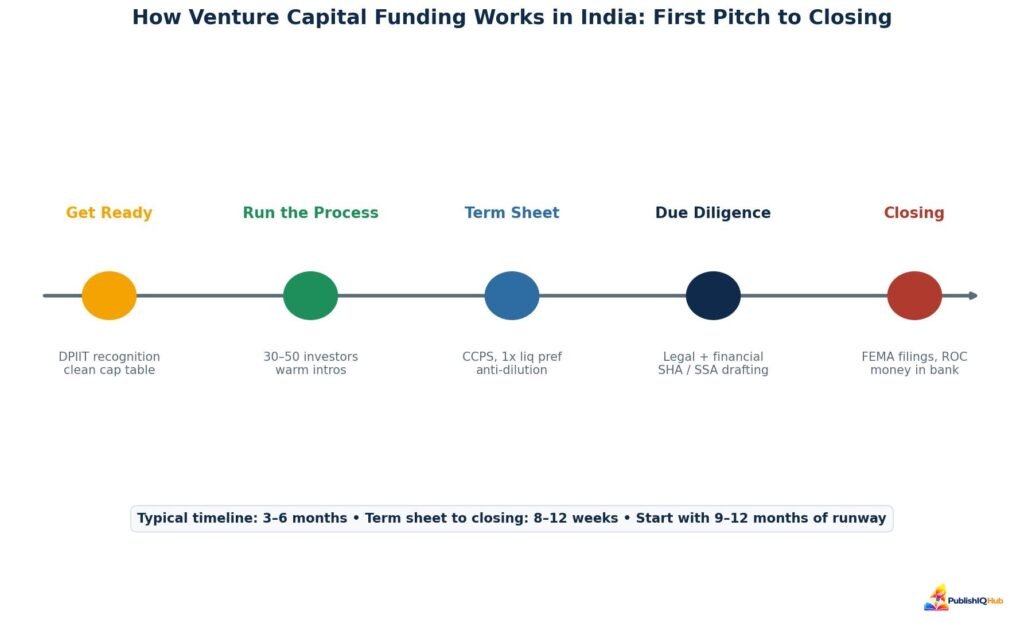
DPIIT startup recognition should be done on day one — it’s free, takes days, and unlocks Startup India benefits including tax deductions (subject to Inter-Ministerial Board approval) and relaxed loss carry-forward rules. Good news on the tax front: the angel tax on premium share issuances has been sunset from assessment year 2025–26, removing a decade-old anxiety from early-stage rounds.
Step 2: Target the Right Investors and Run a Process
Clean up your cap table, ROC filings and IP assignments. VCs run diligence through law firms, and a missing Form PAS-3 from your friends-and-family round will surface at the worst possible moment.
Match your stage and sector to the fund. Micro-VCs and angel networks write ₹50 lakh–₹5 crore cheques; institutional Series A funds like the large Bengaluru and Mumbai franchises typically start at ₹15–40 crore. Run a structured process — 30 to 50 qualified investors, warm introductions where possible, parallel conversations to create competitive tension. A fundraising advisor or investment banker earns their fee here, particularly for Series B and beyond.
PublishIQHub’s guide to India’s top stock brokers and investing platforms is a useful companion once founders start thinking about their own cap table and post-listing liquidity.
Step 3: Understand Indian Term Sheet Norms
Indian VC deals are built on Compulsorily Convertible Preference Shares (CCPS), not plain equity. Standard clauses you will negotiate:
Liquidation preference — almost always 1x non-participating in India today, meaning the investor gets their money back first, then converts if that’s worth more. Watch for participating preferences or multiples above 1x; they quietly reorder who gets what in a modest exit.
Anti-dilution — broad-based weighted average is market standard. Full-ratchet clauses still appear in distressed bridges; we’d urge founders to resist them.
Board and veto rights — reserved matters lists have grown longer post-2022 governance scandals. Reasonable investor protection is fine; approval rights over hiring decisions are not.
Engage a fundraising counsel before signing, not after. Term sheets are “non-binding” except for the parts that aren’t.
SEBI AIF Regulations for Venture Capital Funds 2026
On the investor side, almost all organised venture capital funding in India flows through Alternative Investment Funds registered with SEBI under the AIF Regulations, 2012.
Category I AIF — Venture Capital Funds invest primarily in unlisted startups and enjoy the most supportive regulatory treatment, including pass-through tax status (income is taxed in investors’ hands, not the fund’s) and eligibility to receive capital from government programmes.
Category II AIFs cover growth and private equity style funds that don’t take leverage. Many later-stage “VC” funds in India are actually Category II vehicles.
Key thresholds worth knowing: a minimum investor commitment of ₹1 crore (₹25 lakh for angel funds), minimum fund corpus of ₹20 crore, and manager skin-in-the-game requirements. GIFT City IFSC has emerged as a parallel jurisdiction, letting fund managers pool foreign capital in a dollar-denominated structure with its own tax incentives — a big reason several marquee funds have shifted vehicles there.
Government capital also flows through this architecture. SIDBI’s Fund of Funds for Startups (₹10,000 crore corpus) invests into SEBI-registered AIFs, and the newly notified Startup India FoF 2.0 — approved on 13 April 2026 with another ₹10,000 crore — targets deep-tech and technology-led manufacturing. The ₹1 lakh crore RDI scheme approved in July 2025 adds a further deep-tech fund-of-funds layer. For domestic fund managers, these are anchor LPs worth pursuing.
Government Approvals Required for VC Investment in India
Founders often assume a wire transfer ends the paperwork. It begins it. Here’s the government approvals map, especially where foreign money is involved.
FEMA and RBI Compliance for Foreign VC Money
Most venture capital in India still originates offshore, entering as Foreign Direct Investment. Each allotment to a foreign investor triggers a Form FC-GPR filing within 30 days, pricing must meet fair-valuation norms certified by a merchant banker or CA, and the company must file the annual FLA return. Miss a filing and you’ll be compounding with RBI years later — usually mid-way through your next round’s diligence, or worse, your DRHP.
FDI Sectoral Caps and the Approval Route
Most tech sectors enjoy 100% FDI under the automatic route — no prior government approvals needed. But there are live exceptions: multi-brand retail, insurance (74% cap), print media, and any investment from countries sharing a land border with India, which requires prior government approval under Press Note 3. That last rule reshaped Chinese VC participation after 2020 and still catches founders with legacy investors on the cap table.
Domestic Approvals
Board and shareholder resolutions under the Companies Act, valuation reports under Section 62, ROC filings for each allotment, and — for regulated businesses — sectoral sign-offs: RBI for NBFCs and payment companies, IRDAI for insurtech, SEBI for broking and wealth platforms. Budget these government approvals into your closing timeline; they’re rarely fast.
What Are the Risks and Rewards of Venture Capital Funding?
Let’s do the honest risk rewards maths, because the brochure version misleads both sides.
The Rewards
For founders: capital you can’t get from banks (no collateral, no EMIs), credible investors whose names open enterprise doors, follow-on capacity for future rounds, and structured governance that genuinely improves decision-making. Nykaa’s early backers, Zomato’s Info Edge cheque, Zepto’s rapid-fire rounds — venture capital funding built companies that debt never could have.
For investors: access to the fastest-growing large economy’s private markets. The Bain-IVCA data shows exit value holding steady with IPO-led exits up 30% year on year in 2025 — the reward side of the equation now has receipts, not just projections.
The Risks
For founders: dilution compounds — most founders hold 10–20% by IPO. Preference stacks can zero out common shareholders in a mediocre acquisition. Growth expectations are unforgiving; a VC-backed company that grows 15% a year is a failure by portfolio maths even if it’s a perfectly good business. And control shifts: reserved matters, board seats, and drag-along rights mean you can be compelled to sell.
For investors: illiquidity for 8–12 years, power-law outcomes where two deals return the fund and the rest return nothing, valuation mark-downs (2022–23 vintage LPs know this pain), and regulatory drift. The risk rewards trade-off only works if you size positions expecting most to fail.
Our slightly contrarian view: the biggest risk in Indian venture today isn’t losing money — it’s mediocre outcomes. Companies that neither die nor exit, sitting in fund portfolios for a decade. Which is exactly why exit options deserve more attention than they get at term-sheet stage.
Exit Options for Venture Capital Investors in India
Every rupee of venture capital funding is temporary by design. Funds have 10-year lives (extendable by two); they must return capital. India now offers four working exit options.
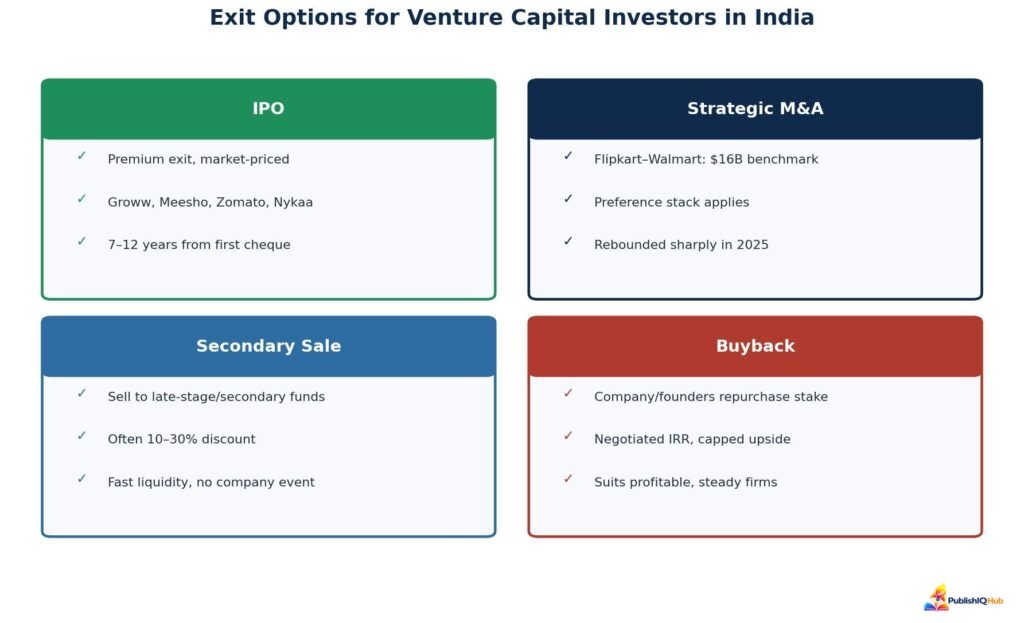
IPO. The premium exit. Zomato (2021), Nykaa (2021), Mamaearth (2023), Ixigo (2024), and the 2025 class — Groww and Meesho — turned VC positions into listed, sellable stock, subject to lock-ins. With Zepto’s ₹11,000 crore issue approved and Flipkart redomiciled for listing, the IPO pipeline is the deepest it has ever been. Public-market exits now dominate Indian VC exit value.
Strategic M&A. The Flipkart–Walmart deal of 2018 — a $16 billion (₹1.05 lakh crore then) transaction — remains India’s benchmark, returning multi-billion-dollar profits to early backers. Strategic sales rebounded sharply in 2025 after a weak 2024, driven by consolidation in fintech, healthcare and consumer brands.
Secondary sales. The quiet workhorse. Early investors and ESOP-holding employees sell to incoming late-stage funds or dedicated secondary vehicles, often at a small discount to the primary round. As hold periods stretch, India-focused secondary funds have multiplied, and pre-IPO secondaries in companies like NSE (pre-listing) and top unicorns have become a genuine asset class.
Buybacks and promoter purchases. The fallback. The company or founders repurchase investor stakes, usually at a negotiated IRR. Common in profitable, slower-growth companies where an IPO makes no sense. Buyback tax changes effective October 2024 shifted the tax burden to shareholders, so structure these with advice.
Exit Options Compared
| Exit route | Typical timeline | Return potential | Founder control impact | Best suited for |
| IPO | 7–12 years from first cheque | Highest; market-priced | Founders retain listed-co leadership | Scaled, compliant, growth companies |
| Strategic M&A | 5–10 years | High, but preference stack applies | Usually founders exit or transition | Category leaders, consolidation plays |
| Secondary sale | 4–8 years | Moderate; often 10–30% discount | None — cap table swap only | Early investors seeking liquidity |
| Buyback | 6–10 years | Capped, negotiated IRR | Founders regain ownership | Profitable, modest-growth firms |
Difference Between Venture Capital and Private Equity in India
Founders use the terms loosely; the cheques behave very differently. Venture capital buys minority stakes (10–25%) in early and growth-stage companies, prices risk through preference shares, and expects power-law returns.
Private equity in India typically buys significant minority or control positions in profitable, established businesses, uses leverage where possible, and underwrites 3–4x outcomes with far lower failure tolerance. Regulatory home also differs: VCs sit mostly in Category I AIFs, PE in Category II. The practical founder takeaway — a PE investor will scrutinise your EBITDA; a VC will scrutinise your market and your team. Pitch accordingly
How Long Does Venture Capital Funding Take in India?
From first meeting to money in the bank: 3 to 6 months is realistic for a competitive Series A. Term sheet to closing alone runs 8–12 weeks — legal and financial due diligence, definitive documents (SHA and SSA), conditions precedent, then filings. Foreign investors add FEMA mechanics; regulated sectors add government approvals that can stretch closings past six months. The planning rule we give every founder: start raising when you have 9–12 months of runway left, never less.
Conclusion: Raise Smart, Structure Smarter
Venture capital funding in India has matured from a fashionable experiment into a functioning capital market — roughly ₹1.4 lakh crore deployed in a single year, government approvals frameworks that are demanding but predictable, and exit options that actually pay out. What hasn’t changed is the asymmetry of experience: the fund across the table has negotiated two hundred term sheets; you’ve seen three.
Close that gap before you sign. Whether you’re a founder planning a Series A or an investor evaluating your first AIF commitment, get a professional in your corner early — consult a SEBI-registered investment advisor, engage a fundraising counsel to mark up your term sheet, and have a chartered accountant stress-test the FEMA and tax mechanics. The risk rewards equation of venture capital tilts decisively toward whoever prepared better. In 2026’s market, with capital flowing and exits working, make sure that’s you.
Frequently Asked Questions
1. How can a startup get venture capital funding in India?
? Secure DPIIT recognition, clean up your cap table and compliance, build a data room, target 30–50 stage-appropriate investors through warm introductions, and run parallel conversations. Engage a fundraising counsel before signing any term sheet.
2. What are the risks and rewards of venture capital funding?
Rewards: large non-debt capital, credibility, follow-on funding and governance support. Risks: heavy dilution, liquidation preferences that reorder exit proceeds, aggressive growth expectations and loss of unilateral control. For investors, the trade-off is illiquidity and power-law failure rates against outsized winners.
3. What government approvals are required for VC investment in India?
Foreign investment triggers FEMA compliance (FC-GPR within 30 days, pricing guidelines, FLA returns), Press Note 3 approval for land-border-country investors, sectoral FDI caps, Companies Act allotment procedures, and regulator sign-offs (RBI, IRDAI, SEBI) for regulated businesses.
4. What are the main exit options for venture capital investors in India?
IPOs (now the largest source of exit value), strategic M&A, secondary sales to later-stage or dedicated secondary funds, and negotiated buybacks. Most funds plan for exits within 8–12 years of investment.
5. What are the SEBI AIF regulations for venture capital funds in 2026?
VC funds register as Category I AIFs (growth funds often as Category II) with a ₹20 crore minimum corpus and ₹1 crore minimum investor commitment. Category I VCFs enjoy pass-through taxation and access government fund-of-funds capital, including the ₹10,000 crore Startup India FoF 2.0 notified in April 2026.