
Disclaimer: This article is for information and education only. It is not investment advice, and PublishIQHub is not a SEBI-registered investment adviser. Brokerage and demat charges are as published on broker websites and checked in November 2026; brokers revise pricing often, so confirm the current rate card before opening an account. Statutory levies (STT, exchange fees, SEBI fees, GST, stamp duty) are extra unless stated.
Quick Answer: The top stock brokers in India in November 2026 are Groww (largest by active clients, best for beginners and SIP investors), Zerodha (₹0 delivery brokerage, best for long-term investors who also trade), Angel One (now India’s No. 2 broker, best for research at discount prices) and Dhan (₹0 delivery and ₹0 AMC, best for options traders). Bank-linked investors should look at ICICI Direct, HDFC Sky or Kotak Neo.
What Changed Since Our July 2026 Edition?
India’s broking market moved more in four months than it usually does in a year. Here are the updates that matter for anyone choosing a broker right now:
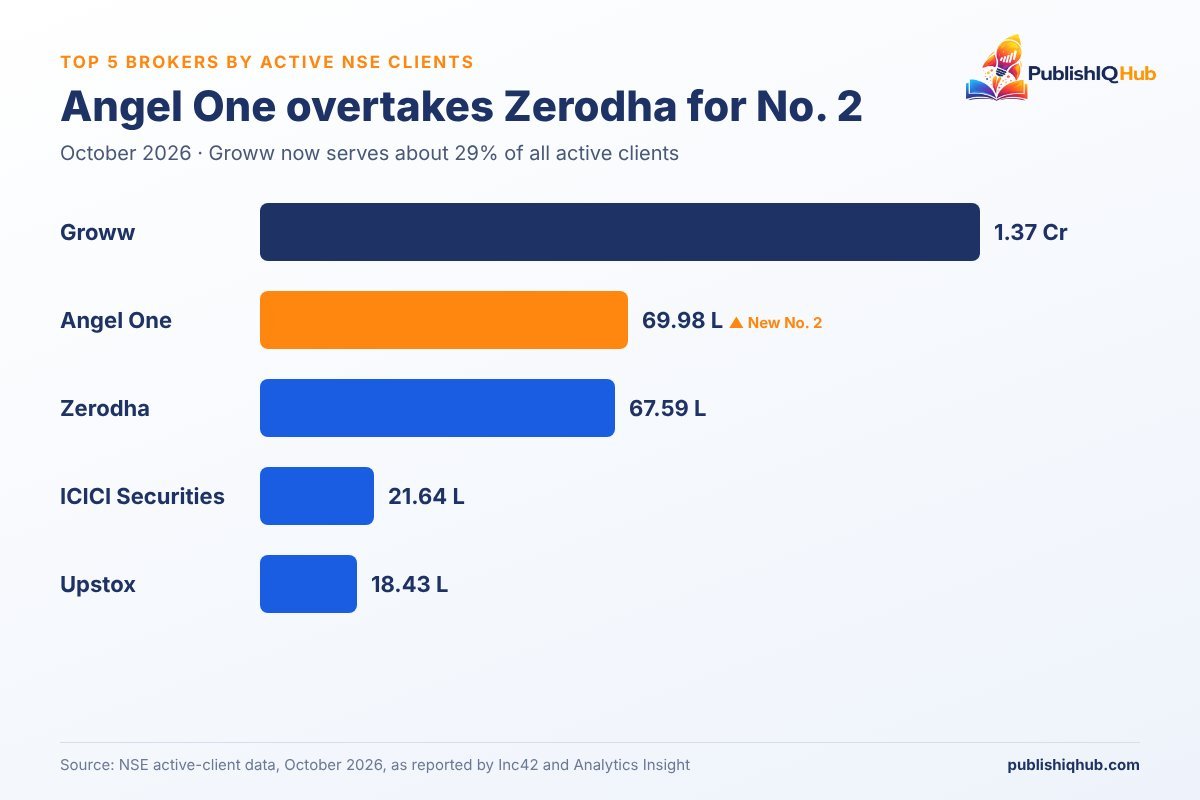
- Angel One overtook Zerodha. In October 2026, Angel One reached 69.98 lakh active NSE clients against Zerodha’s 67.59 lakh, the first change in the top three since Groww took the No. 1 spot in 2023.
- Groww’s lead keeps widening. Groww held about 1.37 crore active clients in October 2026, roughly 29.4% of all active NSE clients, after adding 3.04 lakh users in a single month.
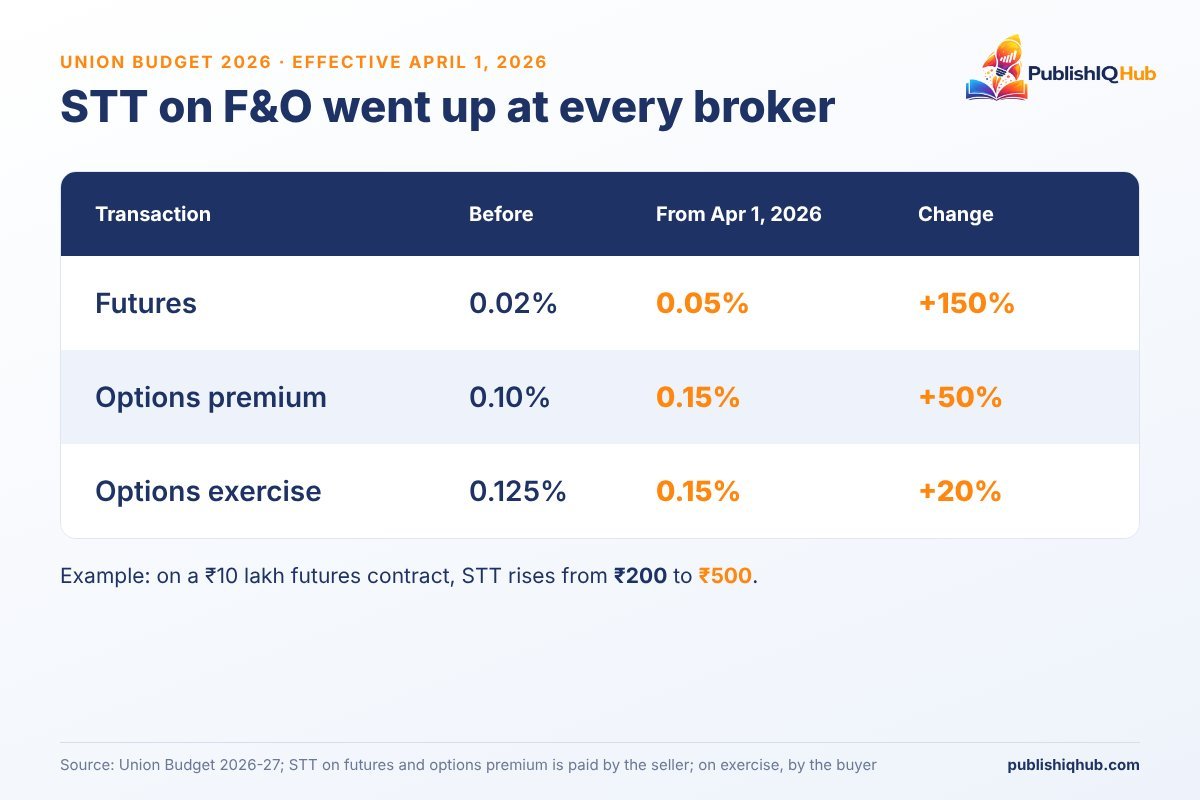
- F&O got costlier. The Union Budget 2026 raised STT on futures from 0.02% to 0.05% and on options premium to 0.15%, effective April 1, 2026.
- Zerodha’s “₹20 everywhere” now has a condition. From April 1, 2026, Zerodha charges ₹40 per executed F&O order if the cash-collateral ratio is not maintained and the shortfall exceeds ₹5 lakh.
- New rulebook for brokers. SEBI notified the SEBI (Stock Brokers) Regulations, 2026 on January 7, 2026, replacing the 1992 framework.
The Indian Broking Market in Numbers (2026)
Before comparing brokers, it helps to see how big the pool has become:
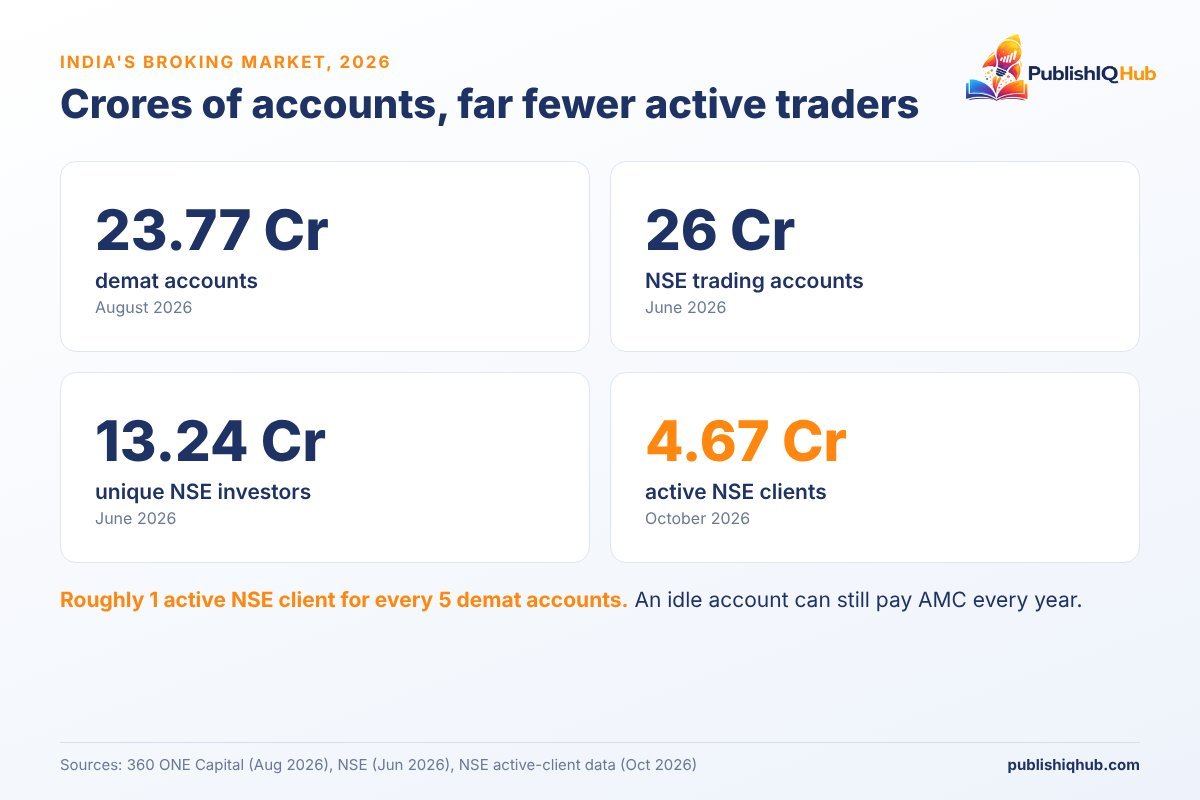
- 23.77 crore demat accounts existed in India by August 2026, according to a 360 ONE Capital report. Many people hold more than one, so unique investors are far fewer.
- 13.24 crore unique registered investors were on NSE by June 2026, up from 3.87 crore in FY20.
- 26 crore NSE trading accounts (client codes) were crossed in June 2026, with over 4.3 crore added in the previous 12 months, per NSE’s press release.
- About 4.67 crore active NSE clients traded at least once in the 12 months to October 2026. Groww, Angel One and Zerodha together hold close to 60% of them.
The gap between 23.77 crore demat accounts and roughly 4.67 crore active clients is the most useful number in this article. It tells you most accounts sit idle, and an idle account at the wrong broker still pays annual maintenance charges every year.
How We Evaluated the Top Stock Brokers
Every broker on this list was judged on the same six points:
- Total cost: brokerage on delivery, intraday and F&O, plus demat AMC and DP (sell) charges.
- Platform stability: how the app and web terminal behave on high-volume days.
- Scale and trajectory: October 2026 NSE active-client counts and the direction of travel.
- Research and tools: charting, screeners, advisory and API access.
- Support: branches, relationship managers, chat and call-and-trade.
- Regulatory standing: SEBI registration, exchange membership and complaint data.
Quick Comparison: Top Stock Brokers at a Glance (November 2026)
| # | Broker | Active NSE clients (Oct 2026) | Delivery brokerage | Intraday / F&O | Demat AMC | Best for |
| 1 | Groww | ~1.37 crore | ₹20 or 0.1% (lower), min ₹5 | ₹20 or 0.1% / ₹20 | ₹0 | Beginners, SIPs |
| 2 | Zerodha | 67.59 lakh | ₹0 | ₹20 or 0.03% / ₹20* | Free yr 1, then ₹300 + GST | Long-term + active traders |
| 3 | Angel One | 69.98 lakh | ₹20 or 0.1%, min ₹5 | ₹20 / ₹20 | Free yr 1, then ₹240 | Research at low cost |
| 4 | Upstox | 18.43 lakh | ₹20 per order | ₹20 or 0.1% / ₹20 | Free yr 1, then ₹300 | TradingView charting |
| 5 | ICICI Direct | 21.64 lakh | ~0.29% (MoneySaver) | ~0.029% / per lot | ₹700 (lower with add-ons) | 3-in-1 banking |
| 6 | Dhan | 11.47 lakh | ₹0 | ₹20 or 0.03% / ₹20 | ₹0 | Options traders |
| 7 | HDFC Securities / HDFC Sky | 13.61 lakh | Sky: ₹20 flat | Sky: ₹20 / ₹20 | Sky: free yr 1, then ₹240 | HDFC Bank customers |
| 8 | Kotak Neo | 14.05 lakh | 0.20% (₹0 for under-30 plan) | ₹10 intraday / plan-based | ₹600 | Under-30 investors |
| 9 | Paytm Money | 7.30 lakh | Flat-fee | ₹20-level | Low | Casual mobile investors |
| 10 | Fyers | ~2 lakh | ₹20 or 0.3% (lower) | ₹20 / ₹20 | ₹0 | Technical traders |
| 11 | 5paisa | ~3.3 lakh | ₹20 flat | ₹20 / ₹20 | Free yr 1, then ₹300 | Budget traders |
| 12 | m.Stock (Mirae Asset) | ~2.2 lakh | ₹0 | ₹5 / ₹5 | Confirm at sign-up | High-volume traders |
| 13 | INDmoney | ~7–8 lakh | ₹20 or 0.1%, min ₹2 | ₹20 / ₹20 | ₹0 | US + Indian stocks |
| 14 | Motilal Oswal | 9.16 lakh | 0.20% | ₹0 intraday / ₹20 per lot | Free yr 1, then ~₹199 | Research-driven investors |
| 15 | Sharekhan (Mirae Asset) | ~5.3 lakh | 0.30% | 0.02% / per lot | Free yr 1, then ₹400 | Branch support |
| 16 | SBI Securities | 10.04 lakh | 0.20%–0.50% (plan) | 0.05% or ₹20 / plan | Plan-based | SBI customers |
| 17 | Axis Direct | ~4.3 lakh | 0.10%–0.50% (plan) | 0.01%–0.05% / ₹20 | Free yr 1, then ₹750 | Axis Bank users |
| 18 | IIFL Capital | 30 lakh+ total | ₹20 flat | ₹20 / ₹20 | Free yr 1, then ₹250 + GST | Advisory + flat fees |
| 19 | Geojit | n/a | 0.30% | 0.03% / 0.01% fut. | ₹0 (promo to Mar 2027) | South India and NRIs |
| 20 | Sahi (new entrant) | 3.15 lakh | ₹10 flat | ₹10 / ₹10 | ₹0 | Low-cost active traders |
*Zerodha charges ₹40 per F&O order if the cash-collateral rule is breached and the shortfall exceeds ₹5 lakh, and an extra ₹20 per order on accounts with a debit balance. Active-client counts come from NSE data as reported by Inc42 and Analytics Insight for October 2026. “n/a” means the broker sits outside the widely reported top 10–20 for that month. Counts for 5paisa, m.Stock, INDmoney, Sharekhan and Axis Direct are Chittorgarh’s active-client figures; IIFL’s is total clients.
Detailed Reviews: The 20 Best Stock Brokers in India
1. Groww — Best for First-Time Investors and SIPs
Groww is India’s largest stock broker by active clients, and its lead is still growing. It ended October 2026 with about 1.37 crore active NSE clients, nearly double the next broker.
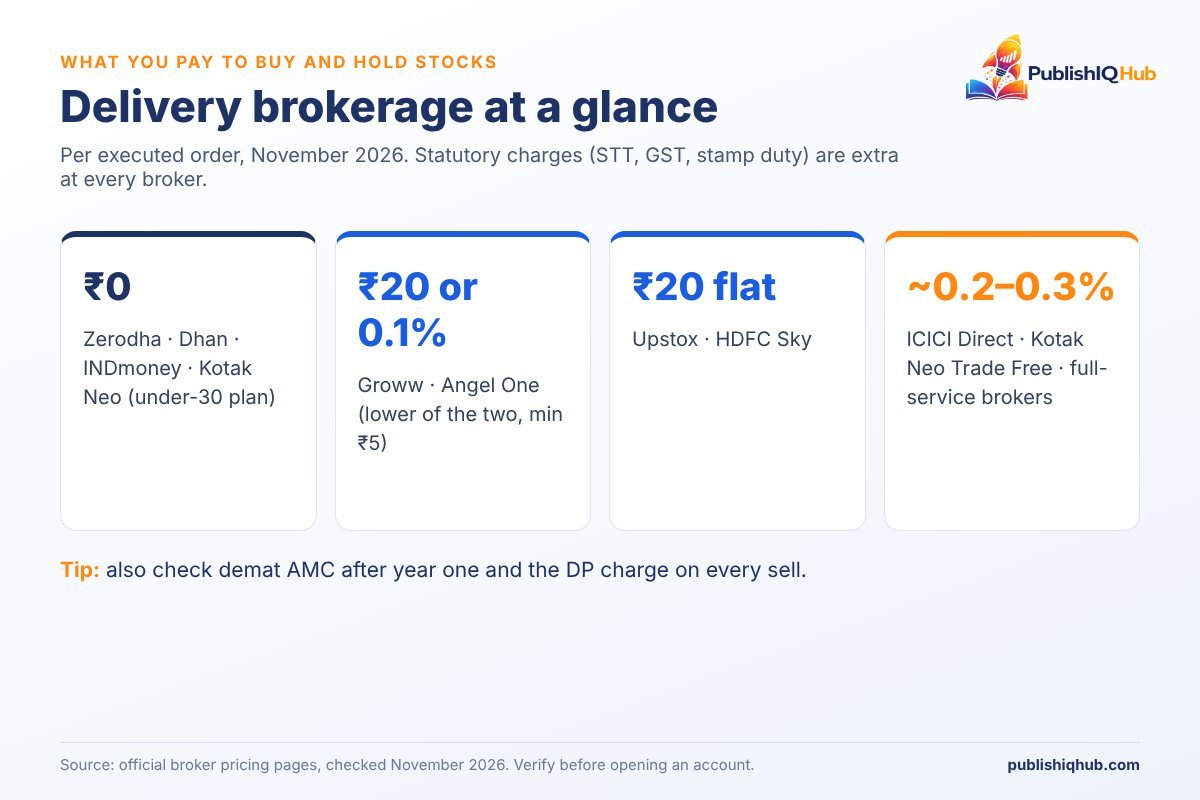
- Charges: Groww’s official pricing page lists equity brokerage at ₹20 or 0.1% per executed order, whichever is lower, with a ₹5 minimum. Account opening and demat AMC are both ₹0.
- DP charge on sells: ₹3.50 depository fee (₹3.25 for women) plus a ₹16.50 Groww fee per delivery sell, before GST.
- Watch out: Delivery is not free at Groww. On a ₹50,000 purchase you pay ₹20, against ₹0 at Zerodha or Dhan.
Verdict: The simplest app for someone starting with mutual funds and a handful of stocks. The zero AMC makes it ideal for small or rarely touched portfolios.
2. Zerodha — Best for Long-Term Investors Who Also Trade
Zerodha still charges ₹0 brokerage on equity delivery, which keeps it the default choice for buy-and-hold investors. It slipped to third by active clients in October 2026 after losing 32,435 users in the month, but the platform remains the benchmark for stability.
- Charges: Intraday and futures at 0.03% or ₹20 per executed order, whichever is lower; options at a flat ₹20, per Zerodha’s charges page.
- AMC: Free in the first year for new resident accounts. After that, ₹300 + GST a year on non-BSDA accounts; BSDA accounts pay nothing up to ₹4 lakh of holdings.
- DP charge: ₹15.34 per scrip sold, which already includes GST.
- 2026 change: The ₹40 F&O brokerage applies when the cash-collateral ratio is not maintained and the shortfall exceeds ₹5 lakh. Most cash-funded traders are unaffected.
Verdict: If you hold stocks for years and trade occasionally, Zerodha is still the cheapest well-established option.
3. Angel One — Best for Research at Discount Prices
Angel One is now India’s second-largest broker by active clients. It added 2.43 lakh active users in October 2026 to reach 69.98 lakh, and its registered client base crossed 4.06 crore.
- Charges: ₹20 or 0.1% (lower), minimum ₹5, on equity delivery under the pricing revised from November 17, 2025; ₹20 per order on intraday and F&O.
- New-user offer: Brokerage up to ₹500 is waived for the first 30 days.
- AMC: Free in year one, ₹240 a year after that.
- Edge: Free research calls, reports and a large offline branch and partner network.
Verdict: A good middle path for investors who want guidance without paying full-service fees. Delivery is no longer free, so compare carefully if you buy often.
4. Upstox — Best for Intraday Charting
Upstox charges ₹20 per executed order across segments, including delivery. It held 18.43 lakh active clients in October 2026.
- Charges: Delivery ₹20 per order; intraday ₹20 or 0.1%; futures ₹20 or 0.05%; options ₹20, per Upstox’s brokerage calculator page.
- AMC: Free in year one; ₹300 a year after that on standard accounts (check your plan).
- Edge: TradingView-based charts and a clean options interface.
Verdict: Strong for chart-driven intraday traders. Long-term investors will pay more here than at Zerodha or Dhan.
5. ICICI Direct — Best 3-in-1 Banking Experience
ICICI Direct is the largest bank-linked broker, with 21.64 lakh active clients in October 2026. Your savings, trading and demat accounts sit under one login.
- Charges: The default MoneySaver plan charges about 0.29% on delivery and 0.029% on intraday and futures. On a ₹1 lakh delivery buy that is about ₹290 in brokerage alone.
- Prime plans: Annual plans at ₹999, ₹4,999 and ₹9,999 lower the percentage rates.
- AMC: ₹700 a year, which drops with add-ons such as iValue.
Verdict: Worth it for ICICI Bank customers who trade in large but infrequent sizes and value the integrated account.
6. Dhan — Best for Options Traders and Zero-AMC Seekers
Dhan combines ₹0 delivery brokerage with ₹0 AMC, a pairing very few large brokers offer. It grew to 11.47 lakh active clients in October 2026.
- Charges: ₹0 on delivery; ₹20 or 0.03% on intraday and futures; ₹20 flat on options.
- AMC: ₹0 for individuals and HUFs, per Dhan’s pricing page.
- DP charge: ₹12.50 + GST per ISIN, which works out to about ₹14.75. That is slightly cheaper than Zerodha’s ₹15.34 (GST included), not dramatically so.
- Edge: Built for fast options execution, with native TradingView charts and free APIs.
Verdict: The best all-round pick for active options traders who also want a zero-cost demat for long-term holdings.
7. HDFC Securities and HDFC Sky — Best for HDFC Bank Customers
HDFC Securities (13.61 lakh active clients, including its Sky app) now runs two very different products. The traditional HDFC Securities account is percentage-based with branch support. HDFC Sky is a flat-fee app.
- HDFC Sky charges: ₹20 per order (or 2.5%, whichever is lower) on equity and F&O, per HDFC Sky’s pricing page. Account opening is free.
- AMC: Free in year one, then ₹20 a month (₹240 a year).
Verdict: Choose Sky unless you specifically need a relationship manager. The traditional plan only makes sense for large, advised portfolios.
8. Kotak Neo — Best for Investors Under 30
Kotak Neo’s age-based pricing is one of the few true zero-delivery deals from a bank-backed broker. It had 14.05 lakh active clients in October 2026.
- Trade Free Plan: ₹10 per order on intraday trades and 0.20% on delivery, with ₹0 delivery for the first 30 days, per Kotak Neo’s plan page. F&O rates depend on the plan you pick.
- Trade Free Youth Plan (under 30): ₹0 brokerage on delivery.
- AMC: About ₹600 a year on standard accounts.
Verdict: Strong if you are under 30, or an intraday trader for whom the ₹10 order rate adds up.
9. Paytm Money — Good for Small, Casual Portfolios
- Fees: From January 15, 2025, all new accounts pay 2.5% or ₹20 whichever lower on delivery, 0.05% or ₹20 on intraday, and ₹20 flat on F&O and the ₹300/year platform fee was simultaneously eliminated. comparesharebrokers
- Older accounts: Early users kept their original lower rates when pricing was raised for new accounts. The review tells readers to check their contract note to see which rates they pay. comparesharebrokers
- Yearly demat fee: ₹0 for life.
- Charge when you sell: about ₹20 per stock sold.
- Client trend: 7.30 lakh active clients in October 2026, the sharpest fall among the top brokers that month.
10. Fyers — Specialist Pick for Technical Analysts
- Fees: Equity delivery is ₹20 or 0.3%, whichever is lower; intraday and futures are ₹20 or 0.03%, whichever is lower; options are a flat ₹20. fyers
- Account and yearly demat fee: Account opening: ₹0. AMC: ₹0. fyers
- Charge when you sell: ₹12.5 + GST per stock sold, made up of a ₹3.5 CDSL fee and a ₹9 FYERS fee. fyers
- Other fees: Orders placed by phone or squared off by the broker cost ₹50 + GST each. fyers
11. 5paisa — Best for Budget Traders Who Want One Flat Fee
5paisa charges the same ₹20 per executed order on every segment, including delivery. That simplicity is its main selling point. It is a listed discount broker that started out as IIFL’s low-cost arm.
- Charges: ₹20 per order on equity delivery, intraday, futures and options, per 5paisa’s brokerage page.
- AMC: ₹300 a year (billed at ₹25 + GST a month), free for the first year.
- DP charge: ₹20 + GST per scrip on sells.
- Watch out: Delivery is not free, so frequent buy-and-hold investors pay more than they would at Zerodha or Dhan. 5paisa also does not offer NRI accounts.
Verdict: A sensible choice for traders who want one predictable fee across segments. Long-term investors will find better value elsewhere.
12. m.Stock (Mirae Asset) — Best for High-Frequency, Low-Ticket Traders
m.Stock pairs free delivery with a ₹5-per-order fee on intraday and F&O, among the lowest standard order fees in the market. It is backed by the global Mirae Asset group.
- Charges: Under its free delivery plan, delivery is ₹0 and a ₹5 brokerage applies on intraday, futures and options orders, per Chittorgarh’s m.Stock review.
- AMC: Chittorgarh lists AMC as free. Other reviews mention a quarterly fee or a one-time lifetime plan, so confirm which applies when you sign up.
- Edge: Free call-and-trade, option-chain analysis and advanced charts.
- Watch out: Reviewers have reported margin and basket-order glitches, so test the platform with small orders first.
Verdict: Hard to beat on pure cost for very active traders. Check the plan terms and AMC carefully before moving a large portfolio.
13. INDmoney — Best for Investing in Indian and US Stocks Together
INDmoney is the go-to app for Indians who want US stocks and Indian equities in one place, with ₹0 AMC for life. Its wider “super app” also covers mutual funds, FDs and NPS.
- Charges: Equity brokerage is 0.1% or ₹20 per executed order, whichever is lower, with a ₹2 minimum. F&O is ₹20 per order, per INDmoney’s pricing page.
- AMC: ₹0 for both trading and demat accounts.
- US stocks: Access to 9,000+ US stocks and ETFs at 0.25% brokerage per transaction (capped at $25).
- Watch out: No commodity or currency trading, and some users report slow email support.
Verdict: The best pick if global diversification matters to you. Active F&O traders will find its ₹20 pricing ordinary.
14. Motilal Oswal — Best for Research-Driven Investors
Motilal Oswal combines free intraday trading with one of India’s deepest research libraries. It had 9.16 lakh active NSE clients in October 2026.
- Charges: 0.20% on delivery, 0.02% on futures and ₹20 per lot on options. Intraday equity is free for life, according to Chittorgarh’s Motilal Oswal page.
- AMC: Free in year one, about ₹199 a year after that (some sources quote higher, so confirm at sign-up).
- Edge: Every account gets a personal advisor at no extra cost, plus access to tens of thousands of research reports.
- Watch out: Delivery at 0.20% adds up fast. On a ₹1 lakh purchase that is ₹200 in brokerage alone.
Verdict: Worth it if you act on research and advice. Self-directed investors should stick with a discount broker.
15. Sharekhan (Mirae Asset) — Best for Branch-Based Support
Sharekhan has one of India’s largest physical networks, with 4,200+ centres, and is now part of Mirae Asset. It suits investors who want to walk into an office or place orders by phone.
- Charges: 0.30% on delivery and 0.02% on intraday, with a minimum of 1 paisa per share, per Sharekhan’s pricing page. Options are charged per lot.
- AMC: ₹400 a year for non-BSDA accounts, free in the first year.
- Edge: Free dial-and-trade and the long-running TradeTiger desktop terminal.
- Watch out: Delivery charges are among the highest on this list, and only regular (not direct) mutual funds are offered.
Verdict: Choose Sharekhan for hand-holding and offline service, not for low costs.
16. SBI Securities — Best for SBI Account Holders
SBI Securities gives State Bank customers a 3-in-1 setup backed by India’s largest bank. It had 10.04 lakh active clients in October 2026.
- Charges: The standard plan charges about 0.50% on delivery and 0.05% on intraday and futures. Prepaid plans cut delivery to 0.20%–0.35% with ₹20 per order on intraday, per SBI Securities’ brokerage plans.
- AMC: Free in year one on most plans, then as per the plan you choose.
- Safety net: Total brokerage is capped at 2.5% of traded value.
- Watch out: The standard plan is expensive, and the platform lags discount brokers on speed and design.
Verdict: Pick a prepaid plan if you want the SBI ecosystem. Otherwise a discount broker will cost far less.
17. Axis Direct — Best for Axis Bank Customers
Axis Direct is Axis Bank’s broking arm, offering a 3-in-1 account with tiered prepaid plans. Chittorgarh lists about 4.27 lakh active clients.
- Charges: The free Prosperity plan charges 0.50% on delivery, 0.05% on intraday and F&O, and ₹20 per options order. Paid plans (₹1,500 to ₹10,000) lower delivery to 0.10%–0.30%, per Chittorgarh’s Axis Direct page.
- AMC: ₹750 a year, free in the first year.
- Edge: Relationship managers for premium clients and access to global stocks.
- Watch out: The ₹750 AMC is one of the highest here, and the advanced desktop terminal is a paid add-on.
Verdict: Convenient for Axis Bank customers who trade large sizes on a prepaid plan. Compare it with HDFC Sky and Kotak Neo first.
18. IIFL Capital — Best for Advisory Plus Flexible Plans
IIFL Capital (formerly IIFL Securities) mixes full-service research with flat-fee plans. It serves over 3 million clients.
- Charges: The Investor Plan charges ₹20 per order across all segments, delivery included. A ₹999-a-month plan removes brokerage entirely.
- AMC: Free in year one, then ₹250 + GST a year, per IIFL’s charges page.
- Edge: Strong research, IPO and wealth products under one roof.
- Watch out: Delivery is not free on the default plan, so long-term investors pay more than they would at Zerodha.
Verdict: A good middle ground for investors who want research and are happy to pay ₹20 per order.
19. Geojit — Best for South India and NRI Investors
Geojit is a Kochi-based full-service broker founded in 1987, with a strong presence in Kerala and the Gulf. That makes it a familiar name for NRIs in the Middle East.
- Charges: 0.30% on delivery, 0.03% on intraday and 0.01% on futures for online retail trading, per Geojit’s brokerage page.
- AMC: Chittorgarh reports zero AMC under a promotional offer running until March 31, 2027.
- Edge: Branch support, NRI expertise and in-house research.
- Watch out: Brokerage is high compared with discount brokers, and minimum brokerage rules can bite on small trades.
Verdict: Best for NRIs and investors in South India who value a local branch over low fees.
20. Sahi — Best Fast-Growing Challenger for Active Traders
Sahi charges ₹10 per order on every segment, half the usual ₹20, with no AMC. It was the fastest-growing broker in the top 20 in October 2026, adding 34,372 clients to reach 3.15 lakh.
- Charges: ₹10 per executed order on delivery, intraday, futures and options, and ₹0 brokerage for the first 30 days, per Sahi’s pricing page. F&O orders are charged ₹10 up to the exchange freeze quantity, not per lot.
- AMC: ₹0, with free account opening.
- Edge: Built for option scalpers, with scanners and AI-driven insights included at no cost.
- Watch out: Sahi was incorporated in 2023, so it has a short track record. Its product range is narrower (no margin trading funding yet).
Verdict: Worth a look for cost-focused active traders. Keep large long-term holdings with a more established broker until Sahi builds a longer record.
What Does It Actually Cost? A Worked Example
Brokerage is often the smallest part of your trading bill. On a ₹1 lakh delivery trade (buy and later sell), STT alone is 0.1% on each side, or about ₹200, at every broker. Here is how brokerage changes the total:
| Broker | Brokerage (buy + sell) | DP charge on sell (approx.) | Brokerage + DP |
| Zerodha | ₹0 | ₹15.34 | ~₹15 |
| Dhan | ₹0 | ~₹14.75 | ~₹15 |
| Groww | ₹40 | ~₹23.60 | ~₹64 |
| Upstox | ₹40 | ~₹20+ | ~₹60+ |
| ICICI Direct (MoneySaver) | ~₹580 | Varies | ~₹580+ |
Figures exclude STT, exchange, SEBI, stamp duty and GST on brokerage. DP figures include GST where noted.
For F&O traders, the 2026 STT hike matters more than any broker choice. On a ₹10 lakh futures contract, STT rose from ₹200 to ₹500, a ₹300 jump per contract regardless of whether you use Zerodha, Groww or Dhan.
Discount Broker vs Full-Service Broker: Which Should You Choose?
Choose a discount broker if you make your own decisions and want the lowest cost. Discount brokers charge ₹0–₹20 per order. Full-service brokers typically charge 0.2%–0.5% per side but include research, a relationship manager and branch access.
The maths is simple. On a ₹2 lakh delivery purchase, a full-service broker at 0.3% charges ₹600 on the buy side alone. A discount broker charges ₹0–₹20. Unless the advice you receive reliably earns back that difference, the discount route wins.
A full-service broker makes sense for large portfolios that need advisory support, investors who want in-person help, and anyone who values a single bank-linked relationship over saving a few hundred rupees.
How to Verify a SEBI-Registered Broker
Never open an account with a broker you cannot find on SEBI’s intermediary list. Follow these six steps:
- Search the broker on sebi.gov.in under “Recognised Intermediaries” and note the registration number.
- Match that number with the one shown on the broker’s website and account-opening form.
- Cross-check exchange membership on the NSE or BSE member directory.
- Read the broker’s Investor Charter and monthly complaint data, which every broker must publish.
- Confirm your demat account is held with CDSL or NSDL. You should receive depository SMS and email alerts directly.
- Know your escalation path. Brokers must resolve complaints within 21 calendar days; after that, you can escalate through SEBI SCORES and the Online Dispute Resolution (ODR) portal.
Conclusion: Which of the Top Stock Brokers Should You Pick?
There is no single best broker for everyone, but there is a clear best fit for most profiles:
- Complete beginner or SIP investor: Groww
- Long-term investor who trades occasionally: Zerodha or Dhan
- Wants US stocks too: INDmoney
- Very active, cost-focused trader: m.Stock or Sahi
- Wants a branch or advisor: Motilal Oswal, Sharekhan or Geojit
- Wants research without full-service fees: Angel One
- Active options trader: Dhan
- Chart-heavy intraday trader: Upstox or Fyers
- Under 30: Kotak Neo Trade Free Youth
- Bank-integrated, large ticket sizes: ICICI Direct Prime or HDFC Sky
Whichever you choose, check three numbers before you sign up: delivery brokerage, AMC after year one, and the DP charge per sell. Those three explain most of the cost difference between brokers for a long-term investor.
Frequently Asked Questions
Which is the largest stock broker in India in 2026?
Groww is the largest stock broker in India by active clients. It had about 1.37 crore active NSE clients in October 2026, roughly 29% of the market, followed by Angel One (69.98 lakh) and Zerodha (67.59 lakh).
Has Angel One overtaken Zerodha?
Yes, by active NSE clients. In October 2026, Angel One moved to second place with 69.98 lakh active clients while Zerodha slipped to third with 67.59 lakh. Zerodha still leads on several other measures, including zero delivery brokerage.
Which broker has the lowest brokerage in India?
For equity delivery, Zerodha, Dhan and m.Stock charge ₹0. Kotak Neo’s under-30 plan also offers ₹0 delivery. For active traders, m.Stock’s ₹5 and Sahi’s ₹10 per order are the lowest standard F&O fees on this list. For intraday, Kotak Neo’s ₹10 per order is among the lowest from a large broker.
Which brokers offer zero AMC demat accounts?
Groww, Dhan, INDmoney, Fyers and Sahi charge ₹0 AMC for individual accounts. Zerodha, Angel One, Upstox and HDFC Sky waive AMC only in the first year. Zerodha’s BSDA accounts are also free up to ₹4 lakh of holdings.
Did trading F&O get more expensive in 2026?
Yes. From April 1, 2026, STT on futures rose to 0.05% (from 0.02%) and STT on options premium rose to 0.15% (from 0.1%). This applies at every broker. Zerodha also introduced a conditional ₹40 per order charge for accounts that breach its cash-collateral rule.
Is Groww or Zerodha better for long-term investing?
Zerodha is cheaper if you buy stocks often; Groww is better if you mostly invest through SIPs. Zerodha charges ₹0 on delivery but has AMC after year one. Groww charges up to ₹20 per delivery order but has ₹0 AMC forever.
Which broker is safest for large investments?
Safety comes from regulation, not brand size. Your shares sit in your own demat account at CDSL or NSDL, not with the broker. Choose a SEBI-registered broker with a clean complaint record. Bank-backed brokers such as ICICI Direct, HDFC Securities and Kotak add another layer of institutional comfort.