
Disclaimer: PublishIQHub is not registered with the Securities and Exchange Board of India (SEBI) as an investment adviser or research analyst. This article is for educational and informational purposes only and does not recommend buying, selling or holding shares of Jio Platforms, Reliance Industries or any other company mentioned. IPO investments carry market risk. Please consult a SEBI-registered adviser before making investment decisions.
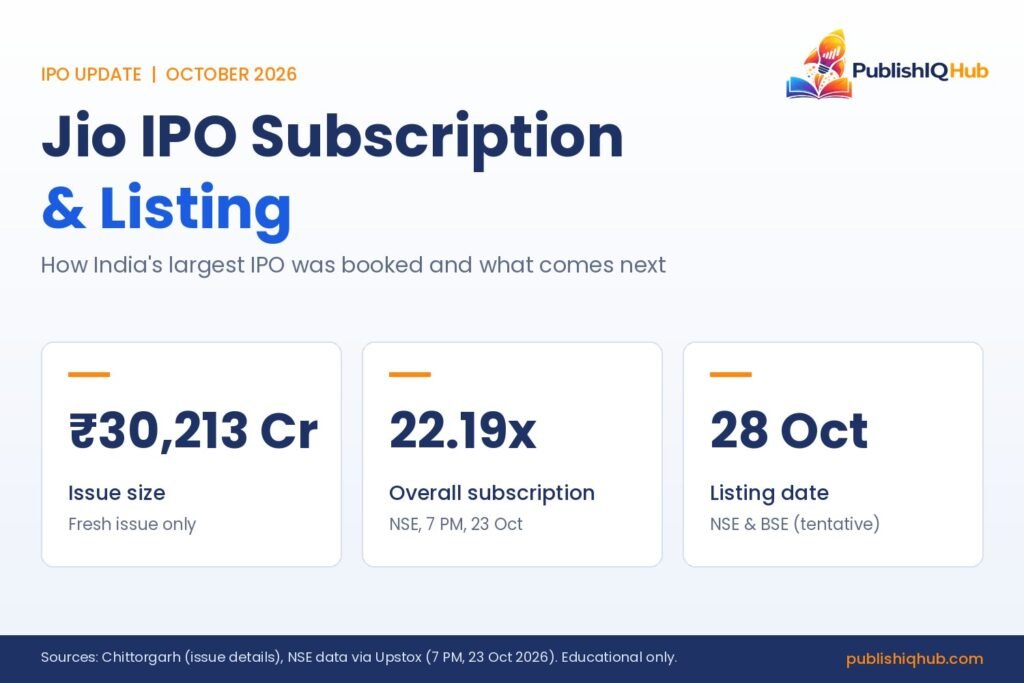
Quick Answer: The Jio IPO was subscribed 22.19 times by 7 PM on 23 October 2026, as per NSE data, with QIBs at 70.55x, NIIs at 14x and retail at 2.72x. Allotment is due on 26 October and the Jio IPO listing date is 28 October 2026 on NSE and BSE. Grey market premium has held near ₹245, but GMP is unofficial and can change.
The Jio IPO subscription and listing story has been the biggest talking point on Dalal Street this month. For three days, office WhatsApp groups in Mumbai, Pune and Lucknow tracked one number after another: minutes to full subscription, QIB multiples, GMP at lunch, GMP at closing. Now that bidding is over, the question has shifted. What did that demand really tell us, and what can investors reasonably expect when the stock lists?
This guide walks through the final Jio Platforms IPO subscription status, how the anchor book shaped sentiment, what the grey market and analysts are signalling, and the risks the company itself has disclosed. If you missed our pre-issue explainer, start with our Jio Platforms IPO guide on price band, GMP and key dates.
Jio IPO at a Glance: Price Band, Lot Size and Key Dates
The ₹30,213 crore issue is entirely a fresh issue of 27 crore shares, with no offer for sale. So every rupee raised goes into the company, not to existing shareholders like Reliance Industries or the 2020-era global investors.
| Detail | Jio Platforms IPO |
| Issue size | ₹30,213 crore (fresh issue only) |
| Jio IPO price band | ₹1,065 to ₹1,119 per share |
| Jio IPO lot size | 12 shares (₹13,428 at the upper band) |
| Employee discount | ₹54 per share |
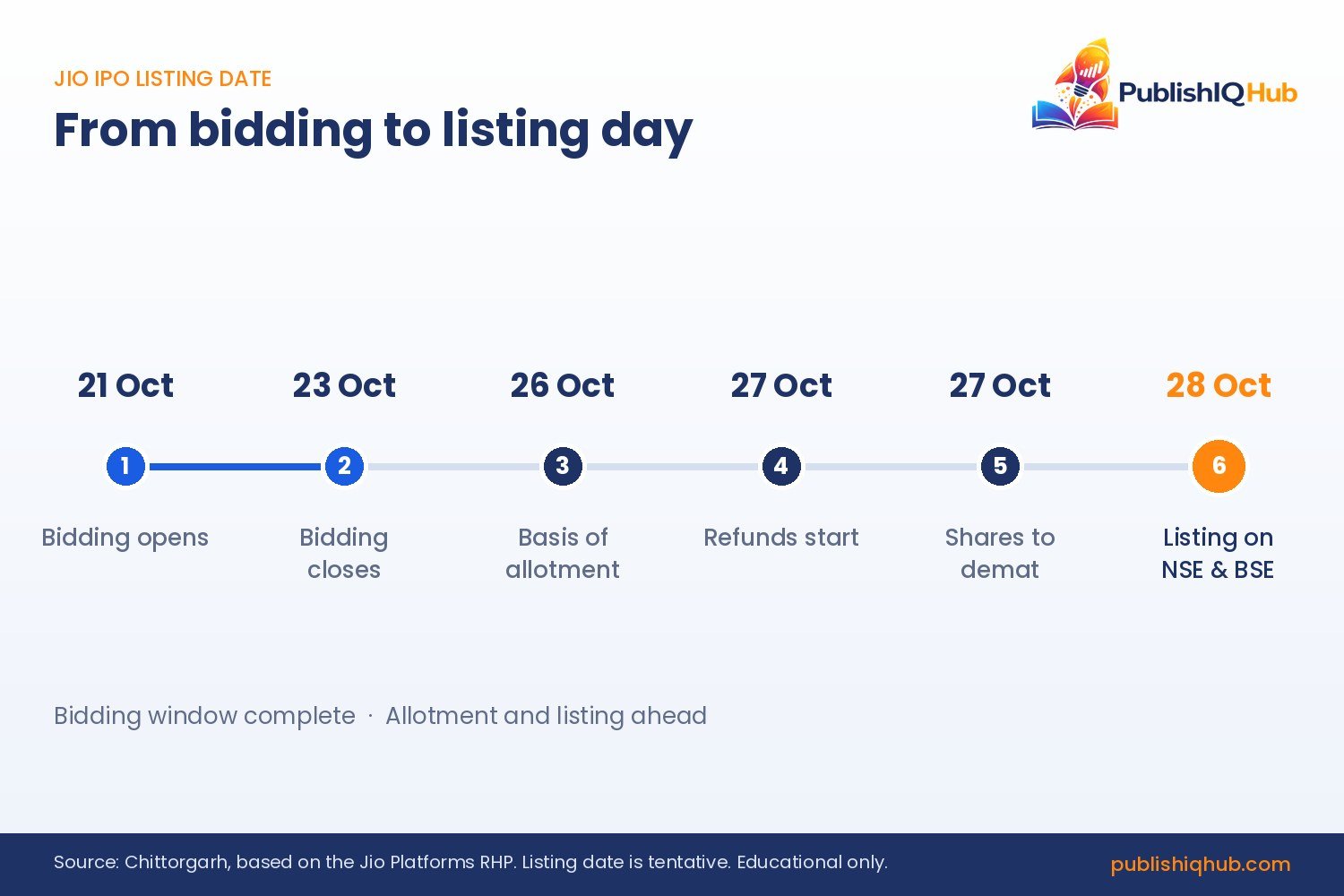
| Subscription window | 21 to 23 October 2026 |
| Basis of allotment | 26 October 2026 |
| Refunds and demat credit | 27 October 2026 |
| Jio IPO listing date | 28 October 2026 (tentative) |
| Registrar | KFin Technologies |
| Exchanges | NSE and BSE |
The reservation split matters for allotment odds. Retail investors got 35% of the net offer, or about 8.5 crore shares, while Reliance shareholders had a separate quota of about 2.23 crore shares (up to ₹2 lakh per application). Employees had their own bucket of roughly 47 lakh shares.
How Many Times Was the Jio IPO Subscribed?
The issue closed with 22.19x overall subscription, based on cumulative NSE data at 7 PM on 23 October. Bids came in for about 438 crore shares against 19.75 crore on offer.
The opening day itself made headlines. The book was fully subscribed within 100 minutes of opening on 21 October, which is the fastest any mega-IPO in India has reached that mark.
Jio Platforms IPO subscription status, day by day
| Category | Day 1 (21 Oct) | Day 2 (22 Oct) | Day 3 (23 Oct) |
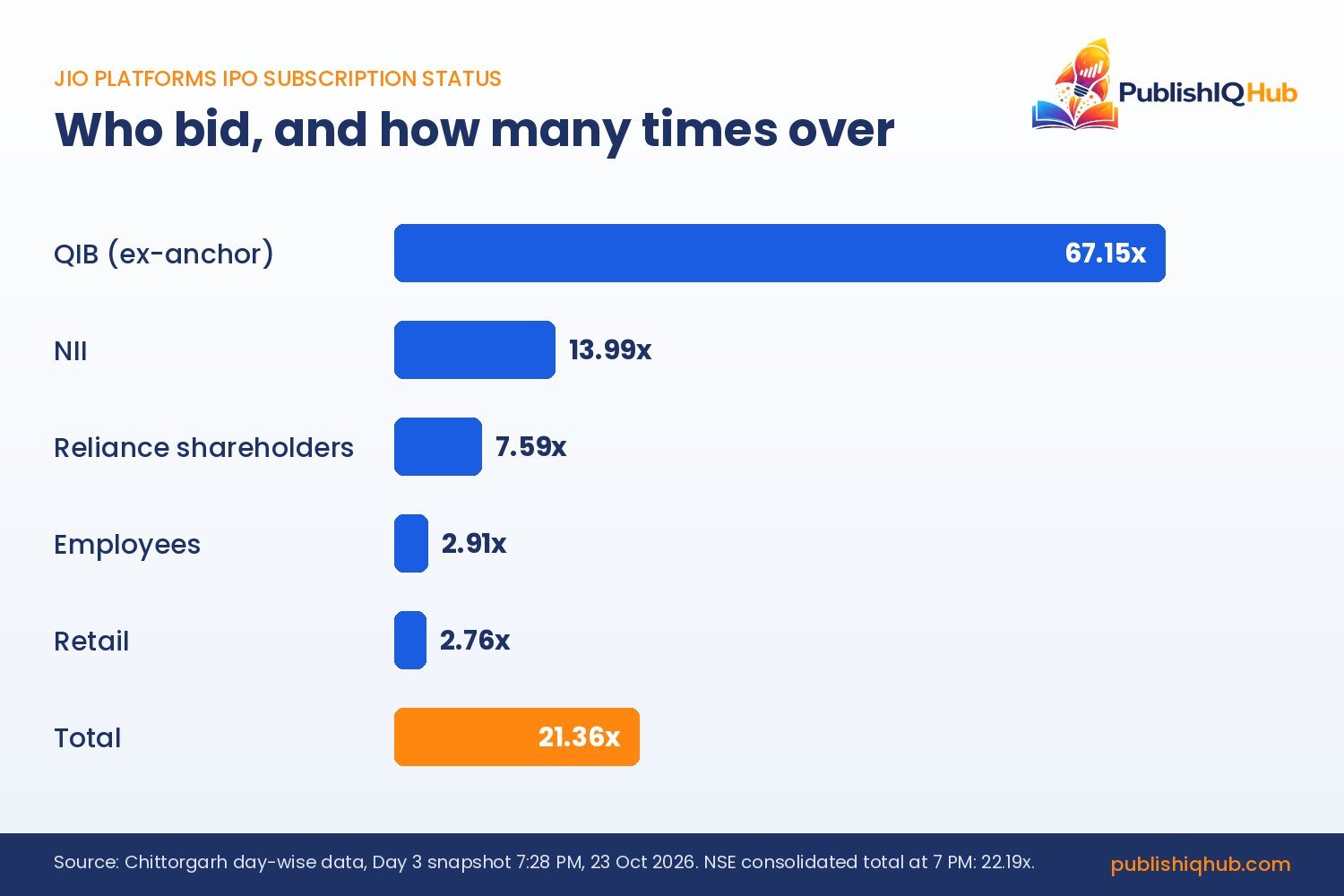
| QIB (ex-anchor) | 9.04x | 12.87x | 67.15x |
| NII | 1.61x | 5.67x | 13.99x |
| Retail | 0.73x | 1.55x | 2.76x |
| Employee | 1.33x | 2.05x | 2.91x |
| Reliance shareholders | 1.41x | 3.92x | 7.59x |
| Total | 3.04x | 5.40x | 21.36x |
Why was retail subscription lower than QIB in the Jio IPO?
Looking only at the Jio Platforms IPO subscription status for retail, a 2.7x number would look modest next to a small-cap IPO that gets booked 100 times. But scale changes everything here. The retail book alone was worth roughly ₹9,516 crore at the upper band. Filling that nearly three times over needs crores of individual applications, and that is exactly what happened: the retail category drew over 1.02 crore applications.
Three other factors kept the retail multiple in check:
- The shareholder quota pulled demand away. Many small investors who already hold RIL shares applied through the Reliance shareholder quota in the Jio IPO, which ended at 7.59x. That demand did not show up in the retail column.
- Institutions bid late and big. QIBs often place the bulk of their bids on the final day, and Jio was no exception. The QIB multiple jumped from about 13x to over 67x in a single session.
- Retail allotment math. Under SEBI rules, oversubscribed retail books are allotted by lottery, one lot per winning applicant. With around 70.86 lakh maximum retail allottees against 1.02 crore applications, roughly two out of three retail applicants could get one lot. That is a rough estimate, not a guarantee, and your actual Jio IPO allotment depends on the lottery.
Anchor Investors and Institutional Demand
Sentiment was set two days before the public opened its UPI apps. Jio Platforms raised ₹8,109.85 crore from 212 anchor investors at ₹1,119 per share, the top of the price band. Demand for the anchor book crossed ₹2.5 lakh crore, more than 30 times the shares available.
The names on that list carried weight. Sovereign funds such as the Monetary Authority of Singapore, Abu Dhabi Investment Authority and Norges Bank Investment Management participated. Closer home, LIC took the single largest anchor allocation at nearly ₹500 crore.
Anchor shares come with a lock-in, so this money cannot exit on listing day. That is one reason institutional demand is read as a medium-term vote of confidence rather than a short-term trade.
Jio IPO GMP Today and Market Expectations
Before reading any GMP number, keep one thing clear. Grey market premium is an unofficial, unregulated price at which dealers trade IPO shares before listing. It is not tracked by SEBI or the exchanges, and it has missed the actual listing price many times in the past.
With that caveat, here is how the Jio IPO GMP today compares with its trend over the past fortnight:
- The premium rose from ₹206 on 14 October to a peak of ₹273 on 20 October, then eased to ₹247 on 22 October.
- After bidding closed, the GMP was quoted at ₹243 on the night of 24 October, about 22% above the ₹1,119 upper band.
What is the expected listing gain of Jio Platforms IPO?
Analysts have been more conservative than the grey market. Sneha Poddar of Motilal Oswal Financial Services said a 10-15% listing pop was possible, while flagging that choppy markets could trigger quick profit-taking. That is a reported opinion, not a forecast we endorse.
So the Jio IPO listing price expectation, and with it the expected listing gain, sits in a range: the grey market implies roughly ₹1,360, while analyst commentary points lower. The gap between the two is itself a useful signal.
Valuation versus Bharti Airtel
At the top of the Jio IPO price band, Jio’s post-issue market capitalisation works out to about ₹10.3 lakh crore, at a P/E of roughly 33x. One brokerage note highlighted that this is about 18% below Bharti Airtel’s P/E of 40.71x. Emkay put Jio’s EV/EBITDA at 15.0-15.6x FY26 numbers, according to the same report.
On operations, Airtel still earns more per user. Jio’s ARPU stands at ₹215.6 against Airtel’s ₹263.9, but Jio serves a larger base of 533.3 million customers.
The underlying numbers are solid. In FY26, Jio Platforms reported total income of ₹1,49,759 crore, EBITDA of ₹76,255 crore and profit after tax of ₹30,053 crore.
Jio IPO Subscription and Listing: What Could Happen on 28 October?
The stock has not listed yet, and the Jio IPO listing date of 28 October is still a few days away. Rather than predict a price, here are three broad scenarios investors usually weigh:
- Strong opening. Heavy QIB demand and a steady GMP carry through, and the stock opens near grey market levels.
- Moderate premium. Listing comes in closer to analyst estimates, as broader market weakness or FII selling trims the pop.
- Flat or weak debut. A sharp market fall on listing day, or heavy selling by allottees chasing quick gains, pulls the price near the issue price.
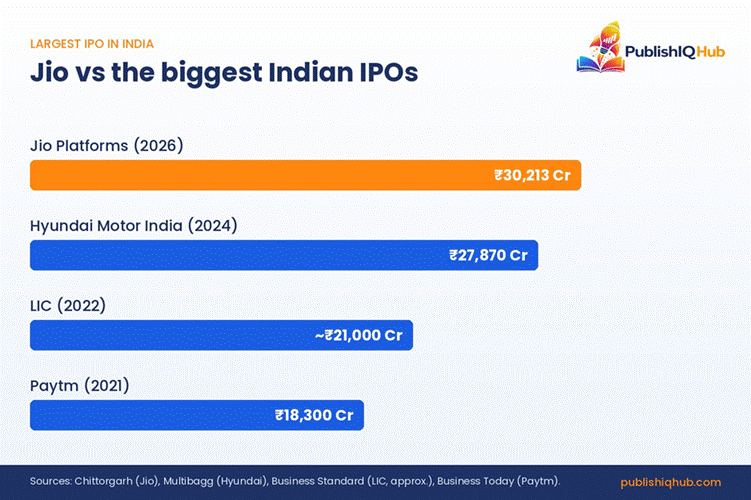
Recent history shows why caution helps. Paytm raised ₹18,300 crore in 2021 and still crashed 27% on its market debut. Size and hype did not protect anyone. We will update this piece with actual listing data after 28 October.
How to Check Jio IPO Allotment Status
The basis of allotment is expected on 26 October, and the Jio IPO allotment status usually goes live on the registrar site by that evening. Here is how to check Jio IPO allotment on each platform:
On the registrar (KFin Technologies) site:
- Open the KFin Technologies IPO status page.
- Select “Jio Platforms Ltd” from the dropdown.
- Enter your application number, PAN or demat account number.
- Submit and view the result.
On NSE:
- Visit the NSE IPO bid verification page.
- Choose “Equity & SME IPO bid details” and select the symbol JPL.
- Enter your PAN or application number and submit.
On BSE: Use the BSE application status page, select the issue name, and enter your PAN or application number.
You can also check your broker app or the UPI app you used for the mandate. If you did not get shares, the blocked amount should be released by 27 October.
Is Jio IPO Bigger Than LIC and Hyundai IPO?
Yes. At ₹30,213 crore, the Jio issue is now the largest IPO in India, and the Jio IPO subscription and listing numbers will be the benchmark for future mega-issues. It overtook Hyundai Motor India’s ₹27,870 crore IPO from 2024. LIC’s 2022 issue was smaller, with the government aiming to raise about ₹21,000 crore.
What Happens to Reliance Shares After the Jio Listing?
Reliance Industries remains the parent, and Jio’s listing gives the market a separate, daily price for its digital business. For years, analysts valued Jio inside RIL using sum-of-the-parts estimates. Once Jio trades on its own, that guesswork becomes a live number.
That can work both ways for RIL. A strong Jio listing could support the “holding company” value of Reliance. A weak one could do the opposite. Some analysts also watch for a holding-company discount, a pattern seen in other Indian conglomerates. Our coverage of the Tata Sons IPO and RBI’s ruling explains how this discount debate plays out, and our Tata Group business empire explainer shows a similar multi-business structure.
For the wider IPO market, a well-received Jio debut may encourage other large issuers waiting in the pipeline. Interest rates also matter here; our piece on the Fed and RBI repo rate outlook covers how rate moves affect market liquidity.
Key Risks Flagged in the Jio Platforms RHP
No IPO is risk-free, however big the brand. These are the points analysts and the Red Herring Prospectus filed with SEBI draw attention to:
- Regulatory and spectrum costs. Emkay listed spectrum costs, competition, dependence on Reliance Group entities, vendor concentration and leverage as key risks.
- Hidden liabilities. About ₹1.05 lakh crore of deferred payment liabilities, mostly spectrum-related, sit outside reported net debt.
- Falling returns on capital. ROCE slipped from 12.5% to 10.8% as capital employed rose.
- Use of proceeds. Up to ₹27,500 crore will repay borrowings of Reliance Jio Infocomm. This cuts debt but does not fund fresh growth.
Telecom is also a policy-sensitive business. Even payment-side rule changes, like the ones we covered in our MDR charges on UPI payments guide, show how quickly regulation can shift economics.
Frequently Asked Questions
How many times was the Jio IPO subscribed?
The Jio IPO was subscribed 22.19 times overall as of 7 PM on 23 October 2026, according to NSE data. QIBs bid 70.55 times their quota, NIIs 14 times and retail investors 2.72 times. Final figures may vary slightly across trackers due to time stamps.
What is the Jio IPO listing date?
The Jio IPO listing date is 28 October 2026 on NSE and BSE. This is tentative and depends on allotment being finalised on 26 October and refunds plus demat credit being completed on 27 October, as per the issue timeline.
What is Jio IPO GMP today?
After bidding closed, the Jio IPO GMP was quoted around ₹243 to ₹250, roughly 22% above the ₹1,119 upper band. GMP is an unofficial, unregulated grey market indicator. It changes often and does not guarantee the actual listing price.
How to check Jio IPO allotment status?
Visit the KFin Technologies IPO status page, select Jio Platforms Ltd and enter your PAN, application number or demat account number. You can also check on the NSE bid verification page using symbol JPL, on the BSE application status page, or through your broker app.
What was the Jio IPO price band and lot size?
The Jio IPO price band was ₹1,065 to ₹1,119 per share. The minimum lot size was 12 shares, which meant ₹13,428 at the upper band for a retail investor. Eligible employees received a discount of ₹54 per share.
What was the Reliance shareholder quota in the Jio IPO?
Reliance Industries shareholders had a reserved quota of about 2.23 crore shares, with bids allowed up to ₹2 lakh. This portion was subscribed about 7.59 times by the evening of the final day, according to day-wise tracker data.
Is the Jio IPO the largest IPO in India?
Yes. At ₹30,213 crore, Jio Platforms is the largest IPO in India so far. It is larger than Hyundai Motor India’s ₹27,870 crore issue in 2024 and LIC’s roughly ₹21,000 crore issue in 2022.
The Bottom Line
If you have applied, check your Jio IPO allotment status on 26 October and keep an eye on official NSE and BSE data on the Jio IPO listing date. If you are tracking it from the sidelines, read the RHP risk section before forming a view. And whatever you decide, speak to a SEBI-registered adviser who knows your goals.
The Jio IPO subscription and listing journey so far tells a clear story. Institutions came in with conviction, retail investors showed up in very large numbers, and the grey market has stayed firm. What it does not tell you is where the stock will trade a month or a year from now. That depends on ARPU growth, debt reduction, competition and the broader market, not on how fast a book filled up.