
Who pays the new 0.4% UPI MDR from 15 October 2026, who is exempt, and what every merchant must do before the deadline
Disclaimer: This article is for general information only and is not legal, tax or financial advice. The UPI MDR framework was notified on 15 September 2026 and some operating details are still being finalised. Please confirm rates, categories and GST treatment with your acquiring bank and the latest NPCI circular before making business decisions.
Quick Answer: What are MDR charges on UPI payments?
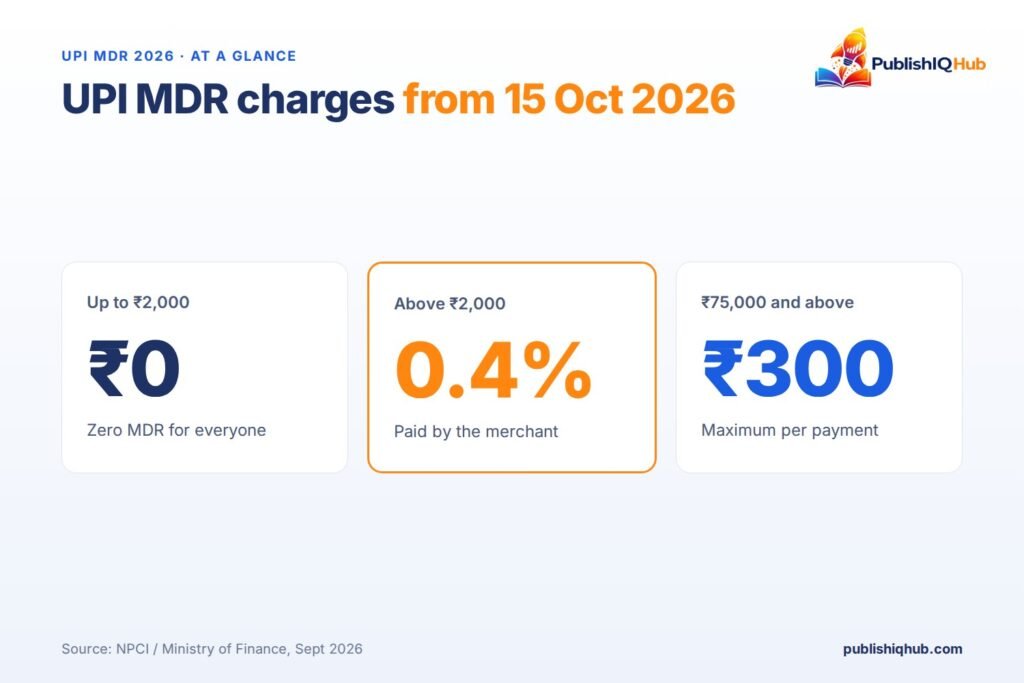
From 15 October 2026, merchants pay a 0.4% Merchant Discount Rate (MDR) on eligible UPI payments above ₹2,000, capped at ₹300 per transaction. Customers pay nothing extra. Person-to-person transfers, merchant payments up to ₹2,000, UPI AutoPay mandates and small merchants receiving up to ₹1 lakh a month through QR codes stay at zero MDR.
For six years, a shopkeeper in India could accept a ₹40,000 UPI payment and receive every single rupee of it. That ends on 15 October 2026.
MDR charges on UPI payments are back, this time in a narrow, capped form. The National Payments Corporation of India (NPCI) announced the framework on 15 September 2026, and the Ministry of Finance backed it the same day. The headlines have been confusing, WhatsApp forwards more so. Some say UPI is no longer free. Others say nothing changes at all. Both are wrong.
Here is what the new UPI MDR 2026 framework actually says, which government rules and regulations sit behind it, and the vendor obligations every business owner needs to sort out in the next few weeks.
What Is MDR on UPI, in Plain Terms?
MDR stands for Merchant Discount Rate. It is the fee a merchant pays to the payment ecosystem for accepting a digital payment. Think of it as the cost of the pipes. When a customer pays ₹10,000, the bank that serves the merchant (the acquirer) keeps a small slice before crediting the rest.
Card payments have always worked this way. UPI was different. Since 1 January 2020, the law barred any MDR on UPI and RuPay debit card payments, under the prescribed electronic modes notified for Section 269SU. Banks, payment apps and NPCI ran the system on government incentives instead.
So the merchant discount rate on UPI is not a new idea. It is an old card-industry fee being brought back to UPI in a limited way. What is new is the design. MDR charges on UPI payments now depend on three things: who is being paid, how much, and in which sector.
One point needs to be clear from the start. MDR is not a tax. It does not go to the government. It is shared between the acquiring bank, the payment service provider and the UPI app, as the HDFC Bank explainer on the new UPI rules notes. That difference matters, because India has seen fake claims before. In 2025, the Finance Ministry had to clarify that there was no GST on UPI payments above ₹2,000. The 2026 change is real, but it is a pricing rule, not a levy.
Why Did the Government Bring Back MDR Charges on UPI Payments?
The short answer is money. UPI grew far faster than the subsidy that paid for it.
Look at the scale. UPI handled a record 24.51 billion transactions worth ₹29.82 lakh crore in August 2026 alone, according to NPCI’s UPI product statistics reported by Business Standard. That is roughly 800 million payments a day.
Running that system is not cheap. Servers, fraud detection, dispute handling and 24×7 uptime cost money. The Department of Financial Services FAQ on UPI MDR puts the annual running cost at about ₹20,000 crore.
Government support never came close. The incentive scheme peaked at ₹3,631 crore in FY2023-24, and the Budget Estimate for FY2025-26 was just ₹437 crore, as Entrepreneur Loop’s breakdown of the subsidy gap shows. Banks and fintechs were absorbing the gap. Many of them said openly that they could not keep doing it.
NPCI has framed the change around sustainability. According to SCC Online’s summary of the NPCI FAQs, MDR revenue is meant to fund technology upgrades, fraud prevention, cybersecurity and long-term sustainability. The DFS FAQ also says this revenue can help smaller payment startups compete, instead of leaving the market to two or three giant apps.
There is a design logic too. The NPCI MDR framework targets the payments that can bear a fee. According to the DFS FAQ, transactions up to ₹2,000 make up more than 95% of UPI merchant volume, and the Ministry of Finance says about 96% of merchant transactions will stay free. In other words, MDR charges on UPI payments fall on a small slice of high-value commerce, not on daily spending.
UPI MDR 2026: The Complete Rate Card
This is the part most people want. Below is the full UPI MDR structure as notified, including the 0.4% MDR on UPI and the special sector rates.
| Transaction type | Amount | MDR | Who bears it |
| Person-to-person (P2P) transfer | Any amount | Zero | No one |
| Person-to-merchant (P2M) | Up to ₹2,000 | Zero | No one |
| P2M, regular merchant | Above ₹2,000 | 0.4% | Merchant |
| P2M, regular merchant | ₹75,000 and above | 0.4%, capped at ₹300 | Merchant |
| Small merchant (P2PM) | Up to ₹1 lakh a month via QR | Zero | No one |
| Railways, fuel, telecom, insurance, utilities, education fees | Above ₹2,000 | Flat ₹5 | Merchant |
| Capital markets (mutual funds, brokers, securities) | Any eligible amount | 0.02%, capped at ₹300 | Merchant |
| UPI AutoPay / mandates (SIPs, subscriptions) | Any amount | Zero | No one |
How much will you actually pay? Worked examples
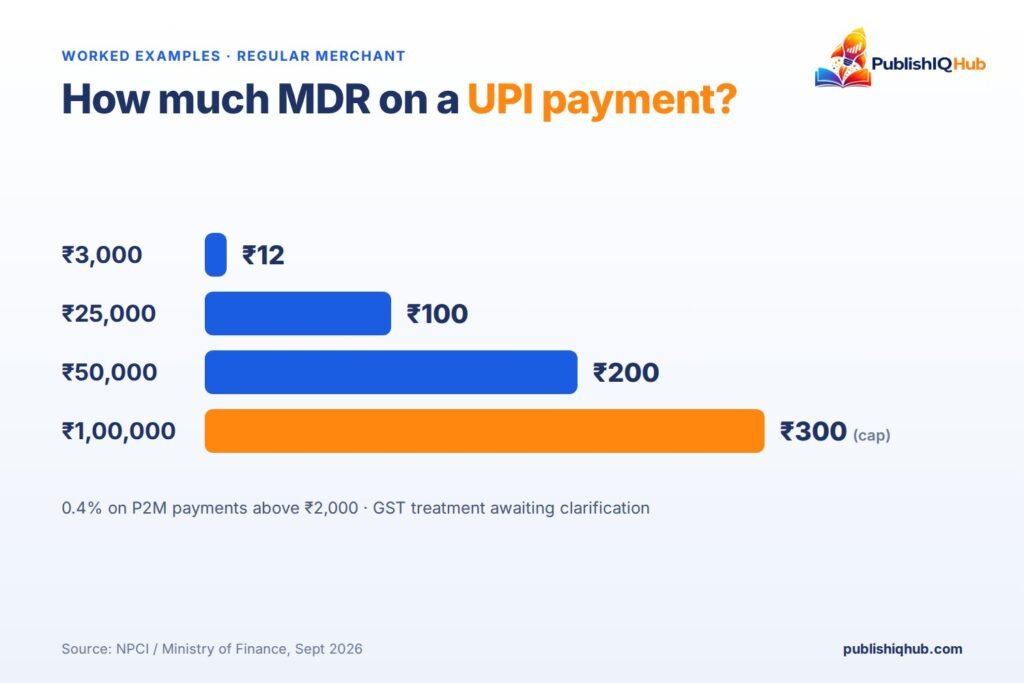
Percentages are easy to misread. Rupee figures are not.
| Payment received | Regular merchant MDR | Why |
| ₹1,500 | ₹0 | Below ₹2,000 threshold |
| ₹3,000 | ₹12 | 0.4% of ₹3,000 |
| ₹25,000 | ₹100 | 0.4% of ₹25,000 |
| ₹75,000 | ₹300 | 0.4% hits the cap exactly |
| ₹1,20,000 | ₹300 | 0.4% would be ₹480, but the cap applies |
Two quick notes. A ₹4,000 fuel payment at a petrol pump attracts a flat ₹5, not ₹16. And a ₹1,00,000 lump-sum mutual fund payment through UPI attracts 0.02%, which works out to ₹20.
Is GST charged on UPI MDR?
This is still an open question. Card MDR attracts 18% GST today. If the same treatment applies to UPI MDR, a ₹12 charge becomes about ₹14.16. The analysis by CA Jatin Karda & Co. warns businesses not to build cost models on an assumption here until the final circular or a clarification settles it. The practical view is simple. Budget for GST on top, and claim input tax credit if you are GST-registered.
Who Pays MDR on UPI Payments, the Merchant or the Customer?
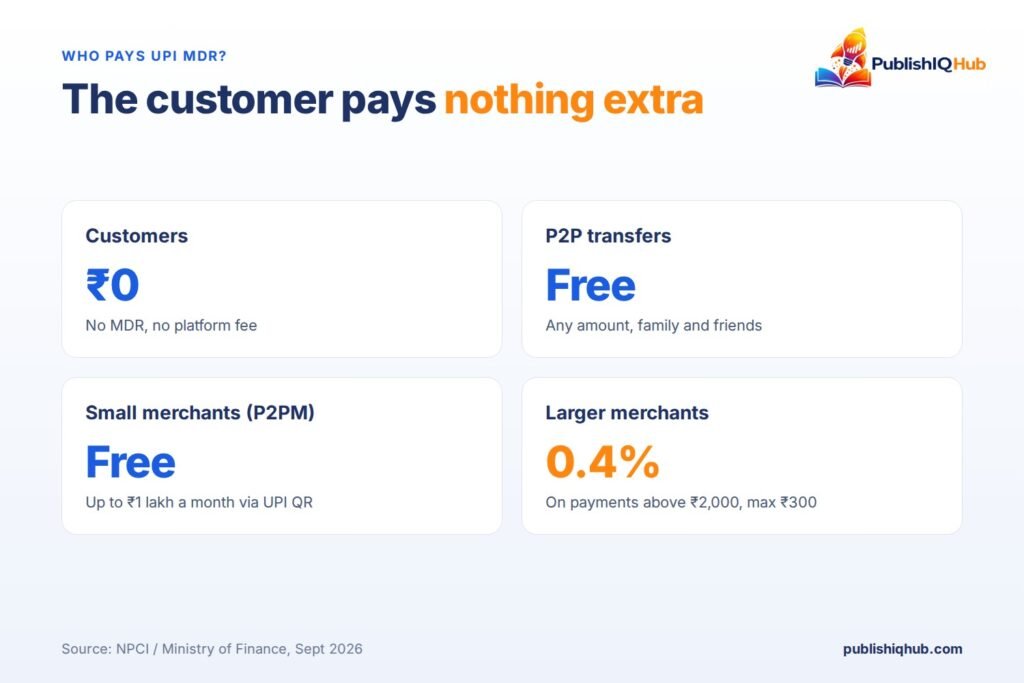
The merchant. Only the merchant.
The Ministry of Finance clarification says customers “will not pay any MDR or platform fees.” Banks have been told to make sure merchants do not pass the charge on. According to NPCI’s own answers reported by Oneindia, consumers will pay “only the posted price.”
UPI apps are also barred from charging users a platform fee or any other charge for making payments, as the DFS FAQ spells out.
So if you are a customer, your ₹8,000 electronics bill stays ₹8,000. The merchant receives ₹7,968 after the acquirer deducts ₹32. Nothing appears on your side.
This is the single biggest source of confusion. UPI merchant charges are real, but they are settled between the merchant and the bank, well out of the buyer’s sight.
Will prices creep up over time? Possibly, in small ways. A merchant cannot add a UPI surcharge, but they can revise overall prices. That is an ordinary business decision, and competition will limit it. For most shoppers, the direct impact is zero.
Government Rules and Regulations Behind UPI MDR
Understanding the legal base helps you see which parts are fixed and which can still change. The government rules and regulations behind MDR charges on UPI payments come in four layers: a change in the law, a government notification, NPCI’s operating rules and RBI oversight.
1. The law was changed first
The zero-MDR rule lived in two places: Section 10A of the Payment and Settlement Systems Act, 2007, and Section 269SU of the Income Tax Act. Together, they barred banks from charging MDR on prescribed digital modes like UPI.
On 6 August 2026, the Lok Sabha passed the Taxation and Other Laws (Amendment) Bill, 2026, which amended both provisions. The change lets the Centre specify which payment modes may carry charges. During the debate, Finance Minister Nirmala Sitharaman said MDR “applies only on the merchants and not on the end users.”
2. The government notified the framework
The government issued its notification on 14 September 2026. The Ministry of Finance followed with a public clarification on 15 September, stating that UPI stays free for P2P and for about 96% of merchant transactions.
3. NPCI set the operating rules
NPCI issued its circular and FAQ on 15 September 2026, as SCC Online reported. The DFS FAQ notes that the UPI and Services Steering Committee, headed by NPCI, decides implementation. NPCI rules cover classification, the ₹2,000 threshold, the ₹300 cap and the ban on surcharges
4. RBI oversight and the small-merchant fund
The Reserve Bank of India (RBI) regulates payment systems under the PSS Act. The detailed framework for a dedicated small-merchant fund will be finalised with RBI within about three months. Per the Ministry of Finance clarification carried by PIB, 5% of MDR collections will go into this fund to support UPI adoption among small businesses, especially in smaller towns.
What this means for you: these government rules and regulations fix the rate and thresholds by notification. The finer details, like GST, category boundaries and enforcement, can still change through NPCI circulars. Keep an eye on your acquiring bank’s emails.
Key dates at a glance
| Date | What happened |
| 1 January 2020 | Zero MDR on UPI and RuPay debit cards comes into force |
| 6 August 2026 | Lok Sabha passes the amendment allowing MDR on UPI |
| 14 September 2026 | Government notification issued |
| 15 September 2026 | NPCI circular, FAQ and Finance Ministry clarification |
| 15 October 2026 | MDR charges on UPI payments take effect |
| By mid-January 2027 (expected) | Small-merchant fund framework finalised with RBI |
Nearly six years separate the first date from the last. For merchants, that long zero-fee run is exactly why MDR charges on UPI payments now feel like a shock, even at 0.4%.
The ₹1 Lakh Small-Merchant Rule (P2PM) Explained
This is the most important exemption, and also the most misunderstood.
NPCI treats very small sellers as P2PM, or Person-to-Person-Merchant. Think of the chaiwala, the vegetable vendor, the neighbourhood tailor. These accounts continue at zero MDR on every UPI payment, even one above ₹2,000.
Here is how the line is drawn, based on Business Standard’s explainer on the ₹1 lakh threshold:
- Only eligible UPI QR receipts count. Cash, card payments and other income do not.
- A merchant is reclassified from P2PM to P2M only after crossing ₹1 lakh a month for three consecutive months. One busy Diwali month will not push you over.
- GST registration is not required to qualify for P2PM, according to the DFS FAQ.
Some questions are still open. It is unclear whether a merchant can move back to P2PM after sales drop, how fast banks will notify a reclassified merchant, and how multiple QR codes across different banks will be tracked. If your UPI receipts hover near ₹1 lakh, ask your bank these questions in writing.
Vendor Obligations: What Every Merchant Must Do Before 15 October 2026
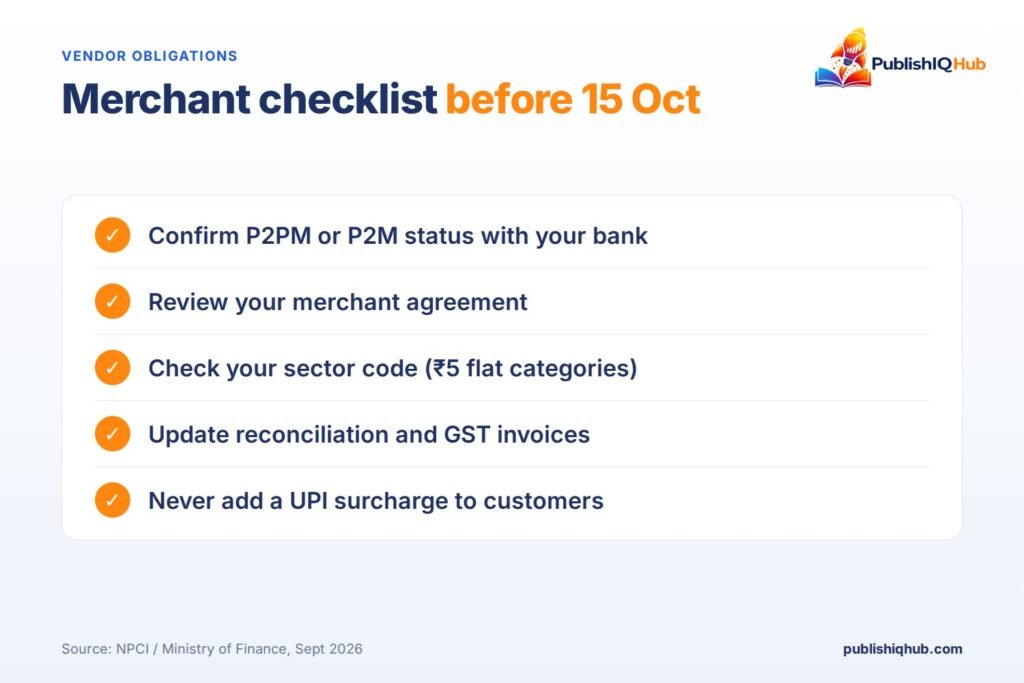
This is where the new rules move from news to action. Vendor obligations under the UPI MDR framework fall into two groups: what you must not do, and what you should do to protect your margins.
Some of these vendor obligations come straight from NPCI. Others are plain good practice. Both matter, because MDR charges on UPI payments will show up in your settlement from day one, whether or not your books are ready.
What merchants must not do
Do not add a UPI surcharge. You cannot add ₹12 to a customer’s bill because they chose UPI. NPCI has said the price displayed is the price payable. This is the clearest merchant obligation under the new UPI rules.
Do not steer customers away with extra fees. A board saying “2% extra on UPI” is not allowed. Offering a cash discount is a grey area, and enforcement of the no-surcharge rule is still not spelt out in detail. The safer path is to keep a single price.
Do not split bills to dodge the threshold. Breaking a ₹6,000 bill into three ₹2,000 payments may look clever. It invites questions from your acquirer and may breach your merchant agreement.
What merchants should do
- Check your classification. Ask your bank or PSP whether your QR is tagged P2PM or P2M. The answer decides whether you pay anything at all.
- Read your merchant agreement. MDR is deducted from settlement under your contract with the acquirer. Look for revised terms, effective dates and any extra processing fees.
- Confirm your sector. If you sell fuel, insurance, telecom, utility services or education, you may qualify for the flat ₹5 treatment. Make sure your Merchant Category Code (MCC) reflects that.
- Update reconciliation. From 15 October, your settlement amount will not match the sale amount on payments above ₹2,000. Your accountant needs to book MDR as an expense, not as a shortfall. High-volume sellers often hand this work to a back-office partner, and our list of top Indian BPO companies is a useful starting point.
- Collect GST invoices from the acquirer. If GST is charged on MDR, get monthly tax invoices so you can claim input tax credit.
- Recheck pricing on high-ticket items. For a jeweller or electronics store, ₹300 per large payment adds up. Build it into margins rather than into a surcharge.
- Train counter staff. Customers will ask about “UPI charges.” Staff should say clearly that the customer pays nothing extra.
How UPI MDR Affects Different Types of Businesses
The same rule lands very differently depending on who you are. UPI merchant charges can be zero for one seller and tens of thousands of rupees a month for another. Five quick scenarios show the range.
A vegetable vendor in Nashik. Receives about ₹60,000 a month on a UPI QR. She stays P2PM. Her MDR is zero, even on the odd ₹2,500 bulk order from a hotel.
A Pune kirana owner. Takes around ₹3 lakh a month through UPI, but 90% of his bills are under ₹1,000. Those stay free. Only the occasional monthly grocery order of ₹3,000 or more attracts MDR. His extra cost may be a few hundred rupees a month.
A Surat textile trader. Receives B2B payments of ₹50,000 to ₹2 lakh from retailers across Gujarat. Each large payment costs ₹200 to ₹300. Over 100 such payments a month, that is up to ₹30,000. He will want to compare UPI with NEFT or RTGS for large invoices, since those bank transfers are outside this MDR framework.
A Bengaluru D2C brand. Average order value of ₹2,400. Many orders now cross the threshold, so MDR becomes a real line item. The brand’s payment gateway may already charge a fee, so it should check whether MDR is added on top or bundled in.
A mutual fund distributor. Clients’ SIPs through UPI AutoPay stay free. A lump-sum investment of ₹5 lakh via UPI attracts 0.02%, capped at ₹300. Investors who use broker apps for such payments can compare platforms in our guide to the best stock brokers in India for investments.
Impact on Consumers: Is UPI Still Free?
Yes, for the person paying.
Sending money to family, splitting a dinner bill, paying your maid, buying groceries: none of it costs you anything. That is true whether the amount is ₹200 or ₹2 lakh.
The ₹2,000 figure has also created a myth. It is not a new limit on UPI payments. Your daily UPI limit, usually ₹1 lakh and higher for some categories, has nothing to do with MDR. The ₹2,000 line only decides whether the merchant pays a fee.
There is also a quiet benefit for consumers. The DFS FAQ says MDR revenue can fund stronger fraud detection and cybersecurity. Payment failures, fake collect requests and screen-sharing scams are real problems. A better-funded system should, in theory, be a safer one.
UPI MDR vs Card MDR: How Do They Compare?
Even with the new charge, UPI remains one of the cheapest ways for a business to get paid. The 0.4% MDR on UPI applies only above ₹2,000 and stops at ₹300, which is a structure cards do not offer.
| Point | UPI (from 15 Oct 2026) | Debit / credit cards |
| Rate | 0.4% above ₹2,000; zero below | Usually higher, varies by card type and network |
| Cap | ₹300 per transaction | Generally no universal cap on credit cards |
| Small merchant relief | Zero MDR up to ₹1 lakh/month via QR | Limited |
| Hardware | Free QR code | POS terminal, often with rental |
| Settlement | Direct to bank account | Usually T+1 |
| Surcharge to customer | Not allowed | Not allowed under card network rules |
Credit card acceptance, especially on premium and corporate cards, typically costs merchants noticeably more than 0.4%. So a merchant who shifts customers from cards to UPI still saves money. The real comparison for large B2B payments is UPI versus NEFT or RTGS, not UPI versus cards.
What Is Still Unclear About MDR Charges on UPI Payments?
The framework is less than a week old in its final form. Business Standard noted in August that several operating rules still needed to be settled. Some remain open:
- GST on MDR and how input tax credit will flow.
- Exact category boundaries for the flat ₹5 sectors and education.
- Failed and disputed payments. What happens to MDR already deducted if a payment is reversed?
- Enforcement of the no-surcharge rule and the penalty for breaking it.
- Marketplace sellers and franchisees, and how they will be classified.
- The small-merchant fund, whose operating rules are due within about three months.
Expect further circulars as the NPCI MDR framework settles in. For now, the core numbers are settled: ₹2,000 threshold, 0.4% rate, ₹300 cap, 15 October start date.
The Bottom Line
The return of MDR charges on UPI payments is a correction, not a reversal. UPI stays free for the people using it and for the smallest sellers who built its success. Larger merchants now pay a capped fee to keep the system running.
The government rules and regulations are now clear on the basics, even if a few operating details are pending.
For most businesses, the cost is small. A ₹12 fee on a ₹3,000 sale is less than the cost of handling that cash. The bigger risk is getting the rules wrong: surcharging customers, misreading your classification or letting reconciliation drift.
Use the next few weeks well. Talk to your bank, check your QR status, and brief your staff. The vendor obligations are simple once you know them, and MDR charges on UPI payments are far easier to manage when they are planned for rather than discovered in a settlement statement.
For more plain-English guides on Indian finance, business rules and digital payments, explore the PublishIQHub blog.
Frequently Asked Questions
These are the questions people are asking most often about MDR charges on UPI payments on search engines and AI assistants.
1. What are MDR charges on UPI payments?
These are the questions people are asking most often about MDR charges on UPI payments on search engines and AI assistants.
2. Who pays MDR on UPI payments, the merchant or the customer?
The merchant pays. Customers do not pay any MDR or platform fee, and merchants are not allowed to pass the charge on through a surcharge.
3. Is UPI free after 15 October 2026?
Yes, for customers. Person-to-person transfers remain free at any amount. Merchant payments up to ₹2,000 also carry zero MDR.
4. Are UPI payments above ₹2,000 charged?
Only certain merchant payments above ₹2,000 carry MDR, and the merchant bears it. P2P transfers above ₹2,000 remain free, as do payments to small merchants in the P2PM category.
5. Can merchants charge customers extra for UPI payments?
No. NPCI has said consumers will pay only the posted price. Adding a UPI surcharge breaks the framework.
6. Do small shopkeepers have to pay UPI MDR?
Not if they receive up to ₹1 lakh a month through UPI QR codes. These P2PM merchants stay at zero MDR, and GST registration is not required to qualify.
7. How much MDR is charged on a ₹50,000 UPI payment?
₹200 for a regular merchant, which is 0.4% of ₹50,000. GST may apply on top, subject to final clarification.
8. Is there MDR on UPI AutoPay, SIPs and mutual fund payments?
UPI AutoPay mandates, including SIPs, carry no MDR. Lump-sum capital market payments via UPI attract 0.02%, capped at ₹300.
9. Is UPI MDR a government tax?
No. MDR stays within the payment ecosystem and is shared among banks, payment service providers and UPI apps. It does not go to the government.
10. What are the main vendor obligations under the new UPI rules?
Merchants must not surcharge customers or split bills to avoid the threshold. They should confirm their classification, review their merchant agreement, update reconciliation and collect GST invoices from the acquirer.