
AI is no longer a pilot project sitting in a lab somewhere — it’s running fraud checks on your bank transfer, predicting when a factory motor will fail, reading your MRI scan, and deciding which product shows up first when you open a shopping app. Every major sector, from banking and manufacturing to healthcare, retail, energy, automobiles, and defense, has moved from experimenting with AI to depending on it for daily operations. The numbers back this up: adoption rates, cost savings, and market sizes across these industries have all grown sharply through 2025 and into 2026.
This piece walks through what AI in various industries actually looks like right now, with the data, sources, and real deployments behind the headlines — not just the hype.
Quick Answer: AI in Various Industries at a Glance
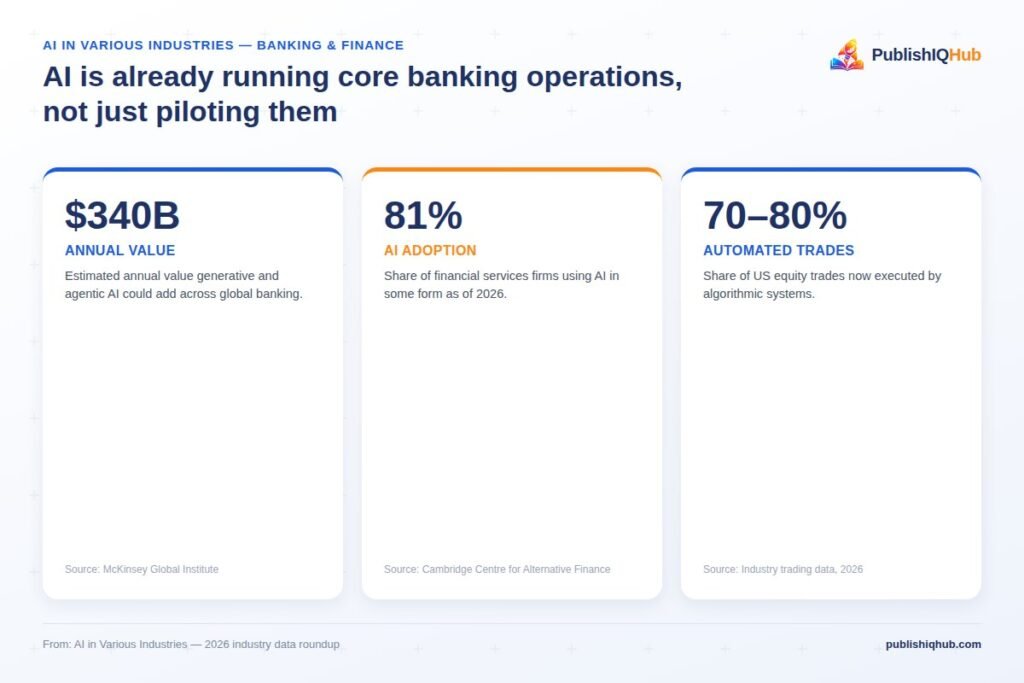
- Banking & finance: Generative and agentic AI could add up to $340 billion in annual value across global banking, according to McKinsey’s Global Institute research.
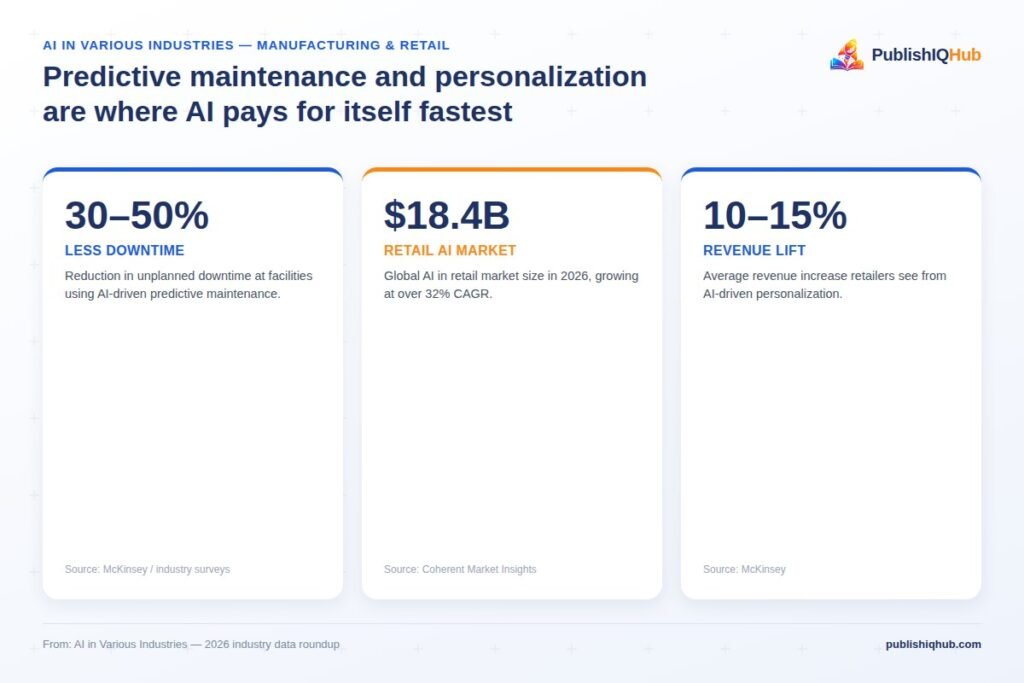
- Manufacturing: Facilities fully using AI-driven predictive maintenance report 30-50% less unplanned downtime and 20-40% longer equipment life (McKinsey).
- Renewable energy: AI-based fault detection can cut power outage durations by 30-50%, and AI-driven forecasting has already boosted the commercial value of wind assets by 20% in documented deployments (IEA; Google DeepMind).
- Retail: The global AI in retail market is valued at roughly $18.4 billion in 2026, with AI personalization driving a 10-15% average revenue uplift (McKinsey, via Coherent Market Insights).
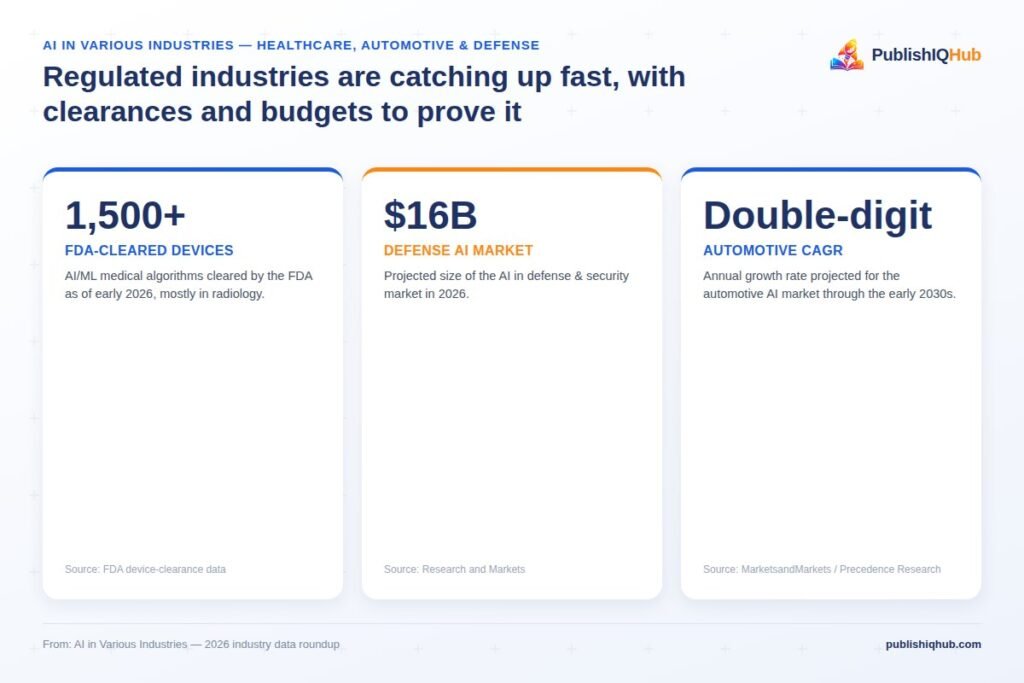
- Healthcare: Over 1,500 AI/ML medical algorithms had been FDA-cleared as of early 2026, most of them in radiology.
- Automobile: The global automotive AI market is estimated between roughly $6 billion and $22 billion in 2026 depending on scope, with double-digit CAGR projected through the early 2030s (Precedence Research; MarketsandMarkets).
- Defense: The AI in defense and security market is projected to reach nearly $16 billion in 2026, growing at close to 13% CAGR (Research and Markets).
How Is AI Transforming Different Industries in 2026?
The short version: AI has moved from generating reports about the future to actively running parts of the present. Two shifts explain most of this change. First, generative AI matured into “agentic AI” — systems that don’t just answer questions but execute multi-step workflows with limited human oversight, a trend McKinsey has flagged as the defining theme in banking, manufacturing, and logistics through 2026. Second, the infrastructure caught up: cheaper sensors, faster edge computing, and better cloud tooling made it economically viable to deploy AI on the factory floor, the trading desk, and the hospital ward, not just inside a software demo.
That combination is why the industries covered below aren’t just “exploring” AI anymore. They’re measuring it in dollars saved, hours of downtime avoided, and lives potentially protected.
What Are the Biggest AI Use Cases in Banking and Finance Right Now?
AI in banking and finance is arguably the most mature of any vertical, because the industry runs almost entirely on data that’s already digital. According to the Cambridge Centre for Alternative Finance’s 2026 Global AI in Financial Services Report, 81% of financial services firms are using AI in some form, though only 14% consider their deployment truly transformational — adoption is broad, but deep transformation is still catching up.
The biggest, most quantified use cases include:
- Fraud detection and AML compliance — used by a majority of institutions to flag suspicious transactions in real time.
- Algorithmic trading — an estimated 70-80% of US equity trades are now executed automatically, with AI systems processing news, sentiment, and price data simultaneously and cutting trading slippage by roughly 15%.
- Credit risk scoring and underwriting — generative AI tools now interpret large volumes of loan documentation and contracts far faster than manual review.
- Customer-facing gen AI agents — McKinsey’s 2026 research found 57% of banking customers would consider a third-party AI financial agent if their own bank doesn’t offer one, a real threat to deposit relationships holding a combined $23 trillion in low-yield checking balances.
McKinsey estimates that AI, taken across the entire financial services value chain — trading, portfolio management, and risk modeling included — could generate an additional $3.8 trillion in annual value globally, according to McKinsey’s corporate and investment banking research. JPMorgan alone reportedly runs more than 400 documented AI use cases across a dedicated team of roughly 2,000 AI specialists, making it one of the most extensively deployed enterprise AI programs anywhere in financial services.
For a look at how AI is reshaping adjacent corners of financial services, see PublishIQHub’s coverage of the best fintech companies in the USA and the top stock brokers in India for investments.
How Is AI Used in Manufacturing to Reduce Downtime and Costs?
AI in manufacturing is overwhelmingly about one thing first: predictive maintenance. Instead of fixing machines on a calendar schedule or waiting for them to break, sensors feed vibration, temperature, and pressure data into machine learning models that flag failures weeks in advance.
The results, compiled across multiple 2025-2026 industrial surveys, are consistent:
- 30-50% reduction in unplanned downtime for facilities running AI-driven predictive maintenance at full scale (McKinsey, industry survey data).
- 20-40% extension in equipment useful life, because parts are replaced based on actual wear, not a fixed schedule.
- 18-25% lower maintenance costs, since AI eliminates unnecessary preventive servicing on healthy equipment.
- 10:1 to 30:1 documented ROI, typically realized within 12-18 months of deployment.
Unplanned downtime is expensive enough that these percentages translate into real money fast: industry estimates put the cost of an hour of unplanned downtime in discrete manufacturing at roughly $260,000 in 2026, so even a 30% reduction is worth millions annually at scale. Unilever’s Indaiatuba, Brazil plant is a widely cited example — after deploying AI-based maintenance across more than 50,000 IoT sensors, the facility reported $2.3 million in annual savings and recovered its $1.2 million investment in under seven months.
Despite the payoff, adoption is still uneven — under a third of manufacturing and operations teams report having fully or partially implemented AI-driven maintenance, which suggests the next few years of growth will come from scaling existing pilots rather than starting new ones. For a closer look at who’s building this technology, PublishIQHub’s roundup of top AI manufacturing companies in the USA covers the vendors leading this shift.
What Role Does AI Play in Renewable Energy and Smart Grid Management?
AI in renewable energy solves a very specific problem: renewable output is unpredictable, and the grid built to manage it is often decades old. According to the International Energy Agency’s 2026 “Energy and AI” report, AI can improve forecasting and integration of variable renewable generation, reduce curtailment, and use AI-based fault detection to cut outage durations by 30-50%. The IEA also estimates that AI-enabled monitoring and management tools could unlock up to 175 gigawatts of additional transmission capacity without building a single new line.
Documented commercial deployments back this up. Google DeepMind used machine learning to forecast wind output 36 hours in advance across 700 megawatts of US wind capacity, increasing the commercial value of that power by 20%. Separately, transformer-based models are now detecting wind turbine faults with roughly 94.7% accuracy, cutting unplanned turbine downtime by 60-70%, and deep reinforcement learning systems have improved battery storage arbitrage profits by close to 58.5% compared to conventional optimization methods.
This matters more than usual right now because grid capacity is becoming a genuine bottleneck: the IEA reports that more than 2,500 gigawatts of renewable and storage projects are currently stuck in interconnection queues worldwide, waiting on grid capacity that smarter, AI-managed infrastructure could help unlock faster.
How Is AI Changing the Retail Shopping Experience?
AI in the retail market has shifted from “recommend a product” to running large parts of the customer journey end to end. The global AI in retail market is valued at approximately $18.4 billion in 2026 and is projected to grow to $130.88 billion by 2033, according to Coherent Market Insights’ 2026 retail AI data — a compound annual growth rate above 32%.
What’s actually driving that growth:
- 89% of retail and CPG companies are actively using or testing AI applications, per McKinsey, though only around a third have fully implemented it across operations.
- AI-driven personalization lifts revenue by 10-15% on average, with top performers seeing gains as high as 25% (McKinsey).
- AI chatbots now resolve up to 86% of customer service questions without a human agent, according to Tidio’s 2026 data — a trend that’s also reshaping outsourced customer service; see PublishIQHub’s list of top Indian BPO companies for your business for how that industry is adapting.
- 97% of retailers plan to increase AI spending in the next fiscal year, per NVIDIA’s retail survey.
- Generative AI-driven traffic to US retail sites grew roughly 4,700% year-over-year by mid-2025, according to Adobe Digital Insights — a sign that AI shopping assistants and chat-based product discovery are becoming a real traffic channel, not a novelty.
Retailers are putting the bulk of their AI budget into personalization first, followed by inventory forecasting — a category where AI has cut forecast errors by 30-50% and reduced overall inventory levels by around 35%, according to recent market analysis.
What Are Real-World Examples of AI in Healthcare Diagnostics?
AI in healthcare is easiest to measure through regulatory data, because every AI-enabled diagnostic device sold in the US has to clear the FDA first. As of early-to-mid 2026, more than 1,500 AI and machine learning medical algorithms have been FDA-cleared, up from around 880 as of mid-2024 — the agency is now clearing roughly 30 new AI devices a month, compared to 21 a month in 2024. Radiology dominates this list by a wide margin, accounting for over 75% of all clearances, led by manufacturers like GE HealthCare, Siemens Healthineers, and Philips.
Beyond imaging, one of the more notable recent approvals is the Sepsis ImmunoScore, the first FDA-authorized AI/ML diagnostic tool specifically for predicting sepsis risk, cleared via the De Novo pathway in 2024. It analyzes up to 22 clinical parameters to flag high-risk patients within 24 hours of assessment, directly inside the electronic medical record.
Adoption among clinicians is climbing too — roughly 80% of hospitals now use AI in at least one clinical or operational function, and the average number of AI use cases per physician rose from 1.1 in 2023 to 2.3 in 2026, with documentation support and differential-diagnosis brainstorming as the most common current uses. It’s worth noting the limits here: a meta-analysis of 83 studies found general-purpose generative AI chatbots hit around 52% diagnostic accuracy on their own, trailing specialist physicians by nearly 16 percentage points — which is exactly why most current healthcare AI is built to support a clinician’s judgment, not replace it.
What Is the Role of AI in Self-Driving and Connected Cars?
AI in the automobile industry covers a wider range than just self-driving cars — it includes advanced driver-assistance systems (ADAS), predictive maintenance, in-vehicle voice assistants, and manufacturing automation on the plant floor. Market sizing varies significantly by which of these are counted: estimates for the global automotive AI market in 2026 range from around $6 billion (narrower software-only scope) to over $21 billion (full hardware-and-software scope), but nearly every major forecast agrees on double-digit annual growth through the early 2030s, according to MarketsandMarkets’ automotive AI market report and Precedence Research.
The clearest commercial proof point is Waymo, which surpassed 20 million fully autonomous trips and exceeded 400,000 weekly rides by December 2025, with expansion into the UK and Japan underway. On the freight side, PlusAI and IVECO launched a Level 4 autonomous trucking pilot across a 300 km corridor between Madrid and Zaragoza in late 2025 — one of the clearest signs that autonomous AI is moving from passenger pilots into commercial logistics.
Asia-Pacific currently holds more than half of global automotive AI market share, driven by vehicle production scale and fast-growing connected-vehicle demand in China, Japan, South Korea, and India — the same software engineering base that underpins PublishIQHub’s coverage of IT outsourcing companies in India.
How Are Defense Agencies Using AI for Surveillance and Decision-Making?
AI in the defense industry is growing fastest in three areas: intelligence, surveillance and reconnaissance (ISR), autonomous unmanned platforms, and AI-assisted command-and-control systems that help commanders process battlefield data faster than a human team alone could manage.
The AI in defense and security market is projected to grow from about $14.15 billion in 2025 to nearly $16 billion in 2026, a 12.8% compound annual growth rate, according to Research and Markets’ defense and security report. A related but distinct category — autonomous weapons systems specifically — is separately estimated at roughly $18-20 billion in 2026, expanding toward $30 billion by 2030, driven largely by unmanned aerial and ground platforms designed to reduce personnel exposure in combat zones.
Swarm intelligence is one of the more advanced applications in active testing: the US Department of Defense’s OFFSET program has demonstrated swarms of up to 250 autonomous robots coordinating in complex urban environments, while DARPA’s Gremlins program is developing recoverable drone swarms to improve mission sustainability. On the policy side, this growth is not happening without friction — a 2024 United Nations resolution on lethal autonomous weapons systems, backed by 166 countries, called for stricter regulation and possible bans on certain fully autonomous targeting capabilities, a debate that continues to shape how fast military AI can be deployed operationally.
Which Industries Are Adopting AI the Fastest and Why?
Looking across all seven sectors above, a pattern emerges: industries adopt AI fastest where (1) the data is already digital, (2) a single AI decision has a clear, measurable dollar value attached to it, and (3) the regulatory path is either well-established or actively being built out.
That’s why banking, finance, and retail — all data-rich, digitally native industries — show the highest reported adoption percentages (80-90% of firms testing or using AI). Manufacturing and energy are close behind, but their AI value depends on physical sensor infrastructure being installed first, which slows rollout even when the ROI case is proven. Healthcare and defense move more cautiously by design — both operate under strict regulatory or ethical review, which is exactly why FDA clearance counts and UN policy debates are such useful proxies for tracking real progress in those two sectors specifically.
What Are the Risks and Limitations of AI Adoption Across Industries?
None of the growth above means AI adoption is risk-free. A few limitations show up consistently across every industry covered here:
- Thin clinical and safety evidence in places you’d expect it to be strongest. A review of hundreds of FDA-cleared AI medical devices found only 1.6% cited randomized clinical trial data, and under 1% reported real patient outcome data — regulatory clearance signals a safety review, not proven clinical benefit.
- A gap between piloting and full deployment. Manufacturing is the clearest example: fewer than a third of maintenance teams have gone beyond partial implementation, even though the ROI data is well-documented.
- Accuracy still varies widely by use case. General-purpose generative AI trails expert physicians by nearly 16 percentage points on diagnostic accuracy, which is why most healthcare deployments keep a clinician in the loop.
- Physical infrastructure constraints. In energy specifically, the IEA notes that AI-driven data center demand is now colliding with grid connection queues that can take five to ten years to clear in some jurisdictions.
- Regulatory and ethical uncertainty, especially in defense, where a 166-country UN resolution reflects real international disagreement about how much autonomous decision-making is acceptable in lethal systems.
The industries seeing the best results tend to be the ones treating AI as an augmentation layer on top of human judgment, not a replacement for it — a distinction almost every source cited in this piece, from McKinsey to the FDA’s own device data, keeps circling back to.
FAQs About AI in Various Industries
Which industry uses AI the most in 2026?
Banking and financial services report the highest AI adoption rates, with 81-89% of firms using AI in some capacity, largely because financial data is already digital and use cases like fraud detection have a direct, measurable dollar payoff.
How much value can AI add to the banking sector?
McKinsey’s Global Institute estimates generative and agentic AI could add between $200 billion and $340 billion in annual value across global banking — roughly 9-15% of the sector’s operating profits.
Does AI actually reduce factory downtime?
Yes. Manufacturing facilities running AI-driven predictive maintenance at scale report 30-50% less unplanned downtime and 20-40% longer equipment life, according to McKinsey and multiple 2025-2026 industrial surveys.
Is AI actually approved for use in hospitals, or is it still experimental?
Both, depending on the application. More than 1,500 AI/ML medical devices are formally FDA-cleared as of 2026, mostly in radiology — but clearance reflects a safety review, not full clinical-outcome proof, so most tools remain decision-support aids rather than autonomous diagnosticians.
How big is the AI in defense market?
The AI in defense and security market is projected to reach close to $16 billion in 2026, growing at roughly 12.8% annually, according to Research and Markets — with a separate, faster-growing autonomous weapons segment estimated near $18-20 billion.
Will AI replace human workers across these industries?
The data suggests augmentation, not full replacement, is the current trajectory — from physicians using AI mainly for documentation and second-opinion support, to banks keeping human review in underwriting, most sectors are pairing AI speed with human oversight rather than removing people entirely.
Sources
- McKinsey & Company — The state of corporate and investment banking in 2026, mckinsey.com
- Axis Intelligence Research — AI in Banking Statistics 2026, citing Cambridge Centre for Alternative Finance 2026 Global AI in Financial Services Report
- Business Stats — Artificial Intelligence (AI) in Finance — 2026 Statistics, businesstats.com
- iFactoryapp / McKinsey (2025) — AI Predictive Maintenance for Manufacturing Plants: The Complete 2026 Guide
- IIoT World — AI Predictive Maintenance 2026: A Manufacturing Guide
- International Energy Agency (IEA) — Energy and AI, Executive Summary, 2026, iea.org
- Tomorrow Desk — Can AI Optimize Renewable Energy Grids?, citing Google DeepMind and IEA data
- Ringly.io — 42 AI in Retail Statistics You Need to Know in 2026, citing McKinsey, Coherent Market Insights, NVIDIA, Adobe Digital Insights, Tidio
- IntuitionLabs — FDA-Approved AI Medical Devices List: Complete 2026 Guide
- ToolixLab — AI Medical Diagnosis Accuracy Statistics 2026
- Uvik Software — AI in Healthcare Statistics 2026
- MarketsandMarkets — Automotive Artificial Intelligence (AI) Market, marketsandmarkets.com
- Precedence Research — AI and Software Redefine the Auto Industry in 2026
- Research and Markets — Artificial Intelligence in Defense and Security Market Report 2026, researchandmarkets.com
- DataM Intelligence — Autonomous Weapons Market Size, Share, Industry Growth Report 2026-2033
Editorial note: All statistics above are drawn from named third-party research and analytics firms as of August 2026. Figures should be re-verified against the original source before publication, since market-sizing estimates vary by methodology and update frequently.