
A comprehensive guide to the top Indian BPO companies — what each one actually does best, how big they really are, and how to pick the right partner for your process.
Ask anyone in global operations where the world’s back office sits, and the answer hasn’t changed in two decades: India. What has changed is what that back office does. The companies on this list no longer just answer phones and process invoices. They run insurance claims end to end, build analytics models for Fortune 500 CFOs, and increasingly deploy AI agents alongside human teams.
If you came here for a quick answer, here it is. The top 10 Indian BPO companies in 2026 are:
1. Genpact
2. TCS BPS (Tata Consultancy Services)
3. Infosys BPM
4. WNS Global Services
5. EXL Service
6. Wipro
7. Tech Mahindra Business Process Services
8. Firstsource Solutions
9. Hinduja Global Solutions (HGS)
10. Conneqt Business Solutions
Stick around, though, because the ranking alone won’t tell you which of these is right for your business. A healthcare payer, a fintech startup, and a telecom brand would each pick a different name from this list — and for good reason. Let’s get into it.
Why India Still Dominates Global Outsourcing
Before ranking companies, it’s worth understanding the ground they stand on — because the scale here is easy to underestimate.
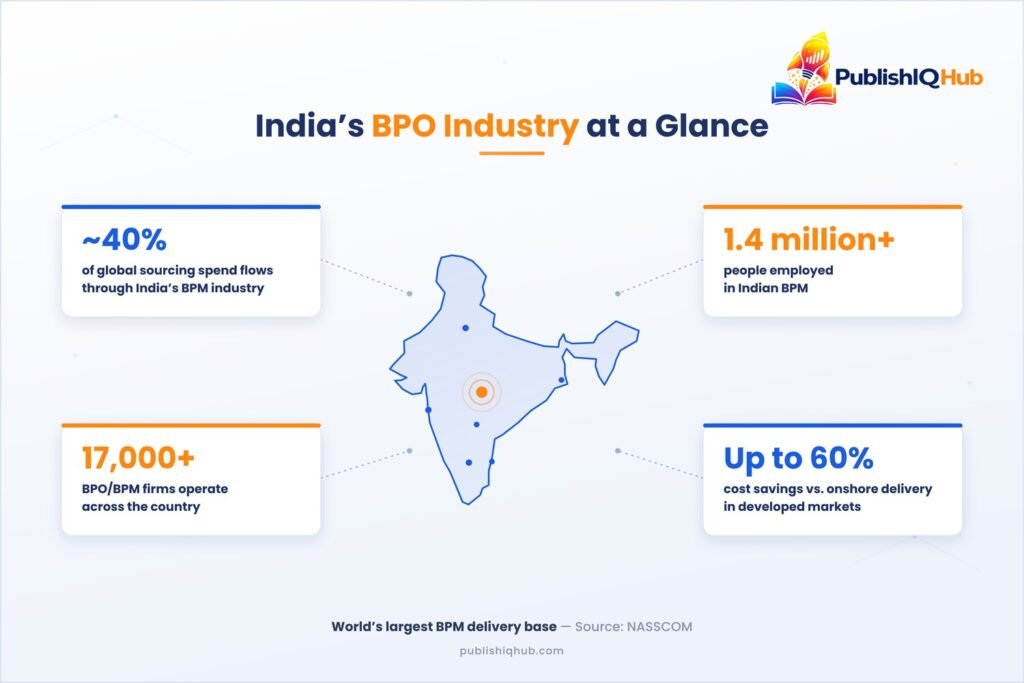
India’s business process management (BPM) industry accounts for nearly 40% of global sourcing spend (NASSCOM), making it the single largest BPM delivery base anywhere in the world. No other country comes close. The Philippines leads in voice-based customer support, sure, but for the full spectrum — finance and accounting, analytics, healthcare operations, legal services, HR outsourcing — India remains the default choice for global enterprises.
Three things keep that lead intact:
Talent depth. The sector directly employs more than 1.4 million people (NASSCOM, FY23), drawing from one of the world’s largest annual pools of graduates. When a client needs 500 trained insurance-claims processors in ninety days, Indian BPOs can actually deliver that. Very few markets can.
Cost arithmetic that still works. Even after two decades of wage inflation, Indian delivery offers cost savings of up to 60% compared to equivalent onshore teams in the US or UK (UJA Global Advisory). The savings have narrowed at the top of the skill pyramid, but for high-volume operational work, the math remains hard to argue with.
The move up the value chain. This is the part outsiders miss. The industry has spent ten years shifting from “we’ll do it cheaper” to “we’ll do it better.” Analytics, domain consulting, automation, and now generative AI are baked into most large contracts. Clients aren’t buying seats anymore; they’re buying outcomes.
With that context, here’s the list.
The Top 10 Indian BPO Companies, Ranked
A quick note on methodology: this ranking weighs revenue scale, global client base, service breadth, industry reputation, and momentum heading into 2026. “Indian BPO” here means companies founded in India or running their primary delivery operations from India — which is why a few NYSE-listed names appear.
Quick Comparison: Top Indian BPO Companies at a Glance
| Company | HQ / Listing | Revenue (approx.) | Employees (approx.) | Core Strengths & Verticals | Best For |
| Genpact | New York / NYSE (India delivery base) | $4.8B+ | 125,000+ | Finance & accounting, insurance ops, supply chain, agentic AI | Enterprise F&A and insurance operations at scale |
| TCS BPS | Mumbai / NSE, BSE | Part of TCS ($30B+) | 600,000+ (TCS overall) | Banking & insurance platforms (BaNCS), healthcare, retail, government | IT + operations from one accountable partner |
| Infosys BPM | Bengaluru / Infosys subsidiary (NSE, NYSE) | Part of Infosys ($19B+) | 55,000+ | F&A, procurement, customer service, AI-first digital ops (Topaz) | Digital-heavy back-office transformation |
| WNS Global Services | Mumbai & New York / NYSE (Capgemini deal announced) | $1.3B+ | 60,000+ | Travel, insurance, logistics, banking; analytics via WNS Triange | Deep domain expertise plus analytics |
| EXL Service | New York / NASDAQ (India delivery base) | ~$2B | 55,000+ | Insurance claims & underwriting, healthcare, data analytics & AI | Analytics-led work in regulated industries |
| Wipro | Bengaluru / NSE, NYSE | Part of Wipro ($10B+) | 230,000+ (overall) | CX, F&A, HR services, industry ops; flexible commercial models | BPO bundled into larger digital programmes |
| Tech Mahindra BPS | Pune / NSE, BSE | Part of Tech Mahindra (~$6B) | 40,000+ (BPS) | Customer experience, telecom, content moderation, trust & safety | Telecom, media & consumer CX at high volume |
| Firstsource Solutions | Mumbai / NSE, BSE (RPSG Group) | $800M+ | 30,000+ | US healthcare (RCM, payer/provider), BFSI, communications, media | US healthcare ops & mid-market BFSI |
| HGS | Bengaluru / NSE, BSE (Hinduja Group) | ~$500M | ~20,000 | Digital-first CX, back-office processing, automation & analytics | Multi-geography customer experience delivery |
| Conneqt Business Solutions | Bengaluru / Quess Corp company | ~$180M | 30,000+ | Domestic CX, collections, customer lifecycle, vernacular support | Serving Indian consumers at domestic scale |
Figures are approximate, based on latest publicly reported results; parent-company revenues shown where the BPO arm is not separately disclosed.
1. Genpact
Genpact is where the modern Indian BPO story begins. Born inside General Electric in 1997 as GECIS and spun out in 2005, it essentially wrote the playbook for offshore finance and accounting. Today it’s a NYSE-listed firm with revenues north of $4.8 billion, over 125,000 employees, and clients across banking, insurance, manufacturing, and consumer goods.
What sets Genpact apart is process depth. Its Lean Six Sigma DNA (inherited from GE) means it doesn’t just run your accounts payable — it re-engineers it. In recent years the company has repositioned hard around data and AI, and its “agentic AI” solutions for finance operations are among the most mature in the industry.
Best for: Large enterprises outsourcing finance & accounting, supply chain, or insurance operations at scale.
2. TCS BPS (Tata Consultancy Services)
TCS is India’s largest IT services company, and its Business Process Services arm is a giant hiding inside a bigger giant. BPS contributes a meaningful slice of TCS’s $30 billion-plus revenue and serves clients across banking, insurance, healthcare, retail, and government — including some of the largest platform-based deals in the industry, like running life insurance policy administration for UK insurers on its BaNCS platform.
The TCS advantage is integration. If you want your technology stack and your business operations handled by one accountable partner, few firms on earth can match it. The Tata brand also carries weight in boardrooms where risk-averse buyers need a safe pair of hands.
Best for: Enterprises wanting IT + operations under one roof, and platform-based BPaaS deals.
3. Infosys BPM
Infosys BPM (formerly Infosys BPO) is the business process arm of Infosys, operating as a wholly owned subsidiary since 2002. With 55,000+ employees across delivery centres in India, Poland, Costa Rica, the Philippines and beyond, it handles finance and accounting, sourcing and procurement, customer service, and digital operations for global clients.
Its calling card is “AI-first” operations — the company has aggressively folded Infosys Topaz (the parent firm’s AI suite) into BPM delivery. Clients like it for the same reason they like TCS: the comfort of a large, listed, well-governed parent, plus genuinely strong process consulting.
Best for: Mid-to-large enterprises seeking digital-heavy back-office transformation with strong governance.
3. Infosys BPM
Infosys BPM (formerly Infosys BPO) is the business process arm of Infosys, operating as a wholly owned subsidiary since 2002. With 55,000+ employees across delivery centres in India, Poland, Costa Rica, the Philippines and beyond, it handles finance and accounting, sourcing and procurement, customer service, and digital operations for global clients.
Its calling card is “AI-first” operations — the company has aggressively folded Infosys Topaz (the parent firm’s AI suite) into BPM delivery. Clients like it for the same reason they like TCS: the comfort of a large, listed, well-governed parent, plus genuinely strong process consulting.
Best for: Mid-to-large enterprises seeking digital-heavy back-office transformation with strong governance.
4. WNS Global Services
WNS started life as a British Airways captive in Mumbai in 1996 and grew into one of the purest BPM plays on the market — travel, insurance, healthcare, banking, shipping and logistics, with deep analytics capability through WNS Triange. Revenue sits around the $1.3 billion mark with 60,000+ employees.
The big 2025 headline: Capgemini announced a $3.3 billion agreement to acquire WNS, a deal aimed at building a global leader in agentic AI-powered “intelligent operations.” For clients, that likely means WNS’s domain depth backed by Capgemini’s global consulting muscle. Watch this space — the combined entity could reshuffle the top of this list.
Best for: Travel, insurance, and logistics firms wanting deep domain expertise plus analytics.
5. EXL Service
EXL is the quiet overachiever of Indian-heritage BPOs. Founded in 1999, headquartered in New York, NASDAQ-listed, with the bulk of delivery from India — EXL bet early and heavily on data analytics, and that bet paid off. Roughly half its business now comes from analytics and AI-led services rather than traditional operations, with revenues approaching $2 billion.
Insurance is its fortress vertical: claims, underwriting support, actuarial services. If your problem involves messy data and a regulated industry, EXL is probably already on your shortlist. Its growth rate has consistently outpaced the industry, which tells you the market agrees.
Best for: Insurance, healthcare, and banking clients where analytics drives the value.
6. Wipro
Wipro’s BPO journey includes one of the industry’s landmark acquisitions — Spectramind, back in 2002 — and today its business process capabilities sit inside a $10 billion-plus IT services giant. Wipro delivers customer experience, finance and accounting, HR services, and industry-specific operations across 60+ delivery centres worldwide.
Wipro’s strength is flexibility: it’s large enough to handle mega-deals but historically more willing than its biggest rivals to structure creative, outcome-linked commercial models. Its FullStride cloud and AI investments increasingly show up inside operations contracts too.
Best for: Enterprises bundling business process work into larger digital transformation programmes.
7. Tech Mahindra Business Process Services
Tech Mahindra BPS runs one of the largest customer experience operations out of India, with a legacy strength in telecom (its parent’s home turf) that has expanded into banking, healthcare, retail, and hi-tech. Think 40,000+ BPS employees across 30+ locations, handling everything from contact centres to content moderation and trust-and-safety work.
The firm has pushed hard on CX transformation — blending human agents with conversational AI — and its telecom heritage makes it unusually good at complex, high-volume consumer operations.
Best for: Telecom, media, and consumer brands with large customer-experience needs.
8. Firstsource Solutions
Part of the RP-Sanjiv Goenka Group, Firstsource is a Mumbai-headquartered, NSE-listed firm with revenues around the $800 million-plus range and a sharply focused playbook: healthcare (payers and providers), banking and financial services, communications, and media. Its US healthcare business — claims processing, revenue cycle management, member services — is the crown jewel.
Firstsource has been one of the faster-growing mid-tier players, winning wallet share from bigger rivals by being more nimble and more willing to co-invest in client outcomes.
Best for: US healthcare organisations and mid-market BFSI firms wanting a focused, agile partner.
9. Hinduja Global Solutions (HGS)
HGS, part of the Hinduja Group, built its name in customer experience management — contact centres, back-office processing, and digital CX across healthcare, consumer brands, telecom, and the public sector. After selling its large healthcare services business to Baring PE Asia in 2022, HGS doubled down on digital-first CX, automation, and analytics.
It’s a leaner company than it once was, but with a global footprint (India, Philippines, US, UK, Canada, Colombia) and decades of CX pedigree, it remains a serious contender for customer-operations work.
Best for: Brands seeking experienced, multi-geography customer experience delivery.
10. Conneqt Business Solutions
Conneqt (a Quess Corp company, formerly Tata Business Support Services) is the domestic-market specialist on this list. With 30,000+ employees, it’s one of the largest BPO players serving Indian clients — banks, NBFCs, telecoms, e-commerce firms, and government bodies — across customer lifecycle management, collections, and digital services.
Why does that matter? Because India’s own domestic BPM market is booming as Indian enterprises adopt the same outsourcing logic global firms did twenty years ago. Conneqt is positioned squarely on that wave.
Best for: Companies targeting Indian consumers who need vernacular, domestic-scale support operations.
How to Choose Among the Top Indian BPO Companies
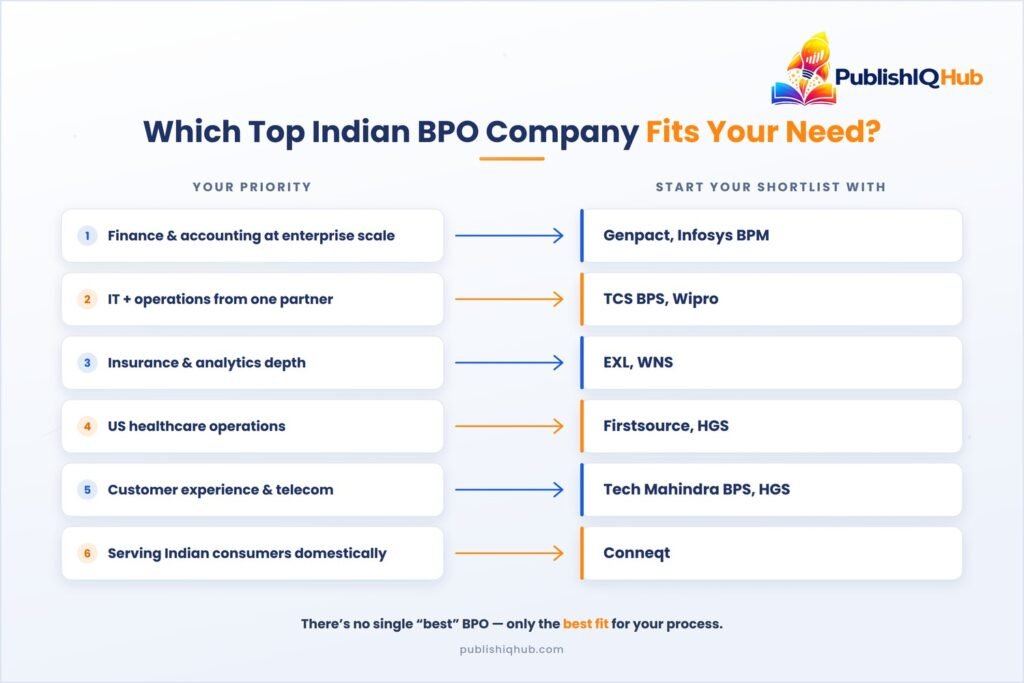
A ranked list is a starting point, not a decision. Having watched plenty of outsourcing deals succeed and fail, here’s what actually separates good partnerships from expensive regrets:
Match domain depth, not just size. A top-three giant with thin experience in your vertical will underperform a mid-tier specialist that has run your exact process a hundred times. Ask every shortlisted vendor: how many clients like us do you serve today, and can we speak to two of them?
Interrogate the AI story. Every vendor now claims “AI-powered operations.” Push past the slideware. Which processes have they actually automated, for whom, and what happened to cost and quality? The gap between AI marketing and AI delivery is wide, and this question exposes it quickly.
Look at commercial models. Traditional per-seat (FTE) pricing is giving way to transaction-based and outcome-based deals. Vendors confident in their delivery will put fees at risk against your KPIs. Vendors who won’t are telling you something.
Check attrition and continuity plans. BPO attrition in India can run high in voice-heavy work. Ask for attrition figures on accounts similar to yours, and how knowledge is retained when people leave.
Start narrow, then expand. The best outsourcing relationships usually begin with one well-defined process, prove value in six to nine months, and grow from there. Be wary of any pitch that pushes a sprawling multi-tower deal on day one.
Where the Industry Is Headed in 2026
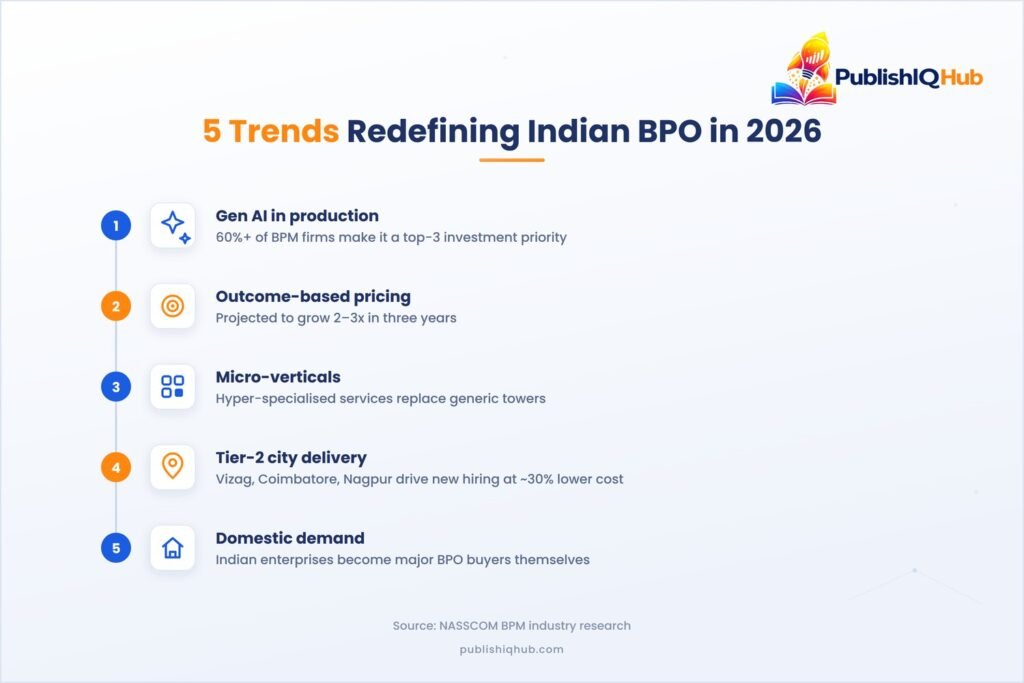
Three shifts are reshaping every company on this list — and they should shape your vendor conversations too.
Generative AI moves from pilots to production. This is no longer optional experimentation. Over 60% of BPM organisations rank generative AI as a top investment priority for the next three years (NASSCOM), and nearly half plan to put more than 12% of BPM revenue into technology. The practical upshot for buyers: contracts are being rewritten around “human + AI” delivery, and pricing is starting to reflect automation gains. If your vendor isn’t proactively passing some of those gains back to you, negotiate harder.
Outcome-based pricing goes mainstream. NASSCOM projects revenue from outcome-based models to grow two to three times over the next three years. The FTE-count era is winding down.
Micro-verticals are the new battleground. Instead of generic “healthcare BPO,” vendors now build sharply specialised offerings — revenue cycle management, fraud detection, loan processing, e-commerce catalogue operations. Specialisation is where the margin (and the client value) lives.
None of this means the “top companies” list becomes irrelevant. Scale still matters — for security certifications, business continuity, and global delivery footprints. But it does mean the smartest buyers evaluate vendors process by process, not logo by logo.
The Bottom Line
The top Indian BPO companies in 2026 aren’t competing on cost anymore — they’re competing on how intelligently they can run, automate, and transform your operations. Genpact, TCS BPS, and Infosys BPM anchor the top of the market with scale and process muscle. WNS and EXL bring unmatched domain-plus-analytics depth (with WNS’s Capgemini deal the story to watch). Wipro and Tech Mahindra bundle operations into broader digital plays, while Firstsource, HGS, and Conneqt prove that focused mid-tier players can outmanoeuvre giants in their chosen lanes.
Pick based on fit, pressure-test the AI claims, structure the deal around outcomes — and India’s BPM industry, four decades into its story, will still be the best operations decision most global businesses can make.
Frequently Asked Questions (FAQs)
Which is the No. 1 BPO company in India?
Genpact is widely regarded as the No. 1 Indian BPO company, with revenues above $4.8 billion, 125,000+ employees, and deep expertise in finance & accounting, insurance, and AI-led operations. That said, TCS BPS rivals it in scale when counted as part of TCS’s overall business.
What is the difference between BPO and BPM?
BPO (Business Process Outsourcing) traditionally referred to handling routine processes — customer support, data entry, payroll — for lower cost. BPM (Business Process Management) is the industry’s evolved form: it adds analytics, automation, consulting, and process transformation on top of execution. Most top Indian firms now describe themselves as BPM companies.
How big is the Indian BPO/BPM industry?
India’s BPM industry accounts for nearly 40% of global sourcing spend and employs more than 1.4 million people (NASSCOM), making India the world’s largest BPM delivery base. The broader IT-BPM sector generated an estimated $283 billion in FY25.
Why do global companies outsource to India?
Four reasons dominate: cost savings of up to 60% versus onshore delivery, a massive English-speaking talent pool, mature process and quality frameworks (ISO, Six Sigma, SOC 2), and 24/7 delivery enabled by the time-zone difference with the US and Europe. Increasingly, access to analytics and AI capability is a fifth reason.
Which Indian BPO is best for healthcare?
Firstsource Solutions and EXL lead in US healthcare — Firstsource in revenue cycle management and payer/provider operations, EXL in claims analytics and payment integrity. Genpact and Infosys BPM also run large healthcare operations practices.
Which BPO companies are best for customer support in India?
For global customer experience work, Tech Mahindra BPS, HGS, and Firstsource are strong choices. For supporting Indian consumers in regional languages at domestic scale, Conneqt Business Solutions is the standout.
Is the BPO industry in India dying because of AI?
No — but it is transforming fast. Routine, rules-based tasks are being automated, while demand grows for judgment-heavy work, analytics, and AI-supervised operations. Over 60% of Indian BPM firms rank generative AI as a top investment priority (NASSCOM), and industry revenue continues to grow. Roles are changing more than they’re disappearing.
How do I choose the right BPO partner from this list?
Shortlist by vertical expertise first, then evaluate proven AI/automation results, commercial flexibility (outcome-based pricing), data security certifications, and client references in your industry. Start with one well-defined process before scaling the relationship.