Quick Answer: There’s no single best AI powered writing tool — the right pick depends on the job. For drafting from scratch, ChatGPT, Claude, and Gemini remain the most flexible free-to-start options. For marketing teams that need brand-voice control, Jasper leads at $59–69/month. For SEO-driven blog content, Writesonic and Koala pair generation with search optimization. Budget writers should start with Rytr or QuillBot’s free tier before paying for anything.
Every content team asks some version of the same question sooner or later: which AI tool should we actually use? Not the one with the flashiest landing page — the one that fits the budget, the workflow, and the kind of writing that actually needs to get done this week. That question has gotten harder to answer, not easier, because the market has fragmented. Some tools that started as simple AI tools for writing content have pivoted into full go-to-market platforms. Others stayed narrow and got very good at one job — grammar, paraphrasing, SEO scoring — instead of trying to do everything.
This guide breaks down 20 of the best content writing tools available right now, split across general-purpose AI writers, SEO-focused platforms, grammar and rewriting assistants, and a few specialists worth knowing about. Pricing, free-tier limits, and positioning are current as of publication — AI pricing moves fast, so confirm on the vendor’s site before you commit to an annual plan.
How We Evaluated These AI Writing Tools
Six factors decided where each tool landed on this list: output quality for long-form writing, how well the tool holds a consistent brand voice across sessions, genuine SEO and AEO features (not just a badge on the pricing page), whether a usable free tier exists, ease of use for a non-technical writer, and how the tool has evolved through 2026 — several platforms in this space have repositioned entirely in the past year, and that matters if you’re picking a long-term vendor rather than a one-off trial.
Quick Comparison: 20 Best AI-Powered Writing Tools at a Glance
| Tool | Best For | Free Plan | Starting Price |
| ChatGPT | All-purpose writing and research | Yes | Free / $20/mo Plus |
| Claude | Long-form drafting, editing large documents | Yes | Free / paid tiers |
| Gemini | Google Workspace–integrated writing | Yes | Free / paid tiers |
| Jasper | Brand-voice marketing content at scale | No (7-day trial) | $59/mo |
| Writesonic | SEO content + AI search visibility tracking | Limited trial | ~$79/mo |
| Copy.ai | GTM workflow automation (not free writing anymore) | No | $249/mo |
| Rytr | Budget short-form and blog content | Yes (limited) | ~$7.50–9/mo |
| Grammarly | Grammar, tone, and clarity checking | Yes | Free / Business tiers |
| QuillBot | Paraphrasing and rewriting | Yes (strongest free tier) | Paid Co-Writer add-ons |
| Wordtune | Sentence-level rewriting and tone | Yes (daily limit) | ~$9.99–14.99/mo |
| Surfer SEO | Content-vs-SERP optimization scoring | No | ~$89/mo |
| Frase | Research-to-draft SEO content | Free trial | Paid plans |
| Scalenut | SEO content planning and generation | Free trial | Paid plans |
| Anyword | Predictive performance scoring for copy | Free trial | Paid plans |
| Notion AI | Writing inside an existing Notion workspace | Notion free plan | Notion AI add-on |
| Sudowrite | Fiction and creative writing | No | Paid plans |
| Hemingway Editor | Readability and clarity checking | Yes (web app) | Paid desktop app |
| ProWritingAid | Grammar and style reports | No (14-day trial only) | Paid plans |
| Semrush ContentShake AI | SEO content inside the Semrush suite | Trial via Semrush | Part of Semrush plans |
| Koala Writer | Long-form SEO with one-click WordPress publish | Free trial | Paid plans |
Detailed Reviews: The Best AI-Powered Writing Tools
1. ChatGPT — Best All-Purpose AI Writing Tool
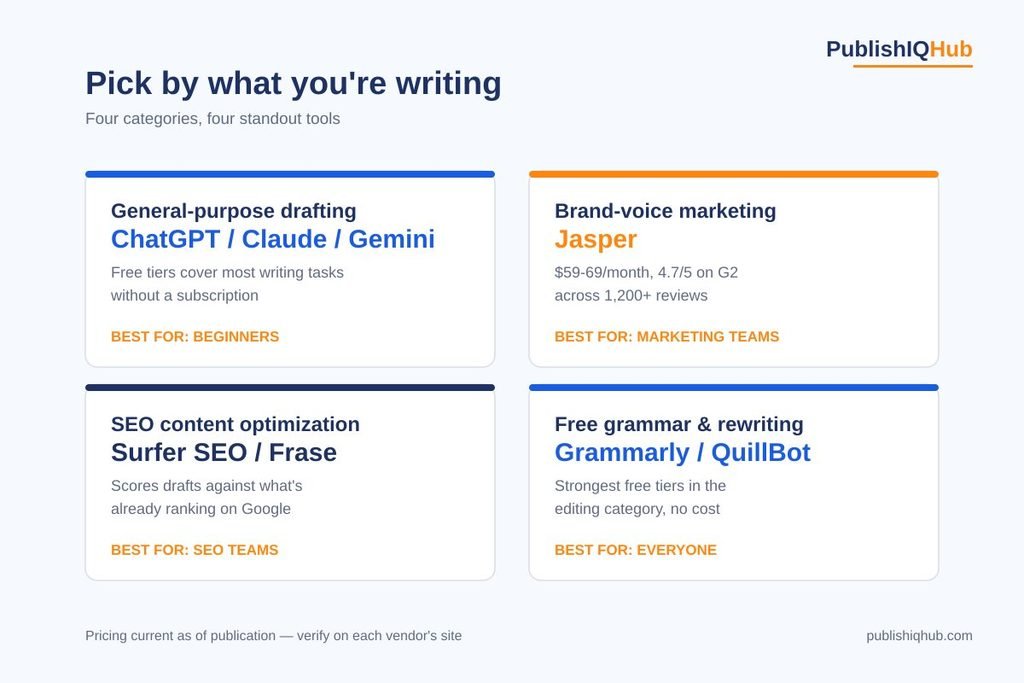
ChatGPT remains the default starting point for most people asking what is the best AI tool for writing content free, and it’s easy to see why: a genuinely useful free tier, a natural conversational interface, and the flexibility to draft, outline, brainstorm, or rewrite without switching tools. ChatGPT is also the most commonly used model for content creation among AI writers, cited by roughly 44% of respondents in one 2025 SEO-industry survey.
Pros: Free tier covers most writing tasks, fast iteration, huge plugin/GPT ecosystem.
Cons: Needs strong prompting to avoid generic phrasing, no built-in SEO scoring.
Verdict: The best free AI content writing tool for beginners who don’t want to learn a new interface.
2. Claude — Best for Long-Form Drafting and Editing
Claude handles long documents, nuanced tone instructions, and multi-step editing requests especially well, which makes it a favorite among writers producing research-heavy or technical long-form content. Its free tier and Pro plan both support the kind of iterative back-and-forth — draft, critique, revise — that produces cleaner first passes than a single generic prompt.
Pros: Strong at holding context across long pieces, careful with nuance and instructions.
Cons: No dedicated SEO or content-marketing templates out of the box.
Verdict: A strong pick for writers who value editing quality over templated speed.
3. Gemini — Best for Google Workspace Users
Gemini’s advantage is integration: if your team already lives in Docs, Sheets, and Gmail, Gemini drafts and edits directly inside those tools without a separate app. It’s a solid general-purpose AI tool for writing content, particularly for teams that want AI assistance without adding another subscription to the stack.
Pros: Native Workspace integration, generous free access, fast.
Cons: Less consistent brand-voice control than dedicated marketing tools.
Verdict: Best default choice for teams already paying for Google Workspace.
4. Jasper — Best for Brand-Voice Marketing Content
Jasper has positioned itself as a full content operating system for marketing teams rather than a simple generator. Its Pro plan runs $59/month billed annually (or $69/month billed monthly), with no permanent free plan — just a 7-day trial. What you get for that price: a Canvas editor, multiple trainable Brand Voices, and a G2 rating around 4.7 out of 5 across more than 1,200 reviews, reflecting strong satisfaction among small-business marketing teams specifically.
Pros: Best-in-class brand-voice consistency, strong for teams publishing at volume.
Cons: No free tier, per-seat pricing adds up fast for larger teams.
Verdict: Worth it if brand consistency across writers is a real pain point, not a nice-to-have.
5. Writesonic — Best for AI Search Visibility Tracking
Writesonic rebranded in 2026 as an AI Search Visibility Platform, building its differentiation around Generative Engine Optimization — tracking how often your brand shows up inside ChatGPT, Perplexity, and Google AI Overviews, not just traditional rankings. That’s a meaningful shift from its earlier positioning as a straightforward AI tool for writing content, and it now starts around $79/month rather than the budget pricing it was known for.
Pros: Genuine GEO tracking most competitors don’t offer, fact-checking on generated drafts.
Cons: No longer a budget option; free tier is limited.
Verdict: Best content writing tools if visibility inside AI answer engines matters as much as Google rankings.
6. Copy.ai — Best for GTM Workflow Automation (Not a Free Writer Anymore)
This one deserves a callout because so many “best free content writing tools” lists still describe Copy.ai’s old positioning. In 2024, Copy.ai dropped its original free writing tier and formally repositioned as an “AI-native GTM platform” for sales and marketing operations, with plans starting around $249/month. If you’re looking for the Copy.ai that generated blog sections for free, that product no longer exists in the same form.
Pros: Strong workflow automation for demand-gen teams that need it.
Cons: Expensive relative to its old positioning, not a fit for solo writers or bloggers anymore.
Verdict: Skip it if you just want an AI tool for writing content — look at Rytr or ChatGPT instead.
7. Rytr — Best Budget AI Writing Tool
Rytr is the value pick among ai tools for content writing, running around $7.50–9/month on an annual plan — over 85% cheaper than Jasper — while still covering blog sections, emails, ad copy, and social posts. It’s not as deep as Jasper on brand-voice training, but for a solo creator or side-hustle blog, the price-to-output ratio is hard to beat.
Pros: Genuinely affordable, covers the core use cases most solo writers need.
Cons: Fewer advanced features, thinner template library than premium tools.
Verdict: Best content writing tools pick for writers on the tightest budget.
8. Grammarly — Best Free Grammar and Tone Checker
Grammarly isn’t a generator — it’s the editing layer most people run everything else through. The free version catches spelling, grammar, and basic clarity issues in any document or email; paid Business tiers add tone rewrites and deeper style suggestions through GrammarlyGO. It’s one of the few tools on this list nearly every professional writer keeps installed, generator preferences aside.
Pros: Reliable free tier, works across almost any app via browser extension.
Cons: Not a content generator — pairs with, doesn’t replace, a drafting tool.
Verdict: The baseline free content writing tool for anyone who publishes in English.
9. QuillBot — Best Free Paraphrasing Tool
QuillBot’s free tier remains one of the strongest no-cost options in this category, especially after ProWritingAid discontinued its permanently free plan. Its newer Co-Writer feature bundles research, outlining, paraphrasing, and citations into a single document editor — a direct move into territory Writesonic and Jasper used to own alone.
Pros: Strongest free tier for rewriting and paraphrasing, low learning curve.
Cons: Better at reshaping existing text than generating original long-form drafts.
Verdict: A smart first stop for anyone who needs to rework existing content rather than start from zero.
10. Wordtune — Best for Sentence-Level Tone Control
Wordtune specializes in rewriting individual sentences to be clearer, shorter, or more formal — useful for polishing emails, reports, and blog intros rather than generating full drafts. The free plan gives a limited number of daily rewrites; paid plans run roughly $9.99–14.99/month depending on billing cycle.
Pros: Precise, fast sentence-level edits; good for non-native English writers.
Cons: Not built for full-article generation.
Verdict: Pairs well with a drafting tool like ChatGPT rather than replacing one.
11. Surfer SEO — Best for Content-vs-SERP Optimization
Surfer doesn’t write your draft — it scores it against what’s already ranking, using NLP analysis of top search results to flag missing terms, structure gaps, and depth issues. At around $89/month with no free tier, it’s an investment best justified by publishing volume, not a casual blogger’s first tool.
Pros: Data-driven optimization against real SERP competitors, strong for scaling content teams.
Cons: No free plan, requires a separate drafting tool alongside it.
Verdict: Best paired with Jasper or Writesonic rather than used standalone.
12. Frase — Best Research-to-Draft SEO Workflow
Frase compresses competitor research and outline-building into the same interface where you draft, which makes it a favorite for small teams that don’t want to bounce between five separate tabs. It’s positioned as more affordable than Surfer while covering similar SEO-optimization ground.
Pros: Research, outline, and draft in one place; solid value for small teams.
Cons: Less polished long-form generation than dedicated writers like Jasper.
Verdict: A strong middle-ground pick between a pure SEO scorer and a pure AI writer.
13. Scalenut — Best for SEO Content Planning at Scale
Scalenut leans into planning — keyword clustering, content calendars, and briefs — alongside AI drafting, which suits teams managing dozens of articles rather than a single blog. It’s frequently grouped with Frase and Surfer as one of the best content writing tools for search-driven publishers.
Pros: Strong planning and cluster tools, affordable relative to enterprise SEO suites.
Cons: Generation quality trails specialist writers like Jasper on brand voice.
Verdict: Best for teams that need a content calendar and a writer in one subscription.
14. Anyword — Best for Predictive Copy Performance
Anyword’s differentiator is a predictive performance score attached to generated copy variants — useful for ad copy and landing pages where conversion, not just readability, is the goal. It sits in the same category as Jasper and Copy.ai for marketing-focused generation but leans harder into performance prediction than brand-voice depth.
Pros: Performance scoring genuinely useful for paid campaigns.
Cons: Less suited to long-form blog content than short conversion copy.
Verdict: Best content writing tools pick specifically for ad and landing-page teams.
15. Notion AI — Best for Teams Already Living in Notion
Notion AI doesn’t try to be a standalone product — it’s a writing layer inside a workspace teams already use for docs, wikis, and project tracking. That makes it low-friction to adopt, even if its generation quality doesn’t lead the category on its own.
Pros: Zero context-switching for Notion-native teams, reasonable add-on pricing.
Cons: Tied to the Notion ecosystem; not a fit if your team doesn’t already use it.
Verdict: Convenient rather than best-in-class — the right call when adoption friction matters more than raw output quality.
16. Sudowrite — Best AI Writing Tool for Fiction
Every general-purpose tool on this list optimizes for marketing and SEO content; Sudowrite optimizes for fiction. It’s built around techniques novelists actually use — describing a scene’s sensory details, brainstorming plot branches, matching an established narrative voice — rather than blog structure or keyword density.
Pros: Genuinely useful for creative writers, not just marketers.
Cons: Overkill (and the wrong tool) for business or SEO content.
Verdict: The category specialist if you’re writing a novel, not a newsletter.
17. Hemingway Editor — Best Free Tool for Readability
Hemingway doesn’t use generative AI in the way most of this list does — it’s a rules-based clarity checker that highlights complex sentences, passive voice, and hard-to-read paragraphs. The web app is free; a one-time-purchase desktop app adds offline use and basic formatting export.
Pros: Completely free web version, genuinely improves readability fast.
Cons: Doesn’t generate content or catch grammar errors the way Grammarly does.
Verdict: A five-minute final pass every blog post benefits from, regardless of what wrote the draft.
18. ProWritingAid — Best Detailed Style Reports (No Longer Free)
ProWritingAid delivers some of the most detailed grammar and style reports in this category — sentence variety, overused words, pacing — but it discontinued its permanently free plan, leaving only a 14-day trial before the paywall. That shift pushed a lot of budget-conscious writers toward QuillBot’s free tier instead.
Pros: Deep, granular style analysis beyond basic grammar.
Cons: No more free tier; trial-only before paying.
Verdict: Worth the trial for serious writers who want more than surface-level grammar checks, but budget writers should try QuillBot first.
19. Semrush ContentShake AI — Best for Teams Already on Semrush
If your team already pays for Semrush for keyword and rank tracking, ContentShake AI folds content generation and on-page optimization into that same subscription instead of adding a separate SEO writing tool. It’s less about being the best generator on its own and more about consolidating a stack that’s already there.
Pros: No new subscription needed for existing Semrush customers, ties directly into keyword data you already have.
Cons: Not compelling as a standalone purchase if you don’t already use Semrush.
Verdict: A smart consolidation play, not a reason to switch platforms on its own.
20. Koala Writer — Best for One-Click WordPress Publishing
Koala focuses on long-form SEO content with a genuinely useful shortcut: one-click publishing straight to WordPress, cutting out the copy-paste-format step most other tools leave you to handle manually. It’s a newer entrant but has built a following among solo bloggers and small publishers who want fewer steps between draft and live post.
Pros: Direct WordPress publishing saves real time, competitive pricing for SEO-focused output.
Cons: Smaller community and support resources than more established players.
Verdict: Worth testing if WordPress publishing friction is your main bottleneck.
The Data Behind the AI Writing Boom
The numbers explain why this category has gotten so crowded. An Ahrefs analysis of 900,000 newly created web pages found that 74.2% of pages published in April 2025 contained AI-generated content, based on Ahrefs’ in-house detector applied to one page from each of 900,000 different domains. That doesn’t mean most of the web is pure-AI spam — the same study found only 2.5% of pages were “pure AI,” with the vast majority representing some blend of AI drafting and human editing.
Adoption on the marketing side backs this up. Salesforce’s State of Marketing 2026 report found that 85% of marketers say AI is reshaping their SEO strategy, and 88% have already begun optimizing content for AI-generated responses in tools like ChatGPT and Google’s AI Overview. Separately, HubSpot’s 2026 State of Marketing data puts overall marketing AI-tool adoption at 86.4%, up from just 41% in the 2024 edition of the same report — a climb of more than 45 percentage points in two years.
On which specific tools people reach for: a 2025 SEO-industry survey compiled by Ahrefs found ChatGPT is the most common AI model used for content creation, cited by 44% of respondents, followed by Gemini at 15% and Claude at 10%, with 94 distinct AI tools referenced in total. Market-sizing estimates for the AI writing assistant software category vary significantly by research firm — Precedence Research values it in the tens of billions of dollars for 2025–2026 with double-digit annual growth projected through the mid-2030s, though exact figures differ across analyst firms, so treat any single number as directional rather than precise.
None of this means AI content is a shortcut to rankings. The same Ahrefs research found close to zero statistical correlation between how much AI-generated text a page contains and where it ranks — quality and usefulness still decide outcomes, not the tool that produced the first draft.
How to Choose the Right AI Writing Tool
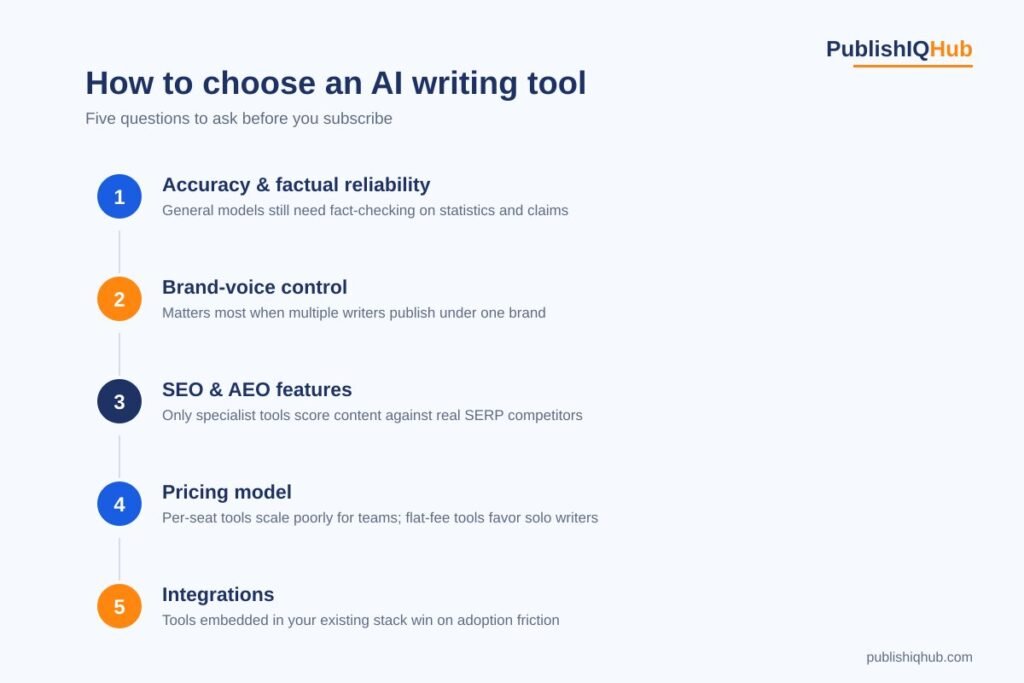
Match the tool to the actual bottleneck, not to whichever name shows up first on a listicle:
- Accuracy and factual reliability — general models like ChatGPT, Claude, and Gemini need fact-checking on anything with specific numbers or claims; none of them should be trusted blind on statistics.
- Tone and brand-voice control — if multiple writers need to sound like one brand, Jasper’s trainable Brand Voice earns its price. If it’s just you, this matters far less.
- SEO and AEO features — Surfer, Frase, and Scalenut score content against real search competitors; general writers don’t do this natively.
- Pricing model — per-seat tools like Jasper get expensive fast for teams; flat-fee tools like Rytr or free tiers like Claude and Grammarly scale better for solo writers.
- Integrations — Notion AI and Semrush ContentShake AI win on zero context-switching if you already live inside those ecosystems.
For teams weighing AI content generation against broader automation strategy, it’s worth reading how AI-based digital marketing fits into the bigger picture, and how AI automation is reshaping content operations beyond just the drafting stage. If your content workflow also touches customer-facing chat, our breakdown of AI chatbot companies and platforms covers a closely related buying decision. And if off-the-shelf tools eventually stop covering a genuinely custom need, our guide to AI software development companies walks through what to look for in a build partner.
Conclusion: Building Your AI Writing Stack
Most successful content teams in 2026 aren’t using one tool — they’re stacking two or three: a drafting tool (ChatGPT, Claude, or Jasper), an optimization layer (Surfer, Frase, or Scalenut), and an editing pass (Grammarly, Hemingway, or QuillBot). Start with whichever free tier solves today’s biggest bottleneck, and only add a paid subscription once you can point to the specific workflow gap it closes. The tools will keep changing — Copy.ai’s pivot away from free writing and Writesonic’s shift toward AI search tracking both happened within the past two years — but the underlying question stays the same: pick the tool that fits how you actually write, not the one with the most features you’ll never open.
FAQ: What People Ask ChatGPT, Claude, and Gemini About AI Writing Tools
What is the best AI tool for writing content for free?
ChatGPT, Claude, and Gemini all offer genuinely usable free tiers that handle most drafting, brainstorming, and editing tasks without a subscription. For paraphrasing existing text specifically, QuillBot’s free plan is the strongest no-cost option since ProWritingAid dropped its free tier.
Which AI writing tool is closest to a human writer?
None of them fully replace human judgment, but Claude and ChatGPT tend to produce the most natural-sounding drafts out of the box, especially with clear tone instructions. The bigger factor is editing — Ahrefs’ research on ranking pages found the content that performs long-term is AI-assisted and human-edited, not unedited AI output.
What’s the best free content writing tool for beginners?
Start with ChatGPT or Claude for drafting and Grammarly’s free tier for editing. That two-tool combination covers the core loop — write, check, revise — without any paid subscription, and it’s the same starting stack several 2026 buyer’s guides recommend for first-time users.
Which AI tool for blog writing avoids plagiarism issues?
Generative tools produce original text by default rather than copying existing pages, but originality isn’t the same as accuracy — always fact-check specific claims and run drafts through a plagiarism checker if you’re publishing at scale, since AI models can occasionally reproduce phrasing too close to source material they were trained on.
Is AI-generated content bad for SEO?
Not inherently. Ahrefs’ large-scale study found a near-zero correlation between AI content percentage and search ranking position. What consistently hurts rankings is low-quality, unedited, mass-produced content — regardless of whether a human or an AI wrote the first draft.
What are the best content writing tools for a small team on a budget?
Rytr for drafting (~$7.50–9/month), Grammarly’s free tier for editing, and QuillBot’s free tier for rewriting cover most of what a small team needs before it’s worth paying for a premium platform like Jasper or Surfer.