The conversational AI market has officially reached a critical turning point in 2026. While the previous year was defined by the novelty of chatting with machines, this year is about market share shifts and specialized execution. Recent data reveals that while ChatGPT remains a giant, its market dominance has dipped from 87% to roughly 68% in just 12 months, as companies like Google and Anthropic carved out specialized niches.
The global chatbot market is now projected to exceed $11.45 billion by the end of 2026, driven by a massive move toward “Agentic” systems- AI that doesn’t just talk, but executes complex tasks independently. Whether you are a developer seeking the best AI chatbot Companies for rapid prototyping or an executive evaluating enterprise chatbot solutions to automate 80% of your high-volume workflows, this guide breaks down the industry leaders defining 2026.
Top AI Chatbot Companies Shaping 2026
In 2026, the landscape is split between the “Model Builders” (the brains) and the “Solution Architects” (the builders).
- Google (The Challenger Surging Forward)
Google Gemini has been the breakout story of the year, capturing over 18% of the market share. Its surge is driven by its massive 2-million-token context window, allowing it to process entire libraries of technical manuals or hours of video in a single prompt. For enterprises, this means the ability to “upload your entire company history” and have an AI that understands every policy ever written.
Specialty: High-speed data retrieval, long-context reasoning, and deep integration with Google Workspace.
- Nurix AI (The Custom Enterprise Leader)
Nurix AI has emerged as the premier choice for organizations that need more than a “plug-and-play” solution. They build intelligent, cloud-native conversational ecosystems that handle the full AI lifecycle- from initial model selection to MLOps and continuous learning pipelines. Their “Private LLM” deployments are becoming the gold standard for data-sensitive firms.
Specialty: Scalable systems for Healthcare, Finance, and Enterprise SaaS.
- Anthropic (The Ethics & Reasoning Standard)
With the Claude 4.5 family, Anthropic has become the “go-to” for regulated industries. Their focus on “Constitutional AI” ensures that responses are ethically aligned and free from bias, making them a favorite for legal and medical applications where accuracy is a matter of compliance and safety.
Specialty: Deep reasoning, high-fidelity document analysis, and ethical guardrails.
- Master of Code Global (The Experience Architects)
For global brands needing end-to-end conversation design across voice and chat, Master of Code Global remains a dominant implementation partner. They specialize in reducing agent overhead for luxury retail and telecom by creating highly sophisticated, empathetic AI interactions that feel uniquely human.
Specialty: Certified Microsoft and LivePerson integrations for Fortune 500 brands.
- OpenAI (The Ecosystem Giant)
OpenAI continues to lead in general-purpose utility. By 2026, they have refined the GPT-5 series to focus on “Reasoning Loops,” allowing the bot to fact-check itself against multiple sources before providing a final answer. Their Custom GPT store has become a massive marketplace of over 5 million niche applications.
Best Chatbot Software for Rapid Growth
If you need the best chatbot software that allows for rapid deployment without a massive engineering team, these four platforms lead the 2026 rankings:
- Botpress: Known as the “developer’s favorite,” it offers a powerful visual flow editor combined with a generative AI engine. It is ideal for building autonomous business workflow agents that require high performance and precision.
- Tidio: The standard for e-commerce. Its “Lyro” AI resolves up to 70% of customer queries instantly, integrating natively with Shopify and Instagram to boost cart recovery and conversion rates.
- Zapier Central: A game-changer for internal operations. It allows you to build bots that act as “managers” for over 6,000 different apps, executing multi-step tasks like “Update my CRM when a lead books a meeting through a specific email thread.”
- Intercom (Fin): Intercom’s Fin AI has set the gold standard for “automated resolution.” By 2026, Fin can handle complex troubleshooting steps by simultaneously referencing help center articles and live website data, significantly reducing the “I don’t know” responses of the past.
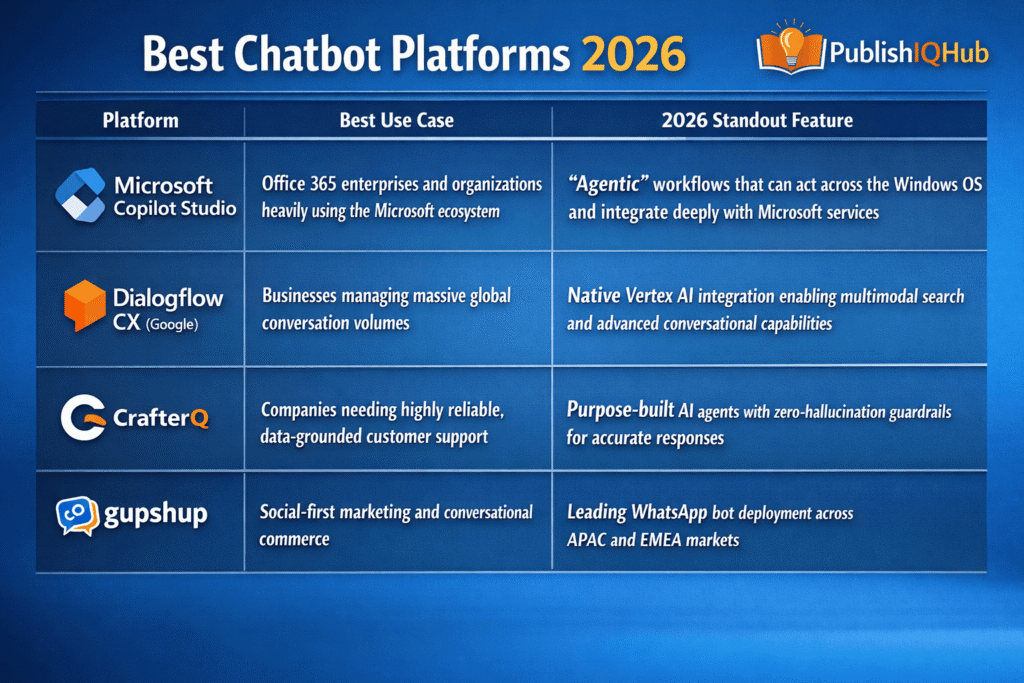
Best Chatbot Platforms: A Technical Comparison
Choosing the best chatbot platform requires a balance between standalone agility and ecosystem integration.
Disclaimer: The following list represents our curated selection of top-performing AI platforms based on 2026 security audits, API reliability, and verified user ROI.
Strategic Investment: The ROI of Enterprise AI in 2026
In 2026, forward-thinking organizations have moved away from viewing AI as a “cost center” and instead treat it as a high-yield digital asset. Strategic planning now focuses on the “Total Cost of Ownership” (TCO) and measurable efficiency gains.
The Value Drivers of Modern Implementation
The investment in enterprise chatbot solutions is typically influenced by four key architectural pillars:
- Data Maturity & Engineering: Organizations with “AI-ready” data architectures see significantly faster deployment cycles because their LLMs have clean sources to reference.
- Integration Complexity: Deep-linking a chatbot into legacy ERPs (SAP/Oracle) or CRMs (Salesforce) requires secure API orchestration.
- Human-in-the-Loop (HITL) Workflows: Successful solutions integrate seamless handoffs between AI and human agents to ensure brand voice consistency and emotional intelligence during escalations.
- Security & Compliance Overlays: For regulated industries, the investment includes robust “Zero-Retention” firewalls and custom encryption layers to meet global privacy standards.
The Future of Implementation: Multimodal and Proactive
The next frontier for enterprise chatbot solutions is “Proactive Multimodality.” Instead of waiting for a user to type a question, these systems use predictive analytics to identify a problem before it occurs. For example, a logistics bot might see a weather delay in a shipping route and proactively message the customer with an updated delivery time and a discount code—all without a human clicking a single button.
2026 ROI Benchmarks: Beyond Cost Savings
While labor cost reduction remains a factor, the real return on investment (ROI) in 2026 is measured by operational agility:
- Resolution Velocity: Leading enterprises report moving from a 40% resolution rate with older scripted bots to over 85% resolution with context-aware AI agents.
- Average Handling Time (AHT): Support cycles have dropped from an average of 10 minutes (human-led) to under 3 minutes (AI-orchestrated).
- Cost Avoidance: By automating 70-80% of routine Tier-1 inquiries, global firms are reporting a 50-70% reduction in support-related overhead.
Industry Insight: “The goal in 2026 is not to replace the human element, but to use AI to remove the ‘friction’ from the human experience. Organizations achieving the highest ROI are those that redesign their workflows around AI’s capabilities, not just layer AI over old processes.”
Conclusion: The Path Forward
The era of the “generic bot” is officially over. As the market for AI chatbot companies matures, the winners are those who move beyond simple conversation and into the realm of autonomous execution. Whether you choose the best chatbot platform for its flexibility or a custom enterprise chatbot solution for its security, the goal is the same: transforming your digital presence from a passive resource into an active, intelligent, and highly efficient digital workforce.
The shift from conversational to agentic AI is the defining trend of 2026. Keep following us for the latest deep dives into the tools and trends shaping our digital world.
Frequently Asked Questions (FAQs)
Who is the leading AI chatbot company in 2026?
While OpenAI leads in general awareness, Google Gemini is the fastest-growing challenger due to its massive context window. For implementation, Nurix AI and ScienceSoft lead the enterprise custom build market.
What is the difference between chatbot “software” and a “platform”?
Software (like Tidio) is a finished product for immediate use. A Platform (like Dialogflow or Botpress) is the infrastructure used to build, train, and customize a unique bot from scratch.
Are AI chatbots safe for my sensitive company data?
Yes, provided you use enterprise chatbot solutions. These versions are designed with strict data privacy “firewalls” and “Zero-Retention” modes that prevent your inputs from being used to train the general AI models.
How is ROI measured for AI chatbots in 2026?
ROI is primarily measured through Resolution Velocity (how many issues the bot solves without human help) and AHT (Average Handling Time), alongside long-term support cost avoidance and customer satisfaction (CSAT) scores.
Can these bots handle phone calls as well as text?
Yes. In 2026, the best platforms are multimodal, meaning the same “brain” powering your text chat can handle voice calls with near-human latency and emotional intelligence.
How long does it take to deploy a custom enterprise chatbot?
Simple SaaS software can be live in hours. However, a fully integrated enterprise chatbot solution linked to your CRM and ERP typically takes 8 to 12 weeks for a full production rollout.