
We have officially moved past the “shiny new toy” phase of artificial intelligence. Today, building an AI application isn’t just about plugging into an API and hoping for the best- it’s about architectural integrity and real-world utility. For most businesses, the challenge isn’t a lack of ideas; it’s the massive gap between a cool demo and a secure, production-grade system that actually moves the needle on the balance sheet.
This is where the right AI software development companies come in. They aren’t just vendors; they are the specialized architects who transform raw data and complex models into your most valuable business assets. If you’re feeling the pressure to move from “tinkering” to “integrating,” you’re exactly where you need to be.
Why Custom AI Engineering is Winning
The one-size-fits-all approach to software is dying. Recent industry analysis shows that the global AI software market is skyrocketing toward $386 billion, growing at a staggering 31.9% CAGR. This isn’t just hype; it’s a response to a very real need for precision.
According to Fortune Business Insights, the global IT outsourcing market has reached $638.65 billion, with custom software engineering growing at a 22.6% CAGR.
Real-World Productivity Gains
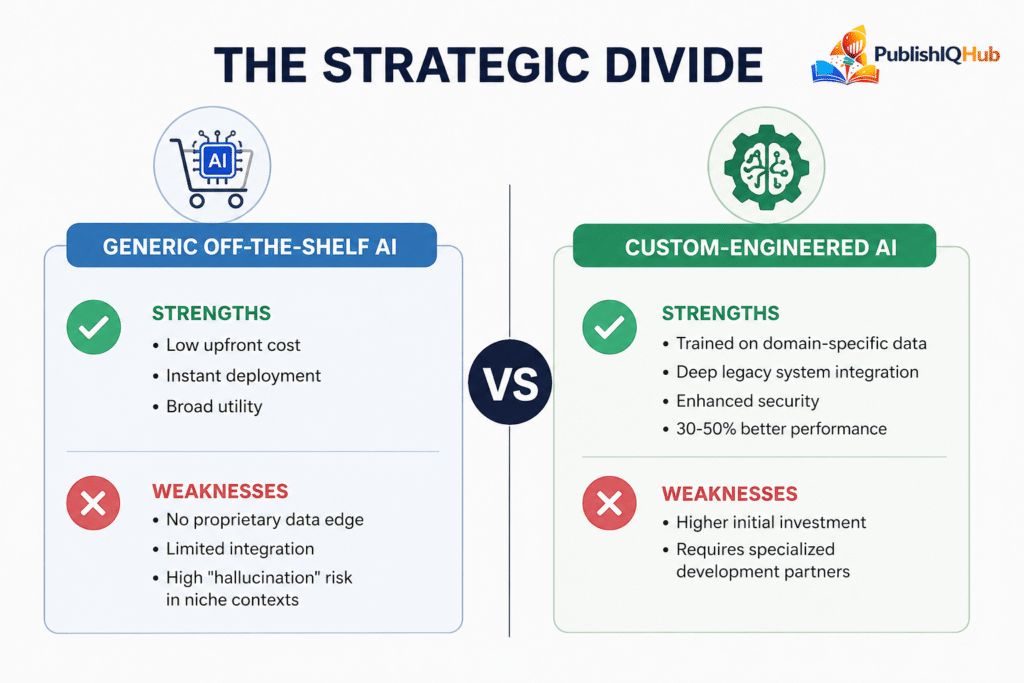
According to McKinsey’s latest Technology Trends Report, companies that have moved from generic tools to custom-engineered AI systems are seeing productivity leaps of 35% to 45%. More importantly, they’re cutting their time-to-market by nearly a third. Why? Because a custom model trained on your specific industry data outperforms a generic one every single time.
The Rise of the “Agentic” Workflow
We are no longer just building chatbots. We are building Agentic AI-autonomous systems that don’t just answer questions but actually execute multi-step tasks across your existing databases and apps. Whether it’s managing a complex supply chain or automating a 24/7 financial audit, these agents are becoming the new workforce of the digital age.
Leading the Charge: 15 Top AI Software Development Companies
The market has matured, and the “best” partners are now those who combine research-level depth with enterprise-level discipline. Here are 15 leaders currently setting the pace:
| Provider Name | Unique Strength | Best For | Considerations |
| Freshcode | GenAI & Prompt Engineering | Startups and SMBs | Ideal for rapid AI-native transitions |
| LeewayHertz | Private Generative AI Agents | Enterprise Security | Strong focus on secure, private AI platforms |
| STX Next | Python-Based AI Infrastructure | Cloud Consulting | Best suited for backend and data-heavy systems |
| HatchWorks AI | Agentic Automation Strategy | Large Transformation | Emphasis on ROI and data strategy alignment |
| deepsense.ai | MLOps & High-Complexity LLMs | Industrial & Financial Giants | Best for scaling complex AI solutions |
| Markovate | Regulatory-Compliant AI | Healthcare and Finance | Strong in regulated industries |
| 10Pearls | Product Engineering & Data | FinTech and HealthTech | Combines design with data science capabilities |
| Quytech | Mobile-First AI Integration | AR/VR & Consumer Apps | Strong in mobile + AI experiences |
| Tooploox | Research-Heavy Deep Learning | Commercializing R&D | Converts research into production-ready solutions |
| Master of Code Global | Conversational AI Orchestration | Global Customer Service | Expertise in multi-agent frameworks |
| MindK | RCM software development company, pre-built AI agents for eligibility, VoB, prior auth, and claims, agent-based product development | Healthcare providers and medical billing companies/MSOs building AI-native RCM systems | HIPAA-compliant; PHI anonymization; audit trails; 68,000+ claims/month; MVP to production in 4 months |
| Azumo | Legacy System Integration | Modernizing Old Stacks | Ideal for upgrading existing systems |
| Accenture | Responsible & Ethical AI | Fortune 500 Compliance | Strong focus on governance and compliance |
| SumatoSoft | Business Analysis & UX | Intuitive AI Tools | Focus on human-centered AI design |
| Itrex Group | Computer Vision & Video Analytics | Logistics and Retail | Best for visual AI and automation use cases |
| InData Labs | Big Data & Predictive Analytics | Predictive Solutions | Strong in advanced data-driven modeling |
Case Studies: AI in Action Across Industries
To truly understand the value of custom development, we have to look at the results. Here are three distinct ways AI is being utilized by leaders today.
1. Finance: The Rise of Autonomous Auditing
A mid-tier global bank was struggling with its manual reconciliation process. It took a team of 40 analysts nearly 10 days to close the books each month. By partnering with a specialized AI firm, they developed a Multi-Agent System (MAS) that operates 24/7. These agents “talk” to one another- one agent scans invoices for missing fields, while another cross-checks those fields against bank ledgers. The result? The “Continuous Close” was achieved, reducing reconciliation time by 90% and allowing analysts to focus on strategic capital allocation.
2. Healthcare: Diagnostic Precision
In oncology, time is the most valuable resource. A medical imaging company worked with custom developers to build a computer vision model that flags potential anomalies in lung scans. Unlike generic models, this one was fine-tuned on a private dataset of over 200,000 anonymized, high-resolution biopsies. The model achieved 97% accuracy in early detection, effectively serving as a “second set of eyes” for radiologists and reducing the diagnostic window from days to minutes.
3. Retail: Predictive Supply Chain Management
A global retailer faced a recurring problem: overstocking in some regions and stockouts in others. They built a custom predictive engine that pulls from over 50 data sources, including local weather patterns, social media sentiment, and historical logistics bottlenecks. By moving from reactive ordering to a proactive, AI-led supply chain, they reduced inventory waste by 22% and saw a 15% lift in quarterly revenue due to improved availability.
The Architecture of a Secure Enterprise AI System
Building for a hobby is one thing; building for an enterprise is another. When you hire an AI software development company, you are paying for an architecture that can withstand the scrutiny of a security audit.
1. Data Sovereignty and Confidential Computing
Top firms now utilize “Confidential Computing” environments. This ensures that your proprietary data-the “Golden Records” that give your company its edge- never leaves your secure cloud. Even during the training phase, data is encrypted both at rest and in transit (using AES-256 and TLS 1.3 standards).
2. Hybrid Cloud Strategy
While the cloud offers flexibility, many firms are opting for a hybrid approach. They keep their sensitive training data on-premises or in a private instance while leveraging the massive GPU compute power of the public cloud for the heavy lifting of model inference. This balance provides the best of both worlds: control and scale.
3. Robust Identity and Permission Management
AI workflows often depend on service accounts and API keys. If these are misconfigured, they create a massive “blast radius” for a potential hack. Professional developers implement Least-Privilege Access and Role-Based Access Control (RBAC) to ensure that an AI agent can only access the specific data it needs to perform its task, nothing more.
The Financial Reality: Cost Breakdown for AI Projects
In the current market, the price of intelligence has stabilized, but it remains a significant investment. Here is what you can expect to pay for custom AI software development:
| Project Type | Cost Range | Timeline |
| Proof of Concept (PoC) | $25,000 – $80,000 | 4 – 10 Weeks |
| Custom AI Feature / Chatbot | $60,000 – $180,000 | 2 – 4 Months |
| Agentic AI System | $150,000 – $450,000 | 4 – 8 Months |
| Full Enterprise AI Platform | $500,000 – $2M+ | 6 – 12 Months |
The Technical Backbone: A Modern AI Tech Stack
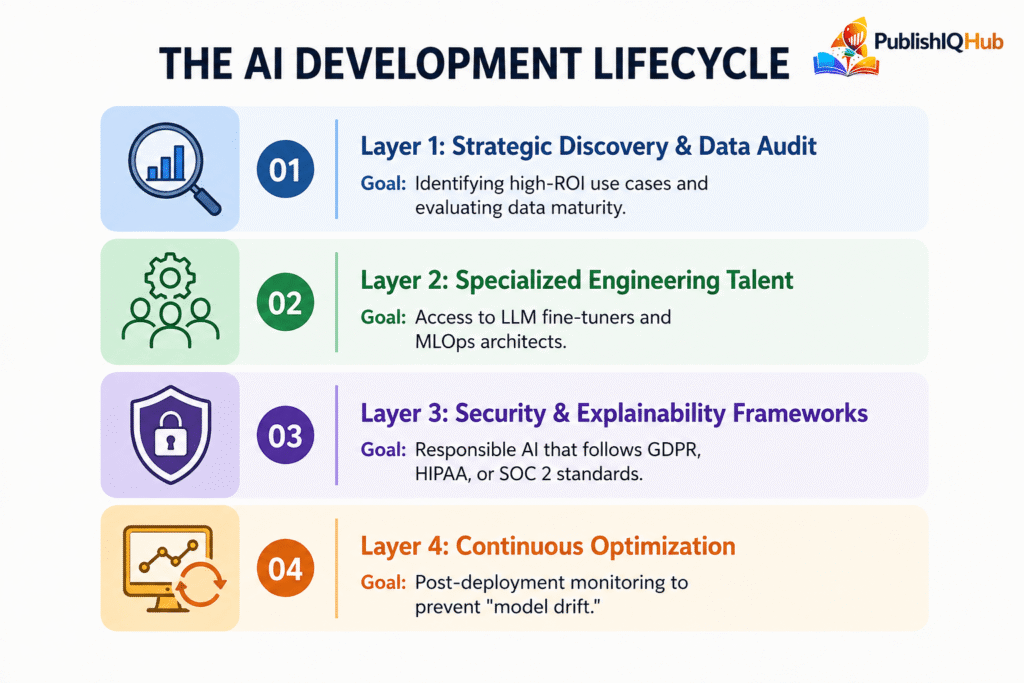
Understanding the “How” of your development partner requires a peek under the hood at the current tech stack. Leading firms no longer just write code; they orchestrate a complex ecosystem of specialized tools.
1. Foundation Models and LLM Selection
The choice between closed-source (OpenAI, Gemini) and open-weight models (Mistral, Llama 4) is a strategic one. High-end developers often use a Hybrid Model Strategy, using large models for complex reasoning and smaller, faster models for routine tasks to optimize latency and cost.
2. Vector Databases and RAG
Retrieval-Augmented Generation (RAG) is the gold standard for preventing hallucinations. This relies on vector databases such as Weaviate, Pinecone, or pgvector. These databases store your company’s knowledge as mathematical coordinates (embeddings), allowing the AI to “look up” facts in real-time before generating a response.
3. Orchestration and Agent Frameworks
To build systems that do things rather than just say things, developers use orchestration frameworks like LangChain, LlamaIndex, or Semantic Kernel. For more complex multi-step reasoning, they deploy agentic frameworks such as CrewAI or AutoGen, which allow multiple AI specialized “agents” to collaborate.
4. The MLOps Pipeline
Once a model is live, it needs a continuous monitoring loop. This involves tools for observability (like Arize or WhyLabs) to track Model Drift-the phenomenon where a model’s performance degrades over time as real-world data changes.
The Strategy Matrix: Build vs. Buy vs. Partner
One of the most frequent questions for any CTO is: “Should we build this in-house, buy a tool, or hire an agency?” The answer is rarely black and white.
- Build In-House
When to do it: If the AI is your core product or a unique strategic differentiator that you must own entirely.
The Cost: High ($400k+ avg. Year 1) due to hiring and infrastructure.
The Risk: High attrition in AI talent can leave your project stranded.
- Buy Off-the-Shelf
When to do it: For commoditized functions like basic customer support, generic email writing, or standard CRM automation.
The Cost: Low to medium (subscription-based).
The Risk: You have zero competitive advantage; your rivals are using the exact same tool.
- Partner with an AI-First Agency (The Hybrid Winner)
When to do it: When you need a custom, production-ready solution fast (3-6 months saved vs building in-house).
The Cost: Predictable ($60k-$150k for specific features).
The Risk: Lowest, provided you maintain ownership of the IP and Codebase. Most Series B+ companies now choose this path to bridge the talent gap while keeping control.
Navigating the Regulatory Minefield: AI Compliance
Compliance is no longer a “nice to have.” Significant portions of global regulations, like the EU AI Act, are coming into full effect, and standards like HIPAA (for health) and SOC 2 (for security) have evolved to include AI-specific requirements.
1. The EU AI Act Tiers
AI systems are now categorized by risk level. “High-risk” systems-those used in recruitment, credit scoring, or critical infrastructure-face strict transparency and human-oversight obligations. Your development partner must provide a detailed “AI-BOM” (Bill of Materials) and technical documentation that meets these standards.
2. Data Privacy (GDPR, HIPAA, CCPA)
Custom developers ensure that personal data is never used for training without explicit consent and that “Data Minimization” principles are built into the code. This prevents the nightmare scenario of an AI accidentally leaking sensitive customer information in a public-facing response.
3. Automated Auditing
The best firms integrate Compliance as Code. This means your CI/CD pipelines automatically scan for non-compliant model behaviors or data leaks before a new update is ever deployed to production.
Selecting the Right Partner: What Actually Matters?
With so many players in the AI software development industry, how do you spot the right one? The criteria have shifted from “Do they have AI?” to “How do they build it?”
- Can They Handle “LLMops”?
Deploying an AI model is easy; maintaining it is hard. You need a partner who understands LLMops (LLM Operations). This means they have systems in place to track model performance and automate retraining so the system gets smarter over time.
- Is “Responsible AI” Part of Their DNA?
Compliance is now non-negotiable. Your developer must be able to explain how the model makes decisions and demonstrate how they are controlling for bias. In regulated sectors like finance, “Because the AI said so” is not an acceptable answer to a regulator.
- Do They Start with “Discovery”?
If a firm gives you a quote before doing a deep-tissue audit of your data, walk away. The best AI software development companies spend weeks assessing your “AI readiness” before a single line of code is written.
The Future of the “Human + Agent” Workspace
As we look toward the next few years, the role of the worker is changing from a “doer” to an “orchestrator.” The most successful businesses will be those where humans and AI agents work in a seamless loop.
- Human-Led Strategy: Humans define the goals, ethics, and “edge cases” that require empathy or complex moral judgment.
- AI-Operated Tasks: Agents handle the data-intensive, repetitive, and high-speed tasks that would burn out a human team.
- Collaborative Refinement: The AI provides the options, and the human provides the “final mile” validation.
This isn’t about replacement; it’s about amplification. Companies using this model are reporting that 79% of their workers feel more empowered and effective in their roles.
Conclusion: Your AI Journey Starts with the Right Architects
Investing in AI software development companies isn’t just about modernizing your tech stack; it’s about future-proofing your business model. In an environment where things move at the speed of silicon, the winners aren’t just the ones with the most data-they’re the ones with the best systems to interpret it.
By finding a partner that understands the “Why What and How” of custom engineering, you’re moving beyond the hype and building a legacy of intelligence. The digital divide is real, and the right partner is the bridge that gets you to the other side.
The shift toward custom precision is happening now. Follow along with our weekly deep dives to make sure your organization stays on the right side of the divide.
Frequently Asked Questions
Does my team need to know how to code to manage this?
No. Most high-end developers build “low-code” or “no-code” interfaces for your internal team. This allows your business leaders to tweak agents and view insights without touching the backend code.
Is AI too risky for my regulated industry?
Not if you use a “Human-in-the-Loop” architecture. Custom developers build systems where the AI provides the data and options, but a human expert makes the final high-stakes decision.
How long until we see a return on investment (ROI)?
Most enterprise AI projects reach break-even within 18 to 36 months. However, “low-hanging fruit” projects-like automating repetitive customer support queries-can pay for themselves in under a year.
Can a developer work with my 15-year-old ERP system?
Yes. Modern AI firms specialize in building “wrappers” or integration layers that allow modern models to communicate with legacy systems via secure APIs.