
Quick Answer: The best AI tools for travel agencies in 2026 are Tern and Travefy for itinerary and client management, Tourwriter for tour operators, Layla, Mindtrip and Wanderlog as AI travel planner options, Smartvel and mTrip for white-label trip planners, Tidio for website chat, ChatGPT for research and writing, and Canva for marketing.
A client in London wants twelve days across Japan. Two kids, one vegetarian, a budget that keeps changing. Five years ago, that request meant an evening of tabs, spreadsheets and copy-paste. Today, an advisor with the right AI tools for travel agencies can have a branded draft ready before the client finishes their coffee.
That speed is no longer a nice extra. Your clients already use AI to plan. The real question is which tools earn a place in your workflow, and which are just noise.
Below are the 11 best AI tools for travel agents we think are worth a look, grouped by the job they do. Pricing was checked in November 2026; confirm before you buy.
Why Are AI Tools for Travel Agencies Taking Off Now?
Because travellers moved first, and agencies are catching up fast.
The shift on the traveller side has been sharp. According to Phocuswright’s 2026 report The AI Surge, 56% of US travellers used AI for planning, booking or in-destination help on at least one trip in the past 12 months, up from 43% in the second half of 2025 and 33% in the first half of 2025. Younger travellers lead: Phocuswright found 74% of millennials and 72% of Gen Z report using AI.
Those AI users are also valuable customers. The same research puts their median household income at $129,200, against $104,000 for non-users. Those are exactly the clients most agencies want to win.
Agencies are responding. The Amadeus Global Travel Agent Report 2026, based on a survey of 756 agents run between April and June 2026, found that more than three in four agents now say AI is part of their selling toolkit. Generative AI chat assistants such as ChatGPT, Gemini and Copilot are used by over half of agents, while automated fare search tools and AI itinerary suggestion platforms are each used by 29%.
Adoption isn’t uniform, though. In the Americas, 35% of agents still said they don’t use AI to support sales. On the business side, Phocuswright’s February 2026 research found that 61% of travel businesses surveyed are experimenting with or scaling agentic AI. And a TravelTech Show survey of 103 travel companies in April 2026 found 64% plan to increase AI investment over the next 12 months, with 21% expecting to double it.
The gap is real. Agencies that adopt AI tools for travel agencies now will quote faster than the ones that wait.
How Do Travel Agencies Actually Use AI Day to Day?
Mostly for the slow, repetitive work that sits between a client’s request and a confirmed booking.
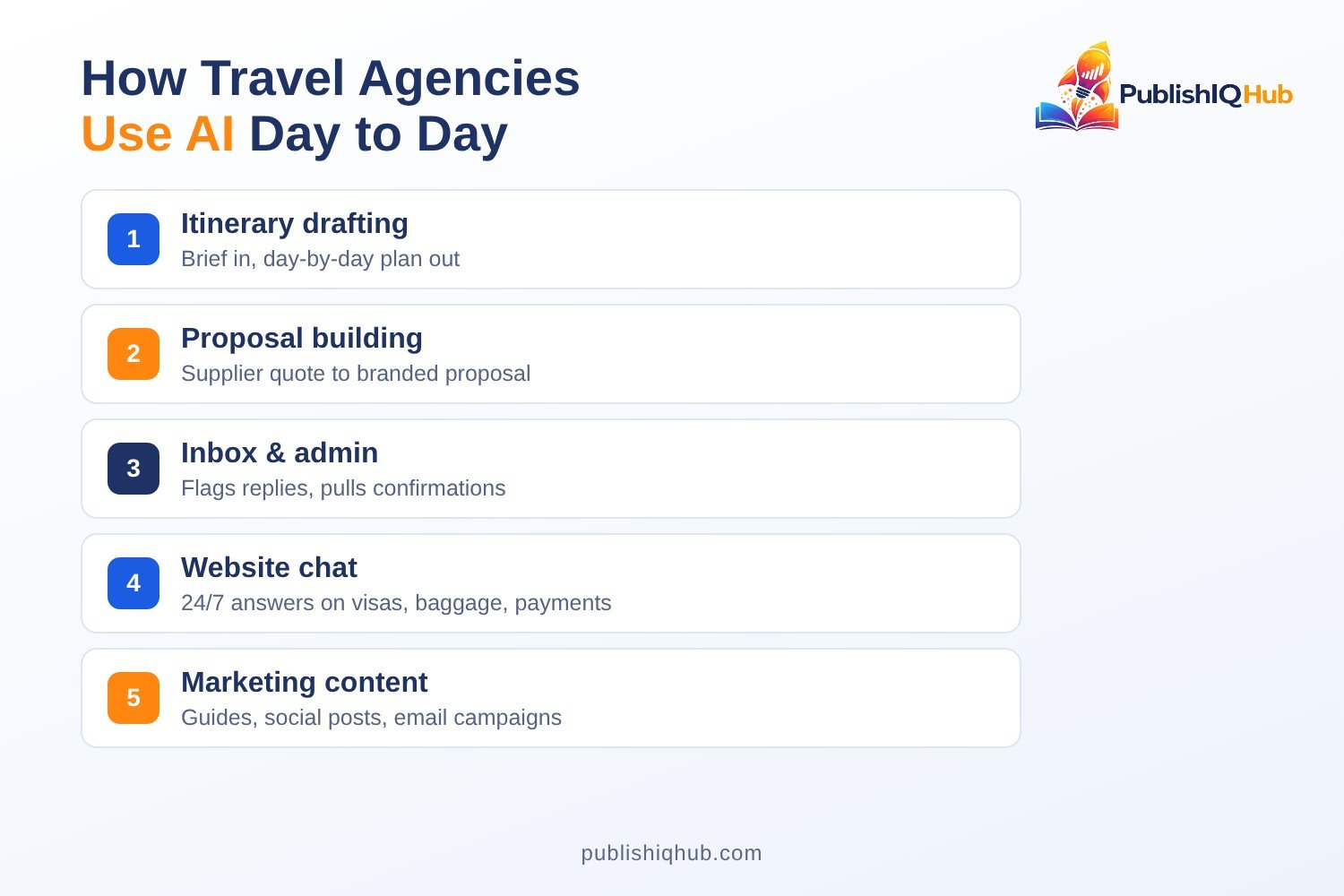
Here’s where AI tools for travel agencies tend to pay off first:
- Itinerary drafting. An AI itinerary generator turns a brief into a day-by-day plan you then refine.
- Proposal building. Paste a supplier quote, get a branded proposal in minutes.
- Inbox and admin. AI reads email threads, pulls out confirmation numbers and flags what needs a reply.
- Website chat. An AI chatbot for travel agency sites answers “Do I need a visa for Thailand?” at 2 a.m.
- Marketing content. Destination guides, social posts and email campaigns, drafted fast and edited by a human.
Picture a three-person agency in Dubai building a 10-day Europe itinerary for a family of five. AI won’t decide which Swiss rail pass makes sense. But an AI itinerary generator can cut the first draft from hours to minutes.
The 11 Best AI Tools for Travel Agencies in 2026
We’ve grouped these by job, because no single tool does everything well.
AI Travel Planner and Itinerary Tools
1. ChatGPT
- What it does: A general AI assistant that handles destination research, client emails, itinerary outlines and supplier comparisons.
- Best for: Solo advisors and small teams who need a flexible all-rounder.
- Key features: Conversational research, document and image uploads, custom GPTs, web search.
- Pricing: OpenAI’s plans include Free, Go at $8/month and Plus at $20/month (US prices; Go is priced locally in some markets).
- Agency use case: Paste a messy client WhatsApp thread and ask for a clean brief with dates, budget and must-haves.
One caution: general chatbots can invent opening hours or train times. Verify before anything reaches a client.
2. Layla
- What it does: A dedicated AI travel planner that builds day-by-day itineraries with flights, hotels and activities.
- Best for: Quick client-facing inspiration and price-aware drafts.
- Key features: Chat-based planning, live pricing, maps, booking links.
- Pricing: Free trip planning, with Premium at $49/year on Layla’s site for unlimited premium features.
- Agency use case: Generate three alternative routes for an undecided honeymoon couple, then build the winner properly in your agency platform.
3. Mindtrip
- What it does: An AI travel planner that builds trips from a prompt, a link or even a photo.
- Best for: Group trips and visual, inspiration-led planning.
- Key features: Real-time group planning with comments and likes, maps, reviews, personalised suggestions.
- Pricing: Free for travellers; Mindtrip earns through affiliate booking partnerships.
- Agency use case: Share a draft with a family group so everyone can react before you finalise.
4. Wanderlog
- What it does: A collaborative trip planner with an AI assistant layered on top.
- Best for: Detailed, map-heavy itineraries and road trips.
- Key features: Live collaboration, booking import, route optimisation, offline access on Pro.
- Pricing: Free tier with limited AI messages; Pro costs $39.99/year and adds unlimited AI help, route optimisation and offline access.
- Agency use case: Optimise the driving order for a self-drive New Zealand trip.
AI Travel Agent Software (All-in-One Platforms)
5. Tern
- What it does: AI travel agent software that replaces your CRM, itinerary builder, forms and back office, with an agentic AI assistant built in.
- Best for: Independent advisors and growing agencies, especially in North America.
- Key features: Its AI can read an advisor’s inbox and flag what needs attention, build cruise proposals and draft client messages, with nothing sent without the advisor’s approval.
- Pricing: About $35 per seat/month billed annually or $49 monthly, with AI included at basic usage and Tern Pro available for heavier use.
- Agency use case: Drop a cruise line quote into Tern and get a branded proposal in seconds.
6. Travefy
- What it does: One of the most widely used itinerary and proposal builders for travel professionals.
- Best for: Advisors who want polished, branded itineraries and a client mobile app.
- Key features: Drag-and-drop builder, CRM with automations, website builder, AI content import, white-label client app.
- Pricing: Core starts at $39 per user/month billed annually, or $49 monthly, with a free trial. Check the Travefy pricing page for current plans.
- Agency use case: Import supplier confirmations with AI and turn them into a client-ready itinerary.
7. Tourwriter
- What it does: End-to-end software for tour operators and DMCs building complex, multi-destination trips.
- Best for: Luxury and bespoke tour operators.
- Key features: Supplier and rates database, automatic pricing, live margin control, booking management.
- Pricing: The Starter plan is listed at $99 per user/month for up to 25 itineraries a year.
- Agency use case: A DMC in Bali can change a hotel in a 14-day trip and watch the quote and margin recalculate instantly.
White-Label Trip Planner AI Builder Tools
A trip planner AI builder puts an AI travel planner on your own website, under your brand. Most consumer apps like Layla and Mindtrip don’t offer reseller programmes, so you need B2B vendors.
8. Smartvel
- What it does: A white-label AI trip planner and itinerary builder for travel businesses.
- Best for: OTAs, tour operators and larger agencies wanting a branded planner.
- Key features: API or embeddable widget, custom branding, configurable content sources.
- Pricing: Quote-based; demos on request.
- Agency use case: Add a “Plan my trip” widget to your site so visitors build an itinerary that feeds straight into an enquiry.
9. mTrip
- What it does: White-label itinerary and mobile app software for travel agencies, used by 300+ agencies, DMCs and tour operators in 35+ countries.
- Best for: Mid-sized and large agencies that want their own branded app.
- Key features: AI import wizard, white-label on every channel, itinerary builder.
- Pricing: Quote-based.
- Agency use case: Give every client a branded app with documents and live updates.
AI Chatbot for Travel Agency Websites
10. Tidio (with Lyro AI)
- What it does: Live chat plus Lyro, an AI agent that answers customer questions from your own content.
- Best for: Small agencies wanting 24/7 website support without hiring.
- Key features: AI answers, live chat handover, help desk, social integrations.
- Pricing: A free plan with 50 one-time Lyro conversations; Starter is $24.17/month billed annually, and the Lyro AI add-on starts at $32.50/month. See Tidio’s pricing page for current tiers.
- Agency use case: Let Lyro handle visa, baggage and payment-deadline questions so advisors focus on selling.
For bigger teams, our guide to enterprise chatbot platforms compares heavier options.
Marketing and Content
11. Canva
- What it does: A design platform with an AI suite (Magic Studio) for social posts, brochures and destination graphics.
- Best for: Agencies without an in-house designer.
- Key features: AI design generation, brand kit, magic resize, background remover.
- Pricing: Free plan available; Canva Business is US$250/year per person on Canva’s site. Pro pricing varies by region.
- Agency use case: Turn one Maldives itinerary into an Instagram carousel, a story and a printable flyer in under an hour.
If visuals are a big part of your marketing, see our roundup of AI image generation tools, and for strategy, how AI in digital marketing is working in 2026.
AI Tools for Travel Agencies: Comparison Table
| Tool | Best For | Free Plan? | Starting Price | Ideal Agency Size |
|---|---|---|---|---|
| ChatGPT | Research and writing | Yes | $8/month (Go) | Any |
| Layla | AI travel planner drafts | Yes | $49/year | Solo to small |
| Mindtrip | Group and visual planning | Yes (free) | Free | Solo to small |
| Wanderlog | Map-heavy itineraries | Yes | $39.99/year | Solo to small |
| Tern | All-in-one advisor platform | Free trial | ~$35/seat/month (annual) | Solo to mid-size |
| Travefy | Branded itineraries | Free trial | $39/user/month (annual) | Solo to mid-size |
| Tourwriter | Tour operators and DMCs | Free trial | $99/user/month | Small to mid-size |
| Smartvel | White-label trip planner | No | Quote | Mid-size to enterprise |
| mTrip | Branded agency app | No | Quote | Mid-size to enterprise |
| Tidio + Lyro | Website AI chat | Yes | $24.17/month (annual) | Solo to mid-size |
| Canva | Marketing design | Yes | Varies by region | Any |
Trip Planner AI Free Options: What You Actually Get
Free tools are great for inspiration and first drafts, but they hit limits fast in agency work.
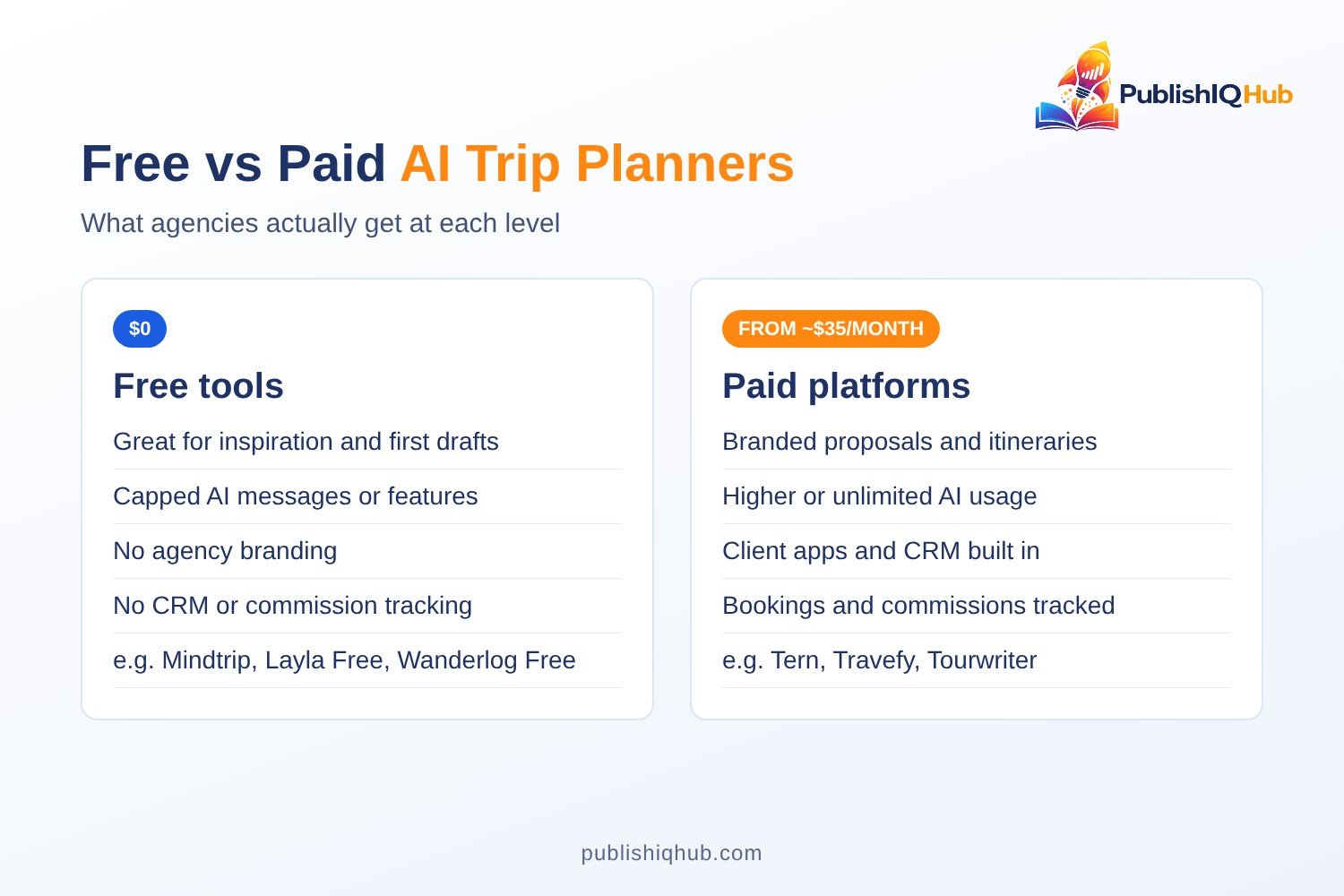
Searching for a trip planner AI free option makes sense when you’re testing. Here’s the honest picture:
- Mindtrip is free for travellers because it earns through booking partners.
- Layla lets you plan free, but unlimited premium features sit behind the $49/year plan.
- Wanderlog gives you a solid free planner, but the AI assistant is capped until you upgrade.
- ChatGPT Free handles brainstorming well, but with tighter usage limits than paid plans.
- Tidio’s 50 free Lyro conversations are a one-time allowance, not a monthly one.
The bigger issue isn’t price. Free consumer tools rarely carry your branding, don’t connect to your CRM, and don’t track commissions. A free AI trip planner is a sketchpad. Your agency platform is where the real work lives.
How to Choose the Right AI Tool for Your Travel Agency
Start with your biggest time drain, not the flashiest feature. Not every AI tool for travel agencies fits every business.
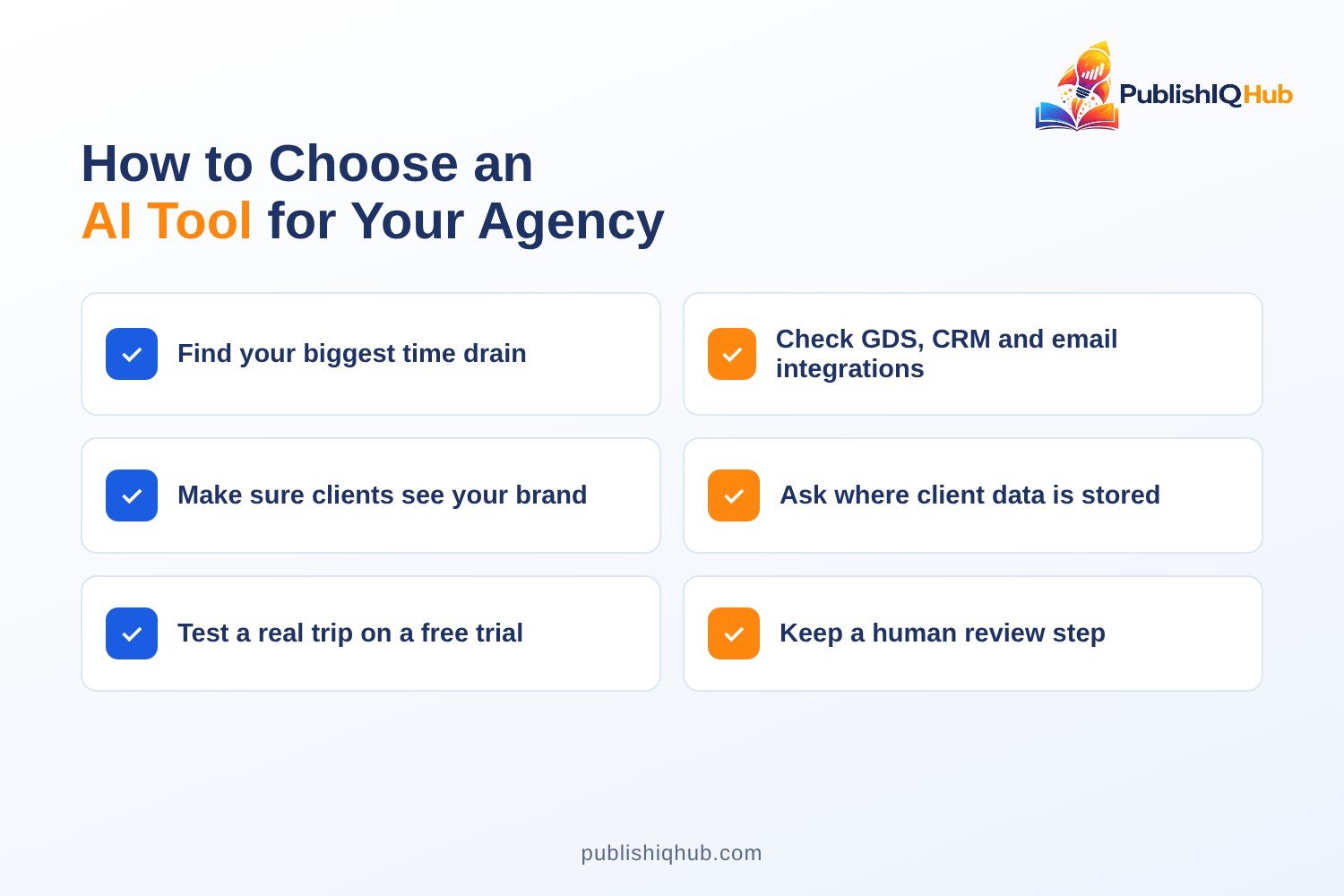
Use this quick checklist:
- Find the bottleneck. Is it itinerary building, email, website enquiries or marketing? Pick one.
- Check integrations. Does it connect with your GDS, CRM, booking tools and email?
- Look at branding. Will clients see your logo, or the vendor’s?
- Ask about data. Where is client data stored, and is it used to train models? This matters under GDPR in the UK and EU.
- Test with a real trip. Run a recent booking through a free trial and time it.
- Confirm human review. The best tools draft; your advisors approve.
- Do the maths. If a $49/month tool saves five hours a week, it pays for itself many times over.
Will AI Replace Travel Agents?
No, but it will separate agencies that use AI from those that don’t.
There’s a real tension here. Travellers are adopting AI quickly, yet trust is uneven. A 2025 YouGov survey found that 30% of US travellers felt comfortable using AI for trip planning, while 40% did not.
That gap is your opening. When a flight is cancelled in Singapore at midnight, people want a human who knows them. AI tools for travel agencies handle research and admin. Advisors handle judgement and relationships. Together, that’s a stronger offer.
For a wider view on how AI is reshaping jobs, see our analysis of AI’s impact on employment.
There’s a marketing angle too. More clients now discover agencies through AI search. Understanding how AI Mode in Google works can help your content show up when travellers ask an AI for help.
Final Thoughts
The best AI tools for travel agencies aren’t the ones with the longest feature lists. They’re the ones your team opens every morning. Start small: one AI travel planner for drafts, one platform for proposals, one chatbot. Measure the hours saved, then expand.
Want more practical guides on AI for business? Explore the latest posts on the PublishIQHub blog.
Frequently Asked Questions
What are the best AI tools for travel agents in 2026?
Strong picks include Tern and Travefy for itineraries and client management, Tourwriter for tour operators, and Layla or Mindtrip for quick drafts. Add Tidio for chat and Canva for marketing.
Is there a good trip planner AI free option for agencies?
Yes. Mindtrip is free, and Layla and Wanderlog have free tiers. A free AI trip planner works for first drafts, but branded proposals usually need a paid platform.
What is a trip planner AI builder?
It’s a white-label tool that puts an AI travel planner on your own website under your brand. Smartvel and mTrip are examples. Visitor itineraries can turn into enquiries for your agency.
Can ChatGPT plan a trip accurately?
ChatGPT can produce a solid outline in seconds, but it can get opening hours, transfer times or visa rules wrong. Treat it as a first draft and verify facts.
How are travel agencies using generative AI?
Agencies use it to draft itineraries, build proposals, answer website questions and create marketing content. Amadeus found more than three in four agents now use AI in their selling toolkit.
How much do AI tools for travel agencies cost?
Costs range from free (Mindtrip, free tiers of ChatGPT and Layla) to roughly $35–$99 per user per month for agency platforms like Tern, Travefy and Tourwriter. White-label planners are usually quote-based.