
Disclaimer: This article is for informational purposes only and does not constitute career, legal, or financial advice. Statistics are drawn from third-party sources as of the publication date and may change as new data is released. PublishIQHub is not affiliated with any of the organisations cited.
Quick Answer
The AI impact on employment so far is about reshaping work more than erasing it. The World Economic Forum expects 170 million jobs to be created and 92 million displaced by 2030, a net gain of 78 million. The pressure is uneven, though. Clerical roles and early-career workers in AI-exposed fields are feeling it first.
Every major technology shift arrives with a jobs scare. Spreadsheets were supposed to finish off accountants, and ATMs the bank teller. Neither happened, but both changed what those jobs looked like.
Generative AI feels different to many workers, and the numbers explain why. In January 2024, the International Monetary Fund estimated that almost 40% of global employment is exposed to AI, rising to about 60% in advanced economies. Exposure is not the same as job loss, which is why the question everyone asks, will AI replace jobs, needs a careful answer. Still, that reach is far wider than earlier waves of automation, which mostly touched factory floors.
By late 2026, the debate has moved past guesswork. Payroll records, hiring data and employer surveys now show where the AI impact on employment is real, where it has been overstated, and who is absorbing the early shocks. This guide on the impact of AI on future jobs brings together the most credible evidence, adds an India-specific view, and closes with practical steps for professionals who want to stay ahead.
What Does the Data Say About the AI Impact on Employment Right Now?
There is no economy-wide job collapse, but there is clear pressure on specific roles and age groups. Credible research finds AI changing tasks inside jobs far faster than it removes whole occupations.
The sharpest recent evidence on the AI impact on employment comes from Stanford. A working paper by Erik Brynjolfsson, Bharat Chandar and Ruyu Chen at the Stanford Digital Economy Lab, revised in August 2026 with ADP payroll data through June 2026, found that employment for workers aged 22 to 25 in AI-exposed occupations is 19% below where it would be had it kept pace with less-exposed peers. Experienced workers in the same occupations show no comparable gap.
The authors also found no evidence of widespread displacement across the US economy, and they call the results early warning signals rather than proof of cause.
The International Labour Organization reaches a similar view from a different direction. Its 2025 global index, built with Poland’s NASK, found that one in four jobs worldwide is potentially exposed to generative AI. In high-income countries, that share rises to 34%. The ILO’s conclusion is that most of these jobs will be transformed, not replaced, because many tasks still need a person in the loop.
So the effect of AI on employment today is best described as concentrated. It shows up in slower hiring for junior roles and in rewritten job descriptions. Across the wider AI impact on job market data, it has not yet shown up as mass unemployment.
AI Jobs Created vs Jobs Lost: Which Side Is Ahead?
On current projections, job creation outpaces job loss. The catch is that the people losing roles and the people gaining them are often not the same.
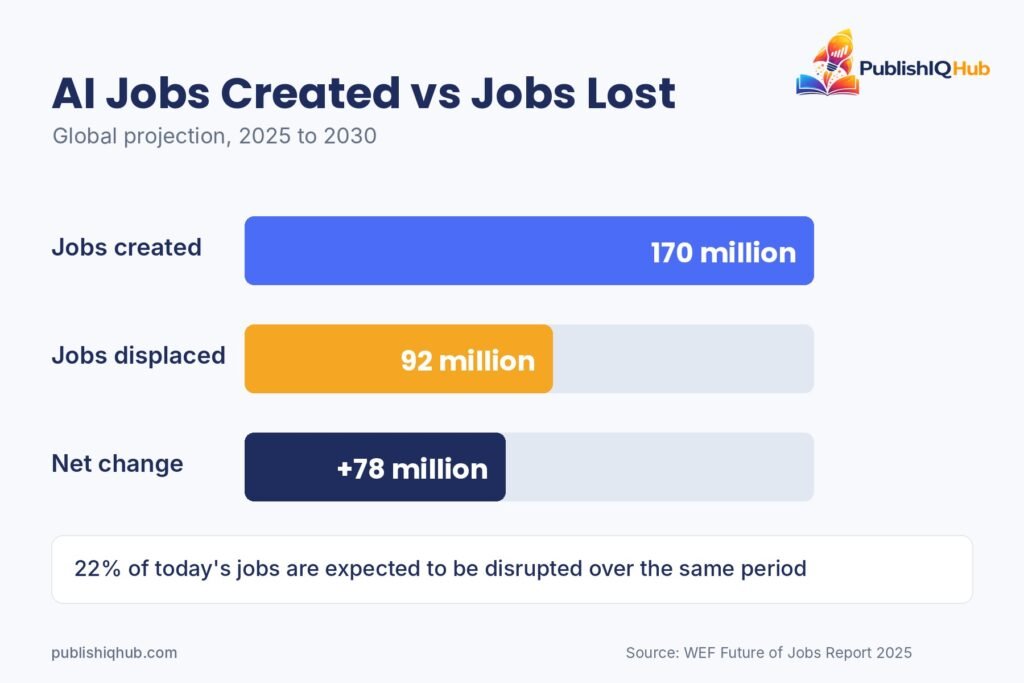
The World Economic Forum’s Future of Jobs Report 2025, based on a global survey of employers, projects the following for 2025 to 2030:
- 170 million new jobs created
- 92 million jobs displaced
- a net gain of 78 million jobs
The more telling figure for the AI impact on employment is that 22% of today’s jobs are expected to be disrupted over the same period. A net increase of 78 million means little to a 45-year-old data entry operator whose role disappears while new openings appear in AI engineering or nursing.
Goldman Sachs offers a longer historical lens on the AI impact on job market trends. Its August 2025 analysis estimates that 6 to 7% of the US workforce could be displaced if AI is widely adopted, within a range of 3% to 14% depending on assumptions. The bank expects the effect of AI on employment to be temporary, adding about half a percentage point to unemployment during the transition. It also notes that roughly 60% of US workers today are employed in occupations that did not exist in 1940.
That last number is the strongest argument for patience. Most of the work people will do in 2040 probably does not have a job title yet.
Where Have AI Job-Loss Fears Been Overstated?
Early predictions assumed AI demos would quickly become job cuts. The real AI impact on employment has not moved at that speed. The McKinsey Global Institute’s November 2025 research estimates that today’s technology could, in theory, automate about 57% of US work hours. McKinsey stresses that this is technical potential, not a forecast of job losses, and that adoption could take decades.
NASSCOM’s 2025 strategic review found that only 10 to 15% of enterprise GenAI proofs of concept make it to full production. A pilot is not a layoff.
Which Jobs Will AI Replace by 2030, and Which Are Safest?
When it comes to the impact of AI on future jobs, roles built on routine information processing face the highest exposure. Roles built on physical presence, care and complex human judgement face the least.
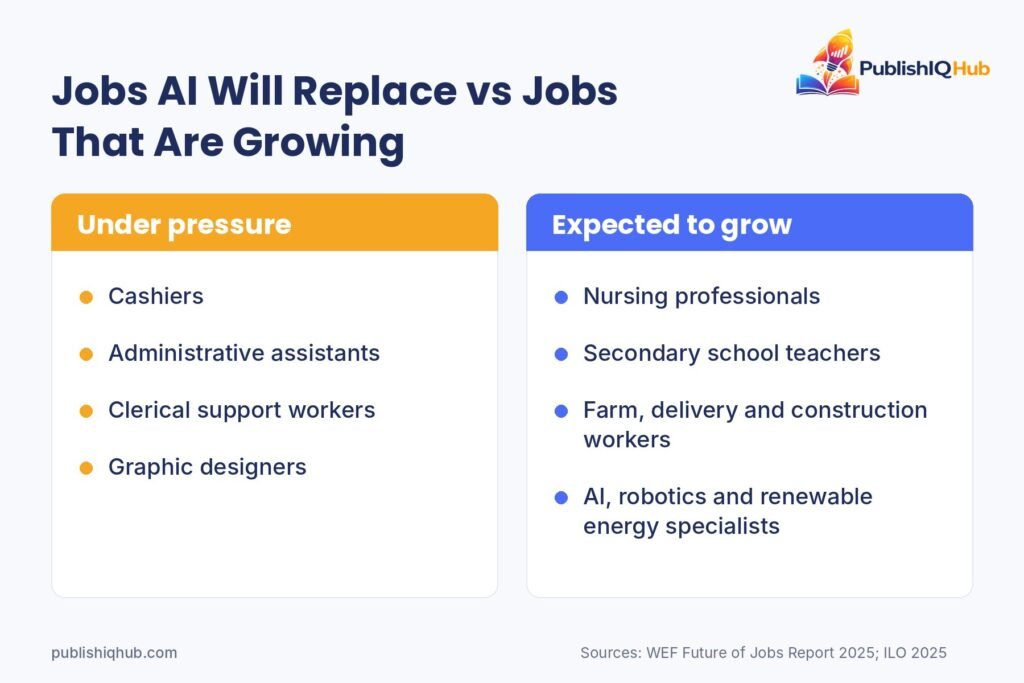
The WEF lists cashiers and administrative assistants among the fastest-declining roles, and graphic designers have now joined them as generative tools mature. The ILO ranks clerical work as the most exposed job category of all. Its index also shows a gender gap: in high-income countries, jobs at the highest risk of automation make up 9.6% of female employment compared with 3.5% of male employment, largely because women are over-represented in clerical roles.
On the growth side, the WEF expects the largest absolute increases in frontline work such as farmworkers, delivery drivers and construction workers, along with nursing professionals and secondary school teachers. Specialist roles in AI, robotics and renewable energy are also expected to grow quickly.
| Role | Direction to 2030 | Main reason | Source |
| Cashiers | Declining | Self-checkout and digital payments | WEF 2025 |
| Administrative assistants | Declining | Scheduling, drafting and filing automated | WEF 2025 |
| Clerical support workers | Highest GenAI exposure | Text and data tasks map closely to GenAI | ILO 2025 |
| Graphic designers | Declining | Generative image tools absorb routine design | WEF 2025 |
| Nursing professionals | Growing | Ageing populations and hands-on care | WEF 2025 |
| Secondary school teachers | Growing | Education demand and human mentoring | WEF 2025 |
| Farmworkers, delivery drivers, construction workers | Largest absolute growth | Physical, frontline work | WEF 2025 |
| AI, robotics and renewable energy specialists | Growing | Building and running new systems | WEF 2025 |
The pattern behind jobs that AI cannot replace is not simply “low-tech versus high-tech.” It comes down to how much a role depends on physical dexterity in unpredictable settings, on trust, and on accountability when there is no clear rulebook. Electricians, nurses, therapists, senior negotiators and site engineers score well on all of these.
AI and Entry-Level Jobs: Is White-Collar Work Under Pressure?
Yes, and this is where the AI impact on job market data is clearest. Junior roles in software, customer support and back-office work are seeing slower hiring, while senior staff in the same fields are largely unaffected so far.
The Stanford research points to a specific mechanism behind this effect of AI on employment. The gap for young workers comes mainly from companies hiring fewer of them, not from firing existing staff. Declines are concentrated in roles where AI substitutes for human tasks. Where AI complements people, employment has held steady or grown, especially for experienced staff.
This matters for the long-term impact of AI on future jobs, because entry-level work is where people learn the trade. A junior analyst who spends two years cleaning data and building basic reports develops the judgement that later makes them a strong manager. If AI absorbs those tasks, companies will need new ways to train people, or they will face a thin talent pipeline within five years.
For white-collar professionals more broadly, the generative AI impact on white-collar jobs is less about replacement and more about output expectations. One marketing executive with good AI writing and analytics tools can now produce what used to take a small team. Our guide to AI tools for marketing that actually work shows how quickly these capabilities have moved into daily workflows.
How Is AI Changing Skills and Wages?
Workers with AI skills are earning more, and the skills employers want are shifting fastest in AI-exposed roles.
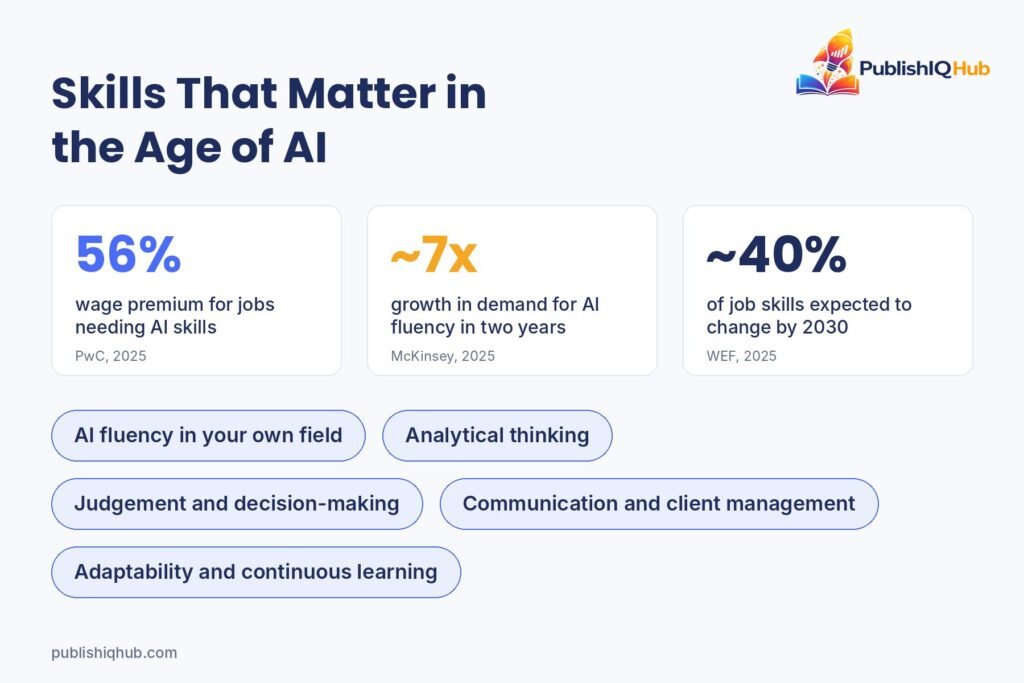
PwC’s 2025 Global AI Jobs Barometer, one of the most cited studies of the AI impact on job market trends, found that jobs requiring AI skills carried an average wage premium of 56% in 2024, up from 25% a year earlier. In the most AI-exposed occupations, the skills employers ask for changed 66% faster than in other roles. Productivity growth in the most exposed industries rose to 27% over 2018 to 2024, up from 7% over 2018 to 2022.
McKinsey adds a clear demand signal. Demand for AI fluency in US job postings grew nearly sevenfold in the two years to mid-2025. Yet McKinsey also estimates that more than 70% of the skills employers seek are used in both automatable and non-automatable work. Most of what a professional already knows stays useful. What changes is how that knowledge gets applied alongside AI.
The WEF expects nearly 40% of the skills required on the job to change by 2030. When thinking about the impact of AI on future jobs, that statistic may matter more than any displacement estimate, because it applies to people who keep their jobs as well as those who change them.
Our breakdown of AI tools for productivity that actually save time is a practical starting point for professionals who would rather learn by doing.
How to Future-Proof Your Career Against AI
Treat AI as a tool to master rather than a threat to wait out. The professionals doing best in the current AI impact on job market are those who combine domain knowledge with practical AI use.
- Audit your own work. List what you do in a typical week and mark the tasks AI can already handle. Those tasks will shrink, so shift your time toward the ones it cannot.
- Build AI fluency inside your field. Learn how AI applies to your specific function, starting with tools you can use this week, such as the best AI-powered research tools for analysis-heavy roles.
- Lean into judgement and relationships. Client management, negotiation, mentoring and decision-making under uncertainty remain hard to automate.
- Make learning a monthly habit. With skills in exposed roles changing 66% faster, a one-time certificate will not last long.
- Show proof, not claims. A short portfolio of AI-assisted work with measurable results beats a list of tools on a CV.
- Track the AI impact on job market signals in your sector. If junior openings in your function are drying up, that is an early sign to broaden your skill set before the change reaches mid-level roles.
Key Takeaways
- The AI impact on employment is real but concentrated, hitting clerical roles and early-career workers in exposed fields first.
- On the impact of AI on future jobs, the WEF projects 170 million jobs created and 92 million displaced by 2030, a net gain of 78 million.
- Workers aged 22 to 25 in AI-exposed US occupations have seen employment fall 19% behind less-exposed peers, mostly through reduced hiring.
- AI skills carried a 56% wage premium in 2024, according to PwC.
- India’s tech sector added 1.35 lakh jobs in FY26, one of its slowest rates in years.
- Continuous, role-specific AI learning is the most reliable way to future-proof your career against AI.
Conclusion
The AI impact on employment is neither the job apocalypse some feared nor the non-event others predicted. The effect of AI on employment is a steady, uneven shift that is already visible in junior hiring, in clerical roles and in the skills employers ask for. The aggregate numbers look reassuring. The individual experience can be much harder, which is why preparation matters more than prediction.
For workers, the practical takeaway is simple: learn to do your job well with AI before someone else does it with AI instead. For employers, the challenge is to keep training the next generation even as the tasks that once trained them get automated.
To keep building your understanding of AI at work, explore more guides, tool comparisons and industry analysis on the PublishIQHub blog.
Frequently Asked Questions
Will AI replace jobs completely?
Most evidence on the AI impact on employment says no. The ILO finds that most jobs exposed to generative AI are more likely to be transformed than replaced, because many tasks still need human judgement. The WEF expects a net gain of 78 million jobs by 2030. Specific roles, however, especially clerical and routine data work, will shrink significantly.
Will AI replace jobs completely?
The roles most at risk include cashiers, administrative assistants, data entry clerks and some graphic design work, according to the WEF Future of Jobs Report 2025. The ILO identifies clerical support as the most exposed category. These jobs involve repetitive information processing that generative AI already handles reliably.
What jobs can AI not replace?
Jobs that AI cannot replace usually combine physical work in unpredictable settings, human trust or high accountability. Nurses, electricians, teachers, therapists, construction workers and senior negotiators fall into this group. The WEF expects frontline and care roles to see the largest absolute job growth through 2030.
How is AI affecting entry-level jobs?
AI and entry-level jobs are where the effect shows up first. Stanford research revised in August 2026 found that employment for workers aged 22 to 25 in AI-exposed occupations is 19% below expected levels, mainly because companies are hiring fewer junior staff rather than letting existing workers go.
How is AI changing the workforce?
AI is changing the workforce by shifting tasks within jobs more than removing jobs entirely. Skills in AI-exposed roles are changing 66% faster than elsewhere, according to PwC, and the WEF expects nearly 40% of required job skills to change by 2030. For the impact of AI on future jobs, that skills churn matters as much as any job-loss figure.
What skills are needed to stay relevant in the age of AI?
The most valuable skills combine AI fluency with human strengths. These include using AI tools within your own field, analytical thinking, communication, client management and adaptability. McKinsey found demand for AI fluency in US job postings grew nearly sevenfold in two years, making it one of the fastest-rising requirements.