
Quick answer: A chatbot for enterprises is a conversational AI system built to operate across departments and channels — customer support, sales, HR, IT helpdesk — while meeting the security, compliance, and integration standards large organizations require. Unlike a basic website chatbot, an enterprise-grade platform connects natively to CRM, ERP, and knowledge systems, supports single sign-on (SSO) and data governance, and increasingly includes generative AI and multi-agent orchestration rather than scripted decision trees. Leading options in 2026 include Kore.ai, NICE Cognigy, Salesforce Agentforce, Microsoft Copilot Studio, IBM watsonx Orchestrate, Yellow.ai, Ada, Boost.ai, Genesys Cloud CX, and LivePerson — each suited to slightly different use cases, from voice-heavy contact centers to CRM-embedded sales workflows.
If you’re comparing enterprise chatbot platforms, enterprise AI chatbot vendors, or simply trying to understand why this category has moved from IT experiment to board-level budget line, this guide walks through the market data, the platforms themselves, and the questions worth asking before you sign a contract.
Why Enterprise Chatbots Are Having a Moment in 2026?
For years, a chatbot for enterprises meant a scripted FAQ bot bolted onto a support page — useful for deflecting simple tickets, largely ignored for anything complex. That has changed. The shift didn’t happen overnight; it tracked the broader move from generative AI as a novelty to generative AI as production infrastructure.
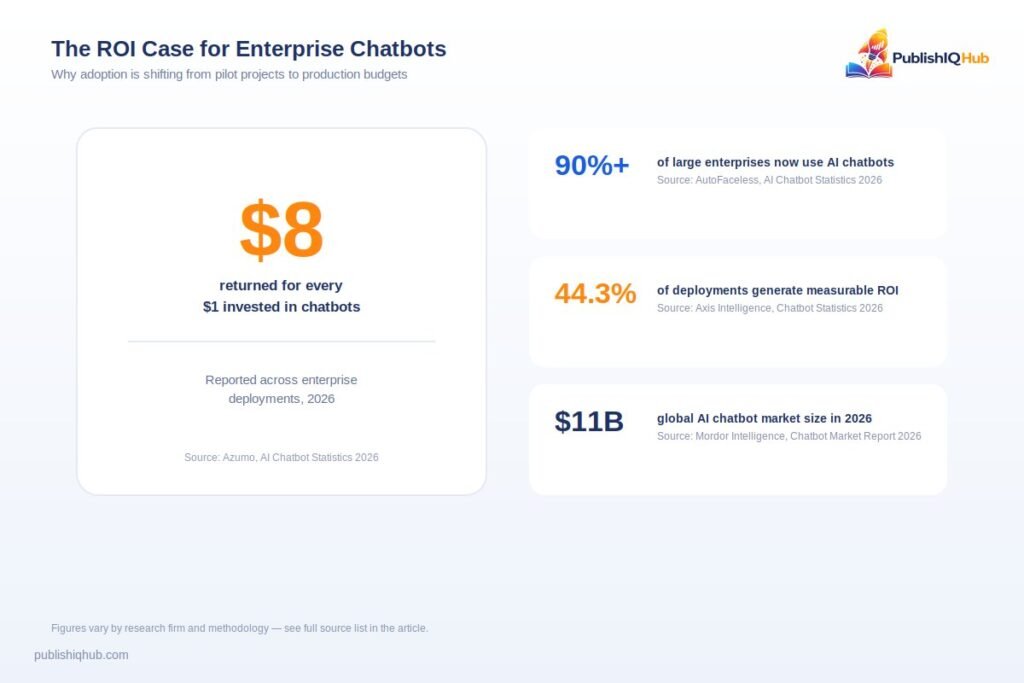
Market sizing depends heavily on scope. Grand View Research pegs the global chatbot market at roughly $9.6–15.5 billion in 2026, while Mordor Intelligence, using a broader definition that includes embedded conversational AI, projects $11.45 billion in 2026 growing to $32.45 billion by 2031 — a 23.15% compound annual growth rate. The generative AI chatbot sub-segment specifically, the LLM-powered layer most enterprise platforms now run on, is valued separately at roughly $13 billion in 2026, growing faster still at just over 31% CAGR.
Adoption tells a similar story from a different angle. Enterprise use of AI chatbots has reportedly crossed 90% among large businesses, and Gartner’s 2022 prediction that chatbots would become the primary customer service channel for about a quarter of organizations by 2027 now looks conservative — Salesforce data cited industry-wide shows AI already resolving roughly 30% of support cases, with projections near 50% by 2027. That’s the “qualitative” shift analysts keep pointing to: these platforms have moved from pilot programs to primary infrastructure.
None of this means every deployment succeeds. One widely cited analysis found that of the organizations that have deployed a chatbot or broader AI tool, only about 44% report measurable business impact — a nearly 50-point gap between adoption and value. That gap is arguably the single most important data point for any enterprise evaluating platforms in 2026: deploying an enterprise AI chatbot is the easy part; making it generate ROI is where most of the real work happens. It’s also not limited to customer-facing chatbots — the same adoption-versus-value gap shows up in broader enterprise AI deployments across manufacturing and other industries.
Search behavior backs this up. Beyond the primary and secondary terms already noted, related queries surging across search engines and AI answer engines in 2026 include “AI agent vs chatbot,” “best enterprise chatbot software,” “enterprise chatbot with LLM integration,” “AI customer service chatbot for enterprises,” “no-code enterprise chatbot builder,” “secure enterprise chatbot solutions,” and “conversational AI platform pricing.” That mix says a lot about where buyer attention sits right now: cost justification, security posture, and the blurry line between a “chatbot” and an “AI agent” that actually takes action rather than just answering.
Enterprise Chatbot Use Cases by Department
One reason this category is no longer an IT-only conversation is that the use cases have spread well past the support inbox.
- Customer service remains the largest application by revenue share, and for good reason — it’s the easiest to measure. Ticket deflection, first-response time, and CSAT are all metrics that existing support tooling already tracks, which makes chatbot ROI easier to prove here than almost anywhere else in the business.
- Sales is a fast-growing use case, particularly for platforms that embed inside a CRM. An enterprise AI chatbot can qualify inbound leads, schedule demos, and surface account context to a rep before a call even starts, cutting the manual research time reps spend before every conversation. Enterprises that already lean on outsourced sales development — see our overview of top Indian BPO companies — often use chatbots to pre-qualify leads before handing them to a human team.
- HR and employee support is one of the fastest-growing application areas by CAGR, according to several market reports. Enterprise chatbot platforms increasingly field benefits questions, onboarding steps, and policy lookups that would otherwise sit in an HR ticket queue for days.
- IT helpdesk is a natural fit for the same reason: password resets, access requests, and known-issue troubleshooting are repetitive, well-documented, and ideal for a retrieval-grounded chatbot to handle without a human in the loop.
- Finance and procurement teams are newer entrants, using conversational AI for expense-policy questions, invoice status lookups, and purchase-order routing — lower-profile than customer service, but a growing share of enterprise chatbot deployments nonetheless
Trends Shaping Enterprise AI Chatbots in 2026
A few shifts are worth understanding before you shortlist vendors, because they change what “enterprise chatbot platform” even means compared to two years ago.
- From chatbots to agents. The industry conversation has visibly shifted from “chatbot” to “AI agent.” The distinction matters: a chatbot answers; an agent acts — updating a CRM record, rebooking a shipment, triggering a workflow across systems. Several platforms covered above, including Kore.ai and Microsoft Copilot Studio, now market agent orchestration as a core capability rather than an add-on, and buyers researching “enterprise chatbot platforms” increasingly find agent-first messaging in the results.
- Multi-agent orchestration. Rather than one large bot trying to do everything, newer architectures coordinate multiple purpose-built agents — one for billing questions, one for technical troubleshooting, one for account changes — that hand off context between each other. This is a meaningful shift in how these systems are architected under the hood.
- Standardized integration protocols. Emerging standards for connecting AI models to enterprise tools and data sources are starting to reduce the custom integration work that used to make enterprise chatbot rollouts slow and expensive. Expect vendor claims about “protocol support” to become a standard part of RFPs going forward.
- Voice re-emerges. Contact-center-focused platforms like NICE Cognigy are seeing renewed investment in voice AI, as natural-sounding generative voice models close the gap that used to make voice bots feel obviously robotic.
- Governance as a selling point, not an afterthought. With enterprise AI chatbot adoption now mainstream, audit trails, explainability, and permission-aware retrieval have moved from “nice to have” to a standard evaluation criterion — especially in regulated industries like banking, insurance, and healthcare.
Build vs. Buy: A Question Worth Asking Early
Not every enterprise should default to a vendor platform. Developer-first, self-hosted options exist for organizations with strong internal AI engineering capacity and a preference for full control over data residency and model choice — often at the cost of a longer time-to-value and an ongoing maintenance burden a managed platform would otherwise absorb. Organizations without that in-house capacity often turn to IT outsourcing partners in India to bridge the engineering gap rather than building a chatbot team from scratch. The right call typically comes down to three questions: how differentiated does the conversational experience need to be for competitive advantage, how much in-house ML engineering capacity already exists, and how tightly does data residency or model choice need to be controlled for regulatory reasons. Most enterprises land on a managed platform for standard use cases like support and HR, reserving custom-built agents for the handful of workflows that are genuinely core to the business.
What Makes a Chatbot “Enterprise-Grade”
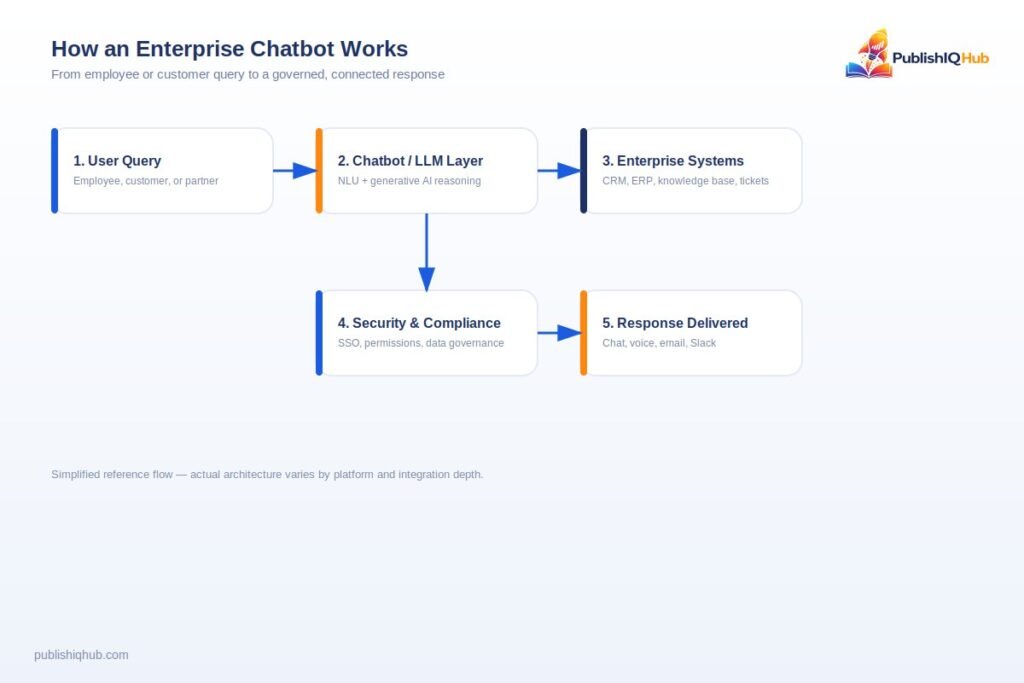
Not every AI chatbot company sells to enterprises, and not every enterprise buyer needs the same thing. Still, a few characteristics separate enterprise chatbot platforms from smaller-business tools:
- Deep systems integration. Native connectors to CRM (Salesforce, HubSpot), ERP, ticketing systems (Zendesk, ServiceNow), and internal knowledge bases — not just a webhook and a prayer.
- Security and compliance posture. SSO, role-based access, SOC 2 Type II, GDPR alignment, and increasingly, audit trails for what the AI said and why.
- Omnichannel deployment. Web chat, voice, SMS, WhatsApp, Slack, Teams, and social — often from a single configuration.
- Governed generative AI. Retrieval-augmented responses grounded in company content and permissions, rather than an LLM freelancing answers from open internet knowledge.
- Agentic workflows. The 2026 differentiator: platforms that don’t just answer questions but complete multi-step tasks — rebooking a shipment, updating a CRM record, escalating with full context attached.
- Pricing that scales (and stays plannable). Forrester-cited estimates put average enterprise chatbot spend around $180,000 per year, versus $2,000–15,000 for small and mid-sized businesses — a gap that reflects both scale and the cost of integration work most vendors quote separately from the license fee.
12 Enterprise Chatbot Platforms to Evaluate in 2026
The list below isn’t ranked — the “best” enterprise ai chatbot platform depends entirely on your channel mix, existing tech stack, and whether voice, CRM embedding, or multilingual reach matters most to your organization. Evaluation criteria and vendor detail draw on public comparisons including Guideflow’s 2026 enterprise chatbot platform roundup.
1. Kore.ai
Consistently named a Leader in Gartner’s Magic Quadrant for Conversational AI Platforms, Kore.ai’s XO Platform is built for large-scale, multi-agent orchestration across customer support, IT helpdesk, and employee self-service. It’s used by hundreds of Fortune 2000 companies and offers strong natural-language understanding, but reviewers note a real learning curve — this is a platform for organizations with a dedicated bot-building team, not a weekend configuration project.
2. NICE Cognigy
Cognigy (now part of NICE) leans into voice-first customer experience and deep contact-center integrations with platforms like Genesys, NICE CXone, and Five9. It was recognized as a Leader in the 2026 Forrester Wave for Conversational AI Platforms for Customer Service. If your enterprise chatbot strategy is contact-center-heavy, especially with European data residency requirements, Cognigy is a strong shortlist candidate.
3. Salesforce Agentforce
For organizations already living inside Salesforce, Agentforce embeds conversational AI directly into the CRM — case deflection, lead qualification, and workflow automation without leaving the Salesforce environment. The trade-off is the reverse of its strength: it’s most compelling for Salesforce-centric organizations and less so for a heterogeneous stack.
4. Microsoft Copilot Studio
Copilot Studio extends Microsoft’s Copilot ecosystem into custom conversational agents across Teams, Microsoft 365, and internal line-of-business apps. It’s the natural choice for organizations standardized on the Microsoft stack, offering low-code bot building with enterprise identity and compliance controls inherited from Azure AD/Entra ID.
5. IBM watsonx Orchestrate / Assistant
IBM’s enterprise AI stack pairs watsonx Assistant’s conversational layer with watsonx Orchestrate’s automation capabilities, targeting regulated industries — banking, insurance, healthcare — where explainability and governance carry as much weight as conversational quality.
6. Yellow.ai
Yellow.ai’s differentiator is reach: multilingual conversational AI across 135+ languages, which makes it a common pick for global enterprises with regionally fragmented customer bases, particularly across Asia-Pacific markets.
7. Ada
Ada focuses on large-scale customer experience automation, with proactive messaging and a stated goal of reducing dependence on live agents for high-volume, repetitive queries — a fit for consumer brands running high ticket volumes through support.
8. Boost.ai
Boost.ai markets itself toward regulated industries needing a no-code build experience without sacrificing governance — banks and public-sector organizations show up frequently in its customer base.
9. Genesys Cloud CX
Genesys folds chatbot automation into its broader Cloud CX contact-center suite, orchestrating chat and voice journeys as one connected customer experience rather than a bolt-on bot.
10. LivePerson
LivePerson’s conversational AI platform spans messaging channels with an emphasis on measurable conversation outcomes — useful for enterprises that want tight reporting ties between chatbot interactions and revenue or retention metrics.
11. Sprinklr
Sprinklr positions its AI chatbot capability inside a unified customer experience management suite that also covers social listening and marketing — a fit for enterprises that want conversational AI reporting alongside broader brand and CX analytics.
12. Glean (Enterprise Search + AI Chatbot)
A different category worth naming: Glean and similar enterprise-search-first platforms (Microsoft 365 Copilot’s search layer, open-source options like Onyx) approach the “enterprise chatbot” problem from internal knowledge retrieval outward, prioritizing permission-aware answers grounded in company documents over customer-facing conversation design. Worth evaluating separately if your primary need is employee-facing knowledge search rather than customer support.
Enterprise Chatbot Platforms Compared
| Platform | Best For | Voice | Native CRM/ERP | Notable Strength |
| Kore.ai | Large-scale multi-agent orchestration | Yes | Yes | Broadest use-case coverage |
| NICE Cognigy | Contact centers, voice-first CX | Yes | Partial | Deep telephony integrations |
| Salesforce Agentforce | Salesforce-native organizations | No | Yes (Salesforce) | Zero-context-switch CRM embedding |
| Microsoft Copilot Studio | Microsoft 365 / Teams environments | Yes | Yes | Inherited enterprise identity/compliance |
| IBM watsonx Orchestrate / Assistant | Regulated industries (banking, insurance, healthcare) | Yes | Yes | Explainability and governance controls |
| Yellow.ai | Global, multilingual support | Yes | Yes | 135+ language coverage |
| Ada | High-volume consumer support | No | Yes | Proactive messaging at scale |
| Boost.ai | Regulated industries | No | Yes | No-code build with governance |
| Genesys Cloud CX | Unified contact-center CX | Yes | Yes | Chat + voice in one journey |
| LivePerson | Revenue/retention-linked CX reporting | Partial | Yes | Tight conversation-to-outcome analytics |
| Sprinklr | Unified CXM with social listening | Yes | Yes | CX + brand/social analytics in one suite |
| Glean | Employee-facing knowledge search | No | Partial | Permission-aware answers grounded in company docs |
How to Evaluate an Enterprise AI Chatbot Platform
Before a demo turns into a decision, a few questions tend to separate the platforms that fit from the ones that just look good in a sales deck:
- What does it connect to on day one? Ask for the exact list of native integrations with your CRM, ERP, and ticketing stack — not just an API that “can” be built against.
- How is generative AI grounded? Retrieval-augmented generation tied to your own permissioned content is very different from an LLM answering from general web knowledge with your logo on it.
- What’s the real implementation cost? License fees rarely include the managed-service and integration work most enterprise rollouts need — get that number in writing early.
- How is success measured? Deflection rate is not the same as resolved-without-escalation rate, and neither is the same as revenue or retention impact. Pin down which metric the vendor is actually optimizing for.
- What happens when it’s wrong? Ask about escalation paths, audit logging, and how the platform handles a confident-but-incorrect answer in a regulated context.
Common Rollout Mistakes Worth Avoiding
Given that under half of deployments report measurable ROI, a few recurring mistakes show up across post-mortems and vendor case studies:
- Launching without a narrow first use case. Enterprises that try to automate everything at once tend to under-deliver everywhere. The stronger pattern is picking one high-volume, well-documented workflow — password resets, order-status lookups — proving value, then expanding.
- Under-investing in the knowledge base the bot draws from. A chatbot is only as good as the content it retrieves from. Stale documentation or fragmented knowledge bases produce confident-sounding wrong answers, which erode trust faster than an honest “I don’t know.”
- Skipping the escalation design. Every deployment needs a clear, low-friction path to a human when the bot is uncertain or the stakes are high enough that being wrong matters. Platforms that make this hand-off seamless tend to score better on customer satisfaction than those optimized purely for deflection rate.
- Measuring the wrong metric. Deflection rate looks great on a dashboard and says very little about whether the customer’s actual problem got solved. Resolution rate, repeat-contact rate, and downstream retention are harder to track but far more honest indicators of chatbot value.
- Underestimating integration cost. As noted earlier, license fees are frequently just the starting point. Budgeting for the license without budgeting for integration and change-management work is one of the most common reasons enterprise chatbot projects run over budget.
Frequently Asked Questions
What is a chatbot for enterprises?
An enterprise chatbot is a conversational AI system designed to operate at scale across an organization’s departments and channels, with native integrations into business systems (CRM, ERP, ticketing), enterprise-grade security (SSO, SOC 2, GDPR), and increasingly, generative AI and agentic capabilities rather than fixed decision trees.
How is an enterprise chatbot different from a regular chatbot?
A regular chatbot typically answers scripted questions on a single channel with minimal system integration. An enterprise chatbot operates across many channels, connects deeply into business infrastructure, and is built to meet compliance and governance requirements that smaller deployments don’t need to consider.
What is the ROI of enterprise AI chatbots?
Reported figures vary by source and methodology, but industry data has cited an average return of roughly $8 for every $1 invested in chatbot technology. That said, other analysis suggests only around 44% of organizations that deploy chatbots report measurable business impact — ROI is real but not automatic, and depends heavily on implementation quality and use-case fit.
Which enterprise chatbot platform is best for CRM-heavy organizations?
Platforms that embed directly into a CRM — such as Salesforce Agentforce for Salesforce environments — tend to fit best when the priority is minimizing context-switching for sales and support teams already living inside that CRM daily.
Do enterprise chatbots require a large IT team to maintain?
It depends on the platform. Some, like Kore.ai, offer deep customization but expect a dedicated bot-building team. Others emphasize no-code configuration for business users, though even “no-code” platforms typically need IT involvement for integration, security review, and ongoing governance.
What should an enterprise budget for a chatbot platform?
Cited estimates put average enterprise spending around $180,000 per year, substantially higher than small-business chatbot budgets, which more commonly run $2,000–15,000 annually — though actual cost depends on channel count, integration depth, and whether managed services are included.
Are enterprise chatbots the same as AI agents?
Not quite, though the terms increasingly overlap. A traditional enterprise chatbot is primarily conversational — it answers questions and routes requests. An AI agent goes further, taking multi-step actions across systems (updating records, triggering workflows) with less human involvement per task. Many 2026-era enterprise chatbot platforms now offer both capabilities under one roof, which is part of why the category’s terminology is shifting.
How long does it take to deploy an enterprise chatbot platform?
Timelines vary widely by integration scope. A narrowly scoped deployment — one department, one or two system integrations — can go live in weeks. A broad, multi-channel, multi-system rollout with strict compliance review more commonly takes several months, particularly when legal, security, and change-management sign-offs are involved.