
Quick Answer:
The main uses of artificial intelligence include personal assistants and smartphones, personalized streaming and shopping, navigation, fraud detection in banking, medical imaging and diagnosis, tutoring and lesson planning in education, customer service chatbots, writing and coding help at work, and self-driving and traffic systems. Most Americans already use AI daily, often without noticing it.
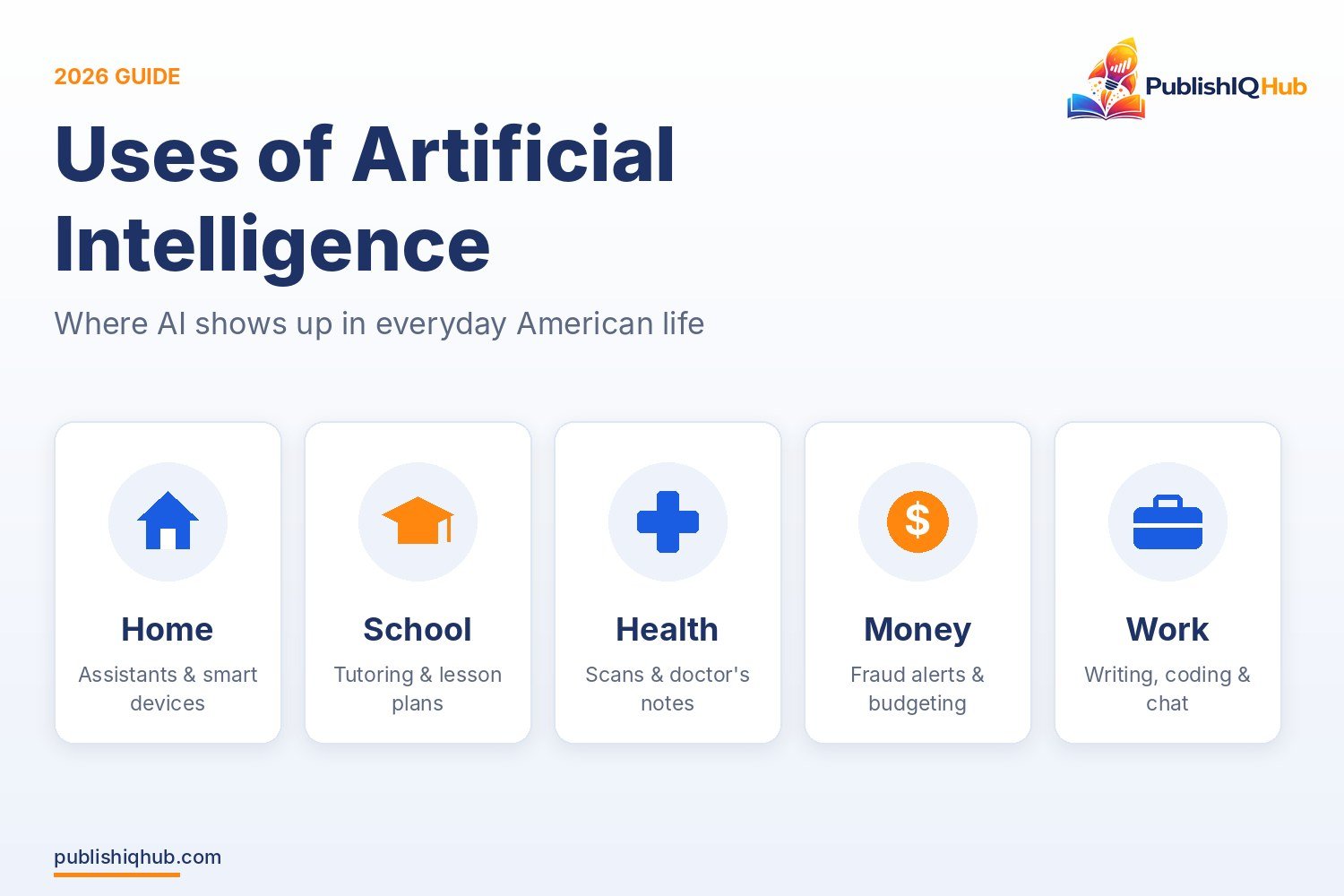
Your alarm goes off. You glance at your phone and Face ID opens it. Google Maps warns you about a wreck on the interstate and reroutes you before you’ve even backed out of the driveway. By lunch, your bank has texted to ask whether that $412 charge in another state was really you. It wasn’t. Card frozen.
That’s four uses of artificial intelligence before noon, and you didn’t type a single prompt. These everyday examples of AI in daily life are so ordinary now that most of us don’t even register them.
Most people picture ChatGPT when they hear “AI.” Fair enough. But the bigger story is how much of it runs quietly in the background of ordinary American life: in your inbox, your kid’s homework, your doctor’s office and your checking account. This guide walks through the most common uses of AI in 2026, explains the importance of artificial intelligence for regular Americans, with real examples, verified numbers and an honest look at the downsides.
What Is Artificial Intelligence, in Plain English?
Artificial intelligence is software that learns patterns from data and uses them to make predictions, decisions or new content. It doesn’t “think” like a person. It spots patterns at a scale no human could.
There are two flavors worth knowing. Traditional AI (often called machine learning) sorts, ranks and predicts. It’s why Netflix knows you’ll probably like that true-crime docuseries. Generative AI creates new text, images, audio or code. That’s ChatGPT, Claude, Gemini and Microsoft Copilot.
Both show up throughout this list of uses of artificial intelligence. And both are now mainstream. According to the St. Louis Fed’s 2025 generative AI adoption survey, 54.6% of US adults ages 18 to 64 had used generative AI as of August 2025, up about 10 percentage points in a single year.
What Are Common Uses of AI in Daily Life?
The most common uses of AI in daily life are smartphone features, voice assistants, recommendations, navigation, spam filtering and online shopping. These are the examples of AI in daily life that most of us touch dozens of times a day, and they’re the easiest way to understand AI in everyday life.
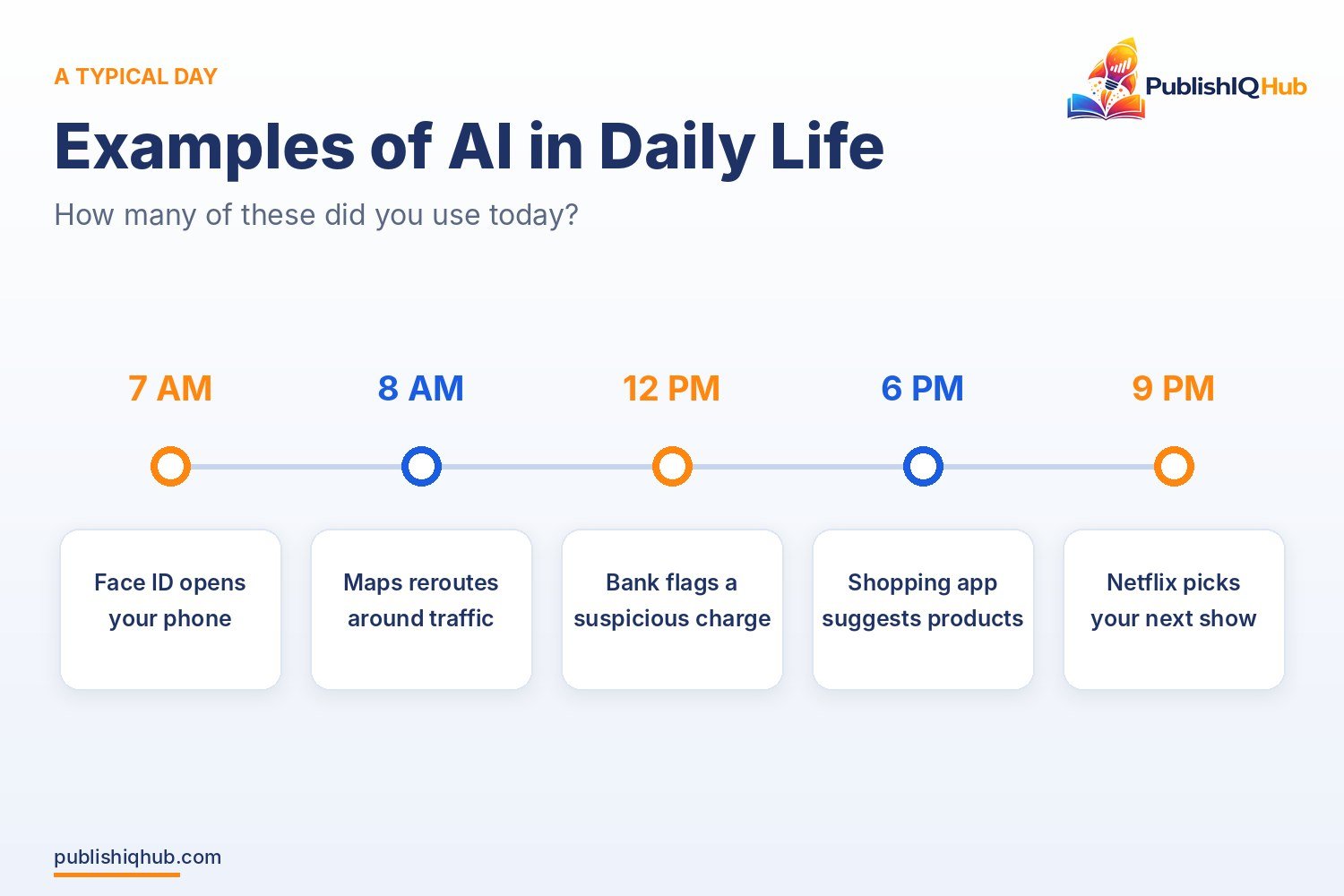
Examples of AI in daily life on a timeline, from Face ID at 7 AM to Netflix picks at 9 PM
1. Your Smartphone
Face ID, autocorrect, photo search (“show me pictures of my dog at the beach”) and the portrait blur on your camera all run on AI. You probably stopped noticing a while ago, which is exactly why phones are among the most common uses of AI.
2. Voice Assistants and Smart Homes
Siri, Alexa and Google Assistant turn spoken words into actions. Ask for the weather, set a timer for the lasagna, dim the living room lights. Smart thermostats like Google Nest go a step further. They learn when you’re usually home and adjust the temperature on their own, which can trim your energy bill.
3. Streaming and Social Feeds
Netflix, Spotify, YouTube and TikTok are recommendation engines with entertainment attached. Every skip, replay and late-night binge teaches the algorithm what to serve next. Spotify’s Discover Weekly playlist is a classic example of AI in everyday life that people actually love.
4. Navigation and Ride-Hailing
Google Maps and Waze predict traffic using live data from millions of phones. Uber and Lyft use AI to match drivers, estimate arrival times and set surge pricing. In a growing list of US cities, including Phoenix, San Francisco and Los Angeles, you can now hail a Waymo with nobody in the driver’s seat.
5. Email and Online Shopping
Gmail’s spam filter catches the overwhelming majority of junk before you ever see it. On Amazon, “customers who bought this also bought” is AI, and so are the review summaries at the top of product pages.
How Is AI Used in Education?
The use of AI in education covers tutoring, personalized practice, lesson planning, grading support and accessibility tools for students with disabilities. It’s also the area where Americans argue about AI the most, so it’s worth a closer look.
How Students Use AI
Students got there first. A February 2026 Pew Research Center survey of US teens found that 54% of teens ages 13 to 17 have used AI chatbots to help with schoolwork, and about 1 in 10 say they do all or most of it with a chatbot’s help.
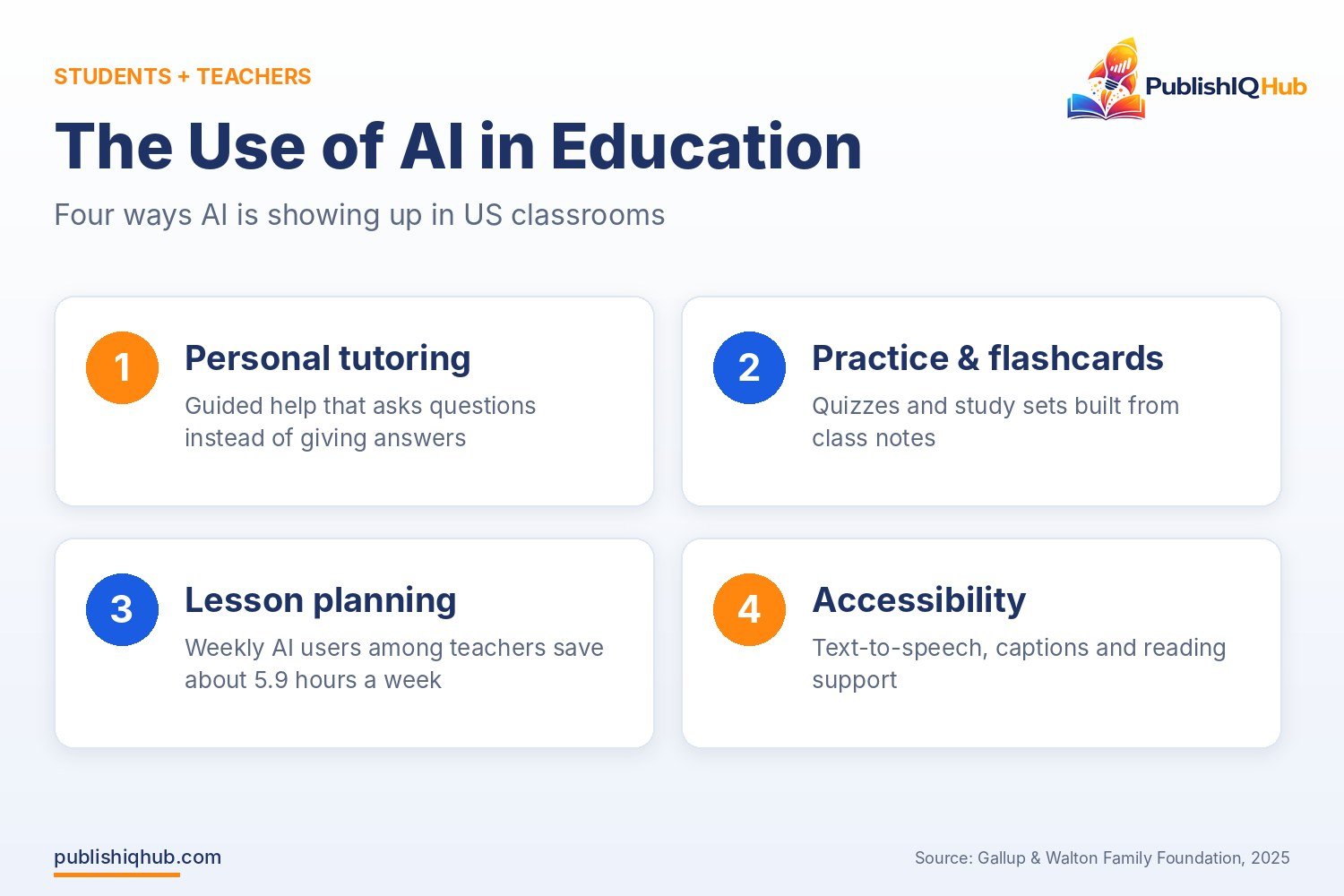
The better AI tools for students don’t just hand over answers. Khan Academy’s Khanmigo works like a patient tutor that asks guiding questions. Duolingo uses AI to adjust lesson difficulty and run practice conversations. Quizlet turns class notes into flashcards and practice tests in seconds. These are the AI tools for students that teachers tend to approve of, because they push kids to practice instead of copy.
How Teachers Use AI in the Classroom
Teachers are catching up fast. A Gallup survey with the Walton Family Foundation found that 60% of US K-12 teachers used AI during the 2024-25 school year, and weekly users saved an average of 5.9 hours per week. Over a school year, that’s roughly six weeks of time back.
Where does that time come from? Mostly the unglamorous stuff: drafting lesson plans, making quizzes, leveling reading passages for different grade levels, writing parent emails and giving first-pass feedback on essays. Platforms like MagicSchool and Brisk are popular with US teachers for exactly these jobs. If you’ve wondered how teachers use AI in the classroom, this is mostly it: less glamour, more saved evenings.
The Academic Integrity Question
Here’s the catch. Cheating is easier than ever, and AI detectors are unreliable enough that many schools have stopped relying on them. Districts are responding with clear AI policies, more in-class writing and assignments that ask students to show their thinking. The goal of the use of AI in education is shifting from “ban it” to “teach kids to use it well.”
Accessibility is the underrated win in the use of AI in education. Text-to-speech, live captions and AI reading support help students with dyslexia, hearing loss or ADHD keep pace in a regular classroom.
How Is AI Used in Healthcare Today?
AI in healthcare helps doctors read scans, catch disease earlier, cut paperwork and speed up drug discovery. It supports clinicians. It doesn’t replace them.
The FDA has now authorized more than 1,400 AI-enabled medical devices, according to MedTech Dive’s analysis of the agency’s official list. Most are in radiology, where AI flags possible strokes, lung nodules or breast cancer on imaging so radiologists can look at the urgent cases first.
The change patients notice most is the “AI scribe.” Tools like Microsoft’s Dragon Copilot and Abridge listen during your appointment (with consent) and draft the clinical notes. Your doctor gets to look at you instead of a keyboard. It’s one of the quieter uses of artificial intelligence, and one of the most welcome.
Other benefits of AI in healthcare include symptom checkers, smarter appointment scheduling, insurance claim processing and faster discovery of new drug candidates. The honest caveat? A wrong answer in medicine has real consequences, so human review stays essential wherever AI in healthcare is used.
How Is AI Used in Banking and Personal Finance?
Banks use AI mainly to stop fraud, approve credit, answer customer questions and power budgeting and investing apps. If you’ve ever gotten a “Was this you?” text, you’ve met one of the most common uses of AI in finance.
Fraud detection is the headline example. The US Department of the Treasury reported that its enhanced fraud-detection processes, including machine learning AI, prevented and recovered over $4 billion in fraud in fiscal year 2024. Machine learning check-fraud detection alone accounted for $1 billion in recovery.
At the consumer level, AI shows up as:
- Virtual assistants like Bank of America’s Erica, which answers balance questions and flags unusual charges
- Credit and loan decisions that weigh more data than a traditional credit score
- Robo-advisors such as Betterment and Wealthfront that rebalance portfolios automatically
- Budgeting apps that sort your spending into categories without manual tagging
One word of caution. AI-driven credit decisions can carry bias if they learn from biased historical data. US regulators, including the Consumer Financial Protection Bureau, have said lenders still have to explain why they denied someone credit, algorithm or not.
How Is AI Used in Business and at Work?
Businesses use AI for customer service, marketing, writing, coding, data analysis and hiring. For small business owners, AI in business often works like an extra employee who never sleeps.
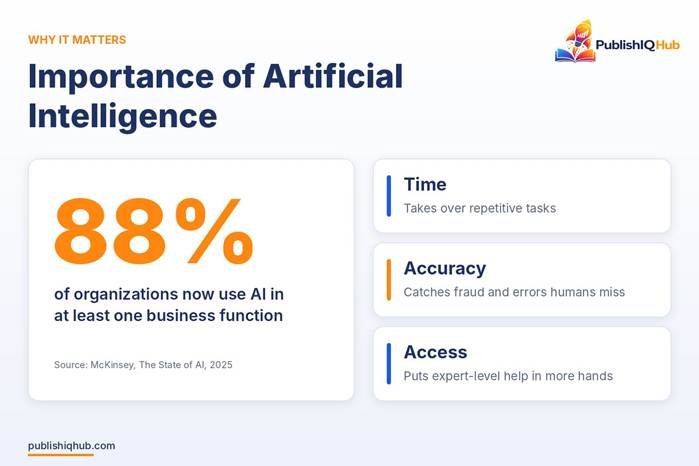
Adoption is close to universal at the company level. McKinsey’s 2025 State of AI research found that 88% of organizations now use AI in at least one business function. But most haven’t scaled it across the whole company yet. That gap between experimenting and getting real results is where the next few years of business AI will play out.
Here’s what AI in business looks like day to day:
- Customer service: Chatbots handle routine questions around the clock and pass harder ones to people. Our guide to enterprise chatbot platforms worth evaluating compares the leading options.
- Marketing: AI drafts ad copy, segments email lists and predicts which customers might churn. See our picks of AI tools for marketing that actually work.
- Office work: Copilot in Microsoft 365 and Gemini in Google Workspace summarize meetings, draft documents and build spreadsheets from plain-English requests. We tested several in our roundup of AI tools for productivity that save time.
- Software development: Developers use GitHub Copilot, Cursor and Claude to write, review and debug code.
- Search: Google’s AI Overviews and AI Mode in Google Search are changing how customers find businesses in the first place.
Workers are using it too, which is why AI in business isn’t just a boardroom topic anymore. The same St. Louis Fed survey found 37.4% of US adults ages 18 to 64 used generative AI at work in August 2025.
How Is AI Used in Transportation and Government?
AI powers self-driving cars, traffic signals, airline operations, weather forecasting and fraud checks on public benefits. Much of it is invisible infrastructure, and it’s some of the least discussed uses of artificial intelligence.
Waymo’s driverless robotaxis now operate in several US metro areas, and Tesla, Zoox and others are testing their own. Many cities use AI-timed traffic lights that adjust to real-time congestion. The National Weather Service and NOAA are adding AI models to sharpen forecasts for hurricanes and severe storms.
On the government side, the Treasury fraud example above is a good model. Agencies also use AI to process paperwork, translate public information into multiple languages and answer common questions on websites like IRS.gov.
Uses of Artificial Intelligence at a Glance: Where Americans Meet AI
| Area | Common use of AI | Examples Americans know |
|---|---|---|
| Home | Voice control, smart thermostats, security cameras | Alexa, Siri, Google Nest, Ring |
| Entertainment | Recommendations and playlists | Netflix, Spotify, YouTube, TikTok |
| Travel | Traffic prediction, route planning, robotaxis | Google Maps, Waze, Uber, Waymo |
| School | Tutoring, practice, lesson planning | Khanmigo, Duolingo, Quizlet, MagicSchool |
| Health | Imaging analysis, clinical note-taking | FDA-authorized radiology AI, Abridge |
| Money | Fraud alerts, budgeting, robo-advisors | Bank of America’s Erica, Betterment |
| Work | Writing, meetings, coding, customer chat | ChatGPT, Claude, Microsoft Copilot, Gemini |
Why Is Artificial Intelligence Important?
The importance of artificial intelligence comes down to time, accuracy and access. It handles repetitive work, catches things humans miss and puts expert-level help in more people’s hands.
A rural patient gets a stroke flagged minutes faster. A first-generation college student gets a free tutor at 11 p.m. A two-person bakery answers customer questions without hiring a call center. That’s the real importance of artificial intelligence, and it’s less flashy than the sci-fi version.
For the US economy, the benefits of artificial intelligence show up as productivity. The benefits of artificial intelligence also reach families directly. When teachers save six weeks a year and doctors spend less time typing notes, that time goes back into the work that needs a human. AI is also reshaping US industry; our look at AI’s impact on employment breaks down which jobs are shrinking and which are growing.
What Are the Risks and Limitations of AI?
The biggest risks of AI are errors, bias, privacy loss, misinformation and job disruption. None of them are reasons to avoid AI entirely, but all of them are reasons to use it carefully.
Americans are clearly uneasy. A Pew Research Center survey from September 2025 found that 50% of US adults are more concerned than excited about the increased use of AI in daily life, up from 37% in 2021. More than half (53%) think AI will make people worse at thinking creatively.
Those worries are reasonable. Here’s what to watch:
- Hallucinations. Chatbots sometimes state false information with total confidence. Double-check anything important.
- Bias. AI trained on skewed data can make unfair decisions in hiring, lending or policing.
- Privacy. Don’t paste medical records, Social Security numbers or client data into free AI tools.
- Deepfakes and scams. Voice-cloning scams that impersonate family members are on the rise. Agree on a family “safe word.”
So, is AI safe to use? For everyday tasks, yes, with common sense. Treat it like a smart intern: helpful, fast and in need of supervision.
What Is the Future of Artificial Intelligence?
The future of artificial intelligence points toward AI agents that complete tasks for you, not just answer questions. The future of artificial intelligence is less about chatbots and more about action. Think booking the dentist, filing an expense report or comparing insurance quotes on your behalf.
Expect AI to become more personal (assistants that remember your preferences), more physical (robots in warehouses and possibly homes) and more regulated, as states and federal agencies set rules on transparency and safety. The skill that will matter most for regular people isn’t coding. It’s knowing what to ask AI, and when not to trust it.
The Bottom Line
The uses of artificial intelligence already reach almost every part of American life, from the phone in your pocket to your child’s classroom to your doctor’s exam room. From examples of AI in daily life to AI in healthcare and the classroom, most of it is helpful. Some of it deserves a skeptical eye. The smartest move is to get familiar with these tools now, use them where they save you real time and keep a human in charge of the decisions that matter.
Frequently Asked Questions
What are 10 uses of artificial intelligence?
Ten common uses of artificial intelligence are Face ID on phones, voice assistants, streaming recommendations, GPS traffic prediction, email spam filters, bank fraud alerts, medical imaging analysis, homework tutoring, customer service chatbots and self-driving cars. Most Americans use at least half of these every week, usually without thinking of them as AI.
How is AI used in everyday life?
AI is used in everyday life to open phones with face recognition, suggest shows and songs, predict traffic, filter spam, recommend products, answer voice commands and flag suspicious bank charges. Generative AI tools like ChatGPT and Gemini add writing, planning and research help on top of those background features.
What is the most common use of AI?
Recommendation systems are arguably the most common use of AI and among the most common uses of AI overall. They decide what you see on Netflix, YouTube, TikTok, Amazon and Spotify. For generative AI specifically, the most common uses are searching for information, writing help and brainstorming.
How do teachers use AI in the classroom?
Teachers use AI to draft lesson plans, create quizzes, adapt reading passages for different levels, write parent emails and give first-round feedback on student writing. A Gallup and Walton Family Foundation survey found weekly AI users among US teachers save nearly six hours a week.
Is it OK for students to use AI for homework?
It depends on the school’s policy and how it’s used. The use of AI in education is still being defined district by district. Using AI to explain a concept, quiz yourself or check grammar is usually fine. Submitting AI-written work as your own is generally considered cheating. Students should always check their teacher’s rules first.
How is AI used in healthcare?
AI in healthcare reads X-rays, CT scans and mammograms to flag possible problems, drafts doctors’ clinical notes, predicts which patients may need extra care and speeds up drug research. The FDA has authorized more than 1,400 AI-enabled medical devices, most of them in radiology.
Is AI safe to use?
AI is generally safe for everyday tasks like writing, planning and research, as long as you verify important facts and avoid sharing sensitive personal or financial information. The main risks are incorrect answers, privacy issues and AI-powered scams such as voice cloning.
Will AI take my job?
AI is more likely to change most jobs than eliminate them. It automates specific tasks such as drafting, data entry and routine customer questions. Roles built heavily on those tasks face the most pressure, while people who learn to work alongside AI tend to become more valuable.