
Tata Trusts want Tata Sons to stay private. The board has voted to list. Group stocks have lost about 10% in between. An update to our Tata Group stock coverage.
This article is for general information and educational purposes only. It does not constitute investment advice, and past stock performance is not a guarantee of future returns. Readers should consult a SEBI-registered investment advisor before making any investment decisions.
Quick Answer
On September 28, 2026, Tata Trusts proposed merging two unlisted Tata units into Tata Sons so it would no longer count as an NBFC or core investment company, which would remove the basis for a stock market listing. The board, which voted on September 17 to start listing steps, is reportedly unlikely to clear the plan, and Harish Salve, advising chairman N. Chandrasekaran, says Tata Sons simply has to become a public company. Meanwhile two Trusts vice-chairmen have asked the Maharashtra Charity Commissioner to act against Noel Tata, and 26 listed Tata stocks have lost about 10% of combined market value since August 12. No court case has been reported, and no new RBI deadline has been set.
What’s New Since Our Last Update
Our Part 2 update covered RBI’s September 11 rejection of Tata Sons’ exemption bid, the 4-1 board vote of September 17, and Noel Tata’s earlier idea of buying out Shapoorji Pallonji. Since then, the Trusts have tabled a different escape route, the Trusts themselves have started to split, and the market has priced in the uncertainty. This piece covers those three developments and what is still unresolved.
The Merger Proposal, Explained
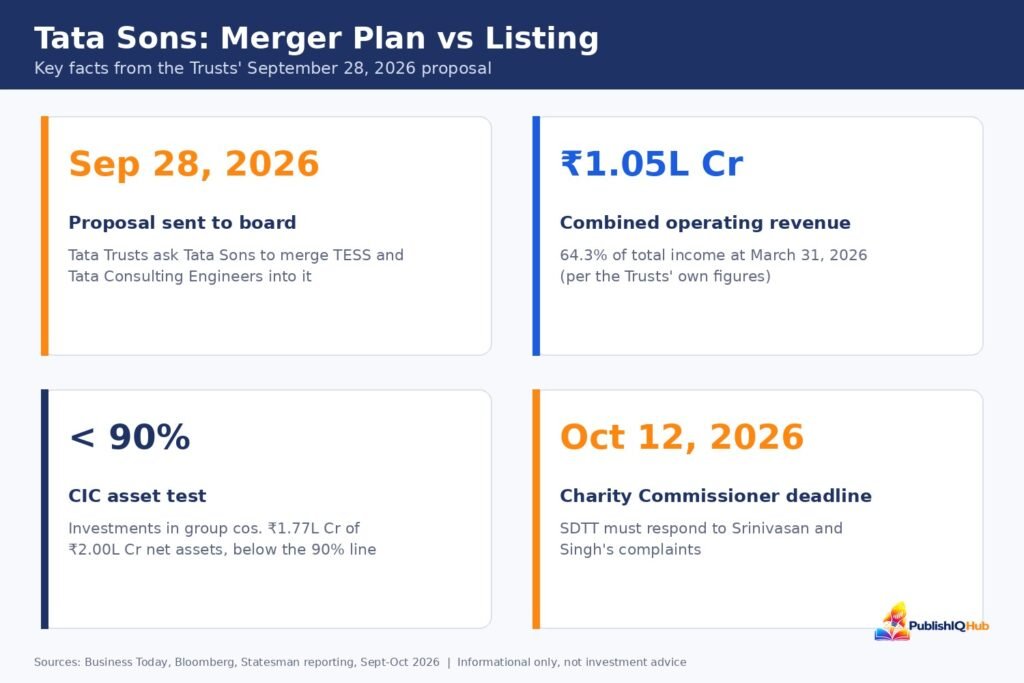
On September 28, 2026, Tata Trusts, led by Noel Tata and holding roughly 66% of Tata Sons, wrote to the Tata Sons board asking it to approve a restructuring that would keep the holding company unlisted. The plan would merge two unlisted operating companies, Tata Electronics Systems Solutions (TESS) and Tata Consulting Engineers (TCE), into Tata Sons.
The logic is arithmetic. RBI classes Tata Sons as an NBFC because of what it holds. A core investment company (CIC) must keep at least 90% of its net assets in investments in group companies. On the Trusts’ figures at March 31, 2026, the merged entity would show combined operating revenue of ₹1,05,043 crore, or 64.3% of total income, against income from financial assets of ₹40,072 crore. Net assets would be ₹2,00,158 crore, of which ₹1,77,120 crore is investment in group companies, which is below the 90% line. On that basis the Trusts argue Tata Sons would no longer meet the NBFC principal-business test or the CIC test, and could surrender its registration.
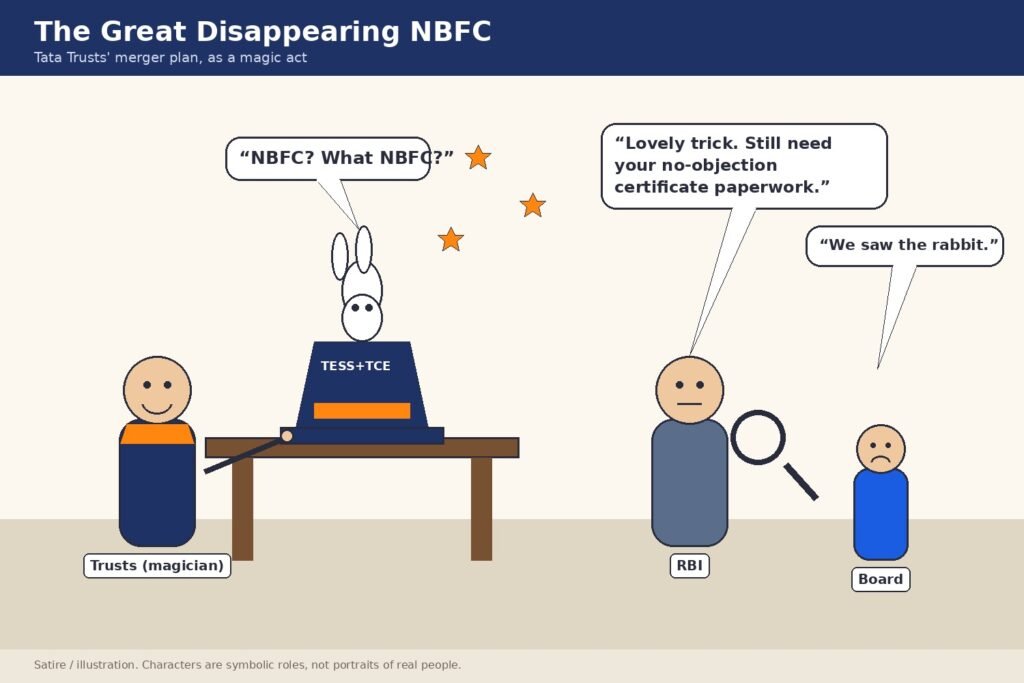
The Trusts also argue this would return Tata Sons to an operating-company model it followed for most of its history, noting that RBI classified it as an NBFC only after 2004. The next steps in their own plan are board approval and an application to RBI for a no-objection certificate, along with a compliance action plan.
Is Listing Actually Mandatory? The Argument Behind the Plan
Noel Tata has said RBI’s September 11 letter rejected the surrender request but did not direct Tata Sons to list. Lawyer Homi Ranina takes a similar line, telling BusinessToday that RBI has only asked Tata Sons to comply with its Section 45-JA guidelines and that there is no outright obligation to list. This is the opposite of how this series framed the ruling in Part 2, and it is worth being plain about the difference: the rejection is a fact, while whether it compels a listing, or can be answered by restructuring, is now a contested legal and regulatory reading.
The Statesman reports, citing unnamed sources, that the board is unlikely to approve the plan, that five directors are voting against Noel Tata in board matters, and that the move is intended to take Tata Sons outside the framework behind RBI’s listing push. No board meeting date for the proposal has been reported. The table below compares the two routes.
| Listing route | Merger route (Trusts’ plan) | |
| Who backs it | Tata Sons board majority; SP Group; Venu Srinivasan | Noel Tata and Tata Trusts’ leadership |
| How it works | Tata Sons stays an Upper-Layer NBFC and lists, as the Tata Capital precedent did | Merge TESS and TCE into Tata Sons so it fails the CIC and NBFC tests, then surrender registration |
| RBI role | Already rejected the exemption on Sept 11 | A no-objection certificate would be needed |
| Board status | Steps approved Sept 17 | Reportedly unlikely to be cleared; no meeting date reported |
| Key risk | Trusts oppose; chairmanship and AGM disputes unresolved | RBI may treat it as a workaround; Trusts’ internal approval questioned |
Harish Salve’s Position: The Case for Converting and Listing
The Statesman reports, citing unnamed sources, that the board is unlikely to approve the plan, that five directors are voting against Noel Tata in board matters, and that the move is intended to take Tata Sons outside the framework behind RBI’s listing push. No board meeting date for the proposal has been reported. The table below compares the two routes.
Senior advocate Harish Salve, a former Solicitor General of India, is advising Tata Sons chairman N. Chandrasekaran. In an ANI interview from London on September 18, reported by The Tribune, he described Tata Sons’ legal position as “legally perfect” and the RBI issue as “very straightforward.” His central point: “One important thing is they have to turn into a public company. That’s all that there is to it.” These remarks came before the Trusts’ September 28 merger proposal, and we found no reported Salve comment on that plan. His views below are those of counsel for one side, not findings of any court or regulator.
On RBI and the CIC rules. As ANI reported it, Salve said Tata Sons had argued that repaying its loans in 2019 meant it no longer needed CIC registration, and that RBI rejected this because of continuing loans at companies where Tata Sons holds majority stakes. His remedy is conversion to a public company, which he said would remove the restrictive clauses in the Articles of Association and open the way to a listing.
On the casting vote and deadlock. Salve defended the chairman’s casting vote and said a company with assets of about ₹2 lakh crore should not be paralysed by trustee disagreements; he warned that “no company can function in deadlock.” In the Singhvi-versus-Salve exchange on September 25, summarised by Business Today, he argued that Article 121 provides casting-vote mechanisms so a split among nominee directors cannot stall the company, and that nominee directors owe their fiduciary duty to Tata Sons itself rather than to the Trusts that appointed them.
On who is really objecting. In an interview with NDTV’s Rahul Kanwal, as relayed by Archyde, Salve said the Trusts had “shifted focus to the board meeting instead of the real issue,” which he described as their opposition to listing. He said Tata Sons has no real option if regulators such as RBI instruct it to list, and that the Trusts’ role is philanthropy, with Tata Sons built to generate the returns that fund it. That outlet’s summary attributes no legal argument on the validity of the board resolution to him.
On the national-interest argument. Salve said “Tatas today are the face of India,” that “a global institution cannot be run by three trustees saying we want it to go by our culture,” and that the best talent should run the group “not for the shareholders, but for India.” He pointed to the group’s interests in aviation, defence and green hydrogen as reasons for transparency. On the Trusts’ request for legal advice, he called it “a good forensic ploy.”
Sources: Business Today, Sept 19; Business Today, Sept 25; Asianet Newsable (ANI); Archyde (NDTV/TOI).
The Trusts Are Now Split
The sharper development is inside Tata Trusts. On September 25, SDTT vice-chairmen Venu Srinivasan and Vijay Singh filed complaints with the Maharashtra Charity Commissioner, alleging that SDTT is involved in Tata Sons’ commercial affairs, which they say puts its charitable status at risk, and that nominee directors’ independent decision-making is being interfered with. Srinivasan has asked for action against SDTT chairman Noel Tata, including possible suspension or removal. Trustees opposing the complaints say the filings also sought to bar Noel Tata from representing SDTT at Tata Sons general meetings. The Commissioner has asked SDTT to respond by October 12.
Srinivasan’s position has changed. He sits on the Tata Sons board as a Trusts nominee, voted for Chandrasekaran’s reappointment on September 17, and, according to reporting, now supports a listing even though the Trusts had earlier passed resolutions to stay private. Four other SDTT trustees are challenging him and Singh for undermining that long-standing position, and the report says Srinivasan and Singh were surprised by the merger proposal and were not consulted.
This matters for the listing question because Sir Ratan Tata Trust (SRTT) has been unable to hold meetings since a May order from the Maharashtra Charity Commissioner. If the Srinivasan and Singh request succeeded in limiting how SDTT can vote, the Trusts’ ability to act at the Tata Sons AGM would shrink further. The Statesman notes the AGM is due before December and that it is where Chandrasekaran’s continuation will be decided, because his reappointment still needs shareholder approval.
Timeline: The Last Three Weeks
| Date | Event |
| Sep 11, 2026 | RBI rejects Tata Sons’ bid to surrender its CIC registration (covered in Part 2). |
| Sep 17, 2026 | Board votes 4-1 to reappoint Chandrasekaran and to take steps toward a listing; Noel Tata dissents on both. |
| Sep 25, 2026 | Venu Srinivasan and Vijay Singh file complaints with the Maharashtra Charity Commissioner about Sir Dorabji Tata Trust (SDTT). |
| Sep 28, 2026 | Tata Trusts write to the Tata Sons board proposing a merger of two unlisted units into Tata Sons to keep it unlisted. |
| Oct 1, 2026 | Reports put the 26-stock Tata group market-cap loss since Aug 12 at about ₹2.66 lakh crore (about 10%). |
| Oct 6, 2026 | Charity Commissioner asks SDTT to respond to the complaints by October 12. |
| Oct 9, 2026 | Dispute still unresolved; no court filing or hearing date reported by either side. |
What the Dispute Has Cost Group Stocks
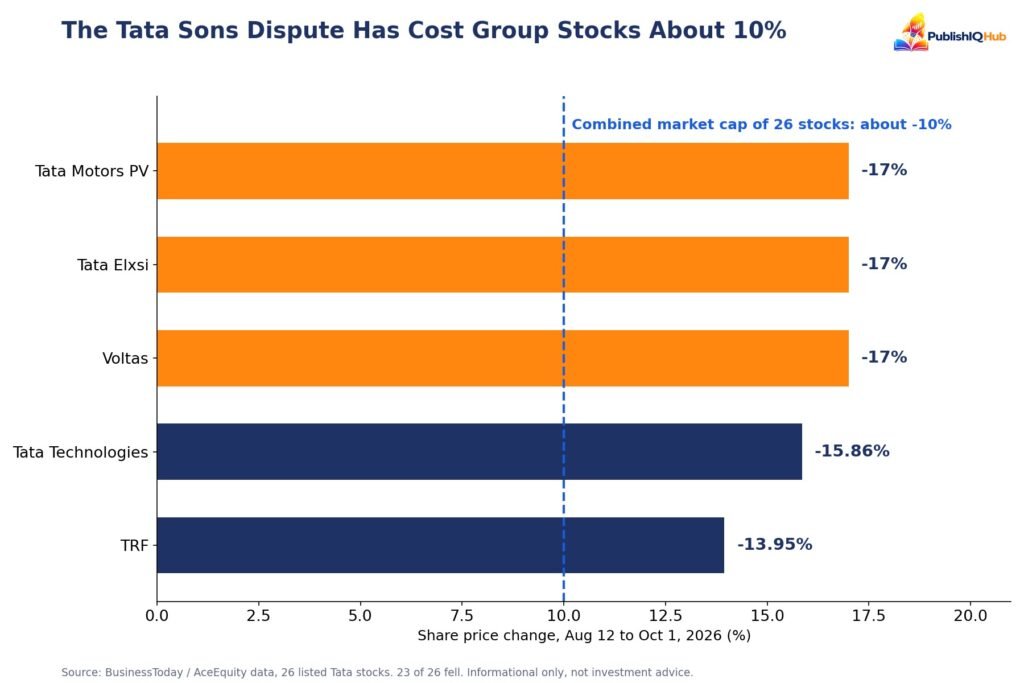
The September 15 rally in Tata Chemicals and Tata Investment Corporation has been overwhelmed by a broader sell-off. Across 26 listed Tata stocks, combined market value fell by ₹2,65,748 crore, about 10%, from ₹27.03 lakh crore to ₹24.37 lakh crore between August 12 and October 1. Twenty-three of the 26 stocks fell and a dozen dropped by double digits.
- Tata Motors Passenger Vehicles, Tata Elxsi and Voltas fell about 17% each; Tata Technologies fell 15.86% and TRF 13.95%.
- TCS and Trent fell 12% to 14%; Titan, Tata Consumer Products and Tata Capital fell 10% to 11%.
- Tata Chemicals holds 2.53% of Tata Sons. For Tata Investment Corporation, Bloomberg’s figure is 0.08%, which differs from the 0.25% cited in Part 2, so treat that holding as a range until the company’s filing is checked.
Many of the steepest fallers have no direct stake in Tata Sons at all. That points to governance and ownership-rights worry across the group rather than a repricing of Tata Sons’ unlisted value, the way the Tata Chemicals and Tata Investment Corporation moves were. Business Today’s Oct 9 coverage reports industry figures warning that sidelining a 66% shareholder could unsettle promoters with much smaller stakes, and one corporate leader compared the risk for foreign investors to the Vodafone retrospective-tax episode.
What Is Still Unresolved
- No court filing. As of October 9, no NCLT or High Court case has been reported over the chairmanship vote or the RBI ruling, despite earlier signals that Tata Trusts were preparing one. RBI’s September 15 caveat in the Bombay High Court is the only court-related step reported so far.
- No RBI response to the merger idea. Any restructuring would need an RBI no-objection certificate, and none has been reported.
- The AGM. It must be held by December 31, 2026, and Chandrasekaran’s reappointment needs shareholder approval there, with SRTT still barred from meeting.
- The Charity Commissioner. SDTT’s response is due today, October 12, and the Commissioner has made no reported decision on the SRTT case after five months.
What This Means for Retail Investors
Nothing about how to buy Tata Group exposure has changed: Tata Sons still cannot be bought on any exchange, and access runs through listed Tata companies via a demat account with a SEBI-registered stockbroker. What has changed is the kind of risk. In Part 2, the headline question was when Tata Sons would list. It is now whether it will list at all, who gets to vote on that, and whether the Trusts can act as one body. A merger would also change what Tata Sons is, and with it the logic of the stocks that have traded as proxies for its unlisted value. Price moves tied to these headlines say little about the operating performance of the companies themselves, so check results and valuations before reacting to either direction
The Bottom Line
Tata Sons now has two competing answers to the same RBI ruling. The board has voted to start listing steps, and chairman N. Chandrasekaran’s counsel, Harish Salve, says the company simply has to become a public company. The Trusts, led by Noel Tata, have asked the board to merge two unlisted units into Tata Sons so it would no longer count as an NBFC, and their own vice-chairmen are now challenging them before the Maharashtra Charity Commissioner. The market has taken about 10% off 26 listed Tata stocks while this plays out. Nothing is settled: there is no court ruling, no RBI position on the merger, and the AGM must still be held by December 31, 2026. For retail investors, the route to Tata Group exposure is unchanged, which is through the listed companies and their own results, with a SEBI-registered advisor, rather than on the strength of any single boardroom headline.
Frequently Asked Questions
What is the Tata Trusts’ merger proposal?
On September 28, 2026, Tata Trusts asked the Tata Sons board to merge Tata Electronics Systems Solutions and Tata Consulting Engineers into Tata Sons. The Trusts say this would push operating revenue above financial income and investments in group companies below 90% of net assets, so Tata Sons would stop qualifying as an NBFC or core investment company and could surrender its registration.
Will the Tata Sons board approve the merger?
Reports say it is unlikely to. The Statesman, citing unnamed sources, says five directors are voting against Noel Tata’s position and that no board meeting date has been set. Any restructuring would also need an RBI no-objection certificate.
Is Tata Sons still required to list?
RBI rejected Tata Sons’ request to leave NBFC registration on September 11, and the board has approved steps toward listing. Noel Tata and some lawyers argue RBI has not formally directed a listing. No new deadline has been set, so the position remains contested.
Why are Venu Srinivasan and Vijay Singh complaining about Tata Trusts?
They told the Maharashtra Charity Commissioner on September 25 that SDTT is interfering in Tata Sons’ commercial affairs and nominee directors’ independence, and asked for an inquiry. SDTT was asked to respond by October 12. Four other trustees say the two are undermining the Trusts’ stance that Tata Sons should stay private.
How much have Tata Group stocks fallen?
Business Today reports that 26 listed Tata stocks lost about ₹2.66 lakh crore, roughly 10% of combined market value, between August 12 and October 1, 2026. Tata Motors Passenger Vehicles, Tata Elxsi and Voltas fell about 17% each.
What is Harish Salve’s opinion on the Tata Sons listing?
Salve, who is advising chairman N. Chandrasekaran, told ANI on September 18 that Tata Sons’ legal position is “legally perfect” and that it has to become a public company. He defends the chairman’s casting vote under Article 121 and says nominee directors owe their duty to Tata Sons. The Trusts’ counsel, Abhishek Manu Singhvi, disputes this. We found no reported Salve comment on the merger plan.
Has anyone gone to court yet?
Not according to reporting up to October 9. Tata Trusts had signalled a possible challenge to the chairmanship vote and RBI filed a caveat in the Bombay High Court on September 15, but no case or hearing date has been reported.