Quick Answer
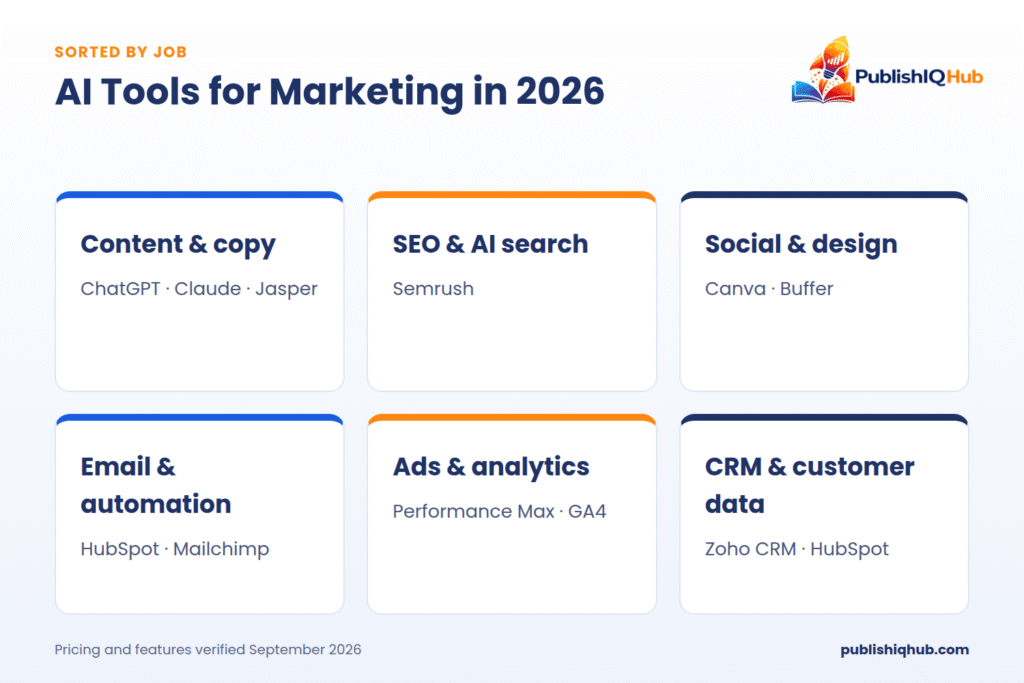
What are the best AI tools for marketing? The best AI tools for marketing in 2026 are ChatGPT and Claude for content, Semrush for SEO and AI search visibility, Canva and Buffer for design and social media, HubSpot and Mailchimp for email and automation, Google Performance Max for ads, and Zoho CRM for customer data. Most of them offer a free plan to start.
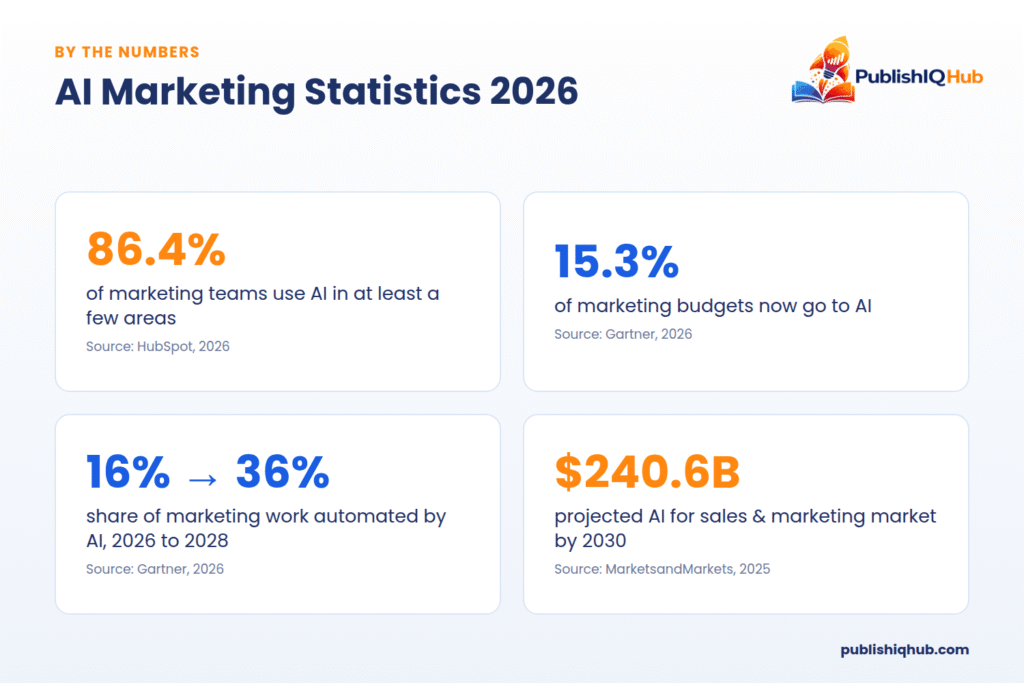
Almost every marketing team you talk to now uses AI tools for marketing in some form. HubSpot’s 2026 State of Marketing report found that 86.4% of marketing teams use AI in at least a few areas of their work. So the question is no longer whether to use AI tools for marketing. It’s which ones deserve a place in your stack, and which ones are just another monthly bill.
That’s harder than it sounds, because thousands of products now call themselves marketing AI software. This guide keeps it practical. You’ll get 11 tools sorted by the job they do, verified pricing (including INR where the vendor shows it), a list of genuinely free AI marketing tools, a real automation workflow you can copy, and a checklist for choosing well.
What Are AI Tools for Marketing, and How Are They Different from Regular Marketing Software?
AI tools for marketing are software products that use machine learning or generative AI to create, predict, personalise or automate marketing work. A regular email platform sends the campaign you built. An AI-powered one can write the subject line, pick the best send time for each subscriber and tell you which leads are most likely to buy.
The difference comes down to three shifts:
- From rules to predictions. Old automation ran on “if this, then that” rules you wrote by hand. AI tools for digital marketing learn from your data and adjust on their own.
- From templates to generation. Instead of filling in a template, you describe what you need and the tool drafts copy, images or video.
- From reports to answers. You can ask a question in plain English, like “which campaign brought the cheapest leads last month?”, and get a direct reply.
This isn’t unique to marketing. The same pattern is playing out in AI-driven HR software and on the factory floor, as seen with the top AI manufacturing companies in the USA. Marketing just happens to be one of the functions where adoption of AI tools for marketing moved fastest.
What Do the Numbers Say About Generative AI in Marketing?
A few figures worth knowing before you spend money on AI tools for marketing:
- The AI for sales and marketing market was valued at USD 57.99 billion in 2025 and is projected to reach USD 240.58 billion by 2030, a 32.9% CAGR, according to MarketsandMarkets (2025).
- CMOs now put an average of 15.3% of their marketing budgets into AI, yet only 30% say their AI capabilities are mature, per Gartner’s 2026 CMO Spend Survey.
- Marketing leaders expect AI-driven automation of marketing work to jump from 16% in 2026 to 36% by 2028, based on a separate Gartner survey (2026).
- 78% of marketers say they need more personalised content than they can produce, according to Salesforce’s State of Marketing report (2026).
- Roughly one-third of marketers using AI save 10 to 14 hours a week, and another third save more than 15 hours, per HubSpot (2026).
Put simply, budgets are moving to marketing AI software faster than teams are learning to use it. Picking the right AI tools for marketing matters more than picking many.
The Best AI Tools for Marketing in 2026, Sorted by Job
Rather than one long ranked list, the AI tools for digital marketing below are grouped by the work they handle. Most teams need one tool per group, not three.
AI Content Marketing Tools
1. ChatGPT (OpenAI)
- What it does: Drafts blog outlines, ad copy, product descriptions and email sequences from a prompt.
- Best for: Solo marketers and small teams who need a flexible all-rounder.
- Pricing: Freemium. OpenAI launched the Go plan in India at ₹399 a month, with Plus and Pro tiers above it.
- Use case: A Pune-based D2C skincare brand writes 30 Instagram captions in one sitting, then edits them for its own voice.
2. Claude (Anthropic)
- What it does: Long-form writing, editing, research summaries and analysis of large documents like survey exports or brand guidelines.
- Best for: Content teams that work with long briefs and need careful, well-structured drafts.
- Pricing: Free plan available. Pro costs Pro costs $20 amount billed monthly(17 a month billed annually), as listed on Claude’s pricing page.
- Use case: An agency uploads a 40-page client report and asks for a two-page executive summary plus five LinkedIn post angles.
3. Jasper
- What it does: A marketing-specific writing platform with brand voice controls, audience profiles and content agents.
- Best for: Mid-size teams that need every writer to sound like the same brand.
- Pricing: Paid only. Pro is $69 per seat a month, or $59 billed yearly, with a 7-day free trial.
- Use case: A SaaS company loads its style guide once, and every campaign draft follows it without manual policing.
SEO and AI Search Visibility
4. Semrush
- What it does: Keyword research, site audits, rank tracking and, newer, tracking of how your brand shows up in AI answers.
- Best for: Teams that care about both Google rankings and visibility in ChatGPT or Google AI Overviews.
- Pricing: A free account gives 10 reports a day. The SEO plan starts at $117.33 a month billed annually.
- Use case: A B2B firm checks which prompts in AI tools mention its competitors but not itself, then plans content around the gap.
For AI tools for digital marketing, this matters more than it did a year ago. Salesforce found that 88% of marketers are now optimising for AI-generated responses in tools like ChatGPT and Google AI Overview. If you publish content, follow Google’s own guidance on generative AI content: AI-assisted pages are fine, but pages mass-produced without adding value can count as scaled content abuse.
AI Social Media Marketing Tools and Design
5. Canva
- What it does: Design tool with AI features that generate images, resize layouts and match styles across a set of posts.
- Best for: Anyone who makes social graphics, carousels or presentations without a full-time designer.
- Pricing: Free plan includes up to 20 AI uses a month. Pro is $144 a year for one person.
- Use case: A café chain in Bengaluru turns one menu design into Instagram, WhatsApp status and print sizes in minutes.
If image generation is your main need, see our round-up of the best AI image generation tools for more options.
6. Buffer
- What it does: Schedules and publishes posts across channels, with a built-in AI Assistant for rewriting and repurposing.
- Best for: Small businesses managing three or fewer social accounts.
- Pricing: Free for up to 3 channels and 10 scheduled posts per channel. Essentials starts at $5 per channel a month.
- Use case: A freelance consultant repurposes one blog post into a week of LinkedIn and X updates.
AI Email Marketing Tools and Automation
7. HubSpot
- What it does: CRM plus email, landing pages, forms and workflows. The free CRM includes Breeze Assistant and an AI content writer.
- Best for: B2B companies that want marketing and sales data in one place.
- Pricing: Free CRM for up to 2 users. Marketing Hub Starter begins at $7 per seat a month billed annually; Professional starts at $800 a month.
- Use case: A software reseller scores inbound leads and sends the hottest ones straight to sales.
8. Mailchimp
- What it does: Email campaigns, audience segments and automated journeys, with generative AI features on selected plans.
- Best for: E-commerce stores and small businesses starting with email.
- Pricing: Free for up to 250 contacts and 500 sends a month. Essentials starts at $13 a month.
- Use case: An online saree store sends abandoned-cart emails that trigger automatically.
Ads and Analytics
9. Google Performance Max
- What it does: A goal-based Google Ads campaign type that uses AI to place your ads across Search, YouTube, Display, Discover, Gmail and Maps from one campaign, as explained in Google Ads Help.
- Best for: Advertisers with clear conversion goals and decent conversion data.
- Pricing: No tool fee; you pay only for ad spend.
- Use case: A coaching institute feeds in its best-performing creatives and lets bidding shift budget toward the cheapest enquiries.
10. Google Analytics 4
- What it does: Tracks website and app behaviour, with predictive metrics such as purchase probability when your data volume qualifies.
- Best for: Every website owner.
- Pricing: Free standard version.
- Use case: Build an audience of likely buyers and share it with Google Ads.
CRM and Customer Data
11. Zoho CRM
- What it does: Indian-built CRM with Zia, an AI assistant that gives predictions, insights and recommendations.
- Best for: Indian SMEs that want INR billing and local support.
- Pricing: Free for up to 3 users. Paid plans run from ₹800 per user a month (Standard); Zia’s AI sales assistant arrives on Enterprise at ₹2,400 per user a month, billed annually.
- Use case: A real estate developer in Hyderabad uses Zia to flag which site-visit leads are going cold.
CRM and Customer Data
| Tool | Category | Best for | Free plan? | Starting paid price |
| ChatGPT | Content and copy | All-round drafting | Yes | ₹399/month (Go, India) |
| Claude | Content and analysis | Long-form and research | Yes | $20/month (Pro) |
| Jasper | Brand content | Consistent brand voice | 7-day trial | $59/seat/month (yearly) |
| Semrush | SEO and AI search | Rankings plus AI visibility | Limited free account | $117.33/month (yearly) |
| Canva | Design | Social graphics | Yes | $144/year (Pro) |
| Buffer | Social scheduling | Small social teams | Yes | $5/channel/month |
| HubSpot | CRM and automation | B2B lead management | Yes | $7/seat/month (yearly) |
| Mailchimp | Email marketing | E-commerce email | Yes | $13/month |
| Performance Max | Paid ads | Conversion-focused ads | No tool fee | Ad spend only |
| Google Analytics 4 | Analytics | Tracking and prediction | Yes | Free |
| Zoho CRM | CRM | Indian SMEs | Yes | ₹800/user/month |
What Are the Best Free AI Marketing Tools in 2026?
Yes, you can build a working AI marketing setup for ₹0 using free AI marketing tools. The catch is the limits. Here’s what the free plans actually give you:
- ChatGPT Free: Everyday text chats, with limited uploads and restricted access to advanced features.
- Claude Free: Chat, web search, file creation and memory, within usage limits.
- Canva Free: 1,000+ design types, over 1.6 million templates and up to 20 AI uses a month.
- Buffer Free: 3 channels, 10 scheduled posts per channel and the AI Assistant.
- HubSpot Free CRM: 2 users, 1,000 contacts, Breeze Assistant, AI content writer and a chatbot builder.
- Mailchimp Free: 250 contacts, 500 emails a month (maximum 250 a day).
- Zoho CRM Free: Up to 3 users with contact management and basic workflows.
- Google Analytics 4: Free for most businesses.
A realistic stack of AI marketing tools for small business owners looks like this: Claude or ChatGPT for writing, Canva for visuals, Buffer for scheduling, HubSpot as your CRM and GA4 for measurement. When a limit starts to hurt, upgrade that one tool, not all five.
How Does AI and Marketing Automation Actually Work?
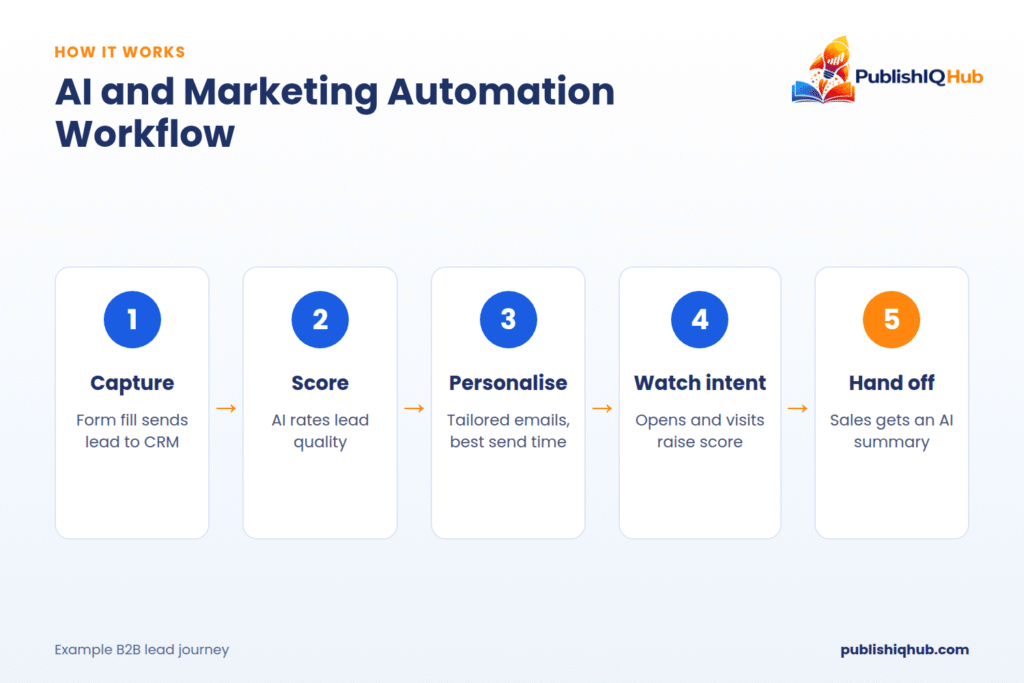
AI and marketing automation work together by using data to decide what happens next for each lead, without someone manually pushing every step. Traditional automation follows fixed rules. AI adds scoring, timing and content choices that adjust for each person. The newest shift, agentic AI marketing, goes a step further: AI agents that plan and run parts of a campaign under human review.
Here’s a realistic workflow for a B2B software company:
- Capture. A visitor downloads a pricing guide from a landing page. The form sends their details to the CRM.
- Enrich and score. The CRM adds company size and industry. Marketing AI software then scores the lead based on how similar past leads behaved.
- Personalise. High-scoring leads get a three-email sequence written for their industry. AI picks the send time for each person.
- Watch for intent. If the lead opens the pricing email twice and visits the demo page, the score jumps.
- Hand off. Sales gets an alert with a short AI summary of everything the lead has done, so the first call doesn’t start cold.
Gartner’s data shows only 16% of marketing work is automated with AI today, so most teams have plenty of room to grow their use of AI and marketing automation. That said, some companies prefer to hand the operational side to a partner. If that’s you, our list of top Indian BPO companies covers firms that run campaign operations and customer support at scale.
How to Choose the Right Marketing AI Software and AI Tools for Marketing
Before you enter a card number for any marketing AI software, run through this checklist:
- Budget. Compare AI marketing tools on the real monthly cost, including per-seat and per-channel fees. A plan that looks cheap per seat can multiply fast once the whole team needs a login.
- Team size. A two-person team rarely needs enterprise features. Start with free AI marketing tools and upgrade when a limit actually blocks you.
- Integrations. Check that the tool connects to your CRM, website and ad accounts. If your stack is complicated, an IT outsourcing partner in India can handle the setup and integration work.
- Data privacy. Indian businesses need to plan for consent and data-handling duties under the Digital Personal Data Protection Act. Read the DPDP Rules, 2025 notified by the Government of India and ask each vendor where your customer data is stored and whether it trains their models.
- Learning curve. The most expensive AI marketing tools are the ones nobody opens. Run a two-week trial with the people who will use them daily.
Can AI Replace Digital Marketers? The Risks You Should Know
No, AI won’t replace good marketers, but marketers who use AI well will outpace those who don’t. HubSpot found that 73.4% of marketers see AI as assisting them rather than replacing them. Still, the risks are real:
- Accuracy. AI tools can state wrong facts with full confidence. Every stat, price and claim needs a human check.
- Brand voice. Unedited AI copy tends to sound the same across brands. Readers notice.
- Data privacy. Pasting customer lists into a free chatbot may break your own privacy commitments.
- Over-automation. AI and marketing automation can multiply mistakes as easily as wins. Salesforce found that 84% of marketers admit to running generic campaigns. More automation without better data only makes that worse.
- Staff anxiety. Gartner reports that 80% of CMOs see staff fear and anxiety as a major barrier to AI adoption. Training fixes this faster than mandates do.
The teams getting the best results use AI tools for marketing on first drafts, data crunching and repetitive steps, then put their own judgement on top.
Final Thoughts
The best AI tools for marketing are the ones your team actually uses every week. Start with free AI marketing tools, pick one workflow to automate and measure the hours you save. Upgrade only when a limit gets in your way, and keep a human editor between every AI draft and your customers. That’s how AI and marketing automation earn their keep.
Want more practical guides like this? Explore the PublishIQHub blog for more research on AI, B2B services and finance.
Frequently Asked Questions
What is the best free AI tool for marketing in 2026?
There’s no single best option among free AI marketing tools; it depends on the job. For writing, ChatGPT Free or Claude Free work well. For design, Canva Free gives 20 AI uses a month. For CRM and email, HubSpot’s free CRM includes an AI content writer and Breeze Assistant for up to two users.
How can small businesses use AI for marketing?
Small businesses can use AI tools for marketing to write content, design posts, schedule social media and follow up with leads. Start with free plans from Canva, Buffer and HubSpot. Focus on one workflow, such as turning one blog into a week of posts, before adding more tools or paying for upgrades.
How do I use AI for marketing automation?
Connect your lead capture forms to a CRM, then use AI to score leads and personalise follow-up emails. Tools like HubSpot and Mailchimp let you build triggered sequences. Begin with one journey, such as a welcome series or abandoned-cart email, measure results and expand once it works.
Can AI replace digital marketers?
No. AI handles repetitive tasks and first drafts, but strategy, creativity and judgement still need people. HubSpot’s 2026 research shows 73.4% of marketers view AI as an assistant, not a replacement. Marketers who learn AI tools for digital marketing are likely to become more valuable, not less.
What is the difference between marketing AI software and marketing automation?
Marketing automation follows rules you set; marketing AI software learns from data and makes its own recommendations. An automation tool sends email two on day three. An AI tool decides the best day for each person and may write a different subject line for each segment.
Is it safe to use AI marketing tools with customer data in India?
It can be, if you choose vendors carefully and follow consent rules. Under India’s DPDP Act and Rules, you need valid consent and clear purposes for personal data. Check where each vendor stores data, whether it trains models on your inputs and whether you can delete records on request.
How much do AI marketing tools cost?
Many start free, and paid plans range from around $5 a month to thousands. Buffer starts at $5 per channel, Mailchimp at $13 and Claude Pro at $20 a month. Enterprise tools like HubSpot Professional start at $800 a month, plus onboarding fees.