Human Resources used to be the department people associated with paperwork, filing cabinets, and slow email threads. Not anymore. Walk into almost any mid-sized or large company today and you’ll find AI quietly running in the background of recruiting, onboarding, performance reviews, payroll, and even employee wellbeing check-ins.
This shift isn’t hype — it’s happening at scale. AI and Human Resources have become so intertwined that it’s now hard to talk about modern HR strategy without talking about AI-based HR software. But adoption doesn’t automatically mean success. Plenty of HR teams are experimenting with tools without a clear plan, and plenty of employees still don’t trust the technology making decisions about their careers.
This guide breaks down what AI in HR actually means, where it delivers real value, which AI HR tools are leading the market in 2026, and how to evaluate them — without the marketing fluff.
What Is AI in HR? (Quick Answer)
AI in HR refers to the use of machine learning, natural language processing, and predictive analytics inside human resources software to automate, accelerate, or improve tasks like recruiting, onboarding, performance management, payroll, and employee engagement.
Instead of HR teams manually screening resumes or scheduling interviews, AI-based HR software can do it in seconds — while also surfacing patterns humans would take weeks to notice, like flight-risk indicators or skills gaps across a workforce.
In short: AI doesn’t replace HR. It replaces the repetitive parts of HR, freeing people teams to focus on strategy, culture, and the human side of “human resources.”
Why AI and Human Resources Are Becoming Inseparable
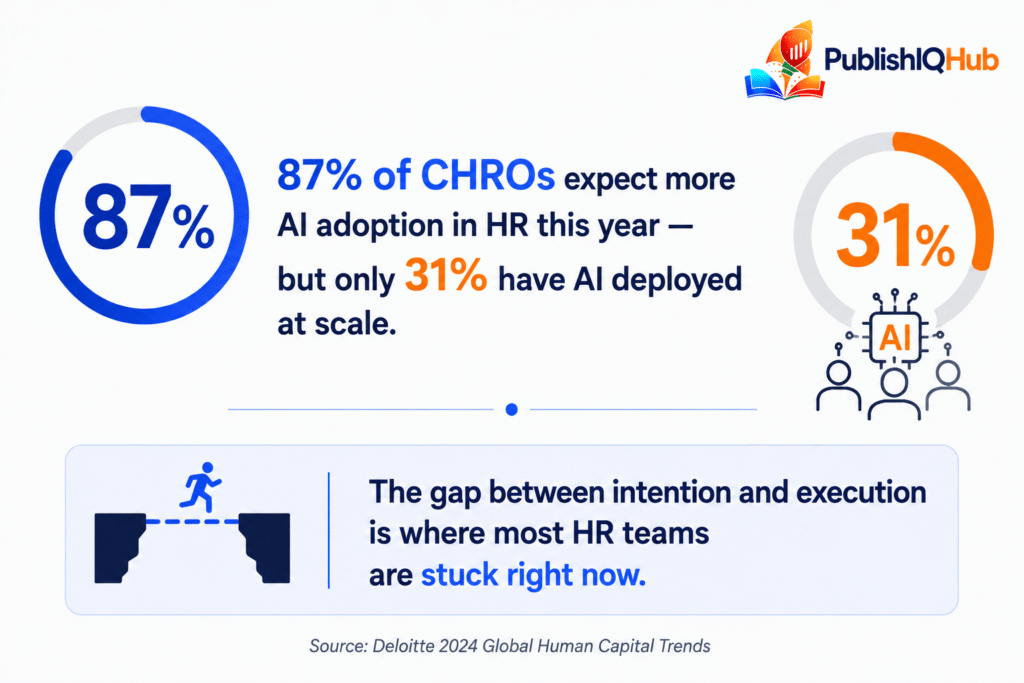
The scale of this shift is bigger than most people realize. According to SHRM’s State of AI in HR 2026 report, 92% of CHROs expect AI to be further integrated into the workforce this year, and 87% are forecasting greater adoption of AI within HR processes — up from 83% just a year earlier.
That’s not a fringe trend. That’s nearly every Chief HR Officer in the country planning around AI as a core part of how their department will function going forward.
There are a few forces driving this:
- Talent shortages are pushing recruiting teams to move faster with fewer people.
- Hybrid and remote work created more employee data than HR teams can manually analyze.
- Rising compliance complexity (pay transparency laws, DEI reporting, global hiring rules) needs software that can track and flag issues automatically.
- Employee expectations have shifted — people expect the same instant, personalized digital experiences at work that they get from consumer apps.
Where AI HR Tools Are Actually Being Used
AI-based HR software isn’t one single thing — it’s a category that spans the entire employee lifecycle. Here’s where it’s showing up most:
1. Recruiting and Talent Acquisition
This is, by far, the most mature use case. AI recruitment software can screen resumes, rank candidates against a job description, auto-schedule interviews, run chatbot-based first-round screening, and even conduct structured video interview analysis.
2. Onboarding
AI-driven onboarding tools personalize the first 90 days for a new hire — surfacing the right training modules, answering policy questions through a chatbot, and flagging when a new employee seems disengaged based on activity patterns.
3. Performance Management
Instead of a single annual review, AI HR platforms now pull in continuous signals — project completion, peer feedback, goal tracking — to give managers a real-time picture of performance instead of a once-a-year snapshot.
4. Learning & Development (L&D)
AI recommends personalized learning paths based on skill gaps, career goals, and even internal mobility opportunities — matching employees to roles they didn’t know existed inside their own company.
5. People Analytics and Retention
Predictive models flag flight risk, burnout indicators, and engagement dips before they show up in an exit interview.
6. Payroll and Compliance
AI checks payroll runs for anomalies, flags compliance risks across jurisdictions, and automates tax and benefits calculations.
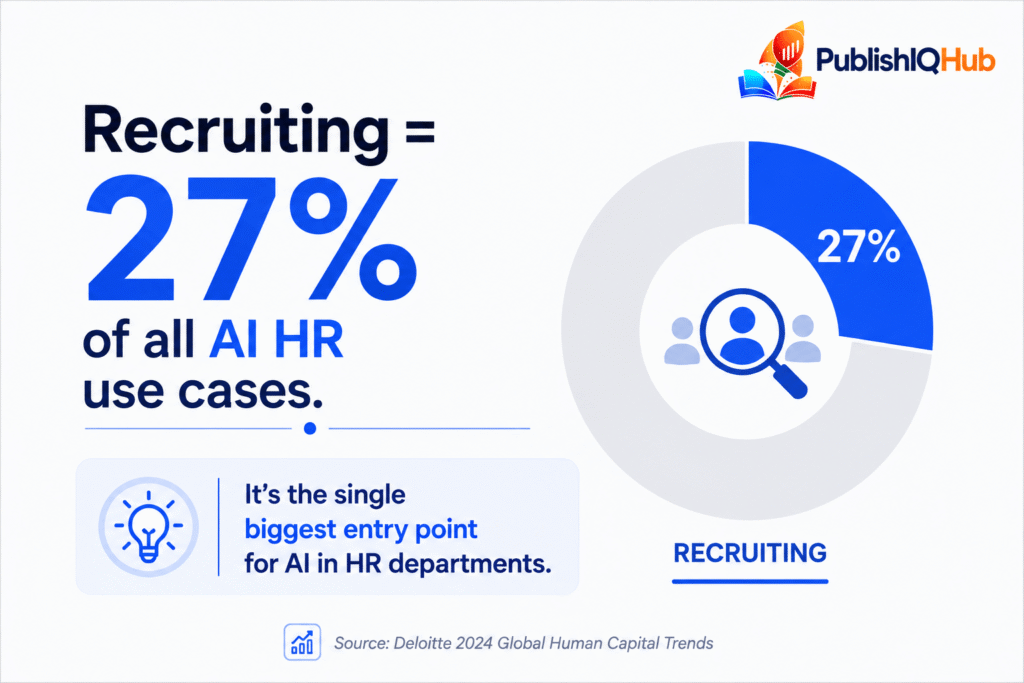
This breadth of use explains why recruiting still leads adoption. SHRM’s research found HR professionals report AI is most common in recruiting (27%), HR technology (21%), learning and development (17%), and employee experience (14%), while areas like DEI, board relations, and compliance still lag behind.
How AI-Based HR Software Actually Works (Without the Jargon)
Most AI HR tools are built on a few core technologies working together:
- Natural Language Processing (NLP) — lets chatbots understand employee questions and lets systems read and interpret resumes, reviews, and open-text survey answers.
- Machine learning models — trained on historical HR data to predict outcomes like attrition risk or candidate success.
- Generative AI — increasingly used to draft job descriptions, write performance review summaries, and generate personalized learning content.
- Predictive analytics — turns raw HR data (tenure, engagement scores, promotion history) into forward-looking insights.
The best AI HR software platforms don’t just bolt AI onto old workflows — they redesign the workflow around what AI makes newly possible, like real-time coaching nudges for managers or dynamic org-wide skills mapping.
The Real Benefits of AI HR Software
- Speed — resume screening that took days now takes minutes.
- Consistency — the same criteria applied to every candidate or review, reducing (though not eliminating) inconsistent human judgment.
- Personalization at scale — thousands of employees can get individualized learning paths or career suggestions that would be impossible to build manually.
- Cost savings — fewer manual hours spent on repetitive admin work.
- Better retention forecasting — HR teams can intervene before a valued employee resigns, not after.
Enterprises are already leaning in heavily. One industry analysis notes that 70%+ of large enterprises now use AI in at least one HR function, signaling that AI in HR has moved well past the “early adopter” phase into mainstream operational reality.
The Honest Challenges Nobody Talks About Enough
AI in HR isn’t a magic fix, and pretending otherwise does a disservice to anyone evaluating these tools.
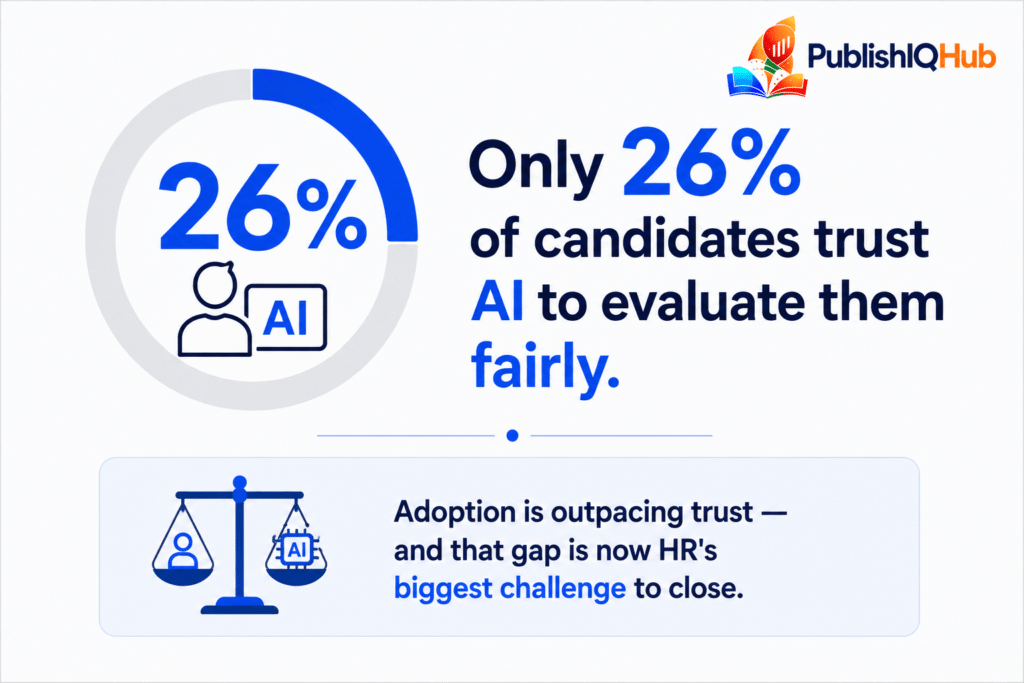
Trust is a real problem. Candidates are not convinced AI makes hiring fairer. Data from a 2026 Greenhouse candidate survey found that only 26% of applicants trust AI to evaluate them fairly during the hiring process — even as employers increasingly use it. That gap in trust matters, because candidate experience directly affects employer brand and offer-acceptance rates.
Other recurring challenges:
- Bias risk. AI models trained on historical hiring data can inherit and amplify past biases if not carefully audited.
- Data quality issues. Messy, incomplete, or siloed HR data leads to unreliable AI recommendations — garbage in, garbage out.
- Regulatory uncertainty. Laws like the EU AI Act and various U.S. state-level automated hiring laws are still evolving, creating compliance ambiguity.
- Change management. Even great software fails if managers and employees don’t trust or understand how to use it.
- Over-automation. Some companies let AI make decisions that really need a human judgment call — like final termination or promotion decisions.
Top 10 AI-Based HR Software Companies in 2026
Here’s a look at 10 well-known platforms currently shaping the AI HR tools landscape. Each has a different specialty, so the “best” one really depends on company size, budget, and which part of the employee lifecycle you’re trying to improve.
- Workday — A large enterprise HR and finance suite with AI (“Workday Illuminate”) built into skills intelligence, talent optimization, and workforce planning.
- SAP SuccessFactors — Enterprise-grade HCM (Human Capital Management) software with AI-driven performance management, succession planning, and generative-AI writing assistance for HR admins.
- BambooHR — Popular with small and mid-sized businesses; uses AI for resume screening, HR chatbot support, and automated onboarding workflows.
- Eightfold AI — A talent intelligence platform built specifically around deep-learning talent matching — pairing candidates and internal employees to roles based on skills, not just job titles.
- HireVue — Known for AI-assisted video interviewing, structured interview scoring, and chatbot-based candidate screening at high volume.
- Paradox — A conversational AI recruiting assistant (“Olivia”) focused on high-volume, frontline, and hourly hiring — handling scheduling and FAQs via chat/SMS.
- Greenhouse — Applicant tracking system (ATS) with AI-powered structured hiring, interview kits, and candidate-matching tools built for consistency and DEI-conscious hiring.
- Lattice — People management platform using AI for performance review summarization, goal tracking, and engagement survey analysis.
- Rippling — All-in-one HR, IT, and payroll platform with AI-powered workflow automation and anomaly detection across HR and finance data.
- Zoho People — Budget-friendly HRMS with AI-driven chatbot assistance, attendance anomaly detection, and performance analytics — popular with SMBs.
AI HR Software Comparison Table
| Company | Best For | Standout AI Feature | Company Size Fit |
| Workday | Large enterprises | Workforce/skills intelligence (Illuminate) | Enterprise |
| SAP SuccessFactors | Global enterprises | AI performance & succession planning | Enterprise |
| BambooHR | Small–mid businesses | AI resume screening & HR chatbot | SMB |
| Eightfold AI | Skills-based hiring | Deep-learning talent matching | Mid–Enterprise |
| HireVue | High-volume hiring | AI video interview scoring | Mid–Enterprise |
| Paradox | Frontline/hourly hiring | Conversational recruiting assistant | Mid–Enterprise |
| Greenhouse | Structured, consistent hiring | AI candidate matching & interview kits | Mid–Enterprise |
| Lattice | Performance & engagement | AI review summaries & survey insights | SMB–Mid |
| Rippling | All-in-one HR/IT/payroll | AI workflow automation | SMB–Mid |
| Zoho People | Budget-conscious teams | AI chatbot & attendance analytics | SMB |
This is where AI-based HR software as a category is heading: enterprise players (Workday, SAP) building deep AI into workforce planning, mid-market specialists (Eightfold, HireVue, Paradox, Greenhouse) owning specific parts of the hiring funnel, and SMB-friendly tools (BambooHR, Zoho People, Rippling) packaging AI as a built-in convenience rather than a separate product.
The Market Is Growing Fast — And That’s Not Slowing Down
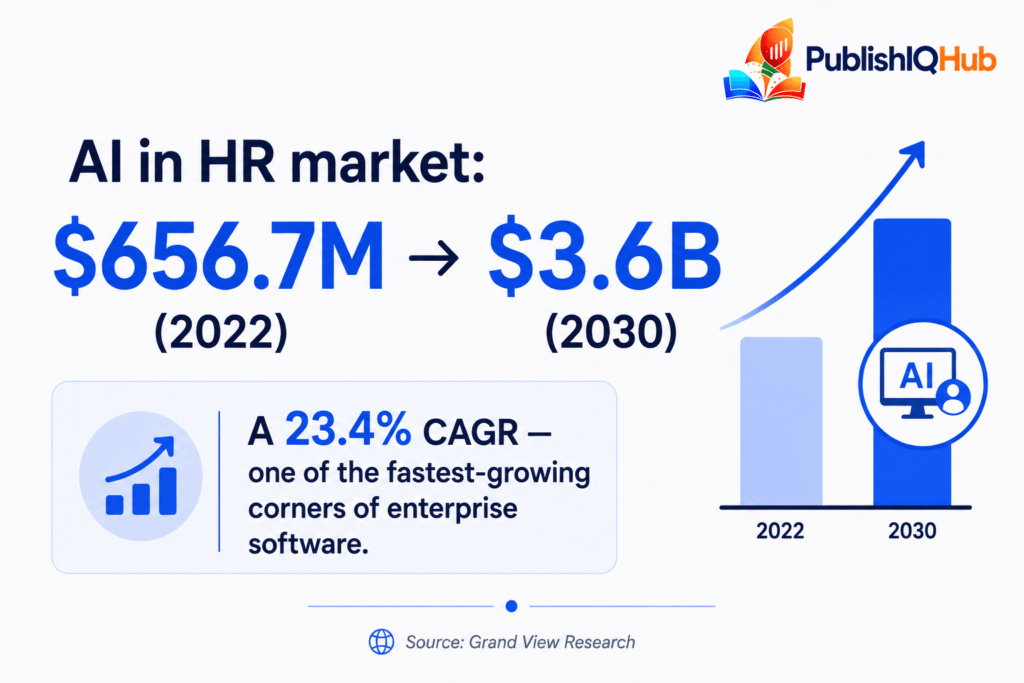
The numbers back up what’s happening on the ground. The global AI in HR market was valued at roughly $656.7 million in 2022 and is projected to reach $3.6 billion by 2030, growing at a compound annual growth rate (CAGR) of 23.4%.
That’s more than a fivefold increase in under a decade — a clear signal that AI HR tools are not a passing trend but a structural shift in how HR departments will operate going forward.
How to Choose the Right AI HR Software for Your Company
Before signing a contract, run through this checklist:
- Start with the problem, not the tool. Are you struggling with slow hiring, high attrition, inconsistent reviews, or manual payroll errors? Pick a tool that solves that problem first.
- Ask about bias auditing. Any credible AI-based HR software vendor should be able to explain how their models are tested for bias and how often they’re re-evaluated.
- Check integration depth. AI is only as good as the data it can access — make sure it connects cleanly with your existing HRIS, ATS, and payroll systems.
- Look for explainability. Can the tool tell a hiring manager why it ranked a candidate a certain way? “Black box” scoring is a red flag, both ethically and legally.
- Involve employees early. Given how low candidate and employee trust in AI still is, transparent communication about how and why AI is used matters as much as the technology itself.
- Start small. Pilot in one function (usually recruiting) before rolling AI out company-wide.
A Quick Reality Check: AI Adoption vs. AI Impact
Here’s the part vendors don’t put on their homepage: buying AI HR software and actually getting value from it are two different things. Many HR teams have licenses sitting mostly unused, or are running pilots that never graduate to full deployment. The gap usually comes down to three things — messy underlying data, lack of manager buy-in, and no clear owner for measuring outcomes.
If you’re evaluating AI HR tools, it helps to separate three distinct maturity stages:
- Stage 1 — Automation. The tool removes manual busywork (auto-scheduling interviews, auto-routing PTO requests). Low risk, fast ROI.
- Stage 2 — Augmentation. The tool gives a human better information to make a decision (candidate scoring, attrition risk flags, performance summaries). Medium risk — requires human review.
- Stage 3 — Autonomy. The tool takes action on its own, like agentic AI sourcing and pre-screening a candidate pipeline with minimal human input. Highest risk and highest potential payoff, and still the least mature category in most organizations today.
Most companies should be comfortably operating in Stage 1 and Stage 2 before pushing into Stage 3. Skipping ahead is where a lot of the “AI backlash” stories in HR tend to come from — not because the technology failed, but because it was handed decisions it wasn’t ready to make unsupervised.
Where AI and Human Resources Are Headed Next
A few trends worth watching for the rest of 2026 and into 2027:
- Agentic AI in HR — instead of single-task tools, expect AI “agents” that can autonomously handle multi-step workflows, like sourcing, screening, and scheduling a candidate end-to-end without human prompting at each step.
- Skills-based everything — hiring, internal mobility, and learning paths are shifting away from job titles and toward verified skills data.
- Regulation catching up — expect more region-specific rules governing how AI can be used in hiring and performance decisions.
- Human-in-the-loop as a design principle — the companies getting the best results are the ones treating AI as a co-pilot for HR teams, not an autopilot.
AI and Human Resources aren’t merging because it’s trendy — they’re merging because the volume, speed, and complexity of managing a modern workforce has outpaced what manual processes can handle. The organizations getting real value from AI HR tools are the ones pairing the technology with clear governance, transparent communication, and a very human sense of judgment about where automation should stop.
Frequently Asked Questions (FAQs)
What is AI-based HR software?
AI-based HR software uses machine learning, natural language processing, and predictive analytics to automate and improve HR tasks like recruiting, onboarding, performance management, and payroll — going beyond traditional rule-based HR systems.
Is AI actually being used in HR departments right now, or is it still mostly hype?
It’s real and growing fast. Recruiting remains the leading use case, and CHRO surveys show the vast majority of HR leaders expect AI adoption to keep expanding through 2026 and beyond.
What are the best AI HR tools for small businesses?
BambooHR, Zoho People, and Rippling are generally considered strong options for small and mid-sized businesses because they bundle AI features into affordable, all-in-one HR platforms.
Can AI in HR be biased?
Yes. AI models trained on historical hiring or performance data can inherit past biases if they aren’t regularly audited. This is why explainability and bias testing should be a top question when evaluating any AI HR tool.
Will AI replace HR jobs?
Unlikely in the near term. AI is mostly automating repetitive, high-volume tasks (screening, scheduling, data analysis), which frees HR professionals to focus on strategy, culture, and complex people decisions that still require human judgment.
How much does AI HR software cost?
Pricing varies widely by vendor, company size, and feature set — from budget-friendly SMB platforms to enterprise contracts that can run into six figures annually. Always request a current quote directly from the vendor.