
Disclaimer: PublishIQHub is not registered with SEBI as an investment adviser or research analyst. This blog is for educational and informational purposes only and should not be treated as tax, legal or investment advice. We do not recommend or encourage buying or selling any stocks or securities mentioned. Tax laws and due dates can change, so please consult a qualified Chartered Accountant or tax professional before making any decisions
Last December, a Pune-based freelance designer (let’s call him Ravi) got an SMS from the Income Tax Department. No notice. No officer. No hearing. Just a polite message saying a deduction in his return looked ineligible and that he might want to revise it before 31 December.
Ravi hadn’t claimed anything fancy. He’d trusted a local agent who quietly added a political donation receipt Ravi never made. The agent had done it for dozens of clients. Nobody in the department sat down and read Ravi’s file. A system did.
That’s the simplest way to understand AI entities in Tax Management in Indian Taxonomy: software that reads your financial trail faster than you can, and increasingly decides who gets a nudge, who gets a notice and who gets left alone.
In this guide, I’ll walk you through how AI in income tax India actually works, who’s using it (the department and taxpayers both), the real pros and cons to assessee, how it changes your tax liability, and the upcoming due dates between October 2026 and March 2027 that you simply can’t miss.
Quick Answer
AI entities in Tax Management in Indian Taxonomy are the data-analytics and machine-learning systems the Income Tax Department uses, such as Project Insight, the Annual Information Statement (AIS), faceless assessment and the NUDGE campaign, to match your reported income against third-party data. The term also covers the AI tools taxpayers and CAs use to file returns, plan taxes and reply to notices.
First, What Changed in 2026? The Income-tax Act 2025 and the “Tax Year”
Before we talk about algorithms, let’s talk about the law, because the rulebook itself changed this year.
The Income-tax Act 2025 came into force on 1 April 2026, replacing the six-decade-old 1961 Act (Source: PIB, 1 April 2026). The new law trims the statute from 819 sections to 536, though the core principles of taxation stay largely the same (Source: PwC Worldwide Tax Summaries). The biggest visible change? “Previous year” and “assessment year” are gone. There’s now a single “tax year.”
Here’s where people get confused. Income you earned in FY 2025-26 is still governed by the old 1961 Act and assessed in AY 2026-27. Income earned from 1 April 2026 onwards falls under the new Act as Tax Year 2026-27 (Source: Income Tax Department, FAQs on Transition to the Income-tax Act, 2025).
So right now, you’re living in two systems at once. You’re filing, revising or correcting last year’s return under the old Act, while paying advance tax for this year under the new one. Honestly? The AI doesn’t care which Act applies. It only cares whether your numbers match.
What Exactly Are AI Entities in Tax Management in Indian Taxonomy?
In plain terms, an AI entity is any automated system that collects, classifies or acts on tax data without a human doing each step manually.
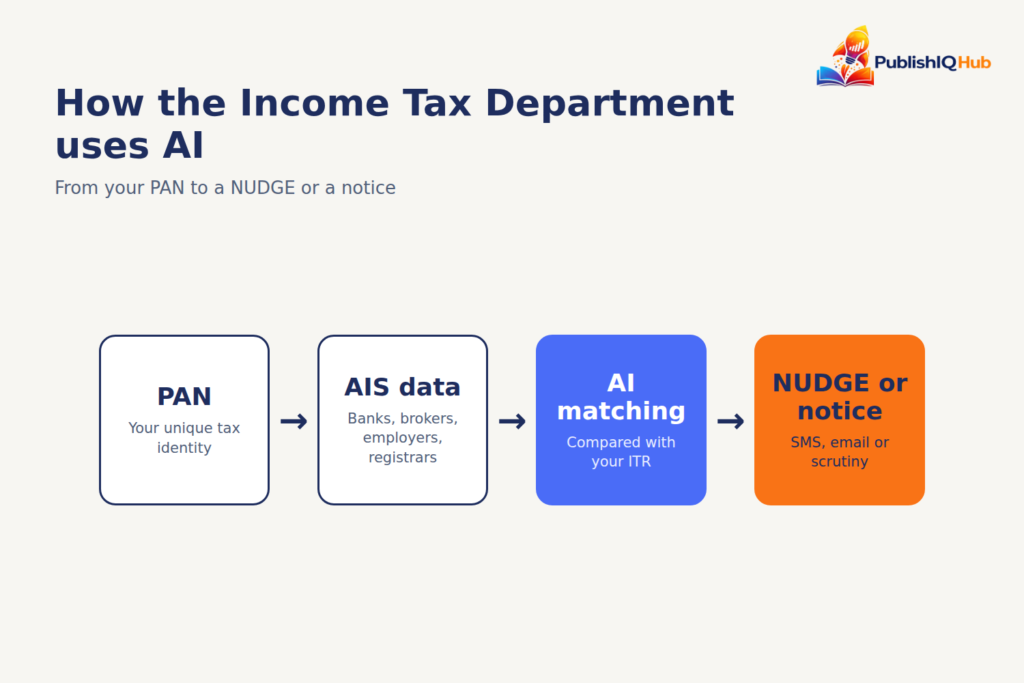
The “taxonomy” part matters more than it sounds. Indian tax law sorts every rupee you earn into five heads: salary, house property, business or profession, capital gains and other sources. Each head has its own rules, deductions and forms. Modern tax systems pull thousands of transactions from banks, brokers, registrars and employers, and then tag each one to the right head. That tagging is the taxonomy. When the tagging goes right, your return is almost pre-written. When it goes wrong, you get a mismatch.
There are two sides to this:
- Department-side AI: Project Insight, AIS/TIS matching, risk-scoring for scrutiny, NUDGE communications and faceless assessment.
- Taxpayer-side AI: filing apps that import AIS data, regime calculators, ChatGPT-style assistants, and tools CAs use for reconciliation and notice replies.
Both sides are getting smarter. The gap between them is where most tax trouble now happens. Any honest look at AI entities in Tax Management in Indian Taxonomy has to cover both.
11 Ways AI Is Reshaping Tax Management in India
1. Project Insight Builds a 360-Degree Profile of You
Project Insight is the backbone of AI in income tax India. Launched in 2017 and operational from 2019, it uses data analytics to create a 360-degree financial profile of each taxpayer, drawing on banking, GST, property and high-value transaction data (Source: Drishti IAS, April 2026). Its core analytics engine is INTRAC, the Income Tax Transaction Analysis Centre.
What does that mean for you? If you bought a flat, booked international trips and invested in mutual funds while declaring ₹6 lakh income, the system notices. Not because anyone is spying on your Instagram, but because the registrar, your bank and your fund house all report to the department.
2. AIS Turns Third-Party Data Into a Mirror of Your Return
The Annual Information Statement is where Project Insight’s data becomes visible to you. According to CBDT Chairman Ravi Agrawal, the department generated 40 crore AIS documents from over 650 crore financial transactions, yet only about 9 crore returns were filed that year (Source: Indian Express, reported by CAalley).
Read that gap again. The department already knows about a lot of income that never shows up in a return. Every AIS mismatch notice starts right here.
3. Your Portal Behaviour Is Data Too
This one surprises people. The same CBDT statement noted that taxpayers visited the portal 3.5 times on average, totalling 24 crore visits (Source: Indian Express, reported by CAalley). Frequent AIS views without a return being filed are treated as a behavioural signal.
In other words, if you keep checking your AIS and still don’t file, the system reads that as “knows about the income, hasn’t reported it.”
4. The NUDGE Campaign: The SMS Before the Notice
NUDGE stands for Non-intrusive Usage of Data to Guide and Enable. Instead of issuing a scrutiny notice straight away, the department sends an SMS or email asking you to review a specific issue.
It works. The NUDGE campaign led to 1.25 crore updated or revised returns and ₹9,494 crore in additional tax during 2024-25 and 2025-26 (Source: Minister of State for Finance Pankaj Chaudhary, reported by Business Standard, August 2026). A CBDT member later put the four-year figure at more than 1.32 crore updated returns and ₹16,083 crore in extra tax (Source: SAG Infotech, September 2026).
My take: a nudge is a gift. It’s the cheapest moment to fix a mistake. Ignore it, and the next message may not be so polite.
5. Risk Flags on Deductions and Donations
Remember Ravi? In December 2025, the department ran a data-driven NUDGE campaign targeting bogus donations to Registered Unrecognised Political Parties, invalid donee PANs and inflated deduction claims (Source: News On AIR, December 2025). By then, more than 15 lakh returns had already been revised for AY 2025-26.
The AI isn’t guessing here. When hundreds of returns claim donations to the same obscure party through the same intermediary, the pattern practically lights up.
6. Foreign Assets Are No Longer Invisible
Thanks to international data-sharing under the Common Reporting Standard, overseas bank accounts, shares and ESOPs now flow into the department’s systems. In November 2025, the CBDT said it would nudge around 25,000 high-risk taxpayers to disclose foreign assets and income (Source: Business Standard, November 2025). An earlier drive led 5,483 taxpayers to file belated returns reporting foreign assets worth ₹29,208 crore (Source: Finance Ministry, reported by Business Standard, June 2025).
If you hold US stocks through an app or have RSUs from a foreign parent company, Schedule FA isn’t optional anymore. It’s watched.
7. Faceless Assessment Takes the Officer Out of the Room
Faceless assessment allocates cases through automated systems, so you never meet or even know the officer handling your file. The Income-tax Act 2025 continues this digital-first, faceless approach to reduce human interface (Source: Income-tax Act, 2025 overview, Wikipedia).
For honest taxpayers, that’s mostly good news: fewer visits, less discretion and a written record of everything. The flip side is that you now argue with documents, not people. A weak written reply hurts more than it used to.
8. Automated Processing and Instant Intimations
When you file, the Centralised Processing Centre compares your return with AIS, Form 26AS and TDS data. Differences can trigger automatic adjustments in your intimation. This is where many “surprise” demands come from: a missed interest entry, a wrongly reported dividend or a TDS credit that doesn’t match.
9. Taxpayer-Side Filing Apps Pre-Fill Almost Everything
On your side of the table, AI tax filing India tools now import AIS data, compare the old and new regime, and flag missing income before you submit. For a salaried person with one employer, a savings account and a couple of mutual funds, a return can take 20 minutes.
The catch: pre-filled doesn’t mean correct. If your AIS has a duplicate entry, the app will happily copy the error into your return.
10. AI Tools for CAs: Reconciliation, Audits and Notice Replies
Tax professionals are using AI to reconcile books with GST returns, AIS and TDS data, draft first versions of notice replies and scan ledgers for audit red flags. This matters this season in particular. The tax audit report for AY 2026-27 is due on 30 September 2026, and CA bodies have been pushing for an extension citing workload and portal issues (Source: CAalley, September 2026). Anything that saves a CA’s hours helps businesses meet their upcoming due dates.
11. Chatbots Like ChatGPT, Claude and Gemini as First-Stop Advisers
Plenty of people now ask a chatbot before they ask a CA. (If you’re curious who builds these tools, here’s our roundup of the top AI chatbot companies and platforms.) That’s fine for understanding concepts. It’s risky for deadlines and numbers.
Here’s a live example. Many answers online still say a revised return must be filed by 31 December. That’s outdated. Budget 2026 extended the revised return window to 31 March of the assessment year, with a fee if you revise after 31 December (Source: Tax2win, September 2026). An AI trained on older data may get this wrong, and you’re the one who pays for the mistake.
Pros and Cons to Assessee: The Honest Scorecard
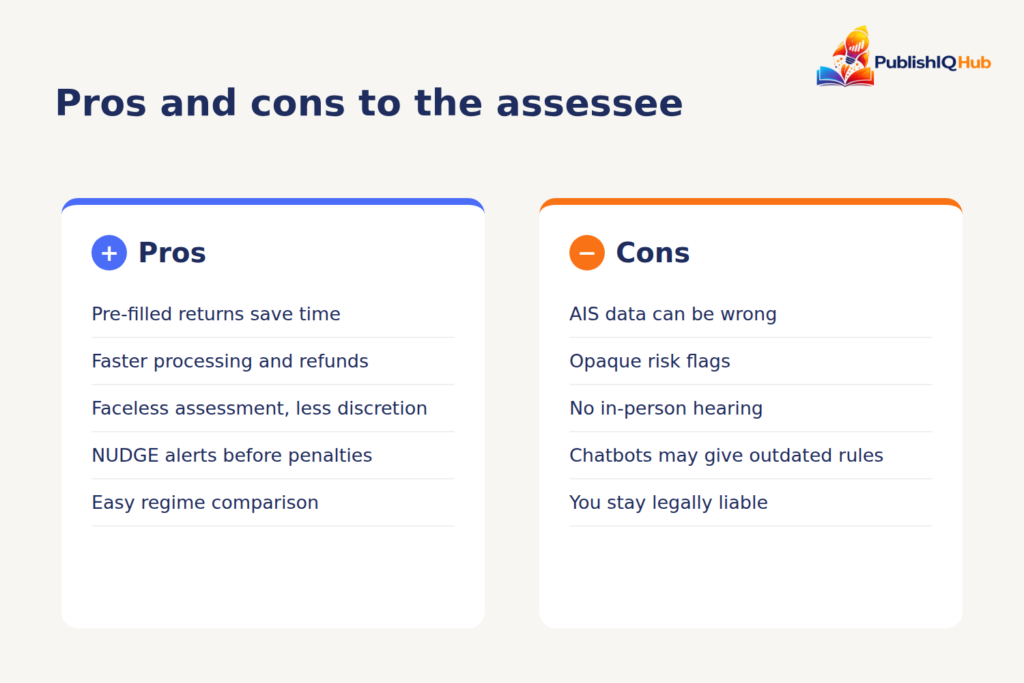
| Pros for the assessee | Cons for the assessee |
| Pre-filled returns save time and reduce typing errors | AIS data can be wrong, duplicated or tagged to the wrong PAN |
| Faster processing and refunds | Algorithms are opaque; you rarely know why you were flagged |
| Faceless assessment reduces harassment and discretion | Written replies must be sharper, since there’s no personal hearing |
| NUDGE lets you correct mistakes before penalties | Nudges can feel like pressure to pay even when the data is wrong |
| AI tools make regime comparison and planning easy | Chatbots can give outdated rules or wrong due dates |
| Lower compliance cost for simple returns | Privacy concerns around large-scale data profiling |
| Fewer chances of genuine income being missed | You stay legally liable, whatever the software said |
The biggest pro, in my experience, is the early warning. Ten years ago, a mistake surfaced years later as a scrutiny notice with interest piled on. Now it often surfaces within months, while it’s still cheap to fix.
The biggest con is false positives. The system is only as good as the data it receives. If your bank reports a fixed deposit twice, or a buyer quotes your PAN by mistake on a property deal, the AI treats it as your income until you prove otherwise. Use the AIS feedback option to mark wrong entries, and keep proof. That one habit prevents most AIS mismatch notice headaches.
Analysts have also raised concerns about algorithmic bias, lack of transparency and data privacy in AI-driven tax governance, and have called for human oversight and independent audits of these systems (Source: Drishti IAS, April 2026). Those are fair concerns, and worth watching as the new Act beds in.
How AI Affects Your Tax Liability
Let’s clear up a myth first. AI entities in Tax Management in Indian Taxonomy don’t change your tax liability. The law does. What AI changes is the chance that under-reporting gets caught, and how quickly.
Think of it as a price ladder. The later you fix a mistake, the more it costs.
Take Ravi’s case. Say the fake donation reduced his taxable income by ₹50,000 and he’s in the 30% slab. The tax he avoided is about ₹15,600 including cess. Here’s how the bill changes depending on when he acts:
- Revise on or before 31 December 2026: Pay ₹15,600 plus interest at roughly 1% a month. No extra fee.
- Revise between 1 January and 31 March 2027: Same tax and interest, plus a fee of ₹5,000 (or ₹1,000 if total income is up to ₹5 lakh) (Source: Patron Accounting, April 2026).
- Miss 31 March 2027 and file an updated return (ITR-U): Additional tax of 25% of the tax and interest if filed within 12 months, rising with delay (Source: Fincart, July 2026).
- Wait for a notice: Under the old Act, penalty can be 50% of the tax for under-reporting and 200% for misreporting, on top of tax and interest.
Look at that ladder once more. The cheapest option is always the earliest one.
AI can also help lower your tax liability legally. A good calculator will show whether the new or old regime suits you better. It can also flag benefits you might miss. For example, from 1 April 2026, the 50% HRA exemption applies in eight cities, now including Bengaluru, Pune, Hyderabad and Ahmedabad, though you must also disclose your relationship with the landlord (Source: ClearTax, June 2026). That disclosure exists for a reason: rent paid to parents without real payment has long been a favourite target for data matching.
Upcoming Due Dates: October 2026 to March 2027
Here are the upcoming due dates that matter most for individuals, professionals and small businesses. Always double-check the income tax e-filing portal before acting, since the CBDT can extend dates at short notice.
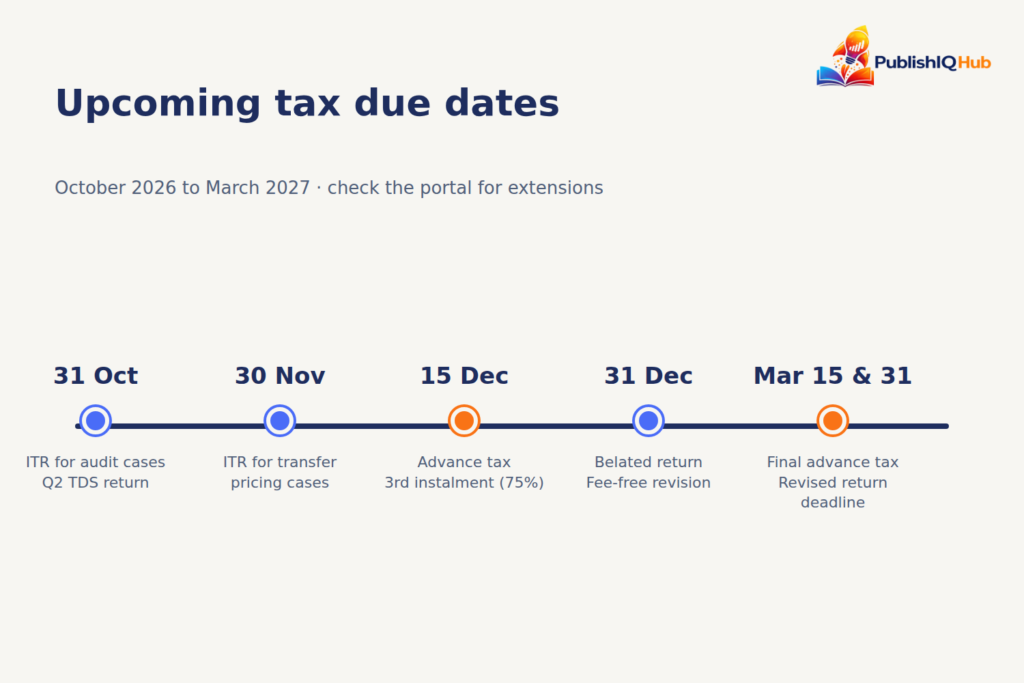
| Due date | Compliance | Who it applies to | If you miss it |
| 7 Oct 2026 (and 7th of every month) | TDS/TCS deposit for the previous month | Deductors and collectors | Interest at 1%–1.5% per month |
| 31 Oct 2026 | ITR for audit cases, AY 2026-27 (unless extended) | Businesses and professionals under tax audit | Interest at 1% per month on unpaid tax, late fee |
| 31 Oct 2026 | TDS return for July–September quarter | Deductors | Late fee of ₹200 per day |
| 30 Nov 2026 | ITR for transfer pricing cases, AY 2026-27 | Taxpayers with international or specified domestic transactions | Interest and late fee |
| 15 Dec 2026 | Third advance tax instalment (75% cumulative), Tax Year 2026-27 | Anyone with tax liability above ₹10,000 after TDS | Interest at 1% per month on shortfall |
| 31 Dec 2026 | Belated return for AY 2026-27; last date to revise without fee | Anyone who missed the original deadline or needs to correct a return | Late fee ₹5,000 (₹1,000 if income up to ₹5 lakh); belated option closes |
| 31 Jan 2027 | TDS return for October–December quarter | Deductors | Late fee of ₹200 per day |
| 15 Mar 2027 | Final advance tax instalment (100%); single instalment for presumptive taxpayers | All advance taxpayers | Interest on shortfall |
| 31 Mar 2027 | Revised return for AY 2026-27 (with fee after 31 Dec); last date for old-regime tax-saving investments for Tax Year 2026-27 | Anyone correcting a return or claiming old-regime deductions | Only ITR-U remains, with additional tax |
The ITR deadline for audit cases is 31 October 2026, and the tax audit report is due on 30 September 2026 (Source: TaxFetch, September 2026). As of mid-September, the CBDT hadn’t issued an extension. It has done so in past years close to the deadline, so check the portal before you plan around either date.
The belated return deadline for AY 2026-27 is 31 December 2026, with a late fee of ₹1,000 if total income doesn’t exceed ₹5 lakh and ₹5,000 otherwise (Source: ANI, September 2026). Also remember to e-verify within 30 days of filing, or the verification date may be treated as your filing date.
For advance tax, the Tax Year 2026-27 instalments fall on 15 June, 15 September, 15 December 2026 and 15 March 2027. Presumptive taxpayers under Section 44AD or 44ADA can pay the full amount by 15 March (Source: FinanceFunda, June 2026). If you’re a freelancer who skipped September, pay the shortfall now. Interest has already started. For small businesses, the easiest way to get advance tax right is to know your numbers early. Here’s why growing companies need cash flow forecasting before they need a CFO.
A Practical Checklist for Staying Safe in an AI-Monitored Tax System
You don’t need to fear the algorithm. You need to be boring in the best sense: consistent, documented and on time.
Start by downloading your AIS and TIS before you file, not after. Compare them line by line with your bank statements, broker reports and Form 16. If something is wrong, submit feedback on the portal right away and save the acknowledgement.
Then work through these steps:
- Match every interest entry, including savings account interest and small FDs.
- Report capital gains exactly as your broker’s statement shows them. (Still choosing a platform? See our list of the best stock brokers in India for investments.)
- Declare foreign assets in Schedule FA, even if they seem small.
- Claim only deductions you can prove with receipts and valid PANs.
- Respond to every NUDGE SMS or email, even if only to confirm your return is correct.
- Keep a folder of proofs for at least eight years.
- Use AI tools for drafts and calculations, but get a CA to review anything complex.
And one final rule I give every client: if an AI tool tells you something that sounds too good to be true, like a deduction nobody else claims, it probably is.
Conclusion
AI entities in Tax Management in Indian Taxonomy have quietly changed the relationship between you and the tax department. The department now sees most of your financial life before you file. It nudges before it punishes. And it catches patterns no human team could track across 9 crore returns.
That’s not a reason to panic. It’s a reason to be accurate. File on time, check your AIS, respond to nudges and use AI tools as helpers, not as advisers of last resort. Understand the pros and cons to assessee, keep an eye on the upcoming due dates above, and your tax liability will be exactly what the law says it should be. Nothing more.
Want more practical guides on Indian tax, investing and AI? Explore more articles on the PublishIQHub blog, or start from the PublishIQHub home page for our latest stories on AI, B2B and finance.
Frequently Asked Questions
What are AI entities in Tax Management in Indian Taxonomy?
They’re the automated systems that collect, classify and act on tax data in India. On the department’s side, that means Project Insight, AIS matching, NUDGE alerts and faceless assessment. On the taxpayer’s side, it means AI tax filing India apps, regime calculators and AI assistants that CAs use for reconciliation and notice replies.
How does the Income Tax Department use AI to detect mismatches?
The department collects data from banks, employers, brokers, registrars and foreign tax authorities, then uses analytics under Project Insight to compare it with your return. When reported income, deductions or assets don’t match third-party data, the system flags your case for a NUDGE message, an automated adjustment or, in serious cases, scrutiny.
What happens if my AIS does not match my ITR?
You may receive an intimation adjusting your income or a notice asking you to explain the difference. First, check whether the AIS entry is correct. If it’s wrong, file feedback on the portal. If your return is wrong, file a revised return before 31 March 2027 for AY 2026-27, ideally before 31 December to avoid a fee.
Is it safe to file ITR using AI tools in India?
Yes, for simple returns, as long as you verify every figure against your AIS, Form 16 and bank statements. AI tools speed things up, but they can copy errors from pre-filled data or give outdated rules. You’re legally responsible for what you file, not the software, so review everything before you submit.
Can AI help reduce my tax liability legally?
It can. AI calculators compare the old and new regimes, flag deductions you’re eligible for and estimate advance tax so you avoid interest. What it can’t do is make an ineligible claim safe. Data matching now catches most fake deductions quickly, so the saving usually disappears once you add interest and fees.
What is the NUDGE campaign by the Income Tax Department?
NUDGE stands for Non-intrusive Usage of Data to Guide and Enable. The department sends SMS and email alerts to taxpayers whose returns show possible errors, asking them to review and correct them voluntarily. It’s advisory, not a formal notice, but ignoring it can lead to scrutiny later.
Is the Income-tax Act 2025 applicable to my current ITR?
Not for last year’s income. Returns for FY 2025-26 (AY 2026-27) are still filed under the 1961 Act. The Income-tax Act 2025 applies to income earned from 1 April 2026, called Tax Year 2026-27, and that return will be due in 2027. Advance tax paid now relates to the new tax year.
What is the last date to file a belated return for AY 2026-27?
The belated return deadline is 31 December 2026, or before completion of assessment, whichever is earlier. The late fee is ₹1,000 if total income is up to ₹5 lakh and ₹5,000 otherwise. Interest on any unpaid tax also applies.
Does faceless assessment mean no human ever reviews my case?
No. Faceless assessment removes face-to-face contact and randomises case allocation, but officers still review cases and pass orders. You communicate in writing through the portal, and you can request a video hearing in many situations. Clear, well-documented replies matter more than ever.
Which AI tools do CAs use for tax filing in India?
CAs typically use tax software with automated AIS and 26AS import, reconciliation tools for GST and TDS data, and general AI assistants for research and drafting notice replies. Most still review every output manually, because liability for errors stays with the taxpayer and the professional.
Sources
- PIB – Income-tax Act, 2025 comes into force from 1 April 2026: https://www.pib.gov.in/PressReleasePage.aspx?PRID=2248005
- PwC Worldwide Tax Summaries – India significant developments: https://taxsummaries.pwc.com/india/corporate/significant-developments
- Income Tax Department – FAQs on Transition to the Income-tax Act, 2025: https://www.incometaxindia.gov.in/documents/81799/11848482/FAQs-on-Interplay-and-Transition.pdf
- Income Tax Department – Objective and scope of the New Act: https://www.incometax.gov.in/iec/foportal/help/all-topics/e-filing-services/objective-and-scope-new-act
- Drishti IAS – AI-Driven Tax Governance in India (April 2026): https://www.drishtiias.com/daily-updates/daily-news-analysis/ai-driven-tax-governance-in-india
- CAalley (Indian Express report) – Income Tax Dept analysing ITR-filing patterns, online behaviour: https://www.caalley.com/news-updates/indian-news/income-tax-dept-analysing-taxpayers-itr-filing-patterns-online-behaviour-says-cbdt-chief
- Business Standard – NUDGE campaign: 1.25 crore updated/revised ITRs, ₹9,494 crore: https://www.business-standard.com/topic/cbdt
- SAG Infotech – 1.32 crore updated returns, ₹16,083 crore (September 2026): https://blog.saginfotech.com/tax-reforms-lead-1-32-cr-updated-returns-inr-16083-cr-additional-tax-cbdt-member
- News On AIR – NUDGE campaign for AY 2025-26 (December 2025): https://www.newsonair.gov.in/income-tax-department-launches-data-driven-nudge-campaign-for-assessment-year-2025-26
- Business Standard – 25,000 high-risk foreign asset cases; 5,483 belated returns with ₹29,208 crore foreign assets: https://www.business-standard.com/amp/topic/income-tax-department
- Wikipedia – Income-tax Act, 2025: https://en.wikipedia.org/wiki/Income-tax_Act,_2025
- CAalley – Tax audit deadline 2026, CA bodies seek extension: https://www.caalley.com/news-updates/indian-news/tax-audit-filing-deadline-2026-ca-bodies-seek-extension-to-october-31-what-taxpayers-should-do
- Tax2win – Revised return deadline and fee (Budget 2026): https://tax2win.in/guide/revised-income-tax-return
- Patron Accounting – Revised return window extended to 12 months: https://www.patronaccounting.com/blog/revised-return-deadline-extended-12-months-itr-2026
- Fincart – Revised return rules and ITR-U additional tax: https://www.fincart.com/blog/revised-income-tax-return-meaning-last-date-penalty-how-to-file
- ClearTax – Income tax changes from 1 April 2026 (HRA 8 cities): https://cleartax.in/s/income-tax-changes-from-april-2026
- TaxFetch – Tax audit due date AY 2026-27: https://taxfetchindia.com/blog/taxation-time/tax-audit-due-date-ay-2026-27
- ANI – Record 7.8 crore ITRs for AY 2026-27; belated return fee: https://aninews.in/news/business/record-78-crore-income-tax-returns-filed-for-ay-2026-27-by-august-31-deadline20260901090909/
- FinanceFunda – Income tax calendar 2026-27 (advance tax dates): https://financefunda.in/blog/income-tax-calendar-2026-27-due-dates
- IncomeTax.tools – India income tax calendar 2026-27: https://incometax.tools/india/tax-calendar
- Income Tax Department – Income Tax Returns help (AY 2026-27 due dates): https://www.incometax.gov.in/iec/foportal/help/all-topics/e-filing-services/income-tax-returns
- Income Tax Department – e-filing portal: https://www.incometax.gov.in/iec/foportal/
- Income Tax Department – AIS (Annual Information Statement) help: https://www.incometax.gov.in/iec/foportal/help/all-topics/e-filing-services/ais-annual-information-statement