
Quick Answer
The biggest digital payment trends in India in 2026 are mandatory two-factor authentication from 1 April, a hard 31 December deadline on the NPCI market share cap, biometric approval limits doubling to ₹10,000, zero MDR continuing as a statutory Government Obligation, and the digital rupee moving from pilot into programmable welfare payments. Volume keeps climbing while ticket sizes shrink.
August 2026 gave India’s payments ecosystem its second record month in a row. UPI processed 24.51 billion transactions worth ₹29.82 trillion, according to data released by the National Payments Corporation of India (NPCI). That worked out to an average of 791 million transactions a day.
But raw volume is the least interesting part of the story. What actually changed in 2026 is the rulebook. Between April and September, the Reserve Bank of India rewrote how every digital payment in the country gets authenticated, NPCI loosened biometric limits, the Union Budget locked in another year of zero merchant discount rate, and a market share cap that had been postponed three times finally landed on a date nobody expects to move again.
India now runs one of the most heavily used retail payment systems on the planet, and 2026 is the year the regulator decided that scale of that size needs firmer banking norms around it. The direction of travel is consistent across every circular issued this year: more authentication, clearer liability, tighter concentration limits, and no change to the zero-fee obligations that make the whole thing free for consumers.
For merchants, fintech founders and ordinary users, these shifts matter more than the headline numbers. Here are the fourteen digital payment trends worth tracking, what each one changes, and where the compliance pressure is building. Each one ties back to either an RBI direction or an NPCI operating circular, so treating these as banking norms rather than market news is the more useful framing.
1. UPI volume is growing faster than value
UPI volume rose 3.6 per cent between July and August 2026, while transaction value slipped 0.2 per cent. Year on year, volume was up 22 per cent and value up 20 per cent.
That gap is the clearest of the current digital payment trends. People are making more payments, not bigger ones. The chaiwala, the auto ride, the ₹40 grocery top-up: these are now UPI transactions, and they were cash three years ago. UPI transaction value has climbed from ₹0.07 lakh crore in FY17 to roughly ₹314 lakh crore in FY26.
For merchants this has a practical consequence. Reconciliation volume grows even when revenue does not, which is exactly the pressure point where cash flow forecasting stops being optional for a growing business.
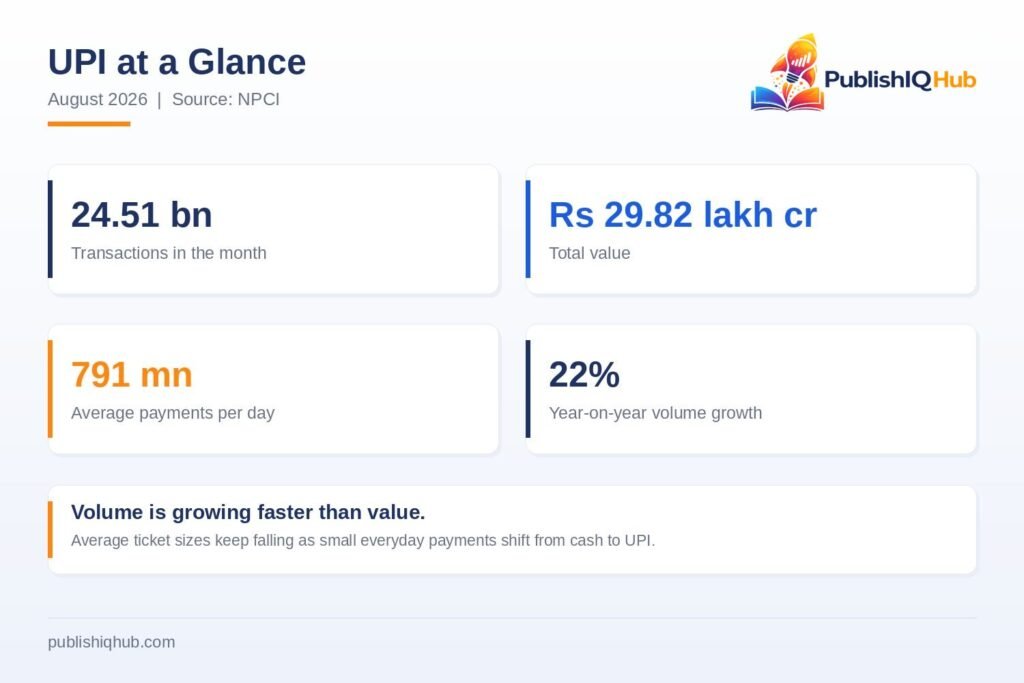
UPI at a glance, August 2026. Source: NPCI.
2. What are NPCI’s new UPI rules and who do they apply to?
NPCI’s most significant consumer-facing change in 2026 raised the ceiling for biometric approval. Circular OC-226A, issued on 3 July 2026, increased the amount that can be authorised through on-device fingerprint or facial recognition from ₹5,000 to ₹10,000 per transaction, effective 7 August 2026.
This gets misreported constantly. NPCI did not cap UPI payments at ₹10,000. It changed only the amount a user may approve using on-device biometrics instead of entering a UPI PIN, and payments above that threshold still go through other permitted authentication methods.
Who does it apply to? Every UPI app and every sponsor bank in the NPCI ecosystem. Consumers do not have to do anything, though the biometric option can be switched off.
3. Two-factor authentication became compulsory on 1 April 2026
This is the single largest change to banking norms in years. The RBI released new authentication guidelines that took effect from 1 April 2026, mandating two-factor authentication for all digital payments, with at least one dynamic element such as a password, OTP or fingerprint, except for card-present transactions.
The formal name is the Authentication Mechanisms for Digital Payment Transactions Directions, 2025. It was issued on 25 September 2025, giving banks, card issuers and payment firms a long runway to rebuild their security stacks, and it applies across banks, card networks, fintech platforms, payment gateways and wallet operators.
As banking norms go, the reach is unusually wide, and the practical effect for users is smaller than the headlines suggest. Most low-value payments on a familiar device still feel identical, because risk-based engines handle the second factor invisibly.
4. How do RBI banking norms affect digital payment companies?
They shift liability onto the institution. Under the 2026 framework, if a fraud loss happens because a transaction was processed without following the authentication directions, the issuer has to compensate the customer.
That is a structural change. Security was previously a cost centre that competed with growth for budget. It is now a balance sheet risk, which is why fraud detection and behavioural scoring have become board-level spending priorities rather than engineering wishlist items. The same economics are pushing adoption of AI in financial services across risk, monitoring and dispute handling.
Compliance costs under the new banking norms are rising in parallel. That burden falls hardest on smaller players, a pattern familiar to anyone tracking the regulatory road from startup funding to IPO in Indian fintech.
5. The 30% market share cap now has a deadline that looks real
NPCI’s rule, first introduced in November 2020, restricts any single player from processing more than 30 per cent of total UPI transaction volume, calculated on a rolling three-month basis. The deadline has already been pushed from 2022 to 2024 and then to December 2026.
The arithmetic behind the UPI market share cap remains uncomfortable. As of July 2026, PhonePe accounted for roughly 45.5 per cent of UPI volume and Google Pay about 34.6 per cent, together controlling over 83 per cent of the market against a prescribed threshold of 30 per cent.
If an existing player stays above 30 per cent past the deadline, the stated consequence is that it must stop onboarding new customers. Whether NPCI enforces that in January 2027 is the single biggest open question in Indian digital payments right now, and it has already delayed at least one major listing plan in the sector. Investors tracking India’s best-performing listed names will find the payments cohort unusually exposed to this one regulatory date.
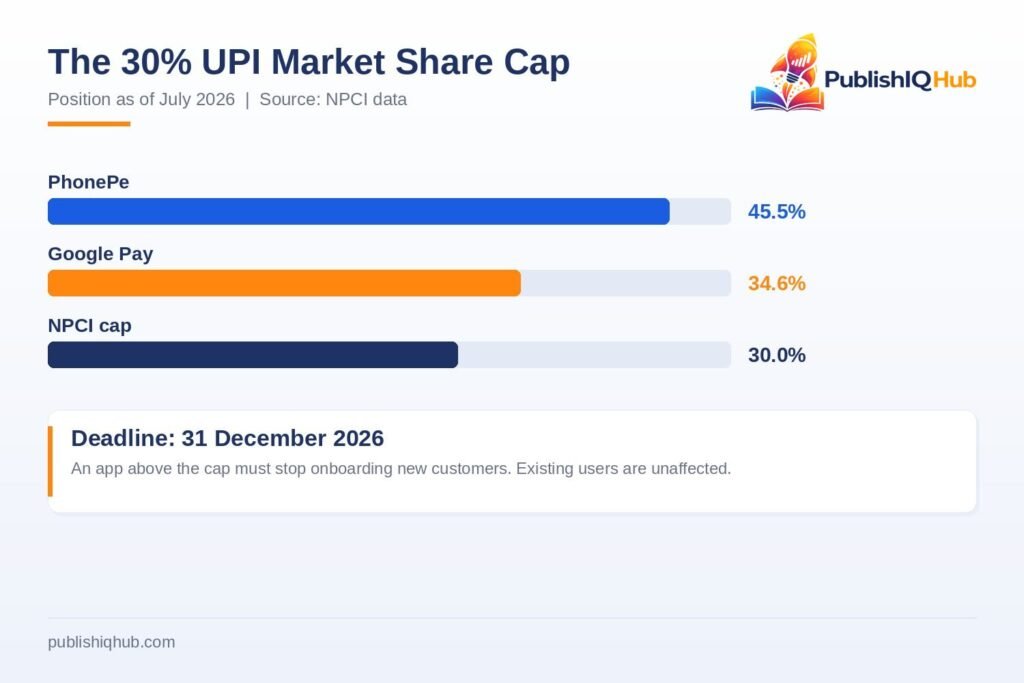
The 30% UPI market share cap against actual July 2026 shares. Source: NPCI data.
6. What are the Government Obligations for digital payment providers in India?
The central one is zero MDR, and it is written into law rather than left to policy discretion. Since January 2020, merchant discount rate has been zero for RuPay debit cards and BHIM-UPI transactions through amendments to section 10A of the Payment and Settlement Systems Act, 2007 and section 269SU of the Income-tax Act, 1961.
The comparison is stark. RBI permits MDR of up to 0.90 per cent on debit cards across card networks, and NPCI’s schedule allows up to 0.30 per cent on UPI merchant transactions. Neither can be charged on the covered categories.
Other Government Obligations sitting on providers include mandatory acceptance infrastructure for prescribed merchants under 269SU, participation in interoperability requirements, and reporting duties that have tightened further under the Finance Bill 2026.
Old norms vs 2026 banking norms
| Area | Position before 2026 | Position in 2026 |
| Authentication | SMS OTP alone was sufficient for most online payments | Two independent factors required, at least one dynamic |
| Biometric approval ceiling | ₹5,000 per transaction | ₹10,000 per transaction from 7 August 2026 |
| Fraud liability | Largely contested case by case | Issuer compensates where authentication norms were not met |
| Market share cap | Repeatedly deferred, no credible date | 31 December 2026, onboarding halt for breach |
| MDR on UPI P2M and RuPay debit | Zero since January 2020 | Unchanged in Budget 2026-27 |
| Cross-border card CNP checks | Domestic focus only | Risk-based mechanisms required by 1 October 2026 |
7. The incentive pool went up, and the industry still called it short
The Union Budget allocated ₹2,000 crore to promote low-value peer-to-merchant UPI and RuPay debit card transactions for FY27, about 8.9 per cent lower than the final FY26 allocation of roughly ₹2,196 crore, though far above the FY26 budget estimate of ₹437 crore.
The reaction was blunt. Payments Council of India chairman Vishwas Patel said that with zero MDR and only ₹2,000 crore allocated, processing 30 crore transactions a day for free would choke the ecosystem of funds for scaling, adding that the industry had expected above ₹10,000 crore and did not want to survive on government incentives at all.
This tension defines the commercial reality behind India’s digital payment trends. The rails are world class. The revenue model underneath them is not settled, which is one reason venture capital flows into the sector have concentrated around lending and distribution rather than payment processing itself.
8. RuPay credit card on UPI has become a mainstream rail
Linking credit to a QR code turned out to be the most successful product decision NPCI has made since UPI itself. UPI-linked credit card transactions now account for close to 40 per cent of all credit card payments by volume, against roughly 10 per cent at the end of FY24, with RuPay’s credit card market share climbing to about 16 per cent from 3 per cent in two years.
Ticket sizes tell the same story as the wider UPI transaction volume data. Average spends on UPI-linked credit cards sit below ₹1,000, which means groceries and fuel rather than electronics and holidays.
There is a catch, and it goes back to the Government Obligations described above. MDR and interchange on RuPay credit cards linked to UPI stay at zero for transactions up to ₹2,000 at small merchants. Volume is rising quickly. Revenue per transaction is not.
9. Will UPI transactions be charged a fee?
Not for ordinary users paying from a bank account. UPI remains free for consumers in 2026, with no transaction fee and no MDR on covered peer-to-merchant payments.
There is one exception worth knowing. Wallet-funded merchant payments above ₹2,000 carry an interchange charge of 1.1 per cent, and that is borne by the merchant, not the payer.
Whether this holds is a live policy question, and it is the one item on this list where the Government Obligations could plausibly change. The industry wants MDR restored on large merchants. The government has declined so far, and Budget 2026-27 left the position unchanged.
10. Recurring payments moved under a single e-mandate framework
On 21 April 2026, RBI issued the Digital Payments E-mandate Framework, 2026, consolidating its earlier recurring-payment circulars into one document covering UPI, cards and prepaid payment instruments. FASTag and National Common Mobility Card balance replenishment are exempt from the 24-hour advance notice requirement.
For subscription businesses, this is the most operationally disruptive of the year’s banking norms. Mandate creation, modification, pre-debit notification and failure handling now follow one rulebook instead of three overlapping ones.
11. The cross-border authentication deadline lands on 1 October 2026
By 1 October 2026, card issuers must implement risk-based mechanisms for cross-border card-not-present transactions. Issuers must also register Bank Identification Numbers with card networks and validate non-recurring international transactions by that date.
Indian cardholders have long experienced international declines because foreign merchants do not support Indian OTP flows. The new framework replaces that blunt approach with risk scoring, which should reduce false declines over time.
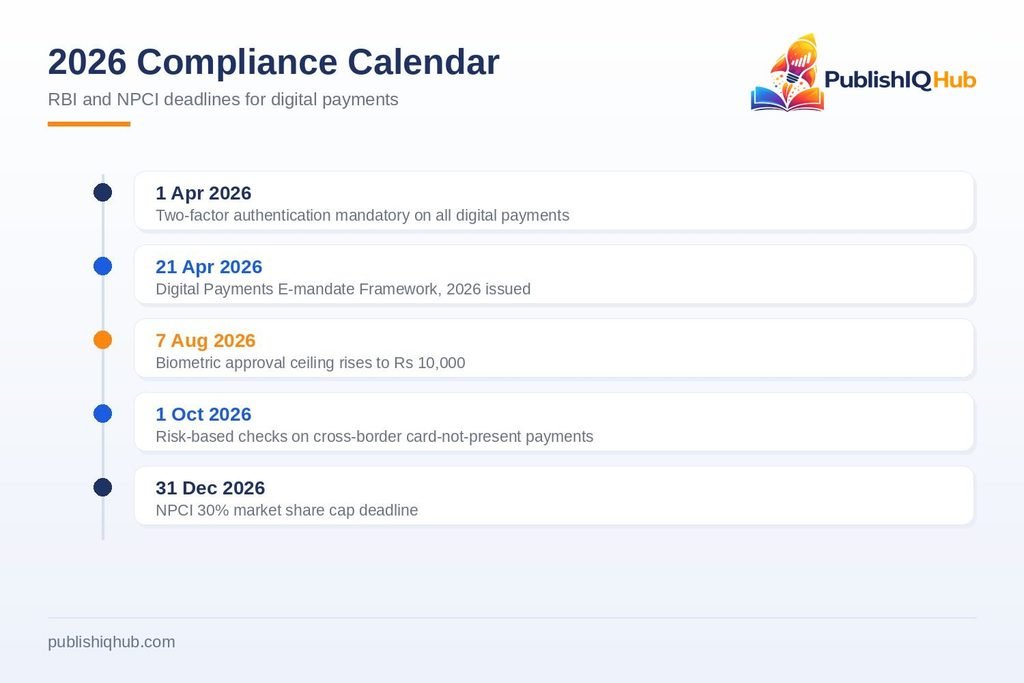
RBI and NPCI deadlines shaping banking norms through 2026.
12. UPI’s international footprint keeps widening
NPCI data shows UPI is accepted in 11 countries, including Uzbekistan, Singapore, the United Arab Emirates, France, Mauritius, Nepal, Bhutan, Qatar, Sri Lanka, Cambodia and Greece. NPCI country counts differ between sources depending on whether an MoU or a live corridor is being counted, so treat any single figure as a snapshot.
Growth from a small base has been steep. Cross-border UPI transactions rose more than twentyfold to over 755,000 in FY25 from 37,060 in FY24, with more than 1.5 million international merchants onboarded.
The strategic prize is remittances. World Bank data puts India’s personal remittance inflows at $150.71 billion in 2025 when compensation of employees is included, and the diaspora currently pays an average of 3 to 4 per cent in fees through correspondent banking channels. NPCI’s published target under the Viksit Bharat 2047 framework is expansion to 20 nations by 2028-29.
13. How does the digital rupee work for everyday users?
The e₹ is a token issued directly by RBI, held in a wallet, and usable much like cash but in digital form. It is not a bank deposit and it does not earn interest.
Adoption remains modest. CBDC in circulation rose from ₹2.34 billion to ₹10.15 billion, with 17 banks and about 6 million users, and 88,000 women receiving welfare benefits through the digital rupee. Set against 24.51 billion monthly UPI transactions, that is a rounding error.
The interesting use case is programmability, not retail payments. During FY2025-26, RBI ran welfare-linked CBDC pilots in Gujarat, Puducherry and Chandigarh, where beneficiaries received food subsidies through the digital rupee, with funds restricted to designated ration shops.
Momentum is building at the policy level. Speaking at the Global Fintech Fest in Mumbai in September 2026, Finance Minister Nirmala Sitharaman urged RBI to further advance both its wholesale and retail CBDC pilots, pointing to REC Ltd’s tokenised corporate bond pilot under SEBI’s regulatory sandbox, where the bond and the digital rupee settled at the same instant.
14. The digitisation index says growth is broadening
The RBI Digital Payments Index stood at 516.76 for September 2025, against 493.22 for March 2025, with the increase driven by payment performance and payment enablers. The index uses March 2018 as its base of 100 and is published twice a year.
Payment performance carries 45 per cent of the weighting, payment enablers 25 per cent. When those two move together, it signals that acceptance infrastructure and usage are growing in step rather than one running ahead of the other.
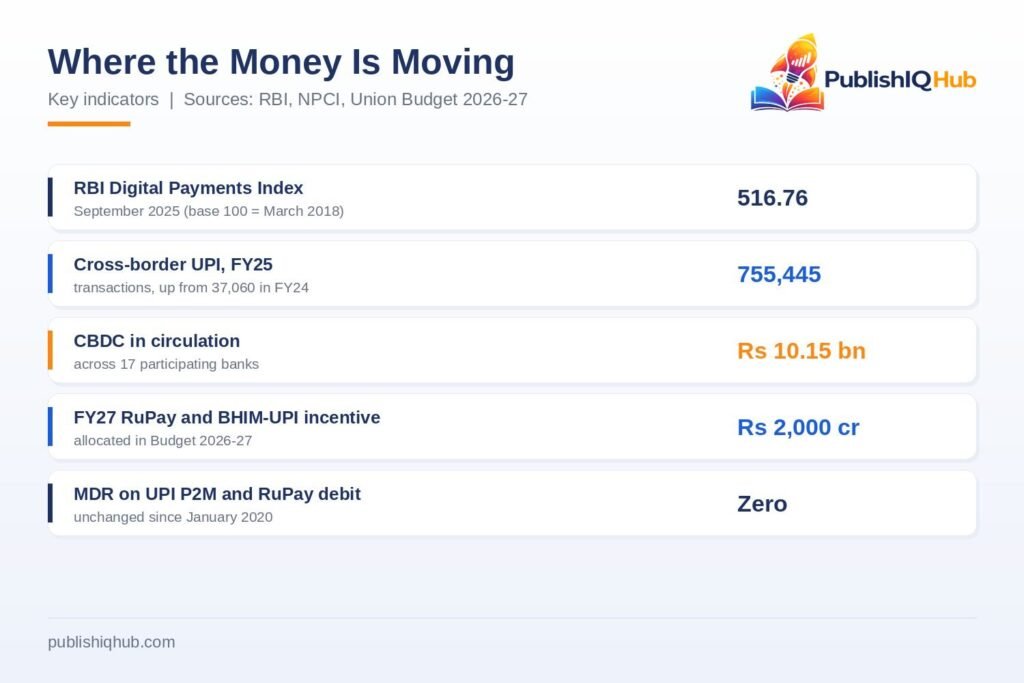
Key indicators across India’s digital payment trends. Sources: RBI, NPCI, Union Budget 2026-27.
Which digital payment trends matter most for small businesses?
Three of these digital payment trends, realistically.
First, the e-mandate framework, if any part of the business runs on subscriptions or standing instructions. Second, zero MDR, because it determines whether accepting UPI stays free. Third, authentication changes, since checkout friction on higher-value orders directly affects conversion.
The UPI market share cap matters less to a small merchant than the news coverage suggests. NPCI designed it as a concentration control, not a consumer measure. If a dominant app has to slow onboarding, existing users keep transacting.
A practical compliance checklist for 2026
Merchants and payment providers working through the new banking norms can treat the following as the short list.
- Confirm your payment gateway is certified for the two-factor framework. The obligation sits with the issuer and the acquirer, but a non-compliant checkout is your conversion problem.
- Re-paper recurring mandates under the Digital Payments E-mandate Framework, 2026, including pre-debit notification timing.
- Check merchant category registration with your acquiring bank. Category determines your applicable UPI limit, and misclassification is the most common cause of avoidable declines.
- Review your cross-border card flows before 1 October 2026 if any revenue comes from overseas customers.
- Keep a fallback payment method at checkout. Daily UPI limits are set per user by their bank, and a customer who has hit the cap is a lost sale unless there is an alternative.
- Track the December NPCI deadline if your business depends on distribution through a single dominant UPI app.
- Reread the NPCI circulars rather than the summaries. Most of the confusion around this year’s digital payment trends comes from secondary coverage compressing a narrow rule into a broad one.
Key Takeaways
- Two-factor authentication has been mandatory on every digital payment since 1 April 2026. SMS OTP alone is no longer sufficient.
- Liability for authentication failures now sits with the issuer, which has turned payment security into a balance sheet question.
- The 30% market share cap expires on 31 December 2026 with two players far above the threshold.
- Zero MDR is a statutory Government Obligation, not a policy preference that can be quietly reversed, and Budget 2026-27 left it untouched.
- Cross-border card-not-present rules take effect on 1 October 2026.
- The digital rupee is finding traction in programmable welfare delivery, not in competing with UPI at the tea stall.
Frequently Asked Questions
What are the latest digital payment trends in India in 2026?
The dominant digital payment trends in India are compulsory two-factor authentication from April, the higher ₹10,000 biometric approval ceiling from August, the December deadline on the NPCI market share cap, continued zero MDR under existing Government Obligations, and expansion of both cross-border UPI corridors and digital rupee welfare pilots.
Are UPI payments still free in 2026?
Yes for consumers paying from a bank account. There is no user fee and no MDR on covered peer-to-merchant transactions. Wallet-funded merchant payments above ₹2,000 attract 1.1 per cent interchange, which the merchant pays.
What is the UPI daily transaction limit?
NPCI’s standard ceiling is ₹1 lakh per day for most users, with higher limits available in specific merchant categories. Individual banks set their own caps within that framework, so the effective limit varies by bank.
What happens if PhonePe or Google Pay breach the 30% cap?
The stated consequence under NPCI’s rule is that an app exceeding the cap must stop onboarding new customers. Existing users are not affected. Enforcement has been deferred three times, so the January 2027 position remains uncertain.
Is the digital rupee replacing UPI?
No. RBI has positioned the e₹ as a complement rather than a substitute. Retail CBDC volumes are a tiny fraction of UPI’s, and the clearer use case so far is programmable government transfers such as targeted food subsidies.
Do the new banking norms slow down everyday payments?
For most transactions, no. Risk-based engines handle the second authentication factor in the background on trusted devices. Additional friction is concentrated on high-value and higher-risk payments.
Who regulates digital payments in India, RBI or NPCI?
Both, at different levels. RBI writes the banking norms and the licensing framework under the Payment and Settlement Systems Act. NPCI operates UPI, RuPay, IMPS, NETC and BBPS, and issues the operating circulars that translate those banking norms into rules inside each system. Government Obligations such as zero MDR sit above both, in statute.