
A comprehensive guide to outsourcing your bookkeeping, payroll, tax, and finance function — what it costs, who it’s right for, and how to pick a firm you won’t regret.
Quick Answer: Outsourced accounting services let a business delegate some or all of its finance function — bookkeeping, accounts payable and receivable, payroll, tax compliance, reporting, even CFO-level strategy — to an external firm instead of hiring in-house. Most small businesses pay between $500 and $5,000 per month depending on scope, compared to $60,000+ a year for a single full-time accountant. It works best for companies that need expert-level accounting but can’t justify (or can’t find) a full internal team.
What Do Outsourced Accounting Services Actually Include?
Outsourced accounting means an external firm runs part or all of your finance function on your behalf, using your data and (usually) your software. You stay in control of decisions; they handle the execution.
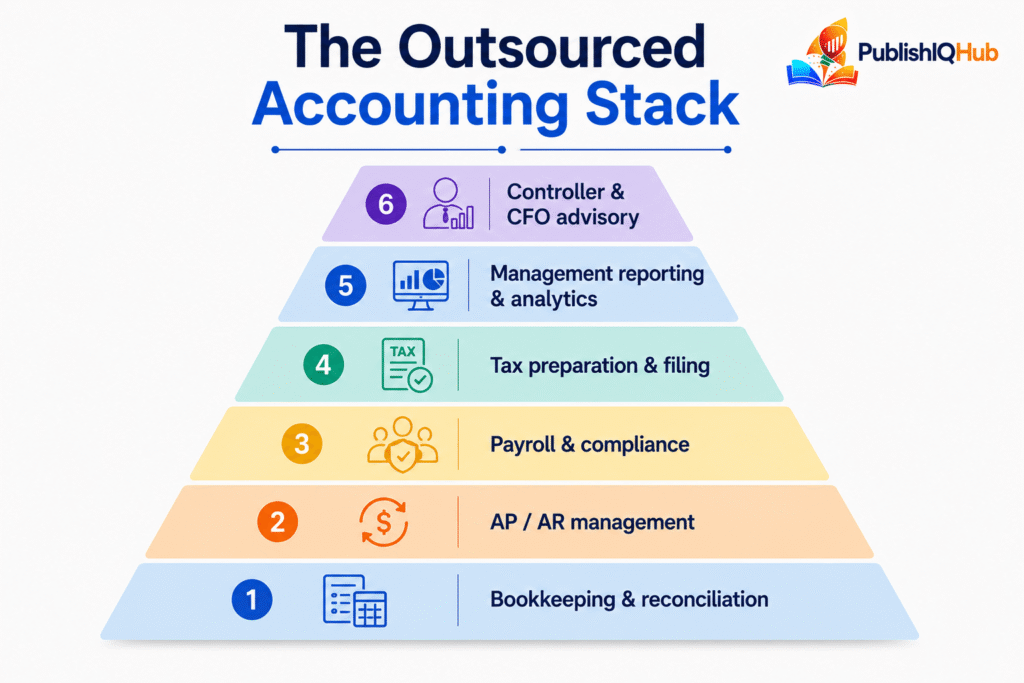
I find it helps to think of it as a menu rather than a single product. Most firms let you pick the layers you need:
- Bookkeeping — recording transactions, reconciling bank accounts, keeping your ledger clean
- Accounts payable and receivable — paying vendors on time, chasing invoices so you don’t have to
- Payroll — salaries, withholdings, filings, compliance across states or countries
- Tax preparation and compliance — returns, estimated payments, staying ahead of deadline season
- Management reporting — monthly P&L, cash flow statements, budget vs. actuals
- Controller and CFO services — forecasting, fundraising support, board reporting, strategic finance
A solo founder might outsource only bookkeeping. A 200-person company might outsource finance and accounting end to end, keeping just one internal finance lead to manage the relationship. Both are “outsourced accounting” — the scope is up to you.
Why Are So Many Businesses Outsourcing Finance and Accounting?
Three forces are driving the shift: cost pressure, a genuine shortage of accountants, and better cloud tools that make remote finance teams practical.
The numbers back this up. The global finance and accounting business process outsourcing market is valued at $76.5 billion in 2026 and is projected to reach $142.7 billion by 2033, growing at 9.3% a year. That’s not a niche trend — that’s a structural change in how companies build their finance function.
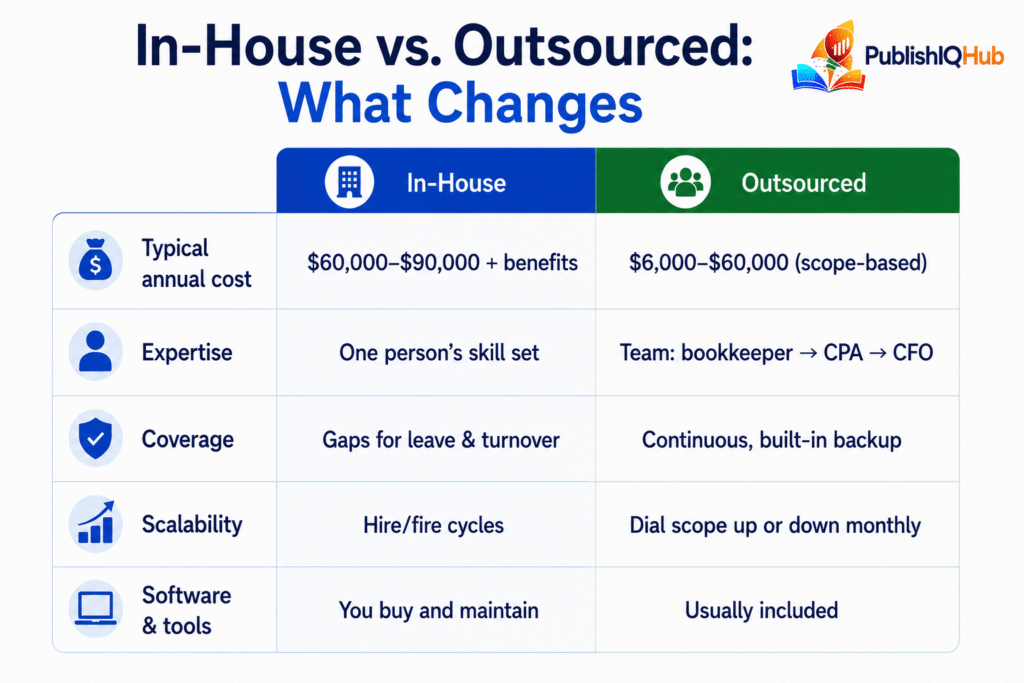
Part of it is simple math. Hiring a full-time accountant means salary, benefits, software, training, and coverage for sick days and turnover. An outsourced firm spreads those costs across dozens of clients.
But the bigger driver right now is talent. 84% of CFOs report significant talent shortages, with the accounting profession’s deficit potentially reaching 3.5 million professionals. Fewer graduates are sitting the CPA exam, experienced accountants are retiring, and mid-sized companies are getting priced out of the hiring market entirely. For many businesses, outsourcing isn’t a cost decision anymore — it’s the only realistic way to get senior accounting expertise at all.
And the technology finally cooperates. Cloud platforms like QuickBooks Online, Xero, and NetSuite mean an external team can work in your books in real time, with you watching every entry. The old fear — “my numbers will disappear into a black box” — mostly belongs to a previous decade.
What Are the Benefits — and the Honest Risks — of Outsourcing Accounting?
The upside is lower cost, deeper expertise, and continuity you can’t get from a single hire. The risks are communication gaps, lost context, and choosing the wrong partner — all manageable if you see them coming.
Start with what businesses actually gain:
- Predictable cost. A fixed monthly fee replaces the lumpy, hidden expense of salary, benefits, software, training, and recruiting. You budget once and move on.
- A team instead of a person. Even the best solo accountant has blind spots. An outsourced arrangement gives you a bookkeeper’s diligence, a CPA’s judgment, and — when you need it — a CFO’s strategic eye, without paying for three salaries.
- Continuity. In-house finance breaks when someone resigns mid-quarter or goes on leave during close. A firm has backup built in; your month-end doesn’t depend on one person’s calendar.
- Cleaner books, faster close. Good firms live and die by their monthly close discipline. That rigor tends to spill over into audit readiness, tax season calm, and financials a lender will actually trust.
- Room to scale. Add payroll when you hire, add a controller when you raise, drop scope in a slow year. Try doing that with a permanent employee.
Now the honest part — the risks nobody puts in their sales deck:
- Communication lag. An external team doesn’t overhear the hallway conversation where you decided to change vendors. Fix it with a standing weekly or biweekly call and a rule that big operational changes get flagged to the finance team the day they happen.
- Context loss. Your business has quirks a generic checklist won’t catch. Insist on documented processes and a stable, named team rather than a rotating pool.
- Data security. You’re handing over bank access and payroll data. That’s exactly why certifications like SOC 2 and ISO 27001 belong at the top of your vetting list, not the bottom.
- Over-dependence. If the relationship sours, you need to walk away intact. Contract for full ownership of your data, your software logins, and your documentation from day one.
None of these is a reason not to outsource. They’re reasons to outsource carefully.
Is Outsourcing Accounting Right for a Small Business?
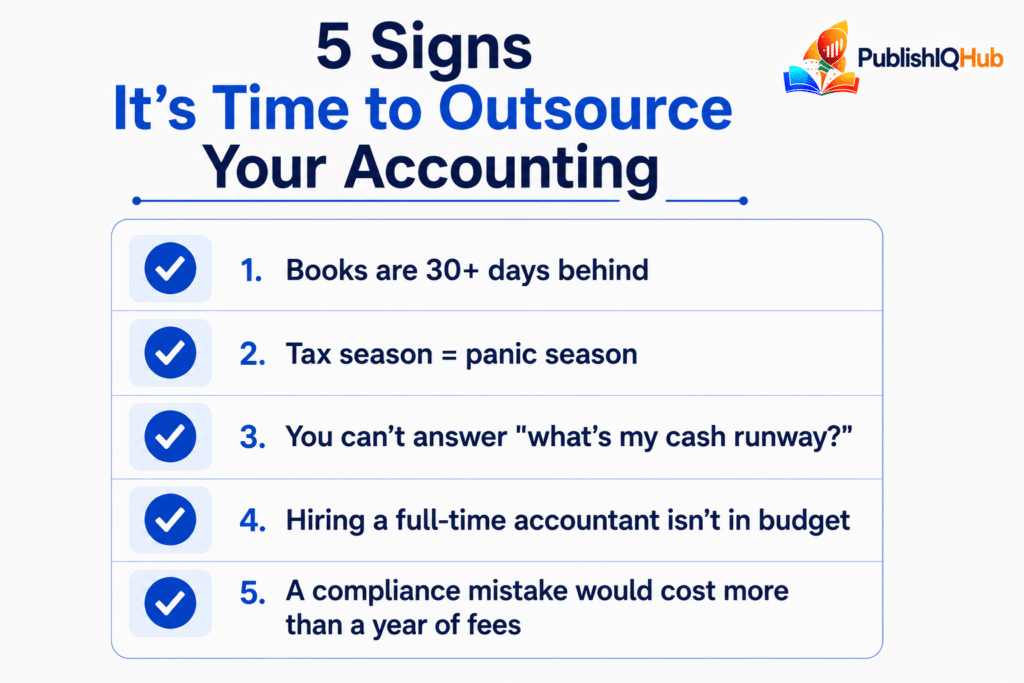
For most small businesses, outsourcing accounting makes sense the moment the owner is doing the books at 11 p.m. — or the moment a mistake would be expensive.
Small businesses were actually the early adopters here. 37% of small businesses already outsource their accounting or IT services, and accounting consistently ranks as the single most commonly outsourced function among them. There’s a good reason: accounting is high-stakes, deadline-driven, and completely outside most founders’ zone of genius.
Here’s when outsourcing accounting for a small business typically pays off:
- You’ve crossed roughly $250K–$500K in revenue and the DIY spreadsheet era is creating real risk
- Tax season hurts. If you’re scrambling every March, a firm that keeps your books clean year-round changes your life
- You’re about to raise money or take a loan. Investors and banks want credible financials, not a shoebox of receipts
- You can’t afford a full-timer but need more than software. A fractional arrangement gets you a real accountant for a fraction of the cost
- Compliance is getting complicated — multiple states, international sales, contractors vs. employees
When is it not the right move? If your business is genuinely tiny (a handful of transactions a month), good software plus an annual tax preparer may be all you need. And if your finances are deeply entangled with operations — say, complex job costing in construction — you’ll want a firm with proven industry experience, not a generalist.
How Do You Choose Between Outsourced Accounting Firms?
The best outsourced accounting firm for you is the one that fits your size, your industry, and your growth plan — not the one with the biggest brand.
Outsourced accounting firms roughly fall into four camps:
- Global BPO and consulting giants — built for enterprises with thousands of monthly transactions
- Specialist finance & accounting outsourcing providers — mid-market firms offering end-to-end finance and accounting with dedicated teams
- Tech-first bookkeeping platforms — software-plus-humans services aimed at startups and very small businesses
- Fractional and marketplace models — on-demand finance talent and bundled back-office services
15 Outsourced Accounting Firms Worth Shortlisting in 2026
Specialist F&A outsourcing providers:
- Datamatics Business Solutions — end-to-end finance and accounting outsourcing for small to mid-market businesses and CPA firms; dedicated teams covering bookkeeping, AP/AR, payroll, tax prep support, and reporting, with strong process automation
- QX Accounting Services — offshore teams trained in US GAAP and CPA workflows; known for overnight delivery, with work ready by morning
- TOA Global — accounting talent solutions for firms, built around dedicated offshore team members rather than pooled staff
- CapActix — bookkeeping, tax preparation, and virtual CFO support for CPA firms and small businesses
- IQ BackOffice — finance process outsourcing with a focus on AP/AR automation and high transaction volumes
- Auxis — nearshore (Latin America) finance and accounting outsourcing for mid-market companies wanting time-zone overlap
Global BPO majors:
- Genpact — enterprise-scale finance transformation, order-to-cash and procure-to-pay at volume
- Accenture — full finance function outsourcing bundled with consulting and technology change
- Infosys BPM — large-scale F&Adelivery with heavy automation and analytics
Tech-first platforms:
- Pilot — bookkeeping, tax, and CFO services for startups, delivered through its own platform
- Bookkeeper360 — US-based bookkeeping and advisory built around Xero and QuickBooks
- 1-800Accountant — bookkeeping plus tax filing for very small businesses and the self-employed
Fractional and marketplace models:
- Paro — a vetted marketplace matching businesses with freelance accountants, controllers, and CFOs
- Escalon — bundled back office (accounting, payroll, HR) aimed at startups and growing SMBs
- AccountingDepartment.com — fully outsourced, US-based client accounting with dedicated bookkeeping teams
Here’s how they stack up at a glance:
Competitive Comparison: 15 Outsourced Accounting Firms
| Firm | Best For | Services | Delivery Model | Pricing |
| Datamatics Business Solutions | SMBs, mid- market & CPA firms | End-to-end F&A: bookkeeping, AP/AR, payroll, tax support, reporting, automation | Dedicated offshore/hybrid teams | FTE or outcome- based |
| QX Accounting Services | US CPA firms | Bookkeeping, tax prep, virtual CFO | Offshore, overnight delivery | FTE / flexible |
| TOA Global | Accounting firms scaling teams | Dedicated accountants & bookkeepers | Offshore team members | Per-seat FTE |
| CapActix | CPA firms & small businesses | Bookkeeping, tax prep, virtual CFO | Offshore dedicated staff | Hourly / FTE |
| IQ BackOffice | Transaction-heavy businesses | AP/AR, payroll, close & reporting | Offshore + automation | Volume-based |
| Auxis | Mid-market wanting time-zone fit | F&A processes, shared services | Nearshore (LatAm) | Custom contracts |
| Genpact | Large enterprises | Finance transformation, O2C, P2P | Global delivery centers | Enterprise |
| Accenture | Global enterprises | Full F&A + consulting + tech | Global managed services | Enterprise |
| Infosys BPM | Large enterprises | F&A operations, analytics | Global delivery centers | Enterprise |
| Pilot | Startups | Bookkeeping, tax, CFO services | US-based + platform | Fixed monthly tiers |
| Bookkeeper360 | Small businesses on Xero/QBO | Bookkeeping, payroll, advisory | US-based teams | Fixed monthly tiers |
| 1-800Accountant | Micro-businesses & self-employed | Bookkeeping, tax filing | US-based, remote | Flat annual/monthly |
| Paro | Businesses needing fractional experts | Freelance accountants to CFOs | Marketplace matching | Hourly / project |
| Escalon | Startups bundling back office | Accounting + payroll + HR | US-managed teams | Monthly bundles |
| AccountingDepartment.com | US SMBs wanting onshore only | Full-charge bookkeeping, controller | 100% US-based | Fixed monthly |
Here’s how they stack up at a glance:
(Verify current service offerings and pricing directly with each provider — these change frequently.)
For growing businesses that have outgrown DIY software but aren’t ready for enterprise contracts, specialist firms like Datamatics Business Solutions tend to hit the sweet spot: dedicated accountants who learn your business, breadth across the whole finance function, and pricing that scales with scope rather than headcount.
Whichever direction you lean, vet every candidate on the same seven points:
- Industry experience — have they handled your business model before?
- Credentials — CPAs/CAs on staff, not just data-entry operators
- Security — SOC 2 or ISO 27001 certification, clear data-handling policies
- Software fit — do they work in your stack, or force a migration?
- Communication — named contact, defined response times, your time zone covered
- Reporting cadence — monthly close by a fixed date, in writing
- Exit terms — you own your data and your books, full stop
Can CPA Firms Outsource Accounting Work Too?
Yes — and they increasingly do. Accounting firms themselves are among the heaviest users of outsourced accounting, delegating routine compliance work so partners can spend their hours on advisory.
This surprises business owners, but it shouldn’t. The talent shortage hits accounting firms hardest of all — they’re the ones competing directly for a shrinking pool of CPAs, and busy season doesn’t care. So a growing number of firms now run a white-label model: an outsourcing partner handles bookkeeping, tax preparation workpapers, and reconciliations behind the scenes, while the firm reviews the output, signs off, and owns the client relationship.
For the firm, the math is compelling. Compliance work that barely broke even at local salary rates becomes profitable again. Seasonal capacity stops being a hiring gamble — you scale the outsourced team up for tax season and back down in the summer. And senior staff get their evenings back, which in this labor market is a retention strategy, not a perk.
Specialist providers like Datamatics Business Solutions serve both sides of this market — businesses that need a finance function, and CPA firms that need capacity — which is worth knowing whether you’re buying accounting services or delivering them.
If you engage a CPA firm and want to know whether your work is handled offshore, just ask. Reputable firms disclose it, remain fully responsible for review and quality, and follow the consent requirements that apply to outsourced tax work.
What Do Outsourced Accounting Services Cost?
Expect $500–$2,500/month for small-business bookkeeping, $2,000–$5,000/month for fuller accounting services, and $3,000–$10,000+/month once controller or CFO work enters the picture.
Pricing usually follows one of three models:
- Fixed monthly fee — most common; based on transaction volume and scope. Predictable, easy to budget.
- Hourly — fine for cleanup projects or overflow work; risky for ongoing services because incentives reward slowness.
- FTE / dedicated resource — you effectively rent a full-time or part-time accountant from the firm; common with offshore providers and typically 40–60% cheaper than an equivalent local hire.
A fair comparison isn’t “outsourced fee vs. zero.” It’s outsourced fee vs. the fully loaded cost of hiring: salary, payroll taxes, benefits, software licenses, training, and the recruiting cycle you’ll repeat when that person leaves. Run that math honestly and outsourcing wins far more often than the sticker prices suggest.
What actually drives your quote? Six things, in roughly this order:
- Transaction volume — 100 transactions a month and 2,000 are different jobs
- Number of entities and accounts — every extra company, bank account, or credit card adds reconciliation work
- State of your current books — clean, current books get standard pricing; a year of catch-up gets a cleanup project first
- Payroll headcount and complexity — ten salaried employees in one state is easy; fifty across five states isn’t
- Reporting needs — a basic monthly P&L costs less than board packs, departmental budgets, and cash forecasts
- Industry complexity — inventory, job costing, revenue recognition rules, and regulated sectors all add hours
Knowing this list helps you compare quotes intelligently. If two firms are far apart on price, they’ve usually assumed different answers to these six questions — so pin the assumptions down before you pin down the fee.
One caution: the cheapest quote is rarely the cheapest outcome. Bargain providers cut corners on review layers, and fixing a year of bad books costs more than doing them properly the first time.
How to Transition Without Breaking Anything
A good handover takes 30–60 days and follows a simple sequence: audit, access, parallel run, then full transfer.
The firms worth hiring will drive this process themselves, but you should know what “good” looks like:
- Weeks 1–2: Discovery and cleanup. The firm reviews your current books, flags errors, and agrees on the chart of accounts.
- Weeks 2–4: Access and documentation. Read-only bank feeds, software permissions, and a written process map for every recurring task.
- Weeks 4–8: Parallel run. They close a month alongside your existing process. You compare outputs before letting go of the old way.
- Ongoing: Rhythm. Monthly close by an agreed date, a standing review call, and a shared dashboard so nothing hides.
The most common mistake I see is skipping the parallel run to save a few weeks. Don’t. It’s the only stage where errors are cheap.
Three other traps worth naming:
- No internal owner. Outsourcing the work doesn’t mean outsourcing the relationship. Someone on your side — even if it’s you, for one hour a week — needs to review reports, answer the firm’s questions promptly, and flag business changes. Firms with unresponsive clients produce late, stale books, and it isn’t their fault.
- Handing over messy books without a cleanup budget. If your ledger is six months behind, the first engagement is a cleanup project, priced separately. Firms that quote ongoing rates without looking at your books first are guessing — and you’ll pay for the guess later.
- Judging the relationship in month one. The first close is always the slowest, because the firm is still learning your quirks. Give it a full quarter, hold them to the agreed close date from month two, and then decide.
Get the handover right and the ongoing relationship mostly runs itself: a fixed close date, a standing call, and financials that arrive before you have to ask.
Frequently Asked Questions
What is the difference between outsourced accounting and a bookkeeper?
A bookkeeper records transactions and reconciles accounts. Outsourced accounting is broader — it can include bookkeeping plus payroll, tax, reporting, and CFO-level strategy, delivered by a team rather than one person.
How much does it cost to outsource accounting for a small business?
Most small businesses pay between $500 and $2,500 per month for bookkeeping-led services, and $2,000–$5,000 per month for a fuller finance and accounting scope. Complexity and transaction volume drive the price more than company size.
Is outsourcing accounting safe?
It is when you choose a firm with SOC 2 or ISO 27001 certification, restricted access controls, and clear data-ownership terms. Ask about security before you ask about price.
Will I lose control of my finances?
No — you should gain visibility. Reputable outsourced accounting firms work inside your own cloud software, so you can see every entry in real time. You approve payments; they process them.
Can outsourced accounting firms handle my taxes too?
Many do, either directly or through partner CPAs. If tax is a priority, confirm the firm has licensed tax professionals for your jurisdiction, not just bookkeeping staff.
When should a business switch from software-only to outsourced accounting?
Typically when books fall more than a month behind, when tax season becomes disruptive, or when you need credible financials for lenders or investors — often around $250K–$500K in annual revenue.
Do outsourced accounting firms work in my time zone?
Most established firms, including offshore providers, offer overlapping hours or dedicated points of contact aligned to your business day. Confirm response-time commitments in the contract.