Quick Answer
The best email marketing tools for small business in 2026 depend on your list size and budget: Mailchimp and Brevo remain the most well-rounded all-rounders, MailerLite and Sender are the strongest low-cost options with real automation, and Klaviyo and ActiveCampaign lead on advanced, AI-driven automation for ecommerce and growing teams. Free plans are genuinely usable in 2026, but subscriber and send limits vary a lot between platforms, so match the tool to how big — and how active — your list actually is.
If you’ve spent any time comparing email marketing tools this year, you’ve probably noticed the category has gotten crowded — and confusing. Every platform now claims “AI-powered” automation, every pricing page hides the real cost until you enter your list size, and every “best of” list seems to rank a different tool first.
This guide cuts through that by focusing on what actually changes month to month for a small business: real pricing at real list sizes, what each free plan actually restricts, and which platforms are worth the switch versus which ones are worth sticking with. Whether you’re choosing your first email marketing platform for small business or migrating away from one that’s outgrown its usefulness, the goal here is a decision you can make in one sitting, not another twelve open tabs.
Why Email Marketing Still Outperforms Every Other Channel
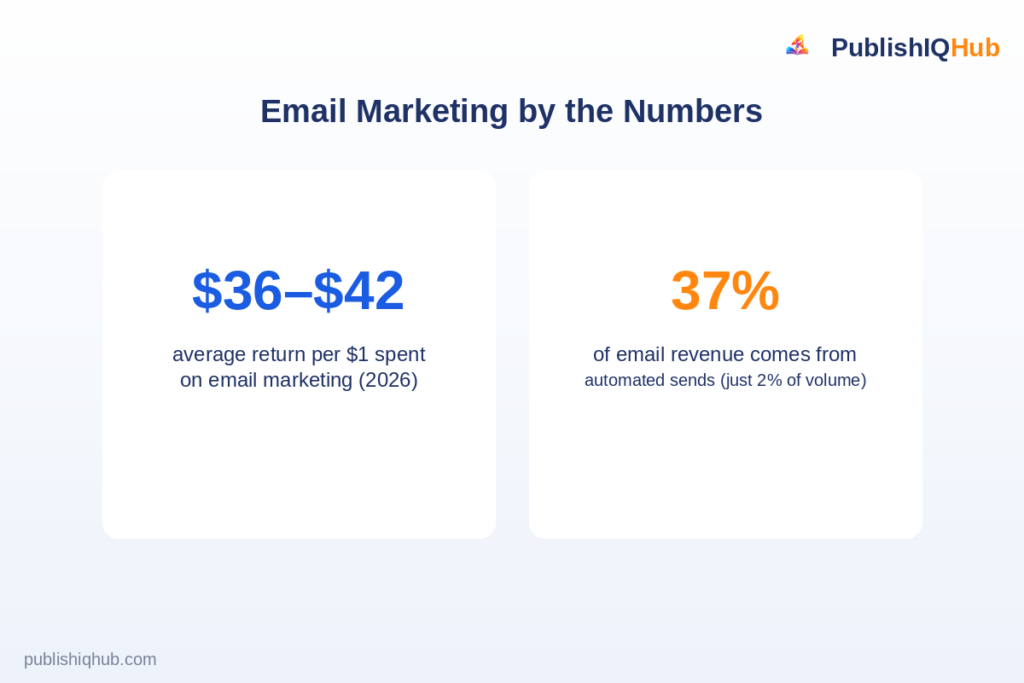
It’s easy to assume email is old news next to social media and paid ads. The numbers say otherwise. Email marketing delivers an average return of $36–$42 for every $1 spent, a figure that consistently outperforms paid search (around $2), social advertising (around $2.80), and display ads (around $1.35) (Digital Applied, 2026). Some agencies do even better — marketing, PR, and advertising agencies report ROI as high as 42:1, largely because their lists are built on genuine permission and engagement (Marketful, 2026).
Scale matters here too. There are roughly 4.5 billion email users worldwide, a number projected to climb to 4.8 billion by 2027 (Statista, 2025, via Entrepreneurs HQ), and people send 376 billion emails a day (Statista, 2025). Despite the rise of chat apps and social DMs, 60% of consumers still say they prefer email over social media for hearing from brands (HubSpot, 2024), and 88% check their inbox multiple times a day (ZeroBounce, 2024).
Automation is where the real leverage is. Automated emails account for just 2% of total email volume but drive 37% of all email-generated revenue (Litmus, via Omnisend, 2026) — and separately, automated campaigns have been shown to generate 320% more revenue than one-off, non-automated sends (Campaign Monitor, via Entrepreneurs HQ, 2026). AI is accelerating that gap further: AI-optimized subject lines lift open rates by roughly 26% compared with manually written ones, and AI-driven personalization has been linked to revenue increases as high as 41–42% in some benchmark sets (Digital Applied, 2026; Verified.email, 2026).
None of this works, though, if messages don’t reach the inbox. It’s worth remembering that a large share of recorded “opens” are inflated by Apple’s Mail Privacy Protection, which affects an estimated 50–60% of tracked opens (Litmus, via InboxAlly, 2026) — one reason serious marketers increasingly judge tools by click, reply, and conversion data rather than open rate alone.
What Should You Look for in an Email Marketing Tool?
Before comparing specific email marketing platforms, it helps to know which features actually move the needle for a small business rather than just looking good on a pricing page.
- Real automation on entry-level plans. Welcome sequences, cart-abandonment flows, and re-engagement emails shouldn’t require the top tier.
- Deliverability track record. A cheap tool that lands in spam isn’t cheap — it’s a churn machine.
- Segmentation depth. The difference between “batch and blast” and genuinely targeted email campaign platforms comes down to how well you can slice your list.
- Honest free-plan limits. Some platforms cap subscribers, others cap monthly sends — know which constraint actually affects you.
- Integration and CRM fit. If you’re already running a CRM or ecommerce platform, native integrations save hours of manual list-syncing every month.
- AI features that are actually usable, not just marketing copy — AI subject line generation, send-time optimization, and content drafting are now standard on several platforms rather than a premium add-on.
What Is the Best Email Marketing Tool for Small Business?
There’s no single winner — the “best” tool depends on whether you’re optimizing for price, automation depth, or ecommerce-specific features. The comparison table below breaks down all 20 email marketing platforms for small business covered in this guide, by pricing tier, free-plan limits, standout feature, and who they suit best.
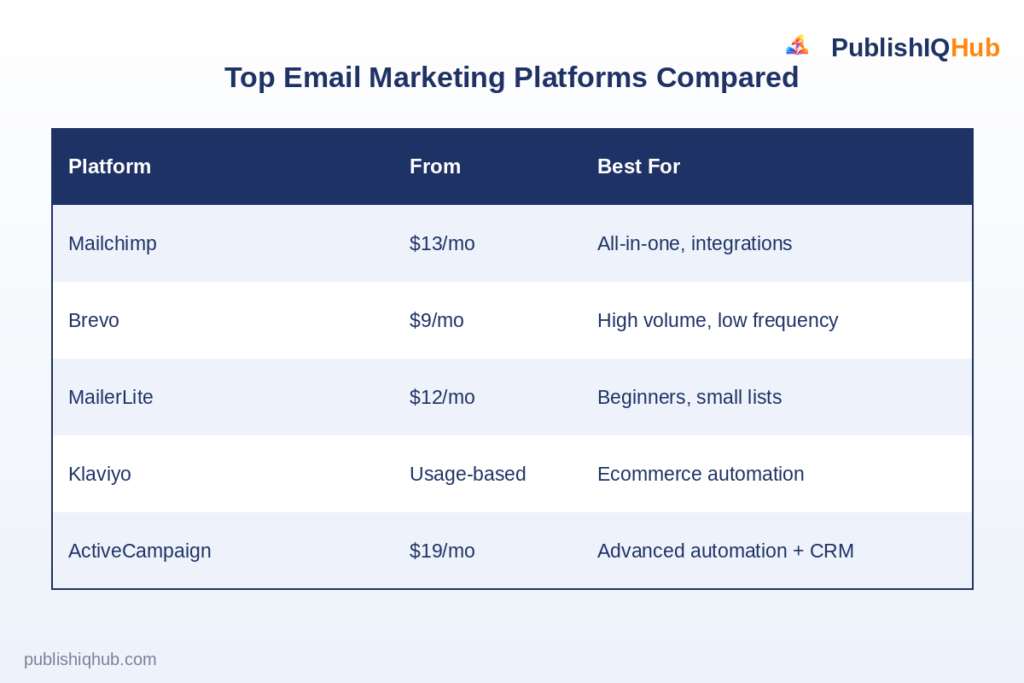
| Platform | Starting Price | Free Plan | Standout Feature | Best For |
| Mailchimp | From $13/mo | 500 contacts, 1,000 sends/mo | 300+ integrations | Brand recognition, all-in-one marketing |
| Brevo | From $9/mo | Unlimited contacts, 9,000 sends/mo | CRM + SMS + email in one plan | High list volume, low send frequency |
| MailerLite | From $12/mo | 250 contacts, 2,500 sends/mo | Simple drag-and-drop automation | Beginners, small lists |
| Klaviyo | Usage-based | 250 contacts / limited sends | Ecommerce behavioral automation | Online stores, Shopify sellers |
| Active Campaign | From $19/mo | None | Deep automation + built-in CRM | Growing teams needing advanced workflows |
| HubSpot | From $9/mo (Starter) | 2,000 sends/mo | Full CRM and sales pipeline integration | Businesses scaling marketing + sales together |
| Omnisend | Usage-based | 250 contacts / limited sends | Ecommerce-specific automation templates | Online stores wanting SMS + email combined |
| EmailOctopus | From $9/mo | Limited free tier | Simple, predictable pricing | Newsletter-first small businesses |
| AWeber | Free tier available | Available | Affordable entry pricing | Solopreneurs, first-time users |
| GetResponse | Free tier available | AI content generator, limited webinars | Built-in AI campaign generator | Testing AI-assisted campaigns |
| Constant Contact | From $12/mo | Free trial only | Easy setup, reliable deliverability | Small businesses wanting simplicity |
| Moosend | From $9/mo | None (30-day free trial) | Unlimited sends at a low starting price | Budget-conscious automation seekers |
| Sender | From ~$7/mo (annual) | 2,500 contacts, 15,000 sends/mo, automation incl. | Automation included on the free plan | Small lists wanting free automation |
| Kit (ConvertKit) | From $33/mo (Creator) | 10,000 contacts, unlimited sending | Creator-focused newsletter tools | Bloggers, YouTubers, podcasters |
| Beehiiv | From $49/mo (Scale) | 2,500 contacts, unlimited sending | Built-in monetization (ads, subscriptions) | Newsletter creators wanting monetization |
| Hostinger Reach | Bundled with Hostinger plans | Available | AI-generated, on-brand campaigns | Small businesses, creators wanting AI drafting |
| Campaign Monitor | From ~$10–$13/mo | None (limited sandbox only) | Premium, polished email templates | Brands prioritizing design quality |
| SendPulse | From ~$10/mo | Available | Multichannel: email + SMS + chatbot + push | Consolidating channels under one platform |
| Zoho Campaigns | From ~$3–$4.50/mo | Available | Native Zoho CRM integration | Zoho ecosystem users, budget-conscious teams |
| Drip | Usage-based | None (free trial only) | Ecommerce behavioral automation | Online stores wanting a Klaviyo alternative |
Top Email Marketing Companies Worth Comparing in 2026
Beyond the comparison table, here’s a closer look at the platforms most frequently recommended across independent reviews and buyer’s guides this year.
Mailchimp
Mailchimp is still the most recognized name in the category, and for good reason — it connects to more than 300 apps and services, so whatever stack you’re already running, Mailchimp probably plugs into it (Sequenzy, 2026). The trade-off is a free plan that’s grown stingier over time, now capped at 500 contacts and 1,000 sends a month (Sequenzy, 2026).
Brevo
Brevo (formerly Sendinblue) takes a different approach to free-tier limits: instead of restricting contacts, it restricts daily sends. You can store unlimited contacts and send up to 300 emails a day — roughly 9,000 a month — which suits businesses with a large list but a lower sending cadence (ThatMarketingBuddy, 2026). Paid plans start around $9/month for 5,000 sends (Vizaca, 2026), and the platform bundles CRM, SMS, and transactional email alongside standard email marketing (Brevo, 2026).
MailerLite
MailerLite built its reputation on being approachable for beginners, with a clean automation editor that supports welcome sequences, abandoned-cart flows, and segmentation without a steep learning curve (EmailVendorSelection, 2026). Its free plan was reduced in mid-2026 to 250 subscribers and 2,500 emails a month, with paid plans starting at $12/month (Sequenzy, 2026).
Klaviyo
Klaviyo is purpose-built for ecommerce and is frequently cited as offering the most advanced automation-per-dollar in that niche, including behavior-based workflows and dozens of ecommerce integrations — though its sending capacity on lower tiers is comparatively limited (Mailtrap, 2026). You can see how it stacks up against competitors directly on G2’s comparison pages.
ActiveCampaign
ActiveCampaign is the platform most reviewers point to for genuine email automation depth: it can generate email drafts from a prompt, includes a built-in CRM and lead scoring, and supports SMS alongside email — but pricing rises quickly with list size, climbing from around $19/month at 1,000 contacts to roughly $489/month at 25,000 contacts on some plans (Constant Contact, 2026). Its most advanced AI features, like predictive sending, are generally gated to higher-priced tiers (InsiderOne, 2026). Full plan details are on ActiveCampaign’s own pricing page.
HubSpot
HubSpot appeals to businesses that want email marketing and CRM under one roof, with reporting dashboards that scale as a company grows from a free plan into more sophisticated sales and marketing tooling (InsiderOne, 2026). The catch is a steep jump in cost — many of the platform’s most powerful automation and reporting features sit behind an $800/month Professional tier (InsiderOne, 2026).
Omnisend
Omnisend rounds out the ecommerce end of the spectrum alongside Klaviyo, built specifically for stores wanting SMS and email combined in one automated flow — abandoned-cart, browse-abandonment, and post-purchase sequences are native to the platform rather than bolted on, and pricing is usage-based rather than a flat monthly fee (Sender.net, 2026).
EmailOctopus
EmailOctopus takes the opposite approach: no ecommerce-specific triggers, no CRM, just a simple, predictable pricing model starting around $9/month for 500 subscribers — a deliberate choice for small businesses and newsletter senders who don’t want to pay for automation depth they won’t use (Sender.net, 2026).
Kit (formerly ConvertKit)
Kit (formerly ConvertKit) is the clearest creator-first pick on this list: its free “Newsletter” plan supports up to 10,000 contacts, one of the most generous free limits in the category, and its paid Creator plan starts at $33/month once you want commerce and automation features layered on top (TrueList, 2026; CognifyFuture, 2026).
Beehiiv
Beehiiv competes directly with Kit for newsletter creators but leans harder into monetization: its free Launch plan covers 2,500 subscribers with unlimited sending, and the paid Scale plan (from $49/month) unlocks an ad network, premium subscriptions, and built-in monetization tools that Kit doesn’t match at the same tier (EmailTooltester, 2026; SendX, 2026).
Sender
Sender is worth a specific mention for its free-tier generosity: its free plan supports unlimited automated workflows for up to 2,500 subscribers and 15,000 emails a month, one of the only free tiers that doesn’t gate automation behind a paid upgrade — the trade-off is that Sender branding appears on every free-plan email, and paid plans start around $7/month on annual billing (ThatMarketingBuddy, 2026; Hack’celeration, 2026).
GetResponse
GetResponse takes a different angle on its free tier — instead of leading with subscriber count, it bundles in features most competitors keep behind a paywall: an AI campaign generator and limited webinar hosting (recording-only, capped at 10 attendees) (CognifyFuture, 2026). Automation on the free plan stays basic, without dynamic segment filters, so it suits businesses wanting to test AI-assisted campaign writing before committing to a paid tier rather than businesses needing production-grade automation from day one.
AWeber
AWeber positions itself at the affordable, low-friction end of the market, with a free plan and pricing tiers aimed squarely at small businesses and first-time users rather than complex enterprise workflows (Brevo, 2026). Its interface is frequently cited as one of the easier learning curves in the category, which matters if email marketing isn’t anyone’s full-time job on your team.
Constant Contact
Constant Contact has built its reputation on ease of setup and reliable deliverability for small businesses that want a straightforward tool without a steep onboarding process — plans start at $12/month, though there’s no permanent free plan, only a trial (ThatMarketingBuddy, 2026).
Moosend
Moosend rarely gets the attention it deserves: it delivers real behavioral-trigger automation, solid segmentation, and a clean visual workflow builder at a noticeably lower starting price ($9/month with unlimited sends) than most automation-focused competitors, though it has no permanent free tier as of 2026, only a 30-day trial (Vizaca, 2026; EmailToolScout, 2026; ThatMarketingBuddy, 2026).
Hostinger Reach
Hostinger Reach is one of the newer entrants worth watching, aimed specifically at small businesses, creators, and solopreneurs who want AI-generated, on-brand campaigns without building sequences manually from scratch (Mailtrap, 2026) — a sign of where several of these platforms are heading as AI content generation becomes a baseline expectation rather than a premium feature.
Campaign Monitor
Campaign Monitor (now part of Marigold) is worth a mention for its email design quality — it’s often cited as having some of the most polished templates in the category — but it has no permanent free plan, only a limited sandbox for testing, and pricing (from roughly $10–$13/month) climbs quickly with both contact count and feature tier.
SendPulse
SendPulse takes a multichannel approach, bundling email, SMS, chatbots, and web push notifications into one platform starting around $10/month, with a free plan available — a reasonable pick if you want to consolidate several outreach channels under one login rather than stitching tools together.
Zoho Campaigns
Zoho Campaigns is the budget pick for businesses already inside the Zoho ecosystem: plans start as low as $3–$4.50/month, there’s a genuine free plan, and native syncing with Zoho CRM means contacts and campaign activity stay in one place without manual exports.
Drip
Drip rounds out the ecommerce-automation category alongside Klaviyo and Omnisend, with behavior-based workflows built for online stores — its main drawback next to those two is the absence of a permanent free plan, offering only a free trial before billing kicks in.
20 Email Marketing Companies at a Glance
For a fast side-by-side reference, here are 20 of the most frequently recommended email marketing companies in 2026, each covered in more detail above:
- Mailchimp — all-in-one marketing platform, 300+ integrations, from $13/mo
- Brevo — CRM + SMS + email, unlimited contacts on the free tier, from $9/mo
- MailerLite — beginner-friendly automation editor, from $12/mo
- Klaviyo — ecommerce behavioral automation, usage-based pricing
- ActiveCampaign — deep automation with a built-in CRM, from $19/mo
- HubSpot — CRM, email, and sales pipeline in one platform, from $9/mo (Starter)
- Omnisend — ecommerce-specific SMS + email automation, usage-based
- EmailOctopus — simple, predictable pricing, from $9/mo
- AWeber — affordable and beginner-friendly, free plan available
- GetResponse — AI campaign generator plus webinar hosting, free tier available
- Constant Contact — easy setup, reliable deliverability for small business
- Moosend — low-cost behavioral automation, no permanent free tier
- Sender — generous free-tier automation for up to 2,500 subscribers
- Kit (formerly ConvertKit) — creator-focused, 10,000-contact free tier
- beehiiv — newsletter platform with built-in monetization, 2,500-contact free tier
- Hostinger Reach — AI-generated campaigns for small business and creators
- Campaign Monitor — premium email templates, no permanent free plan, from ~$10–$13/mo
- SendPulse — multichannel email, SMS, chatbot, and push platform, from ~$10/mo
- Zoho Campaigns — budget-friendly, native Zoho CRM integration, from ~$3–$4.50/mo
- Drip — ecommerce marketing automation, free trial only (no permanent free plan)
Email Campaign Platforms: Ecommerce vs. B2B Use Cases
Not every email campaign platform is optimized for the same job, and this is where a lot of small businesses pick the wrong tool despite doing otherwise-careful research.
Ecommerce-first platforms — Klaviyo and Omnisend chief among them — are built around behavioral triggers tied to a storefront: browse abandonment, cart abandonment, post-purchase follow-up, and win-back flows tied to purchase history. Their integrations lean heavily toward Shopify, WooCommerce, and similar platforms, and their reporting is built to tie email activity directly to revenue per send. If most of your email marketing exists to support a storefront, these platforms will get you to a working automation setup faster than a general-purpose tool will.
B2B and service-business platforms — ActiveCampaign and HubSpot are the clearest examples — lean instead toward lead scoring, sales-pipeline visibility, and longer nurture sequences that account for a sales cycle rather than a single purchase event. A built-in CRM matters more here than ecommerce-specific triggers, since the goal is usually moving a contact toward a sales conversation rather than an instant purchase. If you’re weighing an in-house marketing team against outsourced support to run these workflows, our breakdown of top Indian BPO companies for your business is a useful next read.
General-purpose platforms — Mailchimp, Brevo, MailerLite, and AWeber among them — sit in between, and that flexibility is exactly their appeal for small businesses that don’t fit neatly into either camp yet, or that run a mix of newsletter content, occasional promotions, and light nurture sequences without needing dedicated ecommerce or CRM tooling from day one. The honest advice here: don’t buy ecommerce-specific automation depth you won’t use, and don’t undersize a CRM-integrated platform if sales handoffs are actually central to how your business converts leads.
Best Automated Emails: Where Automation Actually Pays Off
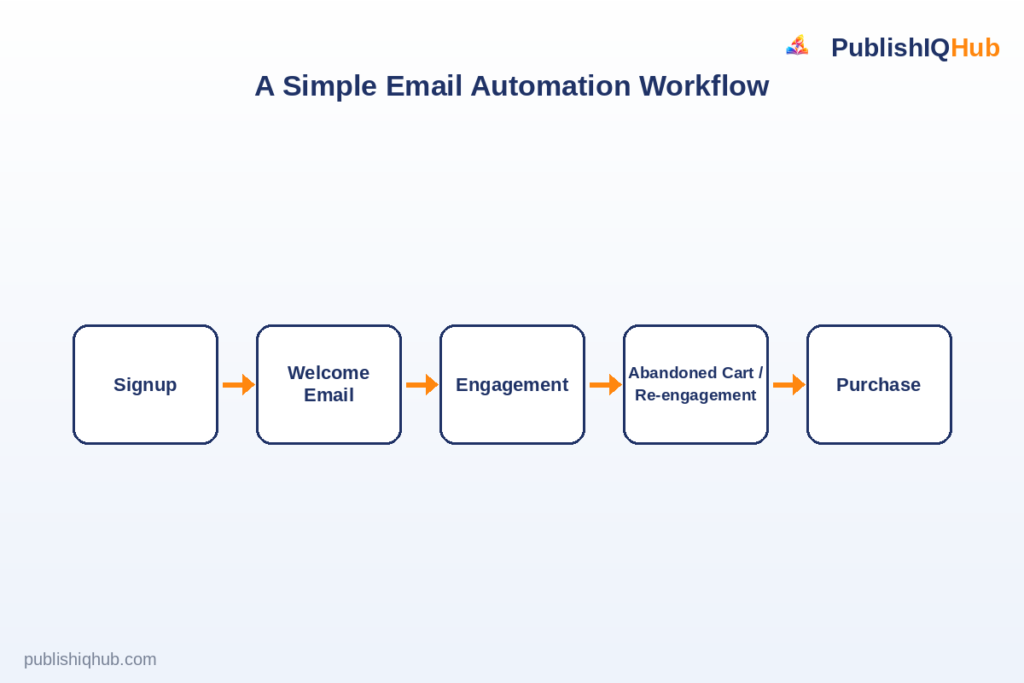
“Best automated emails” isn’t really a tool question — it’s a sequence question. Across the platforms above, the flows that consistently drive the most measurable return are:
- Welcome sequences — sent the moment someone subscribes, while intent is highest.
- Abandoned-cart flows — particularly strong for ecommerce brands on Klaviyo or Omnisend, where behavior-based triggers fire automatically.
- Post-purchase and replenishment emails — nudge repeat purchases without manual list-building.
- Re-engagement or win-back campaigns — targeted at subscribers who’ve gone quiet, protecting deliverability by trimming inactive contacts.
- Transactional-adjacent nurture emails — transactional emails already see roughly 8x higher opens and clicks than standard marketing sends (InboxAlly, 2026), and layering light nurture content around them (without violating transactional-email rules) captures some of that attention.
This is the core argument for email automation generally: it’s not about sending more email, it’s about sending the right email at the moment someone is most likely to act — which is exactly why automated sends punch so far above their volume share in revenue terms.
Free Email Marketing Tools: What “Free” Actually Gets You in 2026
Free email marketing tools have improved substantially, but “free” means different things depending on the platform:
- Contact-capped plans (Mailchimp: 500 contacts; MailerLite: 250 contacts) suit very small or brand-new lists but require an early upgrade decision.
- Send-capped plans (Brevo: unlimited contacts, ~9,000 sends/month) suit larger lists that don’t email daily.
- Creator-first free tiers (Kit: up to 10,000 contacts; beehiiv: 2,500 contacts with unlimited sending) suit newsletter-driven businesses specifically.
- Feature-limited free tiers (GetResponse: AI content generator and recording-only webinars included free, but automation stays basic) suit businesses wanting to test specific features before paying.
The practical takeaway: decide whether your constraint is subscriber count or sending frequency before comparing free plans, since the two most common models optimize for opposite use cases (Sequenzy, 2026; BizToolkit, 2026).
How Much Does Email Marketing Software Cost?
Entry-level plans for small lists typically start between $9 and $30 a month, while advanced automation, AI personalization, and CRM-integrated tiers can run into the hundreds or, for enterprise-tier platforms, low thousands per month (InsiderOne, 2026). The steepest jumps tend to happen between a platform’s “growth” and “professional” tiers rather than at the entry level — so it’s worth mapping your expected list size six to twelve months out, not just where you are today, before committing to a platform.
AI Email Marketing Tools in 2026: Hype vs. Actual Utility
“AI email marketing tools” is one of the most-searched phrases in the category right now, but the feature set behind that label varies enormously between platforms. At the useful end: AI-generated subject lines (shown to lift open rates by roughly 26% over manually written ones), send-time optimization that learns when individual subscribers actually open email, and content drafting that turns a rough prompt into a formatted campaign — all of which are now available on at least entry-to-mid tier plans from ActiveCampaign, GetResponse, and Hostinger Reach (Digital Applied, 2026; Mailtrap, 2026). At the less useful end: AI features that exist mainly as a pricing-page bullet point, gated so deep into premium tiers that a small business will rarely touch them.
The practical filter worth applying: ask whether a platform’s AI features solve a task you were already doing manually (writing subject lines, guessing send times, drafting copy) versus whether they’re a novelty layered on top of the same manual workflow. Enterprise AI adoption in email marketing is reportedly around 61% and accelerating (Digital Applied, 2026) — a shift playing out well beyond marketing tools, as our look at top AI manufacturing companies in the USA shows. For a small business choosing a tool today, the underlying automation and deliverability still matter more than which platform has the flashiest AI demo.
Email Deliverability: The Feature Nobody Markets, But Everyone Needs
None of the automation, segmentation, or AI features above matter if your emails don’t reach the inbox. Deliverability rarely appears as a headline feature on pricing pages, but it’s arguably the most important differentiator between email marketing companies once you’re sending real volume. A few things worth checking before committing to a platform: whether it supports proper authentication (SPF, DKIM, DMARC) out of the box, whether it actively monitors and warns you about list decay (bounces, spam traps, inactive addresses), and whether its sending infrastructure has a track record with major inbox providers rather than a history of shared-IP reputation problems. Because email’s true return is frequently understated by attribution gaps and privacy-driven measurement distortion, some analyses suggest the real economic impact of well-managed email programs runs 20–50% higher than standard ROI benchmarks capture (Verified.email, 2026) — but only for lists that are actually being delivered, not just sent.
The Bottom Line
The best email marketing tool for your business is rarely the one at the top of a generic “best of” list — it’s the one that matches your list size, your sending frequency, and whether ecommerce triggers or CRM-linked nurture sequences actually reflect how you sell. Start with a genuine free plan if you’re early — MailerLite, Brevo, Sender, and Kit all offer real, permanent free tiers rather than time-limited trials — and plan your upgrade path around where your list will realistically be in six to twelve months, not just where it is today. And if scaling your marketing function eventually means bringing in outside help rather than hiring in-house, our guide to IT outsourcing companies in India covers that decision in more depth. The category will keep shifting as AI features become standard rather than premium, but the fundamentals haven’t changed: automation, segmentation, and deliverability still do more for revenue than any single AI bullet point on a pricing page.
FAQ
What is the best email marketing tool for small business in 2026?
There isn’t a single best option — Mailchimp and Brevo suit businesses wanting an all-in-one, well-integrated platform, MailerLite and Sender suit tighter budgets, and Klaviyo suits ecommerce sellers specifically.
How much does email marketing software cost per month?
Entry-level plans generally start around $9–$30/month for small lists; costs rise with list size and automation depth, with some advanced tiers reaching several hundred dollars a month.
Are free email marketing tools actually usable, or just trials?
Several platforms — including Mailchimp, MailerLite, Brevo, Kit, and beehiiv — offer genuine permanent free plans rather than time-limited trials, though subscriber and send limits vary significantly between them.
What’s the difference between email automation and a regular email campaign?
A campaign is a one-time or scheduled send to a list; automation triggers emails based on subscriber behavior (like a signup, purchase, or period of inactivity) without manual sending each time.
Which email marketing tools include AI features?
ActiveCampaign, GetResponse, Hostinger Reach, and several others now include AI-assisted subject lines, send-time optimization, or content drafting, with more advanced AI features often reserved for higher-priced tiers.
Do I need a CRM built into my email marketing platform?
Only if you’re not already using one — HubSpot and ActiveCampaign bundle CRM and email marketing, which helps if sales and marketing teams need shared contact data, but adds cost if you already have a separate CRM.