
Disclaimer: This article is for general informational purposes only and does not constitute professional, legal, or financial advice. The companies listed are presented in no particular order, based on publicly available information at the time of writing, and no listing is a paid placement or an endorsement. Rates, statistics, and market figures change frequently — verify current details directly with providers and cited sources before making any outsourcing decision.
Quick Answer: IT outsourcing in India means delegating software development, infrastructure management, support, or other technology functions to Indian service providers or offshore teams. Companies typically save 50–80% compared to hiring in the US or Western Europe, while gaining access to the world’s largest tech talent pool — nearly 6 million professionals. Costs range from roughly $15–$45 per hour for most roles, and the top IT outsourcing companies in India include TCS, Infosys, HCLTech, Wipro, and a strong mid-market tier covered below.
Every year, thousands of companies — from two-person startups to Fortune 100 giants — send some part of their technology work to India. And every year, a new wave of first-time buyers asks the same questions. Is it actually cheaper once you account for everything? Which company should we pick? What goes wrong, and how do we avoid it?
This guide is written for that buyer. Not the procurement veteran who’s negotiated ten master service agreements, but the founder, CTO, or operations head evaluating IT outsourcing in India seriously for the first time — or re-evaluating it after a mixed experience. We’ll walk through what you can outsource, what it genuinely costs, the benefits and the trade-offs, and 15 companies worth shortlisting, with a comparison block to make that shortlist faster.
Let’s get into it.
Why India Still Dominates Global IT Outsourcing
The short version: no other country combines scale, skill, cost, and maturity the way India does.
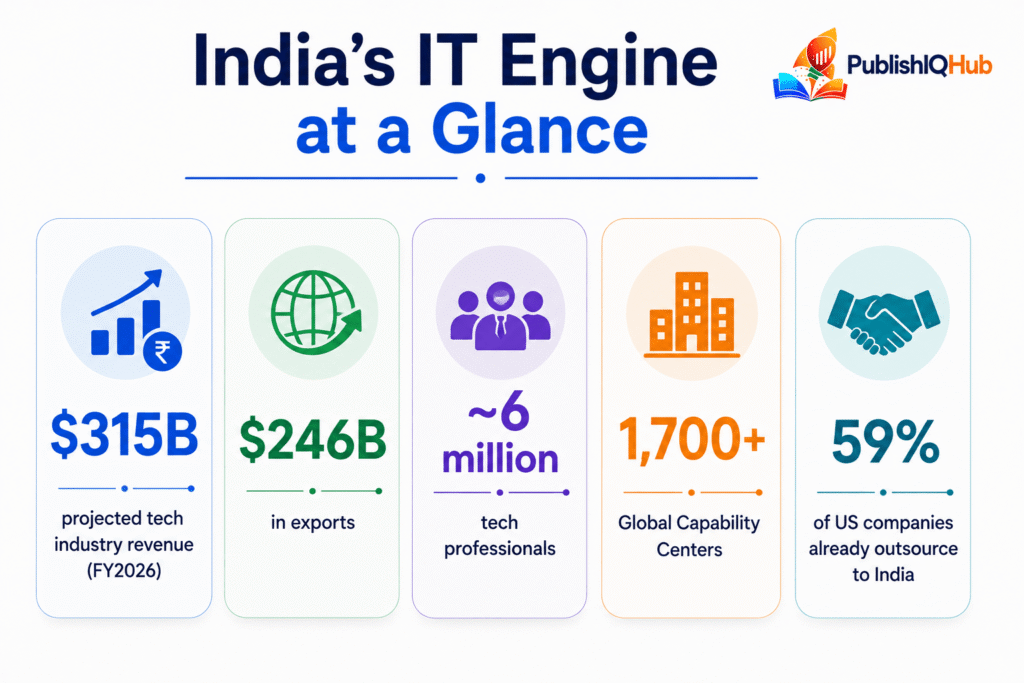
The numbers back this up. According to NASSCOM’s Annual Strategic Review, India’s technology industry is projected to reach $315 billion in revenue in FY2026, with exports contributing around $246 billion. That’s not a niche industry serving a few adventurous clients. It’s the backbone of how global enterprises build and run technology.
Demand-side data tells the same story. Deloitte research indicates that 59% of American companies outsource work to India, and 80% of US and European outsourcing firms rank India as their number one destination for IT services. When four out of five buyers in your peer group land on the same answer, the burden of proof shifts — you’d need a strong reason not to at least evaluate India.
There’s also a structural shift underway that first-time buyers often miss. India isn’t just a vendor market anymore. Over 1,700 Global Capability Centers now operate in India, generating $64.6 billion in revenue and employing 1.9 million professionals. Microsoft, Goldman Sachs, Walmart, and hundreds of others don’t merely buy services from India — they build permanent engineering capability there. That tells you the talent quality argument has been settled at the highest levels of global business.
What Is IT Outsourcing in India, Exactly?
IT outsourcing in India is the practice of contracting technology work — building software, managing infrastructure, running support desks, testing applications — to teams based in India rather than hiring locally.
In practice, it comes in three main flavors, and knowing which one you need is the single most useful thing you can figure out before contacting any vendor:
1. Project-based outsourcing. You hand over a defined piece of work — “build us a customer portal,” “migrate us to AWS” — with a fixed scope, timeline, and price. Best when requirements are clear and stable.
2. Dedicated teams (staff augmentation). You hire developers, testers, or engineers who work exclusively for you, managed either by you or jointly with the vendor. Best when you need ongoing capacity and want control over priorities.
3. Managed services. The vendor takes end-to-end ownership of a function — your helpdesk, your cloud infrastructure, your application maintenance — against SLAs. Best for keep-the-lights-on work you’d rather not think about daily.
Offshore IT outsourcing India-style usually means your team sits in Bengaluru, Hyderabad, Pune, Chennai, Noida, or Mumbai while you’re in New York, London, or Sydney. Many vendors also offer hybrid models with onshore coordinators, which helps when time zones or client-facing work demand local presence.
IT Outsourcing Services in India: What Can You Actually Outsource?
The range of IT outsourcing services in India has broadened dramatically over the last decade. Here’s the current landscape, roughly ordered from most to least commonly outsourced by first-time buyers:
Software development. Custom applications, web and mobile products, SaaS platforms, API development, and modernization of legacy systems. This remains the largest category by volume.
Cloud and infrastructure services. Cloud migration, DevOps, site reliability engineering, and 24/7 infrastructure monitoring. India’s time zone becomes a genuine asset here — your systems get watched while you sleep.
Data, AI, and analytics. Data engineering, BI dashboards, machine learning models, and increasingly, generative AI implementation. This is the fastest-growing service line, and Indian vendors have invested heavily in AI upskilling.
Quality assurance and testing. Manual and automated testing, performance testing, security testing. Often the easiest first project for a cautious buyer because scope is contained and results are measurable.
IT support and helpdesk. L1/L2/L3 technical support, desktop management, ticket resolution. Mature, process-driven, and heavily SLA-based.
Cybersecurity services. Security operations centers (SOC), vulnerability management, compliance support. A growing specialty, particularly among mid-tier firms.
ERP and enterprise platforms. SAP, Oracle, Salesforce, ServiceNow, and Microsoft Dynamics implementation and support. Certified practice teams are a hallmark of the larger vendors.
A practical tip: don’t shortlist vendors by brand first. Shortlist by service line. A company that’s brilliant at cloud managed services may be mediocre at product engineering, and vice versa. The comparison table later in this guide flags each company’s strongest suit for exactly this reason.
Benefits of IT Outsourcing to India: Why Outsource IT to India in 2026?
If you’re building the internal business case, these are the benefits of IT outsourcing to India that consistently survive scrutiny — along with honest caveats.
1. Cost savings that remain substantial
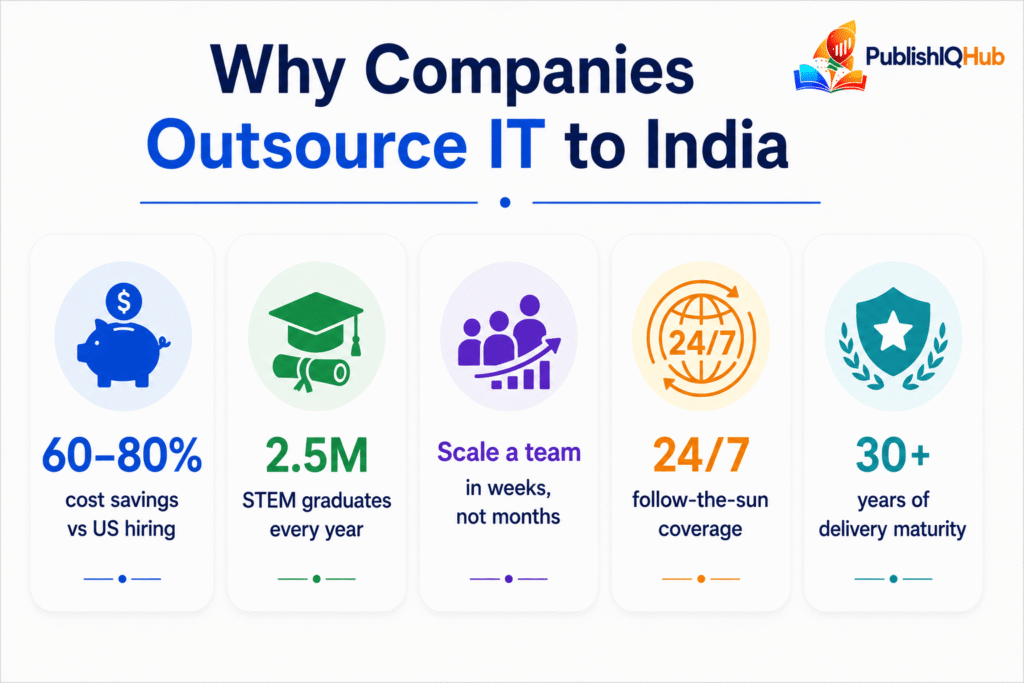
Yes, Indian salaries have risen. Yes, the gap has narrowed at senior levels. It’s still enormous. Businesses outsourcing to India typically save 60–80% compared to hiring equivalent roles in the United States, with the biggest deltas at junior and mid levels. A senior engineer who costs $160,000+ fully loaded in the US might cost $40,000–$70,000 through an Indian partner — and that’s before you count recruiting fees, benefits, and office overhead you’re not paying.
2. Access to talent you simply can’t hire locally
India produces roughly 2.5 million STEM graduates a year and employs the largest technology workforce outside the US. If you’ve spent six months trying to hire a data engineer in a mid-sized Western city, you already understand why this matters. The constraint on most tech roadmaps isn’t budget — it’s people.
3. Speed and scale
Need to go from 3 developers to 12 in eight weeks? An established Indian partner can do that. Doing it through local hiring would take you the better part of a year. For companies in a growth phase or under a deadline, this elasticity is often worth more than the cost savings.
4. Follow-the-sun operations
The 9.5–10.5 hour offset from US time zones means work continues overnight. For support desks, monitoring, and DevOps, that’s a feature, not a bug — issues raised at 6 pm in Chicago are resolved before the team logs in the next morning.
5. Process maturity
India’s top vendors have been doing this for 30+ years. CMMI Level 5 appraisals, ISO 27001 certifications, SOC 2 compliance, GDPR-ready data handling — the compliance and delivery infrastructure is well-worn. You’re rarely their first rodeo.
The honest caveats: time zone overlap requires deliberate scheduling (expect your Indian team to flex, but don’t abuse it), attrition in Indian tech hubs is real and needs contractual protection (ask about backfill commitments), and communication quality varies far more by company and team than by country. Every one of these is manageable. None of them should be ignored.
IT Outsourcing Cost in India: What Should You Budget?
Let’s talk money properly, because “it’s cheaper” isn’t a budget.
Typical hourly rates (2026 ballparks)
| Role | India (per hour) | US equivalent (per hour) |
| Junior developer | $15–$25 | $60–$90 |
| Mid-level developer | $25–$40 | $90–$130 |
| Senior developer / lead | $35–$55 | $120–$180 |
| QA engineer | $15–$30 | $55–$85 |
| DevOps / cloud engineer | $30–$50 | $110–$160 |
| Data scientist / AI engineer | $40–$65 | $140–$200 |
| Project manager | $30–$50 | $100–$150 |
Rates vary by city (Bengaluru and Mumbai run higher than Ahmedabad or Jaipur), by vendor tier (a Tier-1 giant charges more than a 200-person specialist), and by engagement length (dedicated long-term teams get better rates than short projects).
The pricing models you’ll encounter
Fixed price. One number for a defined scope. Predictable, but changes cost extra and vendors pad estimates to absorb risk. Best for well-specified, smaller projects.
Time and materials (T&M). You pay for hours worked. Flexible and transparent, but requires you to manage scope actively. Best for evolving products.
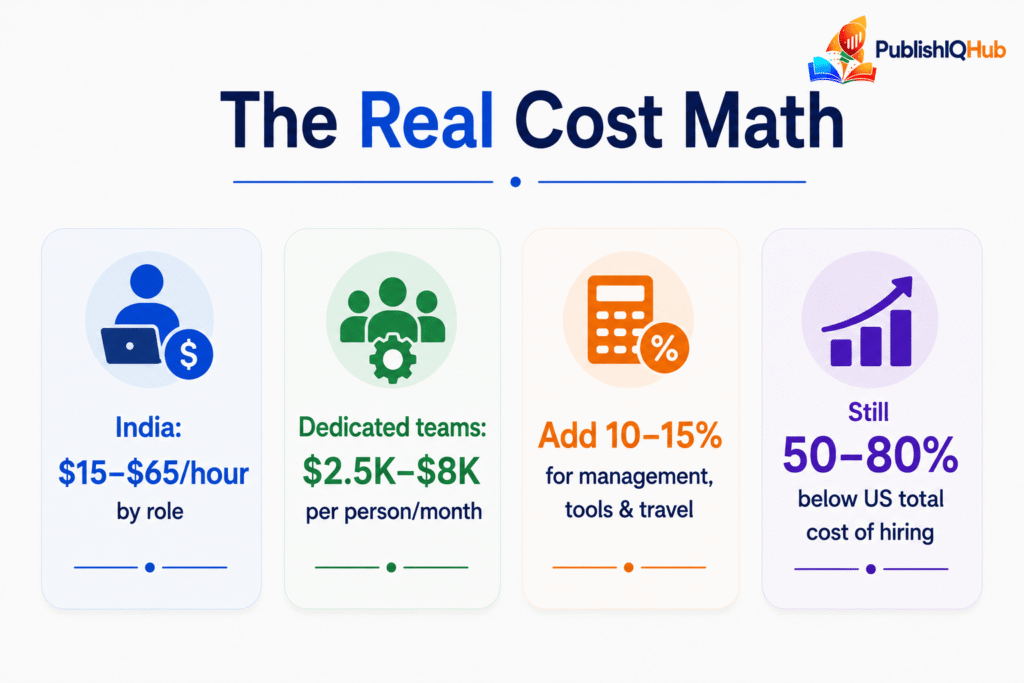
Dedicated team (monthly rate per person). The most common model for ongoing work. Expect $2,500–$8,000 per person per month depending on seniority and stack. Best for long-term capacity.
Outcome or SLA-based. Pricing tied to results — tickets resolved, uptime maintained. Common in managed services.
The costs first-time buyers forget
Budget 10–15% on top of vendor invoices for the real total: your own management time (someone on your side must own the relationship), tooling and licenses, occasional travel (an annual in-person visit pays for itself in goodwill and alignment), knowledge transfer during onboarding, and a transition buffer if you ever switch vendors.
IT outsourcing cost in India is genuinely low — but it’s not zero-effort, and the buyers who model this honestly are the ones who report savings that match their projections.
Top 15 IT Outsourcing Companies in India (2026 Shortlist)
There are thousands of IT outsourcing companies in India. These 15 cover the spectrum from global giants to agile mid-market specialists — deliberately, because the right partner depends entirely on your size and needs, not on who has the biggest logo.
1. Tata Consultancy Services (TCS). India’s largest IT services firm and a global top-two brand. Unmatched scale, deep industry practices, strong in banking, insurance, and large-scale transformation. Best suited to enterprises with complex, multi-year programs.
2. Infosys. Known for consulting-led digital transformation, strong AI and cloud practices (Topaz, Cobalt), and polished governance. A natural fit for large enterprises that want strategy and delivery under one roof.
3. HCLTech. Particularly strong in engineering services, infrastructure management, and product engineering. If your need leans toward IT operations and ER&D rather than pure app development, HCLTech belongs on your list.
4. Wipro. Broad full-service capability with notable strength in cybersecurity, cloud, and consulting after its Capco acquisition. Good for enterprises wanting a single accountable partner across functions.
5. Tech Mahindra. The telecom and network services specialist of the Tier-1 set, with growing strength in manufacturing and BFSI. Strong choice for communications, media, and 5G-adjacent work.
6. LTIMindtree. The merged entity punches hard in data analytics, cloud, and enterprise platforms. Often praised for being more agile than the largest Tier-1s while retaining enterprise-grade process.
7. Mphasis. Focused, BFSI-heavy, and cloud-native. A strong pick for financial services companies that want deep domain fluency without Tier-1 overhead.
8. Persistent Systems. Product engineering DNA — they build software products for a living, including for ISVs and healthcare/fintech firms. Excellent for companies whose outsourced work is their product.
9. Coforge. Mid-cap with outsized strength in travel, insurance, and banking. Known for close client relationships and specialization over sprawl.
10. Hexaware. Automation-first delivery philosophy, strong in cloud, data, and enterprise application services. Popular with mid-market North American and European buyers.
11. Zensar Technologies. Experience engineering and digital services with a strong design orientation. Good for buyers who care about UX quality alongside engineering.
12. Cyient. The engineering services specialist — aerospace, semiconductors, medtech, geospatial. If your outsourcing need involves hardware-adjacent or embedded engineering, Cyient is a category leader.
13. Birlasoft. Enterprise platform strength (SAP, Oracle, Microsoft) with manufacturing and life sciences depth. A sensible shortlist entry for ERP-centric programs.
14. Datamatics. A trusted mid-market partner spanning IT services, intelligent automation, and data-driven BPM. Datamatics stands out for blending technology delivery with process operations — useful when your outsourcing need crosses the line between IT and business operations, such as automation-led finance, data management, or customer operations programs.
15. Happiest Minds. Born-digital mid-cap focused on digital transformation, IoT, security, and analytics. Appeals to buyers who want a modern stack focus and a nimble engagement style.
Comparison Block: Which Type of Partner Fits You?
| Company | Sweet Spot | Strongest Service Lines | Ideal Buyer |
| TCS | Global enterprise | Full-stack transformation, BFSI | Fortune 500, multi-year programs |
| Infosys | Global enterprise | Consulting + AI/cloud delivery | Enterprises wanting strategy + execution |
| HCLTech | Enterprise | Infrastructure, engineering services | IT-ops-heavy and ER&D buyers |
| Wipro | Enterprise | Cybersecurity, cloud, consulting | Single-partner enterprise deals |
| Tech Mahindra | Enterprise | Telecom, network, manufacturing | Comms/media/5G-adjacent firms |
| LTIMindtree | Large mid-market to enterprise | Data, cloud, enterprise apps | Buyers wanting Tier-1 skill, more agility |
| Mphasis | Mid-market to enterprise | BFSI, cloud-native development | Financial services companies |
| Persistent Systems | Mid-market | Product engineering | ISVs, SaaS, healthtech, fintech |
| Coforge | Mid-market | Travel, insurance, banking | Domain-specific specialization seekers |
| Hexaware | Mid-market | Automation, cloud, data | Cost-plus-automation focused buyers |
| Zensar | Mid-market | Experience engineering, digital | UX-conscious digital programs |
| Cyient | Specialist | Engineering, embedded, geospatial | Hardware-adjacent engineering needs |
| Birlasoft | Mid-market | SAP/Oracle/Microsoft platforms | ERP-centric programs |
| Datamatics | Mid-market | IT + intelligent automation + BPM | Buyers bridging IT and operations |
| Happiest Minds | Mid-market | Digital, IoT, security, analytics | Modern-stack, agile engagements |
A note on how to use this: if your annual outsourcing budget is under roughly $500K, the Tier-1 giants will technically serve you but you won’t be a priority account. Mid-market firms — roughly rows 8 through 15 — will treat the same budget as a marquee relationship. Match your spend to a partner for whom it matters.
How to Choose: A Buyer’s Checklist
Here’s an evaluation process condensed from what experienced buyers actually do:
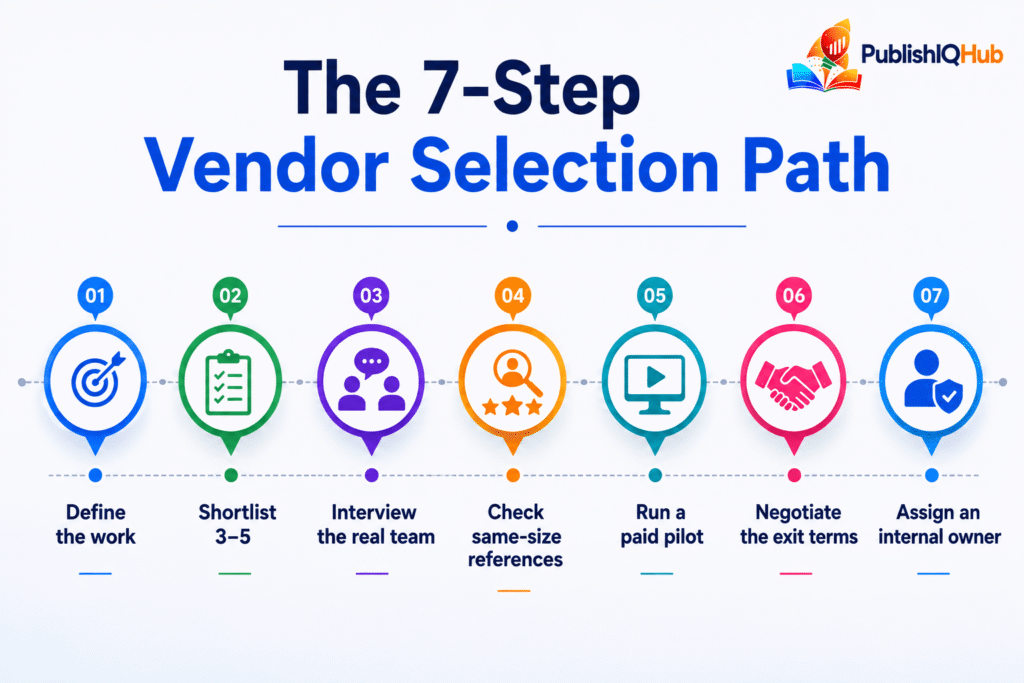
Step 1 — Define the work before the partner. Write one page: what you’re outsourcing, why, success metrics, and constraints. Vague briefs get vague proposals.
Step 2 — Shortlist 3–5 by service line and size fit. Use the comparison block above. Don’t shortlist ten; you’ll drown in sales cycles.
Step 3 — Interrogate the actual team, not the sales deck.Ask to interview the people who’ll do your work. Vendor A’s best team beats Vendor B’s average team regardless of which logo is stronger.
Step 4 — Check references in your industry and your size class. A glowing reference from a Fortune 100 client tells you little if you’re a 60-person company.
Step 5 — Run a paid pilot. Four to eight weeks, real deliverable, defined acceptance criteria. This is the single highest-signal step in the whole process. A vendor who resists a pilot is telling you something.
Step 6 — Negotiate the exit before the entrance.Knowledge documentation requirements, IP ownership (should be unambiguously yours), transition assistance clauses, and attrition/backfill commitments. You negotiate these best when everyone’s still friendly.
Step 7 — Assign an internal owner. The number one predictor of outsourcing success isn’t the vendor — it’s whether someone on your side owns the relationship with real authority and dedicated time.
Common Mistakes First-Time Buyers Make
Choosing on price alone. The cheapest quote usually reflects the least experienced team. The savings between a $22/hour and an $18/hour developer are trivial next to the cost of a failed project.
Under-communicating. Successful buyers over-invest in the first 90 days: daily standups, documented decisions, video-on meetings. The teams that treat offshore colleagues like colleagues get colleague-level performance.
Outsourcing a mess. If your requirements are chaotic in-house, distance amplifies the chaos. Stabilize the process, then outsource it.
Ignoring time zone design. Decide deliberately which 2–3 hours a day overlap, and protect them. Everything else can be async.
Skipping the security review. Verify ISO 27001/SOC 2 certifications, ask how access is controlled, and put data handling obligations in the contract — especially if you handle customer data subject to GDPR or similar regimes.
The Bottom Line
IT outsourcing in India works — the market’s scale, the client roster, and thirty years of results have settled that question. What’s not settled, and what this guide has tried to equip you for, is whether it works for you. That comes down to picking the right service line, budgeting honestly, matching your spend to the right tier of partner, piloting before committing, and managing the relationship like it matters.
Do those five things and the 60–80% savings stop being a statistic and start being your P&L.
Frequently Asked Questions
What is IT outsourcing in India?
? IT outsourcing in India is the practice of contracting technology functions — software development, cloud management, testing, IT support — to India-based service providers or dedicated offshore teams, typically to reduce costs and access a larger talent pool.
How much does IT outsourcing cost in India?
Most roles range from $15 to $65 per hour depending on seniority and specialization, or roughly $2,500–$8,000 per person per month for dedicated teams. Total savings versus US hiring typically land between 50% and 80% once all costs are counted.
Why do companies outsource IT to India rather than other countries?
India combines the world’s largest tech workforce (~6 million professionals), significant cost savings, mature delivery processes built over three decades, English proficiency, and a time zone that enables 24/7 operations. Deloitte research shows a majority of American companies already outsource work to India.
Which are the best IT outsourcing companies in India?
For large enterprises: TCS, Infosys, HCLTech, Wipro, and Tech Mahindra. For mid-market buyers: LTIMindtree, Mphasis, Persistent Systems, Coforge, Hexaware, Zensar, Cyient, Birlasoft, Datamatics, and Happiest Minds. The right choice depends on your service needs and budget size more than brand rankings.
Is IT outsourcing to India safe for data security?
Yes, provided you choose certified vendors. Look for ISO 27001 and SOC 2 compliance, contractual data protection obligations, controlled access policies, and GDPR-readiness if you handle European customer data. India’s top vendors serve heavily regulated banking and healthcare clients globally.
What is the difference between offshore IT outsourcing and a dedicated team in India?
Offshore IT outsourcing broadly covers any model where work is done from India. A dedicated team is a specific model within it: named engineers who work exclusively on your projects, giving you day-to-day control while the vendor handles employment, infrastructure, and HR.
How do I start IT outsourcing in India as a small business?
Start small: pick one contained project (QA, a feature build, or support coverage), run a paid 4–8 week pilot with a mid-market vendor, define acceptance criteria upfront, and scale only after the pilot proves the working relationship.
Will AI replace IT outsourcing to India?
The evidence so far points the other way. NASSCOM projects continued industry growth through FY2026, with AI services becoming a revenue driver rather than a replacement — Indian vendors are increasingly the ones implementing AI for global clients.