
Key Takeaways
• AI in financial services has moved from pilot projects to production: fraud detection, credit underwriting, chatbots, compliance, and trading are now the workhorse use cases
• The market reflects it — AI in financial services is on track to more than quadruple over the next decade
• The biggest measurable benefits: lower fraud losses, faster credit decisions, cheaper customer service, and compliance work that once took thousands of hours
• The biggest risks: model bias, hallucinating chatbots, explainability demands from regulators — every deployment now needs governance, not just a vendor
• Choosing among AI companies means matching the tool to the job: fraud specialists, lending platforms, banking chatbot companies, and foundation-model providers all solve different problems
Ask ten bankers what “AI in financial services” means and you’ll get ten answers — and all ten will be partly right. That’s the thing about AI and financial services in 2026: it isn’t one technology doing one job. It’s a layer spreading through the entire finance industry, quietly rewiring how money gets moved, lent, protected, and advised.
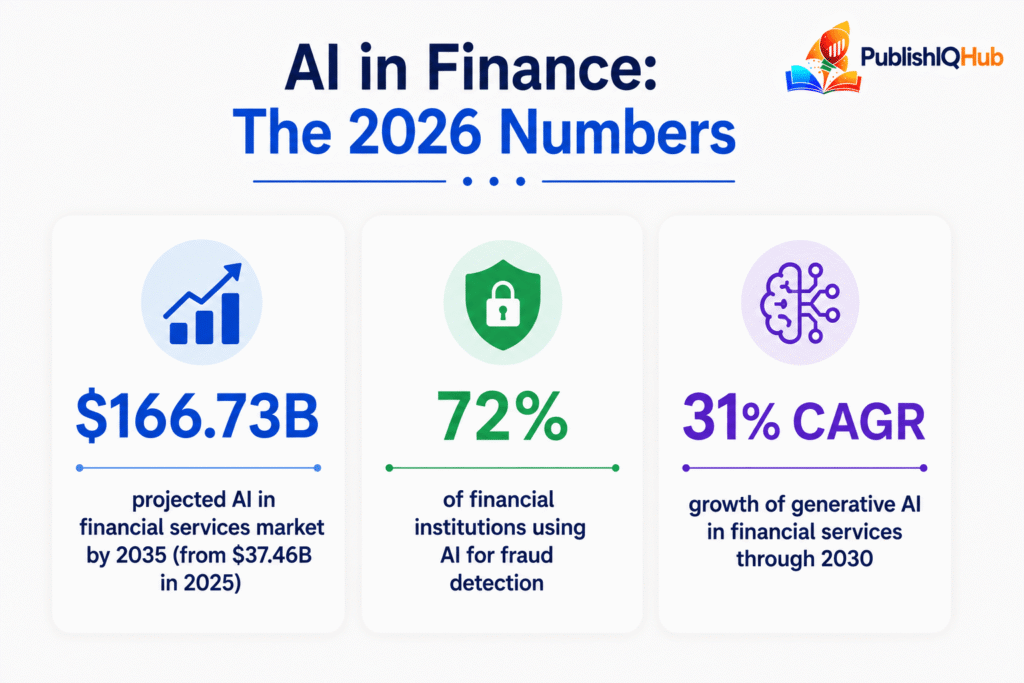
The scale is hard to overstate. The AI in financial services market was valued at $37.46 billion in 2025 and is projected to reach $166.73 billion by 2035. Finance was already the most data-rich industry on earth; it just took modern machine learning — and lately, large language models — to turn that data into decisions at scale.
So let’s skip the hype and walk through where AI actually works in finance today, what it delivers, and who’s building it.
How Is AI Used in the Finance Industry? The 7 Workhorse Applications
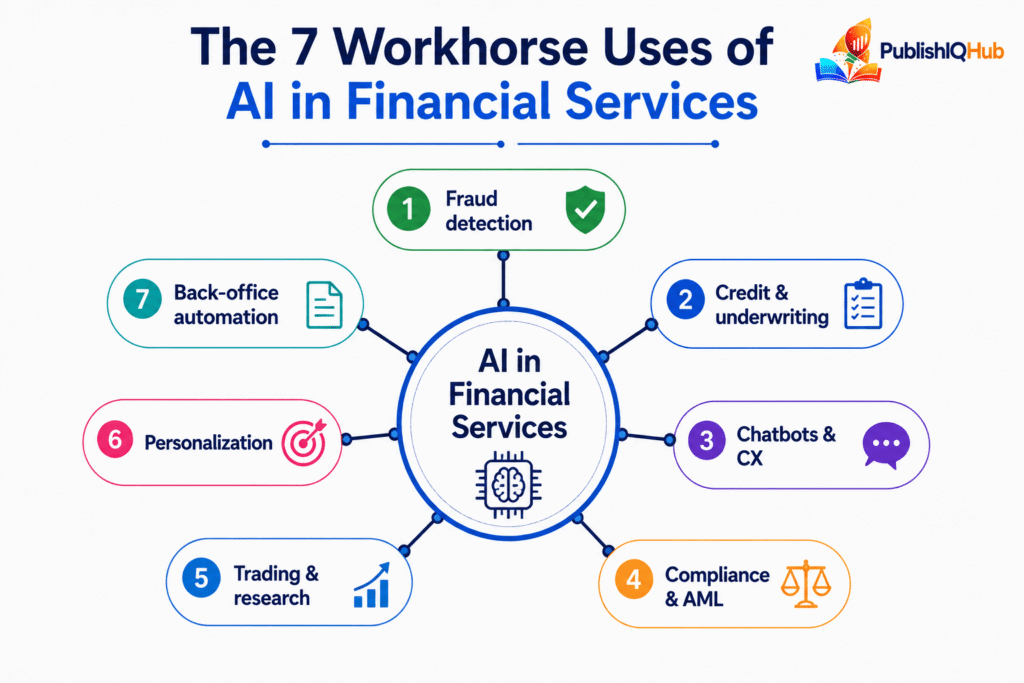
AI in the finance industry concentrates in seven areas: fraud detection, credit underwriting, customer-facing chatbots, compliance, trading and research, personalization, and back-office automation.
1. Fraud detection and prevention
The original killer app, and still the biggest. Machine learning models score millions of transactions in real time, spotting patterns no rules engine or human team could catch — a card used in two cities an hour apart, a login that types differently than you do. It’s also the most widely deployed use case: 72% of financial institutions now use AI for fraud detection. The economics are brutal in the best way: every caught fraud is a directly measurable saving.
2. Credit scoring and underwriting
Traditional credit scores judge you on a thin file of past borrowing. AI models widen the lens — cash-flow patterns, payment histories, thousands of subtle variables — approving borrowers the old models would wrongly reject, and flagging risks they’d miss. Done well, this expands access to credit. Done carelessly, it launders bias into lending decisions, which is exactly why regulators watch this use case most closely.
3. Conversational AI and banking chatbots
The customer-facing layer. Modern banking chatbots check balances, dispute charges, explain fees, and pre-fill loan applications — in natural language, at 3 a.m., in dozens of languages. The leap from the clunky bank bots of five years ago is enormous, and it’s why AI chatbot companies serving finance have become a category of their own (more on them below).
4. Compliance, AML, and regulatory work
The unglamorous goldmine. Anti-money-laundering monitoring, know-your-customer checks, transaction screening, and regulatory reporting consume armies of analysts — and AI is very good at exactly this kind of pattern-matching and document-heavy work. JPMorgan’s contract-analysis AI famously replaced the equivalent of hundreds of thousands of hours of legal review. Multiply that across every regulated institution and you see where the budgets are going.
5. Trading, research, and investment intelligence
Algorithmic trading is decades old, but AI has changed what’s possible: parsing earnings calls in seconds, scanning news sentiment across languages, surfacing signals from filings a human analyst would never finish reading. Generative AI has accelerated this — the generative AI in financial services market alone is projected to grow from $2.48 billion in 2026 to $7.24 billion by 2030, a roughly 31% annual clip, with research and reporting among the fastest-growing uses.
6. Personalization and financial guidance
The same engines that recommend your next series episode now nudge your savings: spotting a subscription you forgot, warning that this month’s spending will breach your budget, suggesting a better-fit product. Insurers use it for tailored pricing; wealth platforms use it for robo-advisory at costs no human advisor could match.
7. Back-office and document automation
Invoice processing, loan document extraction, claims handling, reconciliation — the paperwork ocean underneath every financial product. AI-powered document intelligence turns week-long processes into same-day ones, which is why some of the fastest-growing AI companies in finance are ones most consumers have never heard of.
What Are the Benefits of AI in Finance? Six That Show Up on the P&L
The benefits of AI in finance that survive contact with a CFO: lower fraud losses, faster decisions, cheaper service, scalable compliance, better risk pricing, and products that simply couldn’t exist before.
Plenty of AI benefits live only in vendor slide decks. These six show up in actual financial statements:
1. Reduced fraud losses. Real-time scoring catches fraud before money moves, and fewer false positives mean fewer legitimate customers embarrassed at checkout. This is the highest-ROI, most universally deployed AI application in finance for a reason.
2. Faster decisions. Loan approvals that took days happen in minutes. Claims that took weeks settle in hours. Speed isn’t just customer delight — it’s conversion: applicants who wait, walk.
3. Lower cost to serve. AI chatbots and agent-assist tools absorb the routine majority of customer queries at a small fraction of human cost, freeing staff for the complex, high-value conversations.
4. Compliance at scale. AML monitoring and regulatory reporting that scale with transaction volume instead of headcount — in a world where compliance costs have only ever gone up.
5. Sharper risk pricing. Better predictions mean loans, premiums, and limits priced closer to true risk — fewer good customers overcharged, fewer bad risks underpriced.
6. New products entirely. Robo-advisors, instant credit at checkout, micro-insurance, cash-flow-based small-business lending — categories that only work at AI economics.
The honest counterweight: these benefits are earned, not installed. Institutions that treat AI as a plug-in disappointment themselves; the wins above all required clean data, process redesign, and governance.
What Are the Risks — and What Do Regulators Expect?
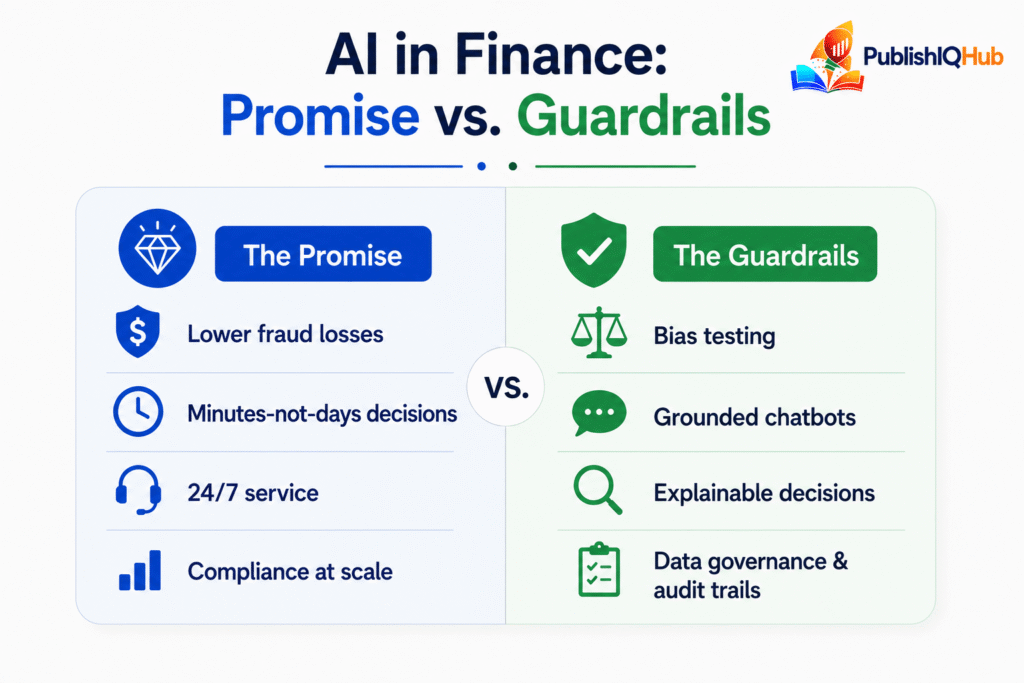
The four risks that matter: biased models, hallucinating chatbots, opaque decisions regulators can’t audit, and data privacy. The institutions winning with AI are the ones that took governance seriously early.
A candid tour of what can go wrong:
• Bias in lending models. If historical data reflects historical discrimination, a model trained on it will too — efficiently. Fair-lending laws apply regardless of whether a human or a model made the call, and regulators have made clear that “the algorithm did it” is not a defense.
• Hallucination in customer-facing AI. A chatbot that invents a fee policy or misstates an interest rate isn’t a quirky error in finance — it’s a compliance incident. Grounding chatbots strictly in approved content, with confidence-based human handoff, is now table stakes.
• Explainability. Deny someone credit and, in most jurisdictions, you must explain why. Black-box models that can’t produce reasons create legal exposure, which is why explainable-AI tooling has become a purchase criterion, not a nice-to-have.
• Privacy and data governance. Financial data is among the most sensitive there is. Where models are trained, where conversations are processed, and whether customer data leaks into training sets are questions every vendor must now answer in writing.
The regulatory direction is consistent worldwide — model risk management, human oversight, documentation, and audit trails. Institutions that built those muscles early are now deploying faster than competitors still cleaning up after their first incident. Governance, it turns out, is a speed advantage.
Which Companies Lead AI and Financial Services in 2026?
No single company “leads AI in finance” — the market splits into fraud and risk specialists, lending platforms, banking-focused AI chatbot companies, research intelligence tools, operations automation, and the foundation-model providers underneath them all.
Fifteen names worth knowing, grouped by what they actually solve:
Fraud, risk & compliance:
1. Feedzai — real-time fraud detection and financial crime prevention for banks and payment processors at massive transaction scale
2. Featurespace — adaptive behavioral analytics for fraud and AML; its models learn each customer’s “normal” to spot the abnormal
3. NICE Actimize — the incumbent heavyweight in financial crime, AML, and compliance monitoring for large institutions
Lending & credit decisioning:
4. Upstart — AI lending marketplace that underwrites with far more variables than traditional scores, partnered with banks and credit unions
5. Zest AI — machine-learning credit underwriting with an emphasis on explainability and fair-lending compliance
Banking chatbots & conversational AI:
6. Kasisto — maker of KAI, a conversational AI platform built specifically for banking, powering assistants at major financial institutions
7. Personetics — AI-driven personalization and proactive financial-guidance engine used by banks to power in-app insights and advice
8. Kore.ai — enterprise conversational AI with a dedicated banking solution; a frequent shortlist entry when banks evaluate AI chatbot companies
Research & investment intelligence:
9. AlphaSense — AI-powered market intelligence and search across filings, transcripts, and research, used widely across finance
10. Kensho (S&P Global) — machine learning and analytics arm of S&P Global, applying AI to markets data and financial research
Finance operations & document AI:
11. HighRadius — autonomous finance platform for order-to-cash, treasury, and record-to-report inside corporate finance teams
12. Ocrolus — document AI that turns bank statements, pay stubs, and loan files into clean, analyzable data for lenders
Foundation-model platforms:
13. OpenAI — GPT models underpin countless financial copilots, research assistants, and document workflows via API and enterprise offerings
14. Anthropic — Claude models, adopted in finance for long-document analysis and reasoning-heavy workflows where reliability matters
15. Google Cloud (Vertex AI) — Gemini models plus the cloud infrastructure and governance tooling many institutions standardize on
Competitive Comparison: 15 AI Companies in Financial Services
| Feedzai | Fraud & risk | Fraud & risk Banks, PSPs at scale | Real-time transaction scoring | Enterprise FIs |
| Featurespace | Fraud & risk | Fraud + AML together | Adaptive behavioral analytics | Banks, payments |
| NICE Actimize | Compliance | Large regulated institutions | Financial crime suite breadth | Tier-1 banks |
| Upstart | Lending | Banks & credit unions | Expanded-variable underwriting | Lenders |
| Zest AI | Lending | Fair-lending-focused lenders | Explainable credit models | Banks, CUs |
| Kasisto | Chatbots | Banking-specific assistants | KAI banking language platform | Banks |
| Personetics | Personalization | In-app financial guidance | Proactive insights engine | Retail banks |
| Kore.ai | Chatbots | Omnichannel banking CX | Enterprise agent platform | Banks, insurers |
| AlphaSense | Research | Analysts & IR teams | AI market intelligence search | Buy/sell side |
| Kensho | Research | Markets data & analytics | S&P Global’s AI arm | Institutions |
| HighRadius | Finance ops | Corporate finance teams | Autonomous order-to-cash | CFO offices |
| Ocrolus | Document AI | Lenders processing docs | Bank-statement intelligence | Fintech lenders |
| OpenAI | Foundation models | Building AI products | GPT model family | All segments |
| Anthropic | Foundation models | Long-doc, high-stakes work | Claude model family | All segments |
| Google Cloud | Foundation models + cloud | Regulated-cloud AI stacks | Gemini + Vertex AI governance | Enterprises |
The pattern worth noticing: the interesting question is rarely “which AI company is best?” It’s “which layer of the stack am I buying?” A regional bank might use Feedzai for fraud, Kasisto for its chatbot, Ocrolus in its lending pipeline, and a foundation model underneath a staff copilot — four vendors, four jobs, one AI strategy.
What’s Changing Now: Generative and Agentic AI in Finance
The frontier has shifted twice in three years — first from predictive models to generative AI, and now from generative AI to agents that complete multi-step financial workflows on their own.
Classic AI in finance predicts: this transaction is probably fraud, this borrower will probably repay. Generative AI produces: a draft credit memo, a summary of a 300-page filing, an answer to a customer’s question in plain language. That’s why its early wins cluster in document-heavy corners of the industry — research, compliance reporting, contract review, and customer communication — where the raw material is text and the bottleneck was always human reading speed.
The next step, already underway in 2026, is agentic AI: systems that chain tasks together. Instead of summarizing a loan file, an agent assembles it — pulling bank statements through document AI, verifying income, running the credit model, drafting the approval memo, and routing exceptions to a human. Instead of answering “what’s my balance?”, a banking agent disputes the charge, files the paperwork, and follows up. Early deployments are deliberately narrow and heavily supervised, because in finance an autonomous mistake is a regulatory event, not a reboot.
Two practical implications if you’re planning around this:
• Human-in-the-loop is the design, not the training wheels.The institutions deploying agents fastest are the ones that decided up front which steps require human sign-off — and built the audit trail to prove it.
• Your document and data quality just became strategy.Agents are only as good as the systems they act through. The unglamorous work — clean data, documented processes, well-structured knowledge bases — is now the gating factor on how much of this wave you can catch.
The safe prediction: five years from now, “AI in financial services” will sound as redundant as “computers in financial services” does today.
How Should a Financial Institution Start With AI?
Start with one measurable, contained use case — usually fraud, document automation, or customer service — prove it with real numbers, and build governance alongside the pilot rather than after it.
A realistic sequence, whether you’re a bank, an NBFC, an insurer, or a fintech:
1. Pick a bleeding-neck problem. Fraud losses, a document backlog, a call-center queue. Something with a number attached that everyone already wants to move.
2. Audit your data first. Every AI project inherits the quality of the data beneath it. A short, honest data audit before vendor selection saves months of disappointment after.
3. Buy before build — mostly. The specialists above have solved your problem hundreds of times. Custom builds make sense at the core of your differentiation, rarely at the edges.
4. Stand up governance with the pilot. Model documentation, bias testing, human-in-the-loop checkpoints, an escalation path. Retrofitting governance after an incident costs vastly more.
5. Measure ruthlessly, then expand. Fraud caught, hours saved, resolution rates, approval turnaround. Let the first project’s numbers fund and justify the second.
The institutions struggling with AI in 2026 aren’t the ones that started small — they’re the ones that started everywhere at once, or nowhere at all.
Frequently Asked Questions
What is AI in financial services?
It’s the use of machine learning, natural language processing, and generative AI across the finance industry — detecting fraud, underwriting credit, powering banking chatbots, automating compliance, informing trading, and processing financial documents.
What are the main benefits of AI in finance?
The measurable ones: reduced fraud losses, faster credit and claims decisions, lower cost of customer service, compliance that scales without headcount, sharper risk pricing, and new product categories like robo-advisory and instant credit.
How big is the AI in financial services market?
It was valued at roughly $37 billion in 2025 and is projected to exceed $166 billion by 2035, with generative AI the fastest-growing slice at around 31% annual growth.
Which AI chatbot companies serve banks specifically?
Kasisto (KAI) and Personetics are built for banking; Kore.ai offers a dedicated banking solution on its enterprise platform. General CX chatbot vendors also serve finance, but banking-specific players handle regulatory and security requirements out of the box.
Is AI in finance regulated?
Increasingly, yes. Fair-lending laws, model risk management guidance, explainability requirements for credit decisions, and emerging AI-specific rules all apply. Regulators expect documentation, bias testing, and human oversight.
Will AI replace jobs in the finance industry?
It’s reshaping them more than erasing them. Routine processing, document review, and first-line queries are automating fast; roles are shifting toward judgment, oversight, client relationships, and managing the AI itself.
Can small financial firms use AI, or is it only for big banks?
Small firms arguably benefit most — cloud-based tools for fraud screening, document processing, and customer chat are subscription-priced now, no data-science team required. The barrier is falling every year.