
A conversational AI chatbot is software that understands natural language and holds free-flowing, human-like conversations — unlike old rule-based bots that only followed scripted menus. Powered by large language models and natural language processing, it can answer questions, resolve support tickets, qualify leads, and complete tasks across chat, voice, and messaging channels.
Costs range from free tiers and ~$30/month for small-business tools to custom enterprise contracts, with per-resolution pricing (around $1 per solved query) becoming the new standard.
What Is a Conversational AI Chatbot — and How Is It Different From a Basic Bot?
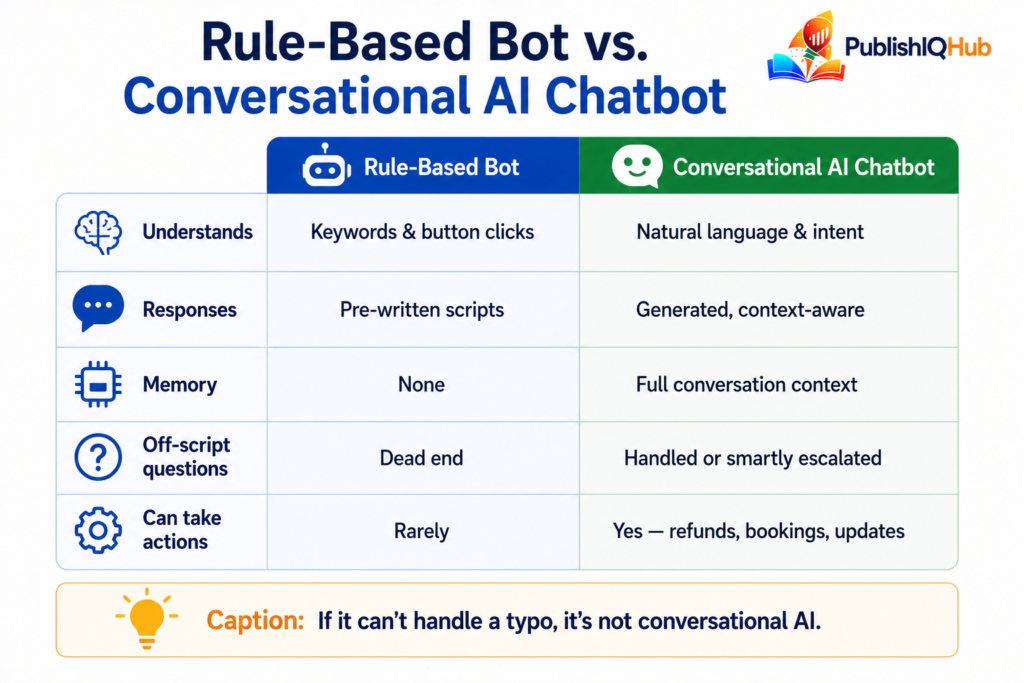
A conversational AI chatbot understands what you mean, not just what you click. A basic rule-based bot follows a decision tree; conversational AI interprets language, keeps context, and generates its own responses.
If you’ve ever typed a question into a website widget and been trapped in a loop of “Please select an option,” you’ve met a rule-based bot. It matches keywords to pre-written scripts, and the moment your question falls outside the script, the conversation dies.
Conversational AI is a different animal. It combines three technologies:
- Natural language processing (NLP) — parsing what the user actually said, typos, slang and all
- Large language models (LLMs) — generating relevant, coherent responses rather than picking from canned replies
- Dialogue management and memory — remembering the earlier parts of the conversation, so “what about the blue one?” makes sense
The practical difference shows up fast. A rule-based bot can tell you store hours. A conversational AI chatbot can check your order status, process the refund, notice you’ve contacted support three times this month, and escalate you to a human with the full context attached.
One more distinction worth knowing in 2026: the industry is shifting from “chatbots” to AI agents — systems that don’t just answer questions but take actions: issuing refunds, updating bookings, filling CRM fields. Most serious platforms now sit somewhere on that spectrum.
Why Is Every Business Suddenly Investing in Conversational AI?
Because the economics finally work. Conversational AI now resolves a large share of routine queries at a fraction of human cost — without the customer experience penalty that killed the first chatbot wave.
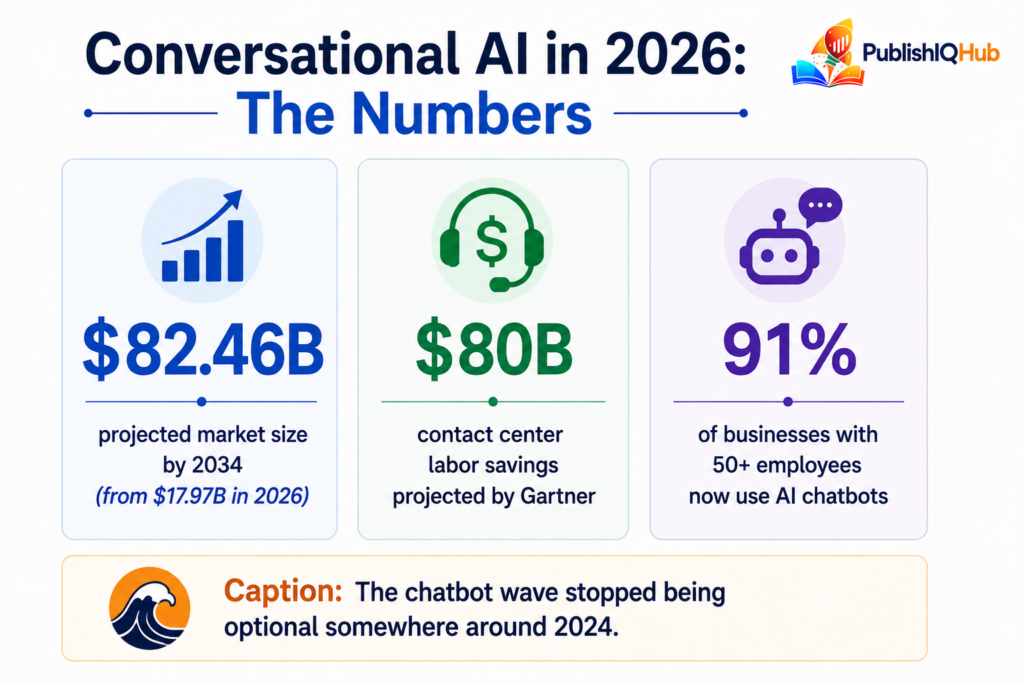
The market numbers tell the story. The global conversational AI market is projected to grow from $17.97 billion in 2026 to $82.46 billion by 2034, a 21% compound annual growth rate. Categories don’t grow at that pace on hype alone — they grow because deployments are paying for themselves.
The cost side explains why. An AI chatbot interaction costs a fraction of a human support ticket, and Gartner projects conversational AI will reduce contact center agent labor costs by $80 billion by 2026. When labor is the overwhelming majority of a contact center’s spend, even automating the easy half of queries changes the budget.
Adoption has followed. 91% of businesses with 50 or more employees have now adopted AI chatbots, and nearly two-thirds of small businesses plan to by the end of 2026. That’s a striking reversal from five years ago, when a chatbot on your site was as likely to frustrate customers as help them.
What changed? Large language models. The pre-2023 generation of bots failed because they couldn’t actually understand people. Today’s conversational AI holds up in messy, real-world conversations — and customers have noticed. Preference for self-service keeps climbing, especially when the alternative is a hold queue.
What Are the Benefits — and the Honest Risks — of Deploying a Conversational AI Chatbot?
The upside is 24/7 coverage, instant answers, and dramatically lower cost per query. The risks are hallucinations, brand damage from bad answers, and data privacy — all manageable with the right guardrails.
Start with what businesses actually gain:
- Always-on support. Your chatbot answers at 3 a.m. on a holiday, in any language, with zero hold time. For global or e-commerce businesses, that alone justifies the spend.
- Scale without hiring. Seasonal spikes, product launches, a viral moment — conversational AI absorbs 10x query volume without a recruitment cycle.
- Faster resolution. Routine questions (order status, password resets, plan changes) get solved in seconds, which shortens queues for the complex cases humans should handle.
- Consistency. The bot never has a bad day, never improvises policy, and applies the same answer to the same question every time.
- Data you didn’t have. Every conversation is a structured record of what customers actually ask, struggle with, and want — gold for product and marketing teams.
Now the honest part:
- Hallucinations. LLM-based bots can state wrong things confidently — a real risk when the topic is refund policy or medical guidance. Mitigate with retrieval grounding (the bot answers only from your approved knowledge base) and confidence thresholds that trigger human handoff.
- Brand risk. A chatbot speaks in your name. Test adversarially before launch, constrain its scope, and monitor transcripts — publicised chatbot failures are almost always governance failures.
- Data privacy. Customer conversations can contain personal and payment data. Check where the vendor processes data, whether your data trains their models, and how deletion requests are honored.
- The frustration cliff. Nothing torches customer goodwill like a bot that blocks access to humans. The best deployments make escalation easy and obvious — the bot earns trust by knowing its limits.
None of these is a reason to skip conversational AI. They’re the difference between a deployment customers thank you for and one that ends up as a screenshot.
What Do Chat Bot Services Actually Include?
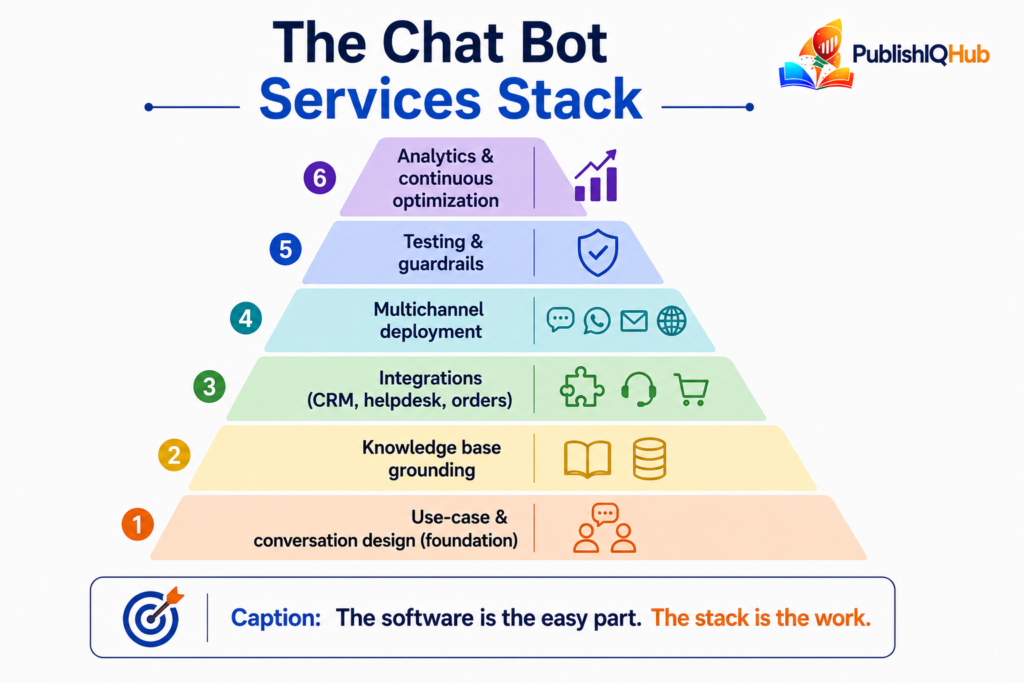
Chatbot services span the full lifecycle: strategy, conversation design, platform setup, integrations, training on your data, testing, and ongoing optimization. Buying software is the smallest part of the job.
If you’re evaluating chatbot services — whether from a platform vendor, an agency, or an AI development partner — here’s the menu:
- Discovery and use-case design — deciding what the bot should (and shouldn’t) handle: support, sales, lead qualification, internal helpdesk
- Conversation design — the scripts, tone, escalation rules, and fallback behavior that make a bot feel helpful rather than robotic
- Knowledge base grounding — connecting the bot to your docs, policies, and product data so answers are accurate and current
- Integrations — CRM, helpdesk, order management, calendars; the difference between a bot that talks and a bot that does
- Multichannel deployment — website, WhatsApp, Instagram, voice, in-app; one brain, many surfaces
- Testing and guardrails — adversarial testing, PII handling, topic restrictions, human-handoff triggers
- Analytics and optimization — resolution rate, deflection rate, CSAT, and the monthly work of fixing what the transcripts reveal
A useful rule: the vendor demo shows you the first 20% of the work. The remaining 80% — grounding, integration, and tuning — is where deployments succeed or quietly fail.
Which Are the Best AI chatbots and Conversational AI Companies in 2026?
The best AI chatbot for you depends on the job: general-purpose assistants for productivity, enterprise platforms for complex automation, CX agents for support, and lightweight tools for small-business chat.
AI chatbot companies roughly fall into four camps:
- General-purpose AI assistants — the consumer-facing chatbots people use for writing, research, and everyday questions
- Enterprise conversational AI platforms — build-and-orchestrate platforms for large organizations automating support, IT, and voice at scale
- Customer experience (CX) AI agents — purpose-built agents that plug into your helpdesk and resolve customer tickets end to end
- SMB and marketing chatbots — affordable tools for website chat, lead capture, and social messaging
14 Conversational AI Companies Worth Shortlisting in 2026
General-purpose AI assistants:General-purpose AI assistants:
- OpenAI (ChatGPT) — the most widely used AI chatbot; strong all-rounder for writing, analysis, and coding, with business tiers and an API
- Anthropic (Claude) — known for long-context reasoning, careful responses, and strong performance on complex professional work
- Google (Gemini) — deeply integrated with Google Workspace and Search; strong multimodal capabilities across text, image, and voice
Enterprise conversational AI platforms:
- Kore.ai — a leading enterprise platform for building AI agents across customer and employee experience, with strong no-code tooling
- Cognigy — contact-center-grade conversational AI with robust voice support, popular with large European and global enterprises
- IBM watsonx Assistant — enterprise assistant building with governance and security emphasis, suited to regulated industries
- Microsoft Copilot Studio — build custom copilots inside the Microsoft ecosystem; natural fit for Teams and Dynamics shops
Customer experience (CX) AI agents:
- Intercom (Fin) — an AI agent that resolves support queries directly in your helpdesk, with headline per-resolution pricing
- Ada — AI-first customer service automation focused on measurable resolution rates across chat, email, and voice
- Zendesk AI agents — native AI resolution inside the Zendesk ecosystem; the low-friction option for existing Zendesk customers
- Sierra — a newer AI-agent company building branded, action-taking customer agents for consumer brands
SMB and marketing chatbots:
- Tidio — website live chat plus its Lyro AI bot; a favorite for small e-commerce teams
- ManyChat — chat marketing automation for Instagram, WhatsApp, and Messenger; built for lead capture and campaigns
- Freshworks (Freddy AI) — AI chatbot and agent-assist bundled with the Freshdesk/Freshchat suite, aimed at value-conscious SMBs and mid-market
Here’s how they stack up at a glance:
Competitive Comparison: 14 AI Chatbot Companies
| OpenAI (ChatGPT) | Individuals & teams, general use | All-round capability, ecosystem | Web, apps, API | Free + subscription tiers |
| Anthropic (Claude) | Professional & complex work | Long-context reasoning, reliability | Web, apps, API | Free + subscription tiers |
| Google (Gemini) | Google Workspace users | Multimodal + Search integration | Web, apps, Workspace | Free + subscription tiers |
| Kore.ai | Large enterprises | Agent platform breadth, no-code | Cloud, omnichannel | Custom enterprise |
| Cognigy | Contact centers | Voice + chat automation at scale | Cloud/on-prem | Custom enterprise |
| IBM watsonx Assistant | Regulated industries | Governance & security | Cloud/on-prem | Tiered + enterprise |
| Microsoft Copilot Studio | Microsoft-stack companies | Teams/Dynamics integration | Microsoft cloud | Per-user/capacity |
| Amazon Lex | AWS-based builders | Voice bots, AWS integration | AWS | Pay-per-request |
| Intercom (Fin) | Support teams | High resolution rates | Helpdesk-native | Per resolution |
| Ada | CX automation at scale | Measured resolution focus | Chat, email, voice | Custom |
| Zendesk AI agents | Zendesk customers | Native helpdesk fit | Zendesk suite | Add-on pricing |
| Sierra | Consumer brands | Branded action-taking agents | Custom deployments | Outcome-based |
| Tidio | Small e-commerce | Easy setup, live chat + AI | Website, socials | Freemium + monthly |
| ManyChat | Social-first marketing | Instagram/WhatsApp automation | Social channels | Freemium + monthly |
| Freshworks (Freddy AI) | Value-conscious SMBs | Bundled CX suite | Freshworks suite | Tiered monthly |
(Verify current features and pricing directly with each provider — this market changes monthly.)
A note on choosing: don’t shortlist by brand recognition. Shortlist by the job. A 10-person store needs Tidio-class simplicity, not an enterprise orchestration platform. A bank needs governance and auditability more than clever small talk. And if your team lives in one ecosystem — Microsoft, AWS, Zendesk — the native option often beats a technically superior outsider, because integration is where projects die.
Whichever direction you lean, vet every candidate on the same seven points:
Resolution rate evidence — ask for real numbers from comparable customers, not demo-day claims
Grounding controls — can you restrict answers to your approved knowledge base?
Escalation design — how easily does a frustrated customer reach a human, with context intact?
Data handling — where is data processed, is it used for model training, and can you delete it?
Integration depth — does it act in your CRM/helpdesk, or just chat about it?
Language and channel coverage — the ones your customers actually use
What Does a Conversational AI Chatbot Cost?
Small-business tools start free or around $30–$100/month. Mid-market deployments typically run $500–$3,000/month. Enterprise platforms are custom contracts, and per-resolution pricing — roughly $1 per solved query — is fast becoming the standard for support automation.
Pricing in this market follows four models:
- Freemium and monthly tiers — SMB tools like Tidio and ManyChat; predictable, cheap, capped by conversation volume
- Per-user or capacity pricing — common in the Microsoft/enterprise-suite world; scales with your team, not your customers
- Usage-based — pay per request or per conversation (Amazon Lex model); efficient at low volume, watch it at scale
- Per-resolution / outcome-based — you pay only when the AI actually solves a query without human help; aligns vendor incentives with yours and makes ROI math trivially easy
What drives your real cost, though, usually isn’t the license:
- Integration work — connecting order systems, CRMs, and internal tools is often the largest line item
- Knowledge base preparation — the bot is only as accurate as the docs you ground it in; messy docs mean a cleanup project first
- Conversation volume — most pricing scales with monthly conversations or resolutions
- Channels — adding voice typically costs meaningfully more than chat
- Ongoing optimization — budget for someone (internal or a chat bot services partner) to review transcripts and tune monthly
The honest math: compare the total cost against your current cost per ticket. If a human ticket costs your business $6–$40 and an AI resolution costs around $1, the question isn’t whether it saves money — it’s what percentage of your queries the AI can genuinely resolve well. That number, not the license fee, decides your ROI.
How Do You Implement a Conversational AI Chatbot Without Annoying Customers?
Start narrow, ground everything, launch with easy human escalation, and expand scope only as the transcripts prove the bot can handle it.
The pattern behind every successful deployment I’ve seen:
- Weeks 1–2: Pick one job. Not “handle support” — something measurable, like “resolve order-status and returns questions.” Narrow scope means testable quality.
- Weeks 2–4: Ground and integrate. Connect the knowledge base and the systems the bot needs to act (orders, bookings, CRM). Fix the documentation gaps this process exposes — there will be some.
- Weeks 4–6: Adversarial testing. Try to break it. Ask off-topic questions, request refunds it shouldn’t give, feed it typos and anger. Tighten guardrails until it fails gracefully.
- Launch: Escalation-first. Make “talk to a human” visible from message one. Counterintuitively, easy escalation increases bot usage — customers trust a bot that isn’t trapping them.
- Ongoing: Read the transcripts. Weekly at first. The transcripts tell you exactly what to fix, what to add to the knowledge base, and when the bot is ready for a bigger job.
Three traps worth naming:
- Boiling the ocean at launch. Bots that try to handle everything on day one fail publicly at the edges. Scope small, expand on evidence.
- Set-and-forget. Products change, policies change, and an ungrounded answer from March is a wrong answer in July. Optimization isn’t optional; it’s the job.
- Measuring deflection instead of resolution. A bot that blocks customers from humans “deflects” beautifully and destroys satisfaction. Measure resolved without escalation and without repeat contact — the only number that means the bot actually worked.
Frequently Asked Questions
What is the difference between a chatbot and conversational AI?
A chatbot is any software that chats; many are simple rule-based scripts. Conversational AI refers to bots powered by natural language processing and large language models that understand intent, keep context, and generate responses — rather than matching keywords to canned replies.
Which is the best AI chatbot in 2026?
It depends on the job. ChatGPT, Claude, and Gemini lead for general-purpose use; Kore.ai and Cognigy for enterprise automation; Intercom Fin, Ada, and Sierra for customer support agents; Tidio and ManyChat for small-business chat and social marketing.
How much does a conversational AI chatbot cost?
Small-business tools run free to around $100/month. Mid-market deployments typically cost $500–$3,000/month including integrations. Enterprise contracts are custom, and per-resolution pricing of roughly $1 per solved query is increasingly common for support automation.
Can a conversational AI chatbot replace human support agents?
It replaces a share of routine queries — often a large share — but not the human team. The best deployments automate repetitive questions and hand complex, sensitive, or emotional cases to humans with full context attached.
Are AI chatbots safe for handling customer data?
They can be, with the right vendor and configuration. Check where data is processed, whether your conversations are used to train models, what certifications the vendor holds, and how personal data deletion is handled.
How long does it take to deploy a conversational AI chatbot?
A simple website bot can launch in days. A grounded, integrated support agent typically takes 4–8 weeks including knowledge base preparation, integration, and adversarial testing.
What is an AI agent, and how is it different from a chatbot?
An AI agent goes beyond answering questions — it takes actions: processing refunds, updating bookings, editing CRM records. Most leading conversational AI companies are evolving their chatbots into agents.