
Artificial intelligence has moved past pilot programs in medicine. It’s now reading scans, writing clinical notes, and narrowing which drug candidates are worth testing — often before a patient or doctor even notices it’s involved. This piece walks through what AI in healthcare actually means today, how it’s being used across the industry, and which companies are driving the shift, based on FDA data, market research, and verified deployments rather than press-release claims.
Key Takeaway
- AI in healthcare means machine learning, NLP, and computer vision applied to clinical, administrative, and research tasks — six distinct categories, not one technology.
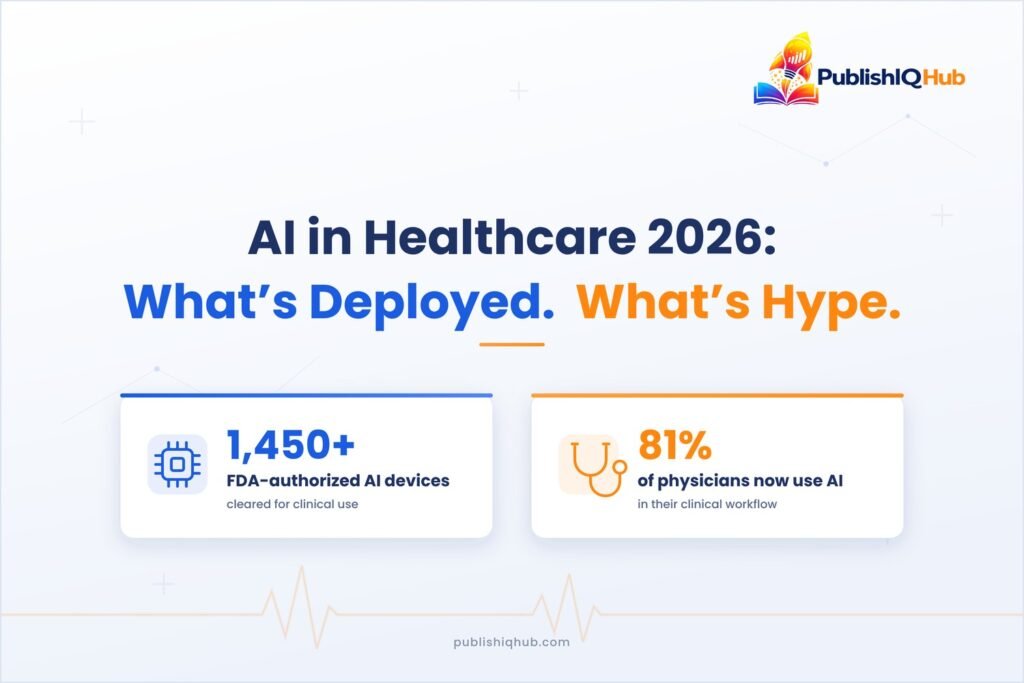
- The FDA has authorized 1,450+ AI-enabled medical devices through end-2025, roughly 76% of them in radiology (FDA AI-Enabled Medical Device List).
- Physician adoption jumped from 38% (2023) to 66% (2024) to 81% in the latest AMA survey (American Medical Association)
- The global market was valued at $36.7 billion in 2025 and is projected to reah $505.6 billion by 2033 at a 38.9% CAGR (Grand View Research).
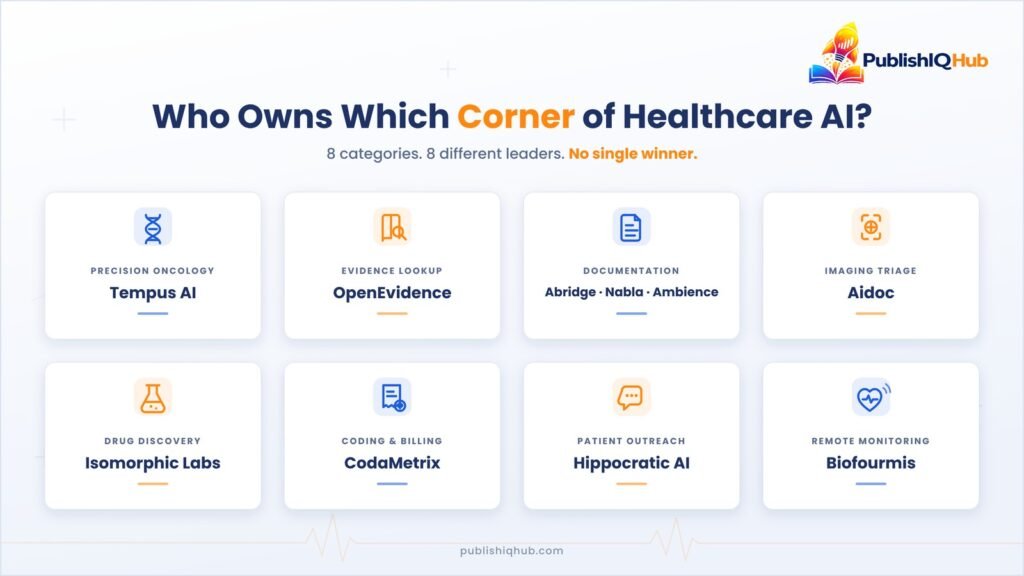
- No company leads everywhere: Tempus AI (oncology), OpenEvidence (evidnce lookup), Abridge/Nabla/Ambience (documentation), Aidoc (imaging), and Isomorphic Labs (drug discovery) each own one slice.
- Current AI assists clinicians rather than replacing them — unaided generative AI scores roughly 52% on diagnostic tasks, comparable to a non-specialist physician.
What Does “AI in Healthcare” Actually Mean?
AI in healthcare refers to the use of machine learning, natural language processing, and computer vision to support clinical, administrative, or research tasks across medicine — from flagging abnormalities in a scan to drafting a doctor’s chart note to predicting which drug candidate might work against a specific tumor.
It’s a broad category, and the term gets used loosely, which is part of why it’s worth separating the hype from what’s actually cleared for use and running inside real hospitals.
The scale is no longer small. Roughly 80% of hospitals use AI in at least one function today, and the FDA has authorized more than 1,450 AI- and machine-learning-enabled medical devices through the end of 2025 — about 76% of them in radiology (FDA AI-Enabled Medical Device List, fda.gov).
How Is AI Used in Healthcare Right Now?
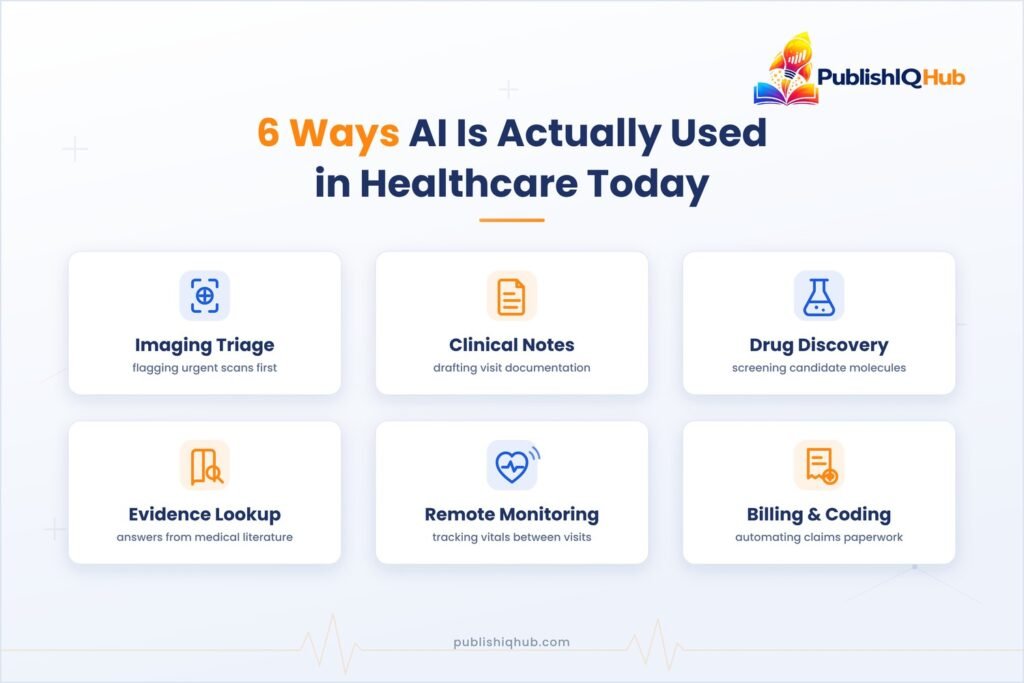
AI is used in healthcare in six main ways: medical imaging triage, clinical documentation, drug discovery, clinical decision support, remote patient monitoring, and billing automation. Each solves a different problem:
- Reading medical images faster. Algorithms scan CTs, MRIs, and X-rays for signs of stroke, blood clots, or tumors, and reorder the radiologist’s queue so urgent cases get seen first. This is the single most FDA-cleared category of healthcare AI, largely because the clinical claim — “flag this for review” — is narrower and easier to validate than “diagnose this.”
- Writing clinical documentation. Ambient AI tools listen to a patient visit and generate the note automatically, cutting documentation time by an estimated 40–45% in institutions that have adopted them. This is arguably the fastest-growing category in the last two years, because it addresses physician burnout directly rather than a downstream clinical metric.
- Speeding up drug discovery. Pharmaceutical researchers use generative models to predict which molecules are likely to work against a given disease target before synthesizing anything physically — turning a search problem that used to take years of lab work into a computational one.
- Giving doctors faster access to evidence. Instead of manually searching medical literature, physicians can query AI tools that surface relevant studies and guidelines at the point of care, in real time.
- Catching patient decline early. Wearables and remote sensors feed continuous data into models that flag deterioration — a drop in oxygen saturation, an irregular heart rhythm — before it becomes an ER visit.
- Automating medical billing and coding. Roughly 60% of total healthcare AI investment reportedly flows into administrative use cases like this, because even a small efficiency gain against a $250 billion U.S. revenue cycle market adds up fast.
How Big Is the AI in Healthcare Market?
The global AI in healthcare market was valued at roughly $36.7 billion in 2025 and is projected to reach $505.6 billion by 2033, growing at a 38.9% compound annual rate (Grand View Research). Estimates vary by scope — some broader “medical AI” definitions run past $1 trillion by the mid-2030s — but the direction is consistent across research firms. North America currently holds the largest regional share, at roughly 54%.
Physician adoption has climbed just as fast. About 66% of physicians reported using health AI in 2024, up from 38% the year before — and the AMA’s latest survey wave puts that figure at 81% (American Medical Association Augmented Intelligence Research). Organisations deploying AI report an average return of roughly $3.20 for every $1 invested. However, that figure is self-reported across surveyed institutions and should be read as directional rather than a guaranteed outcome for any single deployment.
Which Healthcare AI Companies Are Leading Each Category?
No single company dominates AI in the healthcare industry — the market has split into specialists, each owning a narrow slice of the problem.
In precision medicine and genomics, Tempus AI leads by a wide margin, valued at roughly $14 billion on the strength of a dataset that ties genomic, clinical, and imaging records together for oncology treatment matching. It’s since expanded into cardiology using the same model.
In clinical evidence and decision support, OpenEvidence has built a $12 billion business by giving its evidence-lookup tool free to verified physicians and monetizing through pharmaceutical advertising instead — a model that let it skip the usual slow hospital sales cycle and land a Microsoft partnership.
In clinical documentation, three companies are effectively racing each other: Abridge and Nabla, both valued around $5.3 billion, and Ambience Healthcare, which won the 2026 KLAS/CHIME Trailblazer Award and landed a system-wide rollout at Houston Methodist. Abridge has deep Epic integration and is now expanding into billing; Nabla has focused more on outpatient and multi-specialty clinics.
In imaging triage, Aidoc holds the clearest regulatory track record on this list — FDA-cleared, deployed across major radiology departments, and recently expanded through a partnership with Sol Radiology in Southern California.
In drug discovery, Isomorphic Labs — a DeepMind spinout built on the AlphaFold protein-folding model — has raised over $2.7 billion, alongside Exscientia, which has raised close to $475 million pursuing a similar computational approach to small-molecule design.
In administrative automation, CodaMetrix was ranked #1 in the 2026 Best in KLAS category for autonomous medical coding, while AKASA and Innovaccer operate in adjacent billing and population-health data spaces.
| Category | Leading Company | Signal Worth Noting |
| Imaging triage | Aidoc | FDA-cleared, hospital-wide deployments |
| Drug discovery | Isomorphic Labs | $2.7B+ raised |
| Coding & billing | CodaMetrix | #1 in 2026 Best in KLAS |
| Patient outreach | Hippocratic AI | ~$3.5B valuation, patient-facing agents |
| Remote monitoring | Biofourmis | $463.6M+ raised |
Which AI Healthcare Startups Are Worth Watching?
Beyond the category leaders, the startups worth tracking are the ones extending scarce human specialists rather than just raising large rounds.
Hippocratic AI stands out because it’s doing something structurally different from everyone else on this list — instead of building tools for clinicians, it deploys AI agents that talk to patients directly for medication reminders and post-discharge follow-up. At a $3.5 billion valuation backed by a16z, it’s explicitly targeting the healthcare staffing shortage rather than physician paperwork, and it draws more scrutiny than clinician-assist tools because the AI is patient-facing and largely autonomous.
SWORD Health, which has raised nearly $500 million, applies the same logic to physical therapy — AI-guided rehab programs delivered remotely instead of requiring an in-person therapist for every session. PathAI is doing comparable work in pathology, applying computer vision to tissue samples to catch disease markers a human reviewer might miss on a first pass.
What connects all three: they’re each betting on a workflow that’s traditionally required a scarce human specialist, and trying to extend that specialist’s reach with AI rather than replace them outright.
Is AI in Medicine Actually Regulated?
Partially, and unevenly. The FDA’s AI-Enabled Medical Device List — searchable directly on fda.gov — shows over 1,450 authorized devices through the end of 2025, but clearance types differ meaningfully. A 510(k) clearance is a lower evidentiary bar than a De Novo authorization or full Premarket Approval, and vendors don’t always distinguish between “cleared” and “approved” in marketing copy.
It’s also worth knowing what a clearance actually covers. Most imaging AI is cleared narrowly — to flag a finding for a radiologist’s review, not to issue an autonomous diagnosis — even when a product’s messaging implies more. Before trusting a specific tool, it’s worth checking the FDA database directly, confirming the clearance type, and asking the vendor what human oversight sits between the AI’s output and any clinical decision.
Will AI Replace Doctors?
Not based on current evidence. A meta-analysis covering 83 studies found generative AI models achieved roughly 52% diagnostic accuracy when used without human input — comparable to a non-specialist physician, not an expert one. Every major deployed healthcare AI product today, from Aidoc’s imaging triage to Abridge’s documentation tool, is built around assisting a clinician’s judgment rather than replacing it, and current regulatory pathways reflect that framing rather than autonomous diagnosis.
The more accurate near-term picture: AI is absorbing the parts of medicine that are repetitive, time-consuming, or search-like — reading a queue of scans, drafting a note, scanning literature — and leaving the parts that require judgment, context, and accountability with the physician.
What’s Next for AI in the Healthcare Industry?
A few shifts are already visible heading into the back half of 2026. Documentation-focused startups like Abridge are moving into billing and revenue cycle work, suggesting the more durable business model is owning both the clinical conversation and the paperwork that follows it. Established players — Microsoft, Siemens Healthineers, GE HealthCare — are increasingly providing the cloud and hardware infrastructure that startups build on top of, rather than competing head-on for the same narrow workflows. And patient-facing AI, still the least proven category, is the one to watch most closely as companies like Hippocratic AI push further into direct patient interaction.
The aging global population adds a structural tailwind independent of any single AI trend: the number of people aged 65 and older is projected to reach 1.5 billion worldwide by 2050, which keeps demand for remote monitoring and care-coordination tools growing regardless of short-term hype cycles.
Frequently Asked Questions
What is AI in healthcare?
AI in healthcare is the use of machine learning, natural language processing, and computer vision to support clinical and administrative tasks in medicine — including reading medical scans, drafting clinical notes, predicting drug candidates, and automating billing.
How is AI used in healthcare today?
Primarily in six ways: imaging triage, clinical documentation, drug discovery, clinical decision support, remote patient monitoring, and administrative billing automation. Imaging and documentation currently have the deepest real-world adoption.
Which company leads AI in healthcare?
No single company leads across the board. Tempus AI leads in precision oncology (~$14B valuation), OpenEvidence leads in clinical evidence lookup (~$12B), and Abridge and Nabla lead in clinical documentation (~$5.3B each).
How big is the AI in healthcare market?
The global market was valued at about $36.7 billion in 2025 and is projected to reach $505.6 billion by 2033 at a 38.9% CAGR, according to Grand View Research. North America holds the largest regional share at roughly 54%.
Are AI healthcare startups regulated by the FDA?
Many are, but not all products from a given company necessarily carry FDA clearance. Check the FDA’s AI-Enabled Medical Device List directly and confirm whether a specific product holds 510(k), De Novo, or full Premarket Approval status.
Can AI diagnose diseases as accurately as a doctor?
Not reliably yet. Research shows generative AI models score around 52% accuracy on unaided diagnostic tasks — closer to a non-specialist physician than a trained expert — which is why current tools are built to assist diagnosis, not replace it.
What’s the difference between AI in medicine and digital health?
Digital health is the broader umbrella covering telehealth, electronic health records, and wearables, with or without AI. AI in healthcare specifically refers to the machine learning and NLP components doing analytical work inside that infrastructure.