
Manufacturing has always been about efficiency. But the version of efficiency that AI is delivering on the factory floor today is something the industry has never seen before. AI manufacturing companies are not just automating repetitive tasks. They are predicting equipment failures before they happen, optimizing supply chains in real time, reducing defect rates to near zero, and fundamentally changing what it means to run a modern production facility.
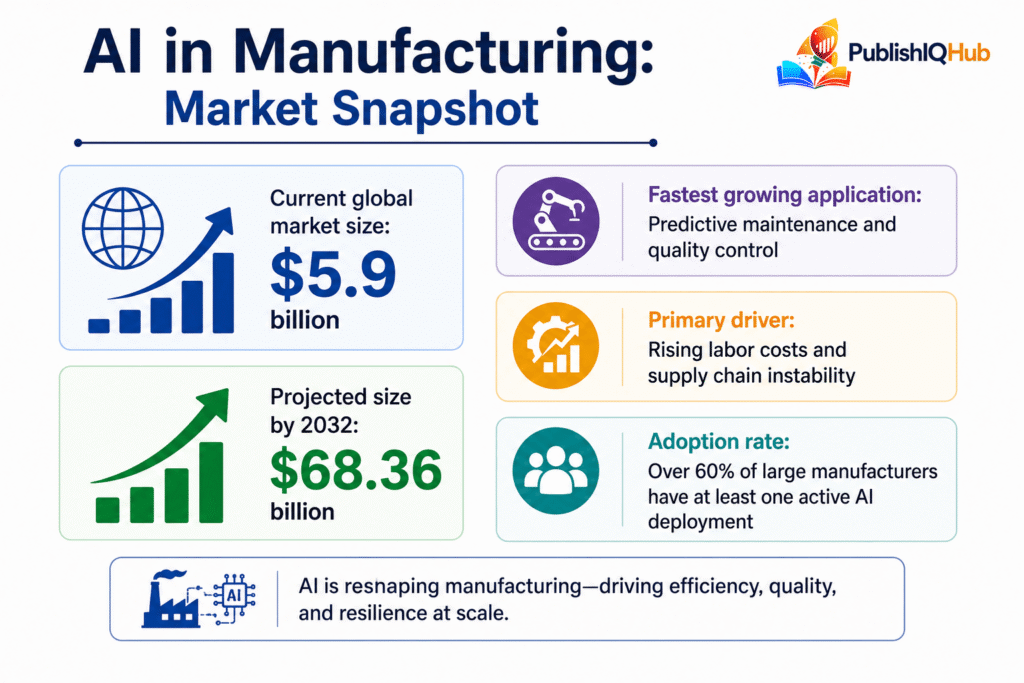
The global AI in manufacturing market is currently valued at $5.9 billion and is projected to reach $68.36 billion by 2032. That is not incremental growth. That is a structural shift, and the companies driving it are worth understanding in detail.
This guide ranks the top 15 AI manufacturing companies, breaks down what each one actually does, and gives any business audience the framework to understand where the real value is being created.
What Is Fueling AI Adoption Across Manufacturing Right Now?
The economics of manufacturing have changed dramatically. Labor costs are rising, supply chains remain fragile, and customer expectations for quality and delivery speed have never been higher. AI is the answer the industry has landed on, and the numbers back it up.
| Metric | Result |
| Reduction in unplanned downtime (predictive maintenance) | Up to 50% |
| Improvement in overall equipment effectiveness (OEE) | 10 to 25% |
| Defect detection improvement over manual inspection | Up to 90% accuracy |
| Supply chain forecasting accuracy improvement | 20 to 50% |
| AI in manufacturing market size (current) | $5.9 billion |
| Projected market size by 2032 | $68.36 billion |
Top 15 AI Manufacturing Companies: Full Comparison Table
| Company | Core Focus | Key Technology | Headline Outcome |
| Siemens | Industrial Automation | Digital Twin & Industrial AI | 20% OEE improvement |
| Rockwell Automation | Connected Manufacturing | Machine Learning & IoT | 50% downtime reduction |
| C3.ai | Enterprise AI | Prebuilt AI Applications | Scalable predictive maintenance |
| Sight Machine | Factory Analytics | Digital Factory Platform | Real-time production visibility |
| Instrumental | Quality Control | Computer Vision AI | 10x faster defect detection |
| Uptake | Asset Intelligence | Predictive Analytics | 30% maintenance cost reduction |
| Augury | Machine Health | Vibration & Audio AI | Early fault detection |
| Bright Machines | Microfactory Automation | Robotics & AI Software | Self-configuring assembly |
| Samsara | Operations Intelligence | IoT & AI Analytics | Real-time monitoring |
| Tulip | Frontline Operations | No-Code AI Apps | Guided workflows |
| Cognex | Machine Vision | Deep Learning Vision | Inspection at scale |
| Landing AI | Visual Inspection | LandingLens Platform | Defect detection AI |
| Plex Systems | Smart Manufacturing | Cloud ERP with AI | Connected operations |
| Parsable | Connected Worker | AI Workflows | 60% error reduction |
| Machina Labs | AI Robotics | Robotic Sheet Forming | Tool-less part production |
Which AI for Manufacturing Companies Are Setting the Standard?
1. How Is Siemens Defining the Smart Factory?
Siemens is the closest thing manufacturing has to a platform company. Their industrial AI portfolio spans digital twins, autonomous control systems, and factory simulation tools that allow manufacturers to model, test, and optimize an entire production facility virtually before a single physical change is made.
What makes Siemens the benchmark:
• Digital twin technology replicates entire production lines in a virtual environment for risk-free testing
• Their Industrial AI suite integrates directly with existing Siemens automation hardware on the factory floor
• AI-driven energy management reduces power consumption in facilities by up to 15%
• Siemens MindSphere connects thousands of machines across global facilities into a single data platform
• Proven OEE improvements of 20% across smart factory deployments in automotive and electronics manufacturing
2. How Does Rockwell Automation Use AI to Prevent Downtime?
Unplanned downtime costs manufacturers an estimated $50 billion annually across industries. Rockwell Automation has built their entire AI strategy around eliminating it.
Core capabilities:
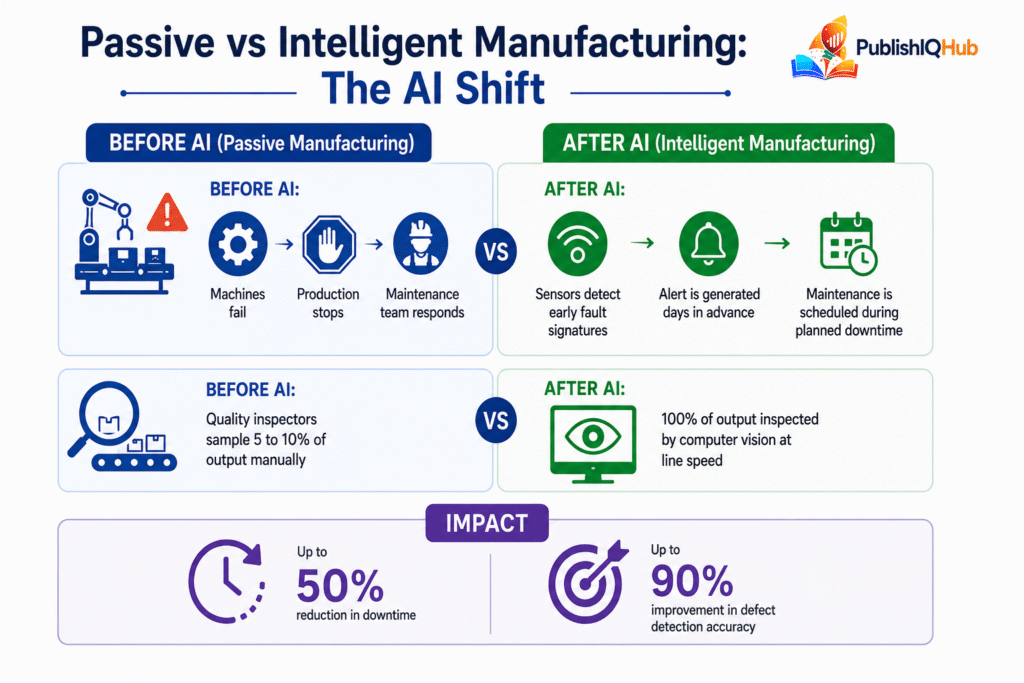
• Machine learning models analyze sensor data from equipment to detect early failure signatures
• Predictive maintenance alerts are generated days or weeks before a fault becomes critical
• Integration with their FactoryTalk platform gives operations teams a single view of plant health
• Reduces unplanned downtime by up to 50% in heavy industrial environments
• Works across legacy equipment through retrofitted IoT sensors, meaning manufacturers do not need to replace existing machinery
3. What Does C3.ai Deliver for AI in Manufacturing Companies?
C3.ai takes a different approach from most vendors. Rather than building hardware-adjacent tools, they offer a library of prebuilt enterprise AI applications that manufacturers can deploy without building models from scratch.
Why manufacturers are choosing C3.ai:
• Prebuilt applications for predictive maintenance, inventory optimization, and demand forecasting
• Connects to existing ERP, IoT, and sensor data without requiring new infrastructure
• Deployed across some of the world’s largest industrial organizations including Baker Hughes and the US Air Force
• Average time to value is significantly shorter than custom AI development
• Applications are industry-specific, meaning they arrive pre-trained on relevant manufacturing data patterns
4. How Does Sight Machine Give Manufacturers Real-Time Factory Visibility?
Most manufacturers are sitting on enormous volumes of production data they cannot act on fast enough to matter. Sight Machine was built to close that gap.
What the platform delivers:
• Aggregates data from machines, sensors, and production systems into a unified digital factory view
• AI models identify the specific variables most correlated with quality outcomes and yield loss
• Real-time dashboards give plant managers visibility across multiple facilities simultaneously
• Continuous process optimization reduces scrap rates and energy waste without manual intervention
• Works with existing equipment across mixed-vendor factory environments
5. How Is Instrumental Catching Defects That Humans Miss?
Quality control has always been one of manufacturing’s most expensive and least reliable processes. Human visual inspection is inconsistent, slow, and impossible to scale at modern production speeds. Instrumental has replaced that process with AI that catches defects at a speed and accuracy level no human team can match.
Documented quality outcomes:
• Computer vision models trained on product-specific imagery detect defects invisible to the human eye
• Inspection happens at line speed, meaning zero production slowdown for quality checks
• Root cause analysis identifies which upstream process variable caused a defect, not just that one occurred
• Customers report catching failure modes weeks earlier than with traditional inspection processes
• Particularly effective in electronics and medical device manufacturing where defect tolerance is near zero
How Are AI Solutions in Manufacturing Delivering Measurable ROI?
This is the section most technology blogs skip. They describe capabilities without answering the question every operations leader actually wants answered: what does this cost and what does it return?
The honest answer is that ROI from AI solutions in manufacturing varies significantly by application, industry, and how well the deployment is managed. But the data that does exist is compelling.
Predictive Maintenance ROI
Unplanned equipment failure is one of the single largest cost centers in any manufacturing operation. The math on predictive maintenance AI is straightforward:
• A mid-sized automotive plant experiencing four major unplanned stoppages per year at an average cost of $500,000 each is losing $2 million annually to downtime
• Predictive maintenance AI that reduces unplanned stoppages by 50% saves $1 million per year
• Enterprise predictive maintenance platforms typically cost between $200,000 and $600,000 annually for a facility of that scale
• Net ROI in year one: positive, often significantly so
Companies like Augury and Uptake consistently report that customers achieve full payback on their investment within 12 to 18 months of deployment, with ongoing savings compounding annually as models improve with more data.
Quality Control ROI
The cost of poor quality in manufacturing includes scrap, rework, warranty claims, and in some industries, regulatory penalties. AI-powered visual inspection attacks all of these simultaneously.
• Instrumental customers report scrap rate reductions of 20 to 40% after deploying AI inspection
• Cognex machine vision systems have documented ROI periods of under 12 months in high-volume production environments
• In medical device and semiconductor manufacturing, where a single defective unit reaching a customer can trigger recalls costing millions, the ROI calculation is even more favorable
Supply Chain and Inventory ROI
Excess inventory is cash sitting on a shelf. Insufficient inventory can stop production while waiting for parts. AI forecasting tools find the optimal point between those two failure modes with a precision that manual planning cannot match.
• AI-driven demand forecasting reduces excess inventory by 20 to 30% on average
• For a manufacturer carrying $50 million in inventory, a 25% reduction frees up $12.5 million in working capital
• Reduced stockouts translate directly to fewer production delays and missed customer delivery commitments
The Total ROI Picture
| AI Application | Typical Cost Reduction | Average Payback Period |
| Predictive Maintenance | 30 to 50% reduction | 12 to 18 months |
| AI Quality Inspection | 20 to 40% reduction | 6 to 12 months |
| Supply Chain Forecasting | 20 to 30% reduction | 12 to 24 months |
| Energy Optimization | 10 to 15% reduction | 18 to 36 months |
| Worker Productivity Tools | 15 to 25% reduction | 6 to 18 months |
How Are AI in Manufacturing Companies Transforming Specific Operations?
Can AI Eliminate Unplanned Equipment Failure?
Augury has built one of the most focused and clinically precise tools in the industrial AI space. Their platform listens to machines using vibration and ultrasound sensors and uses AI to interpret what those sounds mean about the health of the equipment inside.
What Augury detects and delivers:
• Bearing wear, misalignment, imbalance, and lubrication failure detected weeks before breakdown
• Continuous monitoring across pumps, compressors, fans, and rotating equipment of all types
• Fault severity scoring tells maintenance teams which issues are urgent and which can wait for scheduled downtime
• Integration with CMMS platforms so work orders are generated automatically when a fault is detected
• Customers including Heineken, Colgate, and Pfizer report maintenance cost reductions of 25 to 35%
How Is Landing AI Making Visual Inspection Accessible to Mid-Market Manufacturers?
Landing AI, founded by AI pioneer Andrew Ng, was built specifically to bring enterprise-grade AI inspection capability to manufacturers who cannot afford to build custom models from scratch.
What LandingLens delivers:
• No-code interface allows quality engineers to train inspection models without data science expertise
• Models can be trained with as few as 50 to 100 labeled images, dramatically reducing setup time
• Deploys on existing camera hardware in most cases, minimizing infrastructure investment
• Handles complex inspection tasks including surface defects, assembly verification, and label accuracy
• Particularly effective for manufacturers with multiple product variants that change frequently
How Does Tulip Put AI in the Hands of Frontline Workers?
Most manufacturing AI is designed for engineers and analysts. Tulip was built for the people actually running the production line.
How Tulip works on the floor:
• No-code app builder lets operations teams create guided work instructions without IT involvement
• Real-time data capture from machines and worker inputs feeds continuous improvement workflows
• AI identifies patterns in operator behavior and process variation that correlate with quality issues
• Reduces human error on complex assembly tasks by providing step-by-step visual guidance • Used by manufacturers including Danaher, Becton Dickinson, and J&J to standardize processes across global facilities
What Is Machina Labs Doing That Nobody Else Is?
Machina Labs sits at the far edge of what AI manufacturing companies are capable of today. They have combined AI with robotic sheet metal forming to produce complex metal parts without any of the traditional hard tooling that makes low-volume metal fabrication prohibitively expensive.
Why Machina Labs is worth watching:
• AI-controlled robotic arms form sheet metal into complex 3D shapes without molds or dies
• New part geometries can be programmed and produced within days rather than the weeks or months traditional tooling requires
• Particularly valuable for aerospace, defense, and automotive applications where low-volume complex parts are common
• Backed by DARPA and serving customers who previously had no cost-effective path to custom metal fabrication
• Represents the next evolution of AI in manufacturing: not just optimizing existing processes but enabling entirely new production methods
What Are the Biggest Challenges for AI in Manufacturing Companies?
Adoption is accelerating, but the honest picture includes the friction points that slow real-world deployment.
Can AI Eliminate Unplanned Equipment Failure?
1. Data Quality
One of the biggest barriers to successful AI deployment in manufacturing is poor data quality. In practice, this means that factory data is often incomplete, inconsistent, or locked in silos across different systems and machines. As a result, AI models struggle to produce accurate or reliable insights.
To address this, leading companies are prioritizing investments in data infrastructure-cleaning, standardizing, and centralizing data before deploying AI. This foundational step ensures that models are trained on high-quality, usable data.
2. Legacy Equipment Integration
A large portion of manufacturing still runs on legacy machinery that was never designed to generate or share digital data. In real-world terms, this makes it difficult to plug modern AI systems into existing operations without major upgrades.
Companies are solving this challenge by retrofitting older equipment with IoT sensors and using edge computing devices. These additions enable data collection and connectivity without requiring full-scale equipment replacement, making AI adoption more practical and cost-effective.
3. Workforce Resistance
AI adoption often faces resistance from the very people expected to use it. On the ground, this shows up as skepticism from floor workers and plant managers who may not trust AI recommendations, especially when those recommendations are not easily explainable.
To overcome this, organizations are focusing on explainable AI systems that clearly show how decisions are made. In parallel, they are implementing change management strategies that involve employees early, train them effectively, and position AI as a support tool rather than a replacement.
4. Skill Gaps
Most manufacturing organizations do not have the internal expertise required to build, deploy, and maintain AI systems. This creates a dependency gap where even promising AI initiatives struggle to scale.
Leading companies are addressing this by partnering with AI vendors that offer end-to-end support, including implementation, training, and ongoing optimization. This managed-services approach allows manufacturers to adopt AI without needing to build large in-house data science teams.
5. Fragmented Vendors
Many manufacturers adopt AI incrementally, resulting in multiple standalone tools that do not integrate well with each other. In practice, this creates disconnected workflows and limits the overall impact of AI investments.
To solve this, companies are moving toward platform-based solutions that unify multiple AI capabilities within a single ecosystem. Providers like Siemens and Rockwell Automation are leading this shift by offering integrated platforms that bring together data, analytics, and operational workflows.
How Do You Evaluate AI Solutions in Manufacturing for Your Business?
The AI in manufacturing companies generating the most value for their customers share one characteristic: they integrate into how the factory already operates rather than demanding the factory change to accommodate the technology.
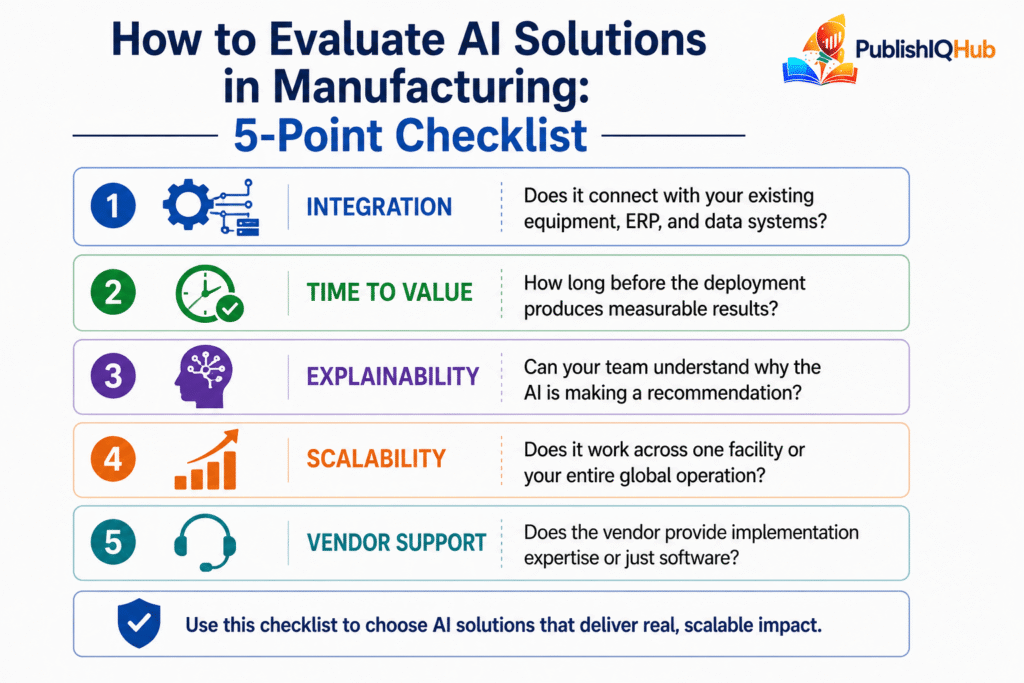
Use this framework when evaluating any vendor:
1. Equipment Integration
One of the first things to evaluate is how well the AI solution integrates with your existing machinery and systems. In practice, many factories operate with a mix of old and new equipment, and a solution that requires complete hardware replacement can quickly become cost-prohibitive and disruptive.
What to ask: Does the solution work with your current machines and control systems, or does it require new hardware or major upgrades?
2. Data Requirements
AI systems depend heavily on historical and real-time data to function effectively. In real-world scenarios, companies often underestimate how much clean, labeled data is needed before models can produce reliable outputs.
What to ask: How much historical data is required for the system to deliver accurate insights, and how does the platform handle incomplete or inconsistent datasets?
3. Deployment Timeline
Time to value is critical in manufacturing, where delays directly impact ROI. Some AI deployments can take months before delivering meaningful results, especially if customization or integration is complex.
What to ask: What is the realistic timeline from implementation to measurable outcomes, and what factors could delay deployment?
4. Total Cost of Ownership
The true cost of an AI solution goes far beyond the initial licensing fee. In practice, companies must account for implementation, training, maintenance, and ongoing support costs, which can significantly impact ROI.
What to ask: What are the full costs involved, including setup, integration, employee training, and long-term support?
5. Proven ROI
Many vendors promise strong results, but not all can back those claims with real-world data. In manufacturing, where margins are tight, proven ROI is one of the most critical decision factors.
What to ask: Can the vendor provide case studies, customer references, or documented financial outcomes that demonstrate measurable ROI?
Conclusion
The gap between manufacturers who have embedded AI into their core operations and those still evaluating it is growing wider every quarter. The companies ranked in this guide are not running pilots anymore.
They are delivering documented financial returns at scale, across some of the world’s most demanding production environments. The question for any manufacturing business today is not whether AI belongs in the operation. It is how much longer waiting is going to cost.
Frequently Asked Questions About AI Manufacturing Companies
What do AI manufacturing companies actually do?
They build software and hardware systems that use machine learning, computer vision, and predictive analytics to improve manufacturing operations. Applications range from predicting equipment failures and automating quality inspection to optimizing production schedules and reducing energy consumption.
Which AI for manufacturing companies has the strongest ROI track record?
Augury, Rockwell Automation, Cognex, and C3.ai consistently appear in ROI case studies with documented payback periods of 12 to 18 months. The strongest returns typically come from predictive maintenance and AI quality inspection deployments.
Are AI solutions in manufacturing only viable for large enterprises?
No. Companies like Tulip, Landing AI, and Parsable were specifically designed for mid-market manufacturers. The cost of AI deployment has dropped significantly, and many vendors now offer modular entry points that allow smaller facilities to start with one application and expand over time.
How long does it take to see results from AI in manufacturing?
Quality inspection and predictive maintenance deployments typically show measurable results within three to six months. Supply chain and energy optimization applications generally take six to twelve months to produce reliable data and demonstrable savings.
Will AI replace manufacturing workers?
The evidence from current deployments suggests augmentation rather than replacement is the dominant pattern. Tools like Tulip and Parsable are designed to make floor workers more effective, not eliminate their roles. The areas where headcount reduction does occur are typically in manual inspection and repetitive data entry, where AI produces both cost savings and quality improvements simultaneously.
What is the biggest mistake manufacturers make when adopting AI?
Starting with the technology rather than the problem. The manufacturers, seeing the strongest returns, identified a specific, measurable operational pain point first and then evaluated AI solutions against it. Those who adopt AI because it is a trend and then search for a use case consistently report longer time to value and lower ROI.