
The digital landscape has reached a critical tipping point. We have spent the last decade obsessed with data collection, building massive lakes and warehouses to store every byte of information generated by our customers and systems. But today, the challenge has shifted. We are no longer starving for information; we are drowning in noise. For the modern enterprise, the primary obstacle to growth isn’t a lack of data-it’s the “Data Trust Deficit.” When your CRM is 30% duplicates, your email bounce rates are climbing, and your AI models are hallucinating because they were trained on inconsistent records, your data is no longer an asset. It is a liability.
This is the era where data cleansing companies have moved from the periphery of IT to the center of the boardroom. Data cleansing-once viewed as a one-time “janitorial” task-is now recognized as a continuous engineering discipline. It is the process of detecting and correcting (or removing) corrupt, inaccurate, or irrelevant records from a record set, table, or database. But beyond the clinical definition, it is about restoring the “Single Source of Truth” that allows a business to function with confidence.
The Role of Data Hygiene in AI and Analytics Accuracy
In the early days of digital marketing, “dirty data” was a nuisance. A stray duplicate meant a customer might receive two identical catalogs in the mail-an expensive mistake, but not a fatal one. Today, the stakes are exponentially higher.
1. The AI Reliability Gap
We are currently seeing a massive surge in Agentic AI-autonomous systems that make decisions, book appointments, and handle customer service without direct human oversight. These agents are only as “smart” as the data they can access. If your data hygiene is poor, your AI will confidently provide wrong answers, offer discounts to the wrong people, or leak sensitive information because it couldn’t distinguish between a test account and a real customer.
2. The Regulatory Hammer
Global privacy regulations like the EU AI Act and updated CCPA standards now mandate data accuracy. “The Right to Rectification” means that if a customer asks you to fix their data, you must be able to find every instance of that data across your silos and correct it. Without professional database clean-up services, manual compliance is virtually impossible at scale.
3. The Erosion of Sales Morale
Ask any sales leader about their biggest frustration, and “bad data” will be in the top three. When an Account Executive spends their morning calling disconnected numbers or reaching out to prospects who left their company six months ago, they aren’t just losing time-they are losing momentum. Professional data cleaning services act as a force multiplier for sales teams, ensuring their energy is focused on real people with real needs.
Why Businesses Choose to Outsource Data Cleansing
To understand the scale of the problem, one needs only look at the numbers. Recent industry reports provide a sobering look at the cost of neglect:
• The 1-10-100 Rule: It costs $1 to verify a record as it’s entered, $10 to cleanse it later, and $100 if you do nothing and let that bad data impact a sale or a legal filing.
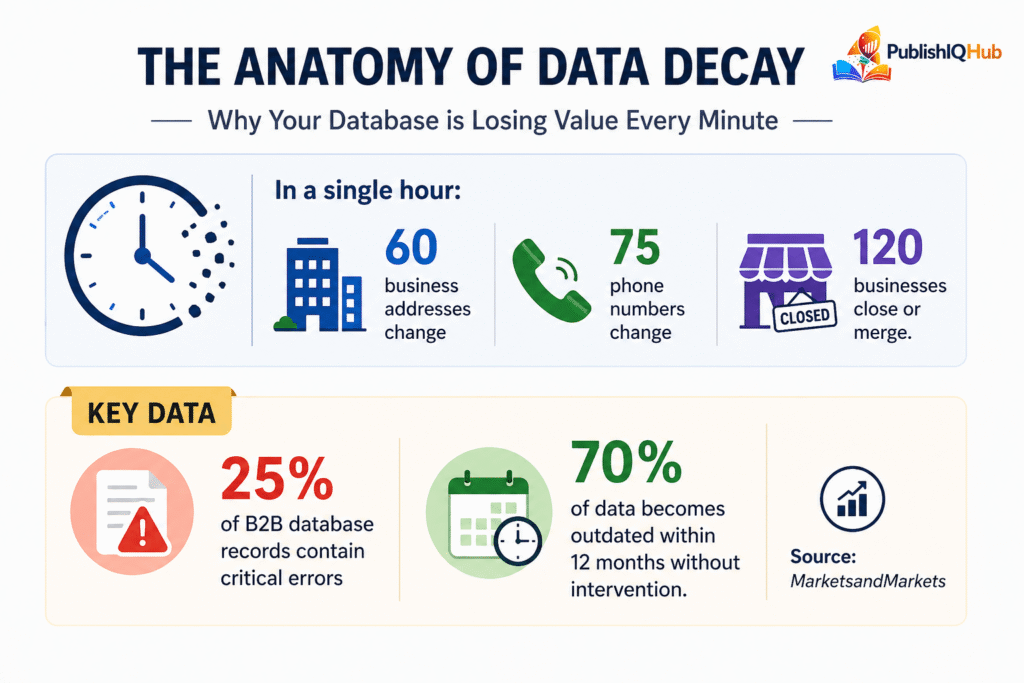
• Data Decay: B2B data decays at a rate of approximately 70.3% per year. People change jobs, companies merge, and titles evolve. Without a strategy for outsourcing data cleansing, your database is effectively “rotting” every day.
• Wasted Budget: Marketing departments estimate that 21% of their lead generation budget is wasted due to poor data quality.
Top 15 Data Cleansing Companies to Watch in 2026
The market for data quality has fragmented into specialized niches. Some firms focus on global address validation, while others use AI to merge complex financial identities. Here are the leaders setting the standard:
| Provider Name | Primary Focus | Best For | Considerations |
| Experian Data Quality | Contact & Identity Validation | Global Enterprises | Large-scale address and identity verification |
| Informatica | AI-Driven Cloud Management | Multi-Cloud Ecosystems | Robust but requires significant setup |
| Cloudingo | Salesforce CRM Hygiene | Dedicated Salesforce Users | Specialist tool specifically for SFDC |
| Demandbase | B2B Account Hygiene | Account-Based Marketing | Focused primarily on B2B firmographics |
| Datamatics Business Solutions | CRM Cleansing & Enrichment | Sales Pipeline Velocity | Hybrid AI + human verification for high accuracy |
| Validity (DemandTools) | CRM Admin Management | CRM Power Users | Strong administrative control over records |
| Melissa Data | Global Identity Verification | Logistics & E-commerce | Leader in global mailing standards |
| TIBCO Software | Master Data Management | Complex Financial Systems | High-level architectural data linking |
| RingLead (ZoomInfo) | Preventative Data Entry | Incoming Lead Capture | Stops bad data at the source |
| Openprise | Data Orchestration | RevOps Automation | Strong workflow and routing capabilities |
| Data Ladder | High-Precision Matching | Non-Technical Users | Very user-friendly fuzzy matching |
| Syncari | Cross-App Synchronization | Distributed Tech Stacks | Maintains data across multiple platforms |
| ZoomInfo | B2B Data Enrichment | Sales & Outreach | Large B2B contact database |
| Dun and Bradstreet | Business Identity Verification | Legal & Compliance | Global standard for business identity |
| Precisely | Data Integrity & Location | Insurance & Telco | Strong location intelligence focus |
Step-by-Step Data Cleaning Process for Large Datasets
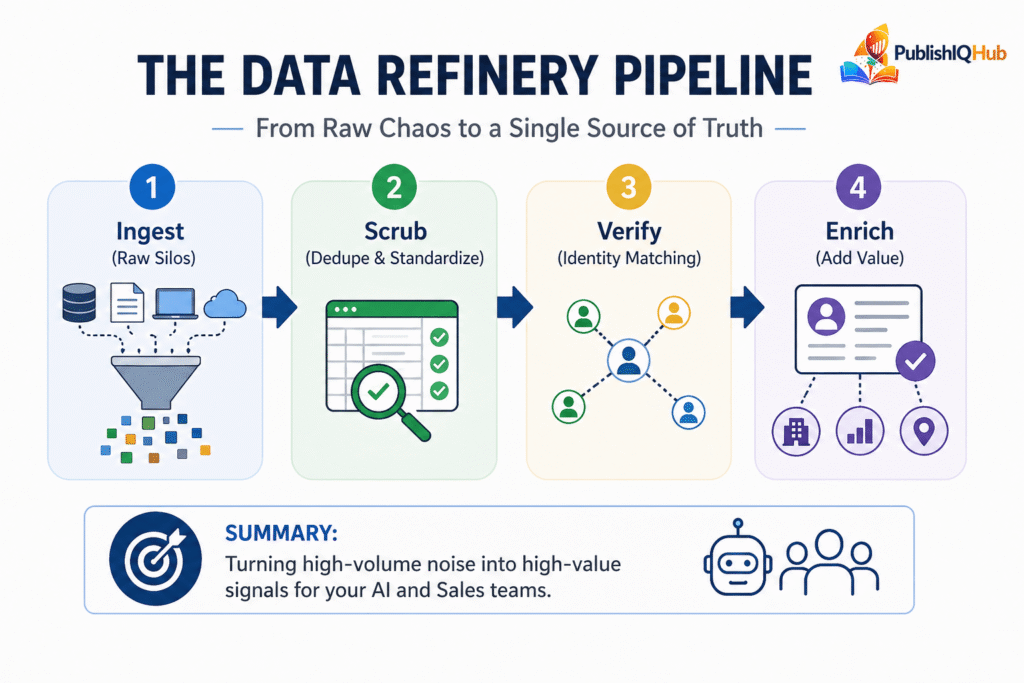
When you decide to outsource data cleansing, you aren’t just buying a software license. You are adopting a methodology. Most data hygiene companies follow a specific framework to ensure a record moves from “Raw” to “Golden.”
Pillar 1: Discovery and Profiling
You cannot fix what you cannot measure. The first step is a comprehensive audit where the cleansing partner analyzes your data silos to identify “hot spots.” They look for missing fields, inconsistent formatting (e.g., “NY” vs. “New York”), and duplicate records. This phase creates a “Data Quality Scorecard.”
Pillar 2: Standardizing and Normalizing
This is the process of bringing all data into a consistent format. This includes:
• Casing: Ensuring names aren’t in all caps or all lowercase.
• Unit Conversion: Ensuring all financial data is in a single currency or all weights are in a single metric.
• Address Normalization: Correcting abbreviations to meet postal standards (essential for delivery and tax compliance).
Pillar 3: De-duplication (The “Fuzzy Logic” Stage)
This is where the magic happens. Exact matching (looking for two identical email addresses) is easy. “Fuzzy matching” is hard. It involves identifying that “Bill Gates” at “Microsoft” and “William H. Gates III” at “One Microsoft Way” are the same individual. Professional data cleansing companies use sophisticated algorithms to calculate “confidence scores” for these matches.
Pillar 4: Enrichment and Verification
A clean record is good, but an enriched record is better. During this stage, the partner pings external databases to fill in the blanks. They might add a LinkedIn URL, a company’s annual revenue, or a direct-dial phone number. They also “ping” email addresses to ensure they are active without actually sending an email (preventing “hard bounces”).
Pillar 5: Monitoring and Governance
Data cleansing is not a “one and done” event. The final pillar involves setting up automated rules that keep the data clean. This might include “Validation Rules” on your web forms or a monthly “Scrub Cycle” where the system automatically re-verifies every record.
Professional Database Clean Up Services and Data Quality
It is common for IT departments to suggest: “We can just write a Python script to de-dupe the database.” While this works for simple tasks, it rarely survives the complexity of a modern enterprise.
The “Reference Data” Problem
To truly clean data, you need a reference set. Data hygiene companies pay millions of dollars for access to global postal datasets, business registries, and phone carrier logs. An internal script can’t “know” that a phone number in London is missing a digit; a professional service can.
The Scalability Wall
A script that works on 5,000 records will often crash or take days to run on 5 million records. Professional database clean-up services use distributed computing and specialized hardware to process millions of rows in minutes.
The Maintenance Burden
Data formats change. API structures change. If you build an internal tool, your developers are now responsible for maintaining it whenever Salesforce updates its API or a new country changes its postal code format. This is a massive drain on high-value engineering resources.
Industry Specific Data Hygiene for Finance and Healthcare
Not all data cleansing is created equal. Depending on your industry, the “cleanliness” requirements change significantly.
1. E-commerce and Logistics
In this sector, the primary focus is on Address Hygiene. A single incorrect zip code can lead to a “failed delivery,” which costs an average of $17.50 per package. Cleansing companies in this space focus on real-time address suggestions (Type-ahead) and verifying that an address is “Residential” vs. “Commercial” to optimize shipping rates.
2. Financial Services and Fintech
Here, the focus is on Identity Resolution and AML (Anti-Money Laundering). Banks must ensure that “Jonathan Doe” isn’t a variation of a name on a global sanctions list. This requires ultra-high-precision matching and a “paper trail” of every change made to a record for regulatory audits.
3. Healthcare and Life Sciences
In clinical settings, data cleansing is literally a matter of life and death. Merging two different “Maria Garcias” into one medical record can lead to dangerous drug interactions. These data hygiene companies use “Deterministic Matching” (relying on social security numbers or unique patient IDs) rather than just fuzzy logic.
4. B2B SaaS and Marketing
The goal here is RevOps Optimization. Marketing needs to know exactly which industry a lead belongs to so they can send the right “nurture” emails. Sales needs to know the company’s “Intent Data” (what they are searching for). Cleansing here is almost always paired with “Technographic Enrichment”-knowing what software the prospect is already using.
Ensuring Data Security and Compliance During Cleansing
When you outsource data cleansing, you are handing over your most precious asset: your customer list. This requires a rigorous security audit of the partner.
SOC 2 Type II and ISO 27001
These are the baseline certifications. They ensure the company has documented processes for handling data and that their employees are trained in security protocols.
The “Zero-Knowledge” Approach
Some modern data cleansing companies now offer “In-Place” cleansing. Instead of you sending your data to them, their software “reaches into” your database (via a secure VPC), cleans the data in your environment, and leaves. Your data never actually resides on their servers.
Ethical AI and Bias Correction
Dirty data often contains historical bias. For example, if your historical sales data is missing entries from a certain demographic, your AI will learn to ignore that demographic. Advanced cleansing firms now offer “Bias Audits,” helping you identify where your data might be skewing your AI’s worldview.
Measuring the ROI of Professional Data Cleansing Services
If you are ready to make a move, follow this selection checklist to avoid common pitfalls:
1. Check for “Real-Time” Capabilities: Does the partner only offer batch uploads, or do they have an API that can clean data the moment it’s entered?
2. Evaluate the “Match Logic”: Ask them to explain their fuzzy matching. Do they use phonetic matching (Soundex)? Do they handle “nicknames” (Bob for Robert)?
3. Data Enrichment Sources: Where does their “truth” come from? Do they own their data, or are they just reselling another provider’s API?
4. Ownership of IP: When they clean your data, do you own the “Golden Record,” or are there restrictive licensing terms on the enriched data?
5. Trial with a “Dead File”: Take 5,000 records you know are messy. Give them to three different data cleaning services and compare the results. Who found the most duplicates? Who corrected the most addresses?
Conclusion: Your Data is Your Destiny
In the 2026 economy, the divide between the leaders and the followers is no longer about who has the most data. It is about who has the most reliable data. Dirty data is a silent tax on your growth, a drag on your AI, and a source of constant friction for your employees.
By outsourcing data cleansing to a specialized partner, you are making a strategic investment in the clarity of your business. You are ensuring that every decision made by your leadership-and every action taken by your AI-is based on a foundation of truth.
The mess won’t clean itself. It’s time to give your data the hygiene it deserves.
Knowledge is your best competitive advantage. Keep reading our blog to discover more industry trends, technical guides, and strategic insights designed for the modern business leader.
Frequently Asked Questions
Is data cleansing the same as data scrubbing?
Yes, the terms are often used interchangeably, though “scrubbing” sometimes refers specifically to removing sensitive information for privacy.
How long does a typical project take?
A PoC (Proof of Concept) can be done in a week. A full enterprise-wide “Golden Record” implementation usually takes 3-6 months.
Does data cleansing help with SEO?
Indirectly, yes. Accurate business data (NAP-Name, Address, Phone) across the web is a critical ranking factor for local SEO.
How does data cleansing differ from data enrichment?
Data cleansing focuses on fixing what is already there: removing duplicates, correcting typos, and standardizing formats. Data enrichment is the next step, in which a cleansing company adds new information from third-party sources to an existing record, such as a prospect’s LinkedIn profile, company revenue, or industry classification.
Can data cleansing help reduce my SaaS or CRM costs?
Yes. Most CRM and Marketing Automation platforms (like Salesforce or HubSpot) charge based on the number of records or the amount of storage used. By removing duplicates and “dead” records, companies often find they can downgrade to a cheaper tier or avoid expensive storage overage fees.