
Data has officially transitioned from a corporate asset to the functional nervous system of the modern enterprise. But as organizations rush to deploy sophisticated autonomous agents and predictive models, they are hitting a hard wall: The Garbage In, Garbage Out (GIGO) principle is more lethal than ever. In an era where AI makes decisions in milliseconds, a single corrupted record isn’t just a typo- it’s a systemic risk.
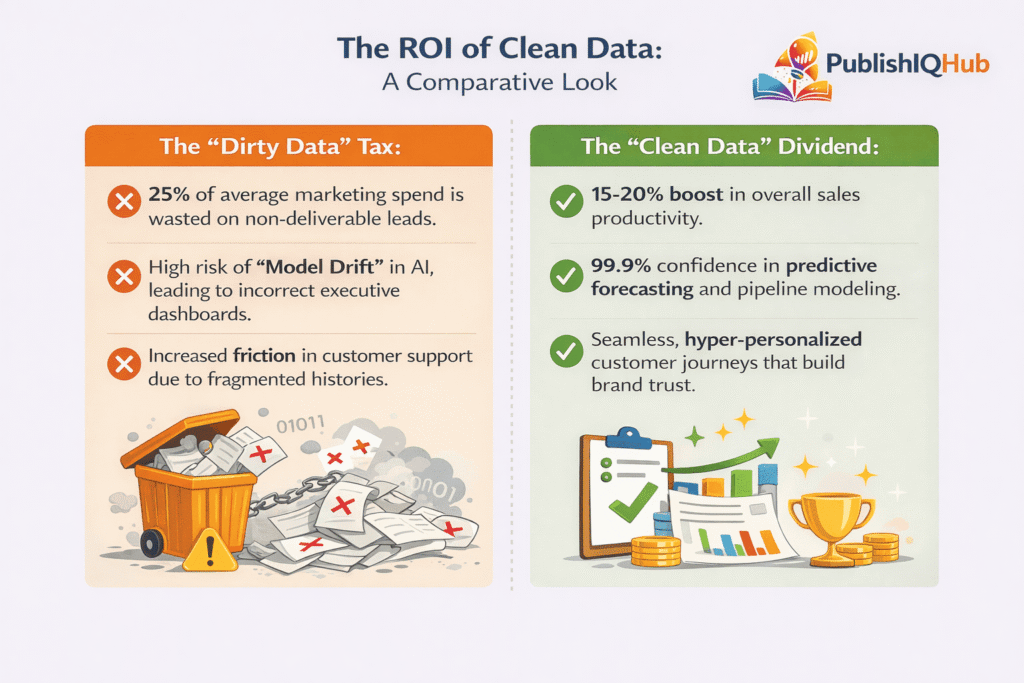
Recent industry audits suggest that the average organization loses nearly 12% of its annual revenue due to poor data quality. This has shifted data cleansing from a “when we have time” IT project to a non-negotiable prerequisite for any firm serious about automation, scaling, or survival.
Beyond “Scrubbing”: The Reality of Modern Data
While the term “scrubbing” implies a surface-level fix, true data cleansing involves deep-tissue structural repair. It is the process of identifying, correcting, or removing corrupt, incorrectly formatted, duplicate, or incomplete data within a dataset.
In a fragmented tech stack, data enters your system from a dozen different directions—LinkedIn signals, website forms, IoT logs, and manual CRM entries. Without a rigorous synchronization of these sources, your data doesn’t just get “dirty”; it becomes contradictory. The goal today isn’t just a clean list; it’s Data Harmonization; ensuring that every department, from Marketing to Finance, operates from a single, verified “source of truth.”
The Anatomy of a High-Fidelity Data Cleansing Process
A professional data cleansing process is no longer a static event. It is a continuous, self-healing loop designed to combat the natural decay of information. A robust workflow now follows five critical stages:
Phase 1: Profiling & Structural Audit
Before a single cell is changed, the system must audit the database to identify failure patterns. This isn’t just about finding empty fields; it’s about understanding why the data is failing. Are your web forms allowing “test@test.com” entries? Is your sales team using a non-standard naming convention for accounts? Profiling highlights the systemic leaks that need to be plugged.
Phase 2: Global Standardization
This is the “logic” layer. It ensures that every piece of information- regardless of its origin- conforms to a unified international standard. This includes:
- Address Normalization: Converting “St.”, “Street”, and “Str.” into a single format.
- Temporal Consistency: Aligning all timestamps to a single UTC standard to ensure event logs make sense across global offices.
- Schema Alignment: Ensuring that “Company Name” in your marketing tool perfectly matches “Account Name” in your ERP.
Phase 3: Intelligent De-duplication
In a multi-touch world, one customer might exist as three different records across your stack. Advanced algorithms now look beyond exact matches to identify “Golden Records.” Using fuzzy logic, these systems can identify that “Anku Sharma” and “A. Sharma” at the same domain are the same individual, merging their behavioral histories into a single, high-value profile.
Phase 4: Third-Party Validation & Verification
Internal data is often “stale” the moment it is entered. Verification involves cross-referencing your records against live, authoritative “truth sets.” This confirms:
- Email Deliverability: Is the mailbox still active, or will this bounce?
- Physical Presence: Is the company still headquartered at this location?
- Employment Status: Has the contact moved to a new company or been promoted?
Phase 5: Contextual Enrichment
Once the data is clean, it must be made useful. Enrichment adds the firmographic (company size, revenue, tech stack) and intent layers that turn a name into an opportunity. Clean data tells you who they are; enriched data tells you why they might buy.
Customer Database Cleansing: The Silent Revenue Driver
For sales and marketing leaders, the CRM is often the leakiest bucket in the building. Customer database cleansing is the only way to plug those holes and recover lost margin.
Protecting Your Sender Reputation
Repeatedly emailing “dead” or invalid addresses doesn’t just waste effort- it destroys your domain authority. Mail servers (like Gmail and Outlook) track bounce rates; if yours is too high, your high-value communications will land in the SPAM folder across your entire prospect list. Cleansing is the most effective way to protect your digital “deliverability score.”
- Boosting Operational Velocity
Every hour a sales rep spends manually researching a lead because the phone number is wrong or the company has been acquired is an hour of lost revenue. Industry benchmarks show that clean data returns approximately 20% of a rep’s week back to active selling. In a 50-person sales team, that is the equivalent of adding 10 full-time reps without increasing your headcount.
- Regulatory Resilience and Trust
Privacy laws (GDPR, CCPA, and emerging global standards) have moved from “suggestions” to “strict enforcement.” Cleansing ensures you aren’t holding data for users who have exercised their “Right to be Forgotten.” Failing to purge these records isn’t just a technical error; it’s a massive legal liability that carries heavy financial penalties.
Industry-Specific Use Cases
Data cleansing looks different depending on the “risk profile” of your industry.
Finance: Risk Mitigation and Fraud Detection
In financial services, “dirty data” can lead to incorrect credit scoring or missed anti-money laundering (AML) signals. Cleansing ensures that customer identities are verified across multiple databases, preventing account takeovers and ensuring that risk models are based on accurate historical performance.
Healthcare: Patient Safety and Compliance
In the medical world, data integrity is a matter of life and death. Duplicate patient records can lead to split medical histories, potentially resulting in allergic reactions or incorrect medication dosages. Data cleansing services in healthcare focus on “Master Patient Index” (MPI) accuracy, ensuring a 360-degree view of the patient across every clinic and pharmacy.
E-commerce: Logistics and Personalization
For retail, the focus is on “Last Mile” accuracy. Clean address data reduces the massive costs associated with failed deliveries. Furthermore, accurate purchase histories allow for hyper-personalized recommendations; an AI that suggests a product the customer already bought (or returned due to a defect) is an AI that actively damages the brand.
Selecting a Partner: Data Cleansing Companies vs. Services
The market is currently flooded with automated “self-serve” tools, but high-stakes environments often require specialized data cleansing services. When evaluating data cleansing companies, the differentiator is no longer “if” they can clean, but “how” they handle the data.
- Agentic Interoperability: Does the service provide “listeners” that sit inside your Snowflake or Salesforce environment to clean data at the point of entry? In 2026, “Batch Processing” is too slow. You need real-time hygiene.
- Privacy-Preserving Computation: Can the company cleanse your records without ever seeing or storing your sensitive PII (Personally Identifiable Information)? In a zero-trust world, this is the gold standard for security.
- Unstructured Processing: The best services can now cleanse more than just spreadsheets; they can standardize voice-to-text transcripts from sales calls and image-based metadata, ensuring your entire data lake is usable for your LLMs.
- Auditability: Does the firm provide a detailed “change log”? You need to know exactly why a record was modified to ensure compliance with internal data governance policies.
The Future: AI-Driven “Self-Healing” Databases
As we look toward the end of the decade, the concept of a “data cleansing project” will vanish. It will be replaced by Autonomous Data Governance.
In this model, AI agents monitor every entry point 24/7. When they detect a typo or a duplicate, they don’t just flag it; they research the correct answer in real-time and fix it. They predict when a contact is about to change jobs based on social signals and update the CRM before the person even leaves their current role. This “Self-Healing Database” is the ultimate goal of any data-driven organization.
Conclusion: Precision Over Volume
In the next era of business, the winners won’t be those with the most data, but those with the most accurate data. Volume is a liability if it is unverified; precision is an asset that compounds over time.
Treating data cleansing as a strategic priority creates a “System of Truth” that powers innovation rather than hampering it. It is the difference between an organization that is guessing and an organization that knows.
Is your data a liability or a competitive advantage? To stay updated on the infrastructure and strategies defining the modern enterprise, keep following us for more in-depth perspectives.
Frequently Asked Questions
1. Can we just do this once a year?
No. B2B data decays at a rate of roughly 3% per month as people change jobs, companies merge, and offices move. By the time your annual scrub rolls around, nearly a third of your database is already obsolete.
2. Is data cleansing the same as data enrichment?
No. Cleansing fixes what is wrong (typos, duplicates); enrichment adds what is missing (company revenue, industry tags). You must clean before you enrich, or you end up paying to append data to a “dead” or duplicate record.
3. How does this affect our AI models?
AI “hallucinations” are almost always caused by poor training data. If your CRM says a customer is in “Tech” but your ERP says they are in “Finance,” the AI will get confused. Clean data is the only way to ensure your automated insights are grounded in reality.
4. What is the “Human-in-the-loop” factor?
While AI handles 95% of the heavy lifting, the best companies keep human auditors for the “gray areas”—such as complex corporate parent-child relationships or ambiguous address matches that require human judgment.
5. Will this disrupt our live systems during the process?
Top-tier data cleansing services operate in the background via API or on a “sandbox” copy of your data, ensuring your team can keep working while the database “self-heals” in real-time.
6. Does data cleansing help with GDPR compliance?
Yes. It is a core requirement. GDPR mandates that data be “accurate and kept up to date.” Regular cleansing ensures you are meeting this legal standard and provides an audit trail showing that you are taking “reasonable steps” to maintain data integrity.