
The traditional sales playbook is effectively broken. In an era where information is the primary currency, the “spray and pray” methodology of the past has become a recipe for high burn and low conversion. Success in the current market isn’t about the volume of your outreach; it is about the surgical precision of your B2B Data. When your data strategy is stagnant, your entire go-to-market infrastructure begins to fracture.
Recent industry research indicates that nearly 70% of the B2B buyer’s journey is completed before a prospect ever engages with a sales representative. This statistic highlights a fundamental shift: buyers are self-educating using digital signals long before they reach out. If you are not using data to identify these silent researchers, you are effectively invisible to the majority of your market. To build a resilient revenue machine, you must treat data as a dynamic, living asset rather than a static spreadsheet.
The Taxonomy of Modern B2B Data Types
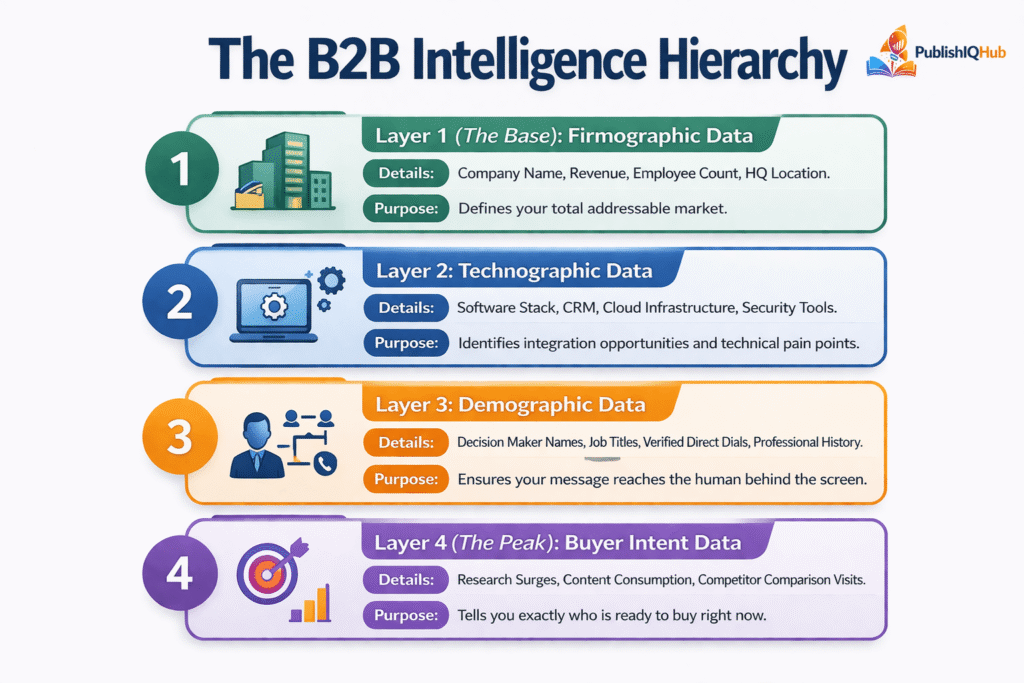
To build a high-fidelity view of your market, you cannot rely on a single data point. You must synthesize multiple B2B Data Types to create a 360-degree profile of your ideal customer.
- Firmographic Intelligence
This is your foundational layer. It defines the “Who” and the “Where.” It includes company size, industry vertical, headquarters location, and annual revenue. While basic, firmographics allow you to segment your market into manageable tiers, ensuring you aren’t chasing enterprise-level solutions with a startup-sized budget.
- Technographic Mapping
In the digital economy, a company’s tech stack is a window into its maturity and pain points. Technographics tell you which software and hardware a prospect currently utilizes. Are they a Salesforce shop? Do they use AWS or Azure? Knowing this allows your sales team to lead with specific integration benefits rather than generic value propositions.
- Demographic & Professional Insights
Business doesn’t happen between companies; it happens between people. This layer focuses on the individual stakeholders within the account. It includes verified job titles, professional history, seniority levels, and functional responsibilities.
- B2B Buyer Intent Data: The “When” Factor
While the first three types tell you who a prospect is, B2B buyer intent data tells you when they are actually ready to buy. This is the “active signal” layer. It tracks behavioral surges, such as an account suddenly researching specific problem sets or visiting competitor comparison pages. By prioritizing accounts in an “active” research phase, you can engage prospects when they are looking for a solution.
The Silent Profit Killer: B2B Data Quality
Even the most sophisticated intent signals are worthless if they are tied to incorrect contact information. Poor B2B Data Quality is a systemic risk that impacts every department in the building.
- The Marketing Tax
Outdated email addresses lead to high bounce rates. In the eyes of modern mail servers, a high bounce rate is a signal of a spammer. This can lead to your entire corporate domain being blacklisted, preventing even your legitimate, high-value communications from seeing the light of day.
- The Sales Friction Problem
The average sales representative spends nearly 38% of their week researching or correcting bad data. In a 50-person sales team, that is the equivalent of losing ten full-time employees to administrative waste. High-quality data returns that time to active selling, which is the single fastest way to increase sales velocity without increasing headcount.
- The AI Integrity Gap
As enterprises deploy AI agents for outreach and predictive modeling, the stakes for data quality have never been higher. AI models rely on patterns. If those patterns are fed corrupted, duplicate, or obsolete data, the “insights” they generate will be flawed at best and brand-damaging at worst.
Evaluating the Market: 15 Leading B2B Data Providers
The market for B2B intelligence is crowded, and the right partner depends on your specific geography, industry, and budget. Here are ten of the most prominent B2B Data Providers currently shaping the industry:
- ZoomInfo: Often considered the industry standard for depth and breadth, especially in the North American market. Their platform combines firmographics with strong intent signals.
- Apollo.io: A favorite for startups and mid-market firms due to its integrated engagement platform and competitive pricing.
- Lusha: Known for its ease of use and high accuracy in direct-dial and mobile number verification.
- Cognism: A leader in the EMEA market, focusing heavily on GDPR compliance and verified mobile data for European prospects.
- 6sense: A powerhouse in the intent data space, utilizing AI to predict “Dark Social” signals and identify anonymous buyers early in the cycle.
- Demandbase: A comprehensive Account-Based Marketing (ABM) platform that integrates deep intent data with advertising and sales intelligence.
- Clearbit (by HubSpot): Excels at real-time enrichment and technographic mapping, helping teams turn anonymous website visitors into identified accounts.
- D&B Hoovers (Dun & Bradstreet): Leverages one of the world’s largest commercial databases, offering unparalleled global firmographic depth for enterprise-scale auditing.
- LeadIQ: Focused on streamlining the workflow between LinkedIn and the CRM, allowing reps to capture and verify leads without leaving their browser.
- UpLead: Positions itself as a high-accuracy alternative, offering a “95% accuracy guarantee” on its verified email lists to minimize bounce rates.
- Lead411: Focuses on “trigger-based” data, alerting sales teams to leadership changes, funding rounds, and office moves.
- SalesIntel: Provides high-quality, human-verified data specifically targeted at the US market with a focus on specific verticals like SaaS and Finance.
- Bombora: The pioneer of third-party intent data, providing “Surge” reports that show which businesses are consuming content related to your products across the web.
- Ocean.io: Uses AI to look at company “lookalikes” based on how they describe themselves on their websites, going beyond traditional industry codes.
- Seamless.ai: Uses a real-time search engine to find contact information across the web, specializing in finding direct dials and cell phone numbers for cold outreach.
The Lifecycle of High-Fidelity Information
Data is not a “set it and forget it” asset. It begins to decay the moment it is entered into your system. To maintain a competitive advantage, you must implement a continuous hygiene cycle.
Phase 1: Ingestion & Verification
Whether data comes from a web form or a third-party provider, it must be verified at the point of entry. Automated “listeners” can check email syntax and domain health in real-time, preventing “trash” data from ever reaching your CRM.
Phase 2: De-duplication & Normalization
A single company might exist in your database as “IBM,” “International Business Machines,” and “IBM Corp.” Normalization ensures that all records follow a unified naming convention, which is critical for accurate reporting and account-based strategies.
Phase 3: Enrichment
Once you have a clean “Golden Record,” you can append secondary data points like tech stack, recent funding rounds, or leadership changes. Enrichment turns a contact into a context-rich opportunity.
Phase 4: Continuous Scrubbing
High-growth teams perform automated “scrubs” every 30 to 90 days. This process identifies people who have changed jobs or companies that have been acquired, ensuring your sales reps aren’t calling people who are no longer there.
Strategies for Activating Intent
Once you have established B2B Data Quality, the next step is activation. How do you turn a signal into a meeting?
- The Trigger-Based Reach Out: When a target account hits a specific intent threshold, your system should automatically trigger a personalized outreach. This isn’t a generic pitch; it’s a message that references the specific problem they are currently researching.
- Coordinated ABM: High-intent accounts should receive a multi-channel “surround sound” approach. While the sales rep is calling the decision-maker, marketing should be serving targeted ads to other stakeholders in the same firm.
- Content Alignment: If intent data shows an account is researching “Data Privacy Compliance,” don’t send them a case study on “Operational Efficiency.” Align your content assets to the specific intent signal to increase resonance.
Precision Over Volume
The era of brute-force sales is over. In a marketplace defined by information density, the winners are those who can navigate the noise to find the signal. High-quality B2B Data provides the clarity needed to move faster, the precision needed to be relevant, and the integrity needed to build long-term trust with your customers.
If your growth has plateaued, the problem likely isn’t your product or your people- it’s the fuel you are putting in the tank. By prioritizing data hygiene and intent-led strategies, you aren’t just filling a CRM; you are building a predictable, scalable engine for future revenue.
Stay updated on the tools and trends defining the modern enterprise. Keep following us for more in-depth perspectives.
Frequently Asked Questions
Is “Buyer Intent” just another buzzword?
No. It is the transition from “Static Prospecting” to “Behavioral Prospecting.” It allows you to focus your most expensive resources (your sales team) on the 3% of your market that is actually in-market to buy today.
Why is my bounce rate so high even with a top-tier provider?
Data providers are not a silver bullet. B2B data changes constantly. Even the best providers might have a 5-10% error rate. This is why internal verification and regular “scrubbing” are necessary components of any data strategy.
How do I choose between different B2B Data Providers?
Start with your ICP. If you sell to European mid-market firms, you need a provider with high EMEA coverage and strict GDPR compliance. If you sell to US tech startups, you might prioritize technographic depth and mobile number accuracy.
Does data quality affect SEO or Ads?
Indirectly, yes. If your marketing data is poor, you are feeding “dirty” signals back into ad platforms like LinkedIn or Google. This makes your “lookalike” audiences less effective and increases your Customer Acquisition Cost (CAC).
How often should we audit our CRM data?
Surface-level scrub should happen monthly. A deep-tissue audit: where you re-verify every record against third-party truth sets should happen at least twice a year.