
Quick Answer: AI in education means using artificial intelligence tools to support teaching, learning and school administration. Common uses include AI tutors, personalised practice, lesson planning, automated feedback and accessibility support. Used with clear rules and human oversight, it saves teachers time and gives students help whenever they need it.
A teenager in Ohio asks a chatbot to explain photosynthesis at 11 p.m. A maths teacher in Singapore builds three versions of one worksheet in ten minutes. Five years ago this felt futuristic. Now it is just Tuesday.
AI in education has moved from pilot projects to daily habit, and the numbers show how fast. According to Pew Research Center’s 2026 study of 1,458 US teens, 54% have used chatbots to help with schoolwork. In the UK, HEPI’s 2026 survey of 1,054 full-time undergraduates found that 95% of students now use AI in some form.
So the question is no longer whether students use AI, but how well. This guide covers the most practical AI uses in education, the global data, the real risks and how schools and parents can set sensible rules.
What Is AI in Education?
AI in education is the use of software that can understand language, spot patterns and generate content to support learning and school operations. That covers everything from a chatbot that answers questions to a system that flags a student who is falling behind.
Picture a 14-year-old stuck on quadratic equations. She opens an AI tutor that asks guiding questions instead of handing over the answer, and her teacher later sees which steps tripped her up. That loop of instant help plus teacher insight is the core promise of AI in education.
Most of today’s tools run on generative AI, the same technology behind ChatGPT, Claude and Gemini. If you want a broader picture of where else this technology shows up, our guide to real-world uses of artificial intelligence covers healthcare, finance and daily life.
How Is AI Used in Education Today? 10 Practical Uses
The uses of AI in education fall into two broad groups: tools that help students learn and tools that free up teacher time. Here are the ten that matter most right now.
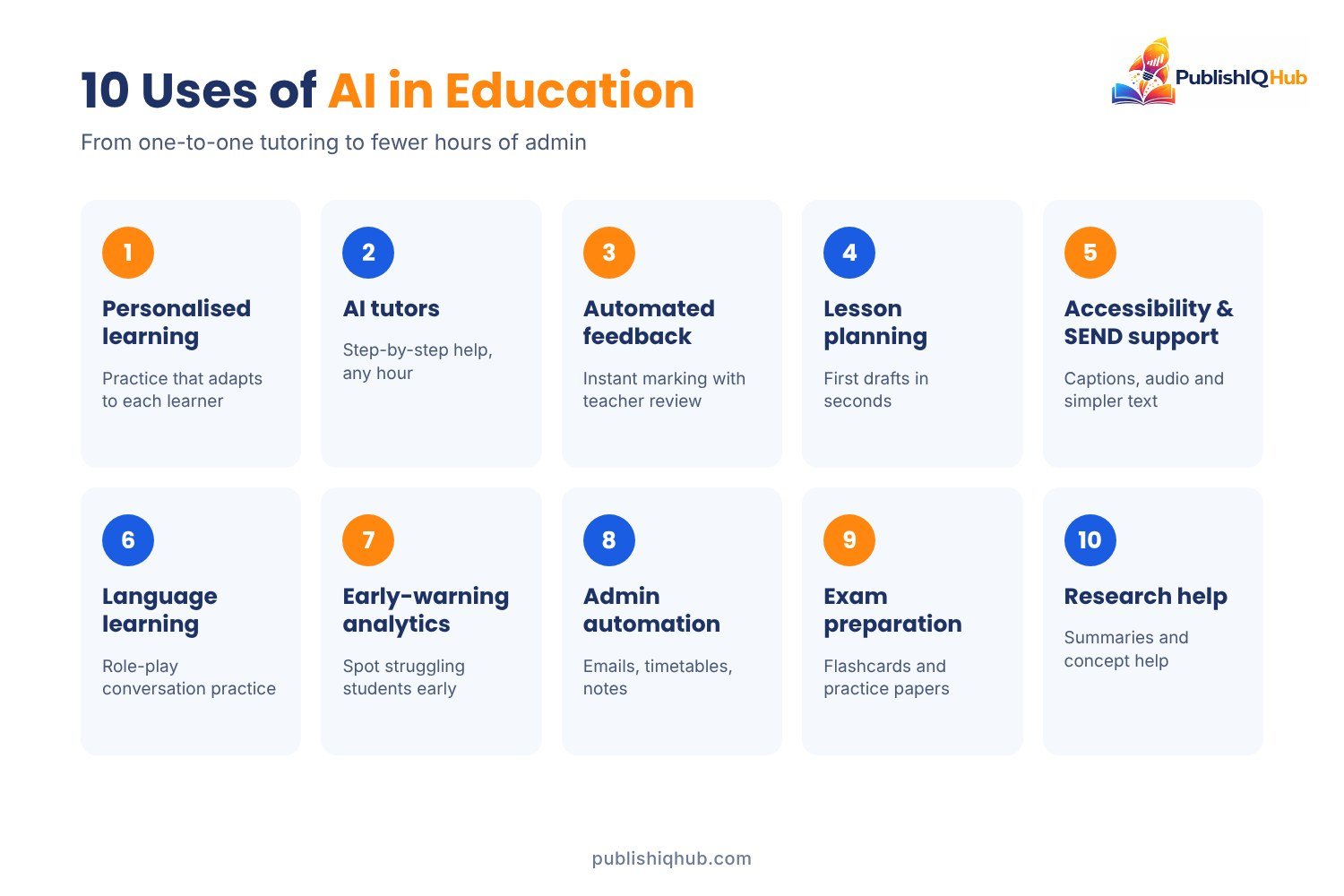
1. Personalised Learning With AI
Adaptive platforms adjust difficulty as a student answers. Get three right and the next question gets harder; struggle, and the system steps back to the basics. Personalised learning with AI used to need a private tutor. Now a phone does a decent version.
2. AI Tutor for Students
An AI tutor for students works around the clock. Khan Academy’s Khanmigo, for example, is designed to nudge learners towards the answer with questions instead of simply giving it away. That design choice matters, because a tutor that does the work teaches nothing.
3. Automated Feedback and Grading
AI can mark multiple-choice tests instantly and draft comments on essays. Teachers still review the output, and adoption here is slower, which makes sense given how much judgement grading needs.
4. Lesson Planning and Resource Creation
This is one of the most common AI uses in education for teachers. Ask for a water-cycle lesson for 12-year-olds with an exit quiz, and a usable draft appears in seconds.
5. Accessibility and Special Needs Support
Text-to-speech, live captions, simpler reading levels and translation help students with SEND (special educational needs and disabilities, the UK term). A dyslexic student can listen to a chapter while following the text.
6. Language Learning
Apps like Duolingo Max run AI role-play conversations and explain mistakes, so learners can practise ordering coffee in Spanish without an audience.
7. Early-Warning Analytics
Some school systems use AI to spot worrying patterns in attendance and grades, prompting a check-in before a student quietly drops out.
8. Administrative Automation
Timetables, parent emails, permission slips, meeting notes. AI help in education often starts here, because cutting admin frees hours without touching classroom teaching.
9. Exam Preparation
Students turn their notes into flashcards, practice papers and summaries. Many free AI tools for students in 2026, including Google Gemini and Microsoft Copilot, can generate quizzes from uploaded material.
10. Research Help
For older students, AI can summarise long papers and explain unfamiliar concepts. Treat it as a starting point, never the final source. Our comparison of the best AI-powered research tools looks at which ones cite their sources properly.
How Can Teachers Use AI to Save Time on Lesson Planning?
Teachers save the most time by using AI for first drafts of lesson plans, worksheets, quizzes and parent communications, then editing the results. The time saved is real and measurable.
A Gallup and Walton Family Foundation study found that six in 10 US teachers used an AI tool for their work in the 2024–25 school year. Teachers who use these tools at least weekly save about 5.9 hours a week. Over a 37.4-week school year, that adds up to roughly six weeks.
Schools with an AI policy saw bigger gains: 2.3 hours saved per teacher per week, against 1.7 hours without one. Clear rules seem to build confidence.
The UK shows a similar trend with an important twist. Bett’s 2026 report, based on a YouGov poll of 1,033 UK teachers, found that 80% now use AI for teaching-related tasks and weekly use doubled from 26% in 2025 to 52% in 2026. Yet only 35% said they were actually working fewer hours. Saved time often gets absorbed by other work.
Practical ways to put AI tools for teachers to work:
- Lesson drafts: Ask for a plan with learning objectives, timings and differentiation for mixed abilities.
- Differentiated worksheets: Generate three reading levels of the same text in one go.
- Feedback banks: Draft comment templates, then personalise them.
- Parent updates: Turn rough notes into a clear, friendly newsletter.
How Does Online AI Learning Personalise Education for Each Student?
Online AI learning personalises education by tracking what each student gets right and wrong, then adjusting the pace, difficulty and type of explanation to match. Students who need more practice get it. Students who are ahead move on.
Students have embraced online AI learning faster than schools. Pew’s 2026 data shows about one in 10 US teens do all or most of their schoolwork with a chatbot’s help. In the HEPI survey, the most common uses for assessed work were having concepts explained, summarising articles and generating research ideas.
The less comfortable side: HEPI found the share of UK students putting AI-generated text directly into assessed work rose from 3% in 2024 to 12% in 2026. Real AI help in education builds understanding; it doesn’t replace the thinking.
AI in Education Around the World
Adoption varies widely by country. The OECD’s TALIS 2024 survey of about 280,000 teachers and school leaders across 55 education systems gives the clearest global picture.
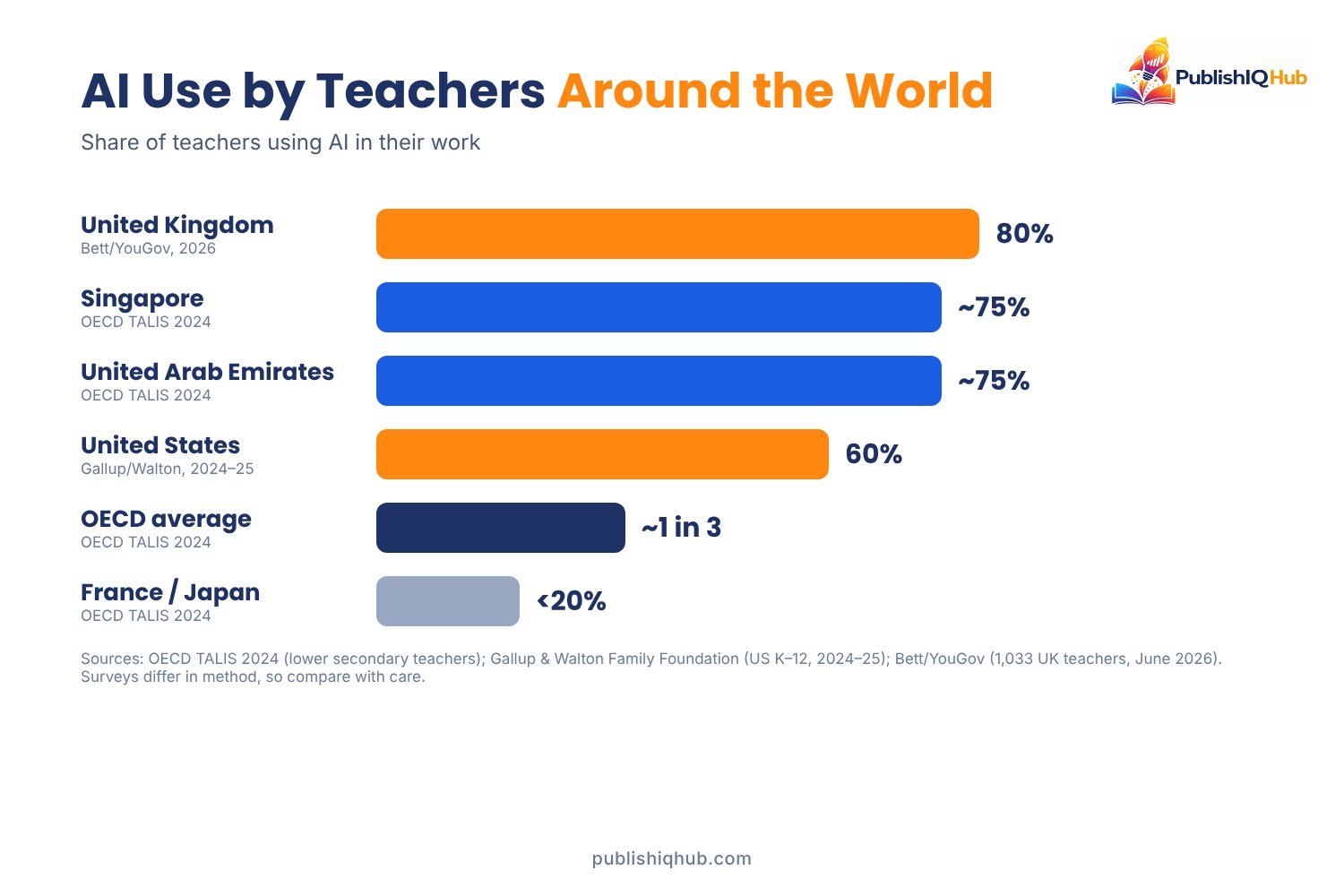
- OECD average: Around one in three lower secondary teachers report using AI in their work.
- Singapore and the UAE: About 75% of teachers use AI, the highest rates in the survey. Singapore also leads on training, with 76% of teachers reporting AI training against an OECD average of 38%.
- France and Japan: Fewer than 20% of teachers use AI at work.
- United States: Gallup puts teacher use at 60% for the 2024–25 school year.
- United Kingdom: Bett’s 2026 data shows 80% of teachers using AI for teaching-related tasks. The Department for Education has published official guidance on generative AI in education covering safety, data privacy and intellectual property.
- India: Edtech platforms are adding AI doubt-solving for exam aspirants, though national data on teacher use is still limited.
One pattern stands out: trained teachers use AI more. TALIS found that three in four teachers say they lack the knowledge or skills to teach using AI.
What Are the Benefits and Challenges of AI in Education?
The main benefits of AI in education are time savings for teachers, round-the-clock help for students and better support for diverse learners. The main challenges are cheating, data privacy, bias and unequal access. Both deserve equal attention.
Benefits of AI in Education at a Glance
- Faster lesson preparation and admin
- Instant, patient help outside school hours
- Content adapted to different reading levels and languages
- Earlier warning when students start to struggle
Is Using AI for Homework Considered Cheating?
It depends on the school’s rules and how the tool is used. Asking AI to explain a concept is usually fine. Submitting AI-written work as your own usually isn’t. Students draw a similar line: in Pew’s 2026 study, 59% of US teens said students at their school use AI to cheat at least somewhat often. Across OECD countries, seven in 10 teachers worry that AI makes plagiarism and cheating easier.
What Are the Risks of AI in Education for Student Privacy?
Many AI tools store what users type, and some use it to train models. Schools should choose tools that meet local data protection laws (GDPR in Europe and the UK, FERPA and COPPA in the US) and teach students never to share personal information with chatbots.
Bias and the Digital Divide
AI models learn from internet data that can carry cultural and language bias, and students without devices or broadband risk falling further behind. UNESCO’s guidance for generative AI in education and research calls on governments to protect data privacy, consider age limits and make sure schools check tools for ethical and teaching quality before rolling them out.
Can AI Replace Teachers?
No. AI can handle repetitive tasks and give instant practice, but it cannot replace the judgement, motivation and human connection that teachers provide. A chatbot won’t notice that a chatty student has gone quiet.
The more realistic future is teachers who use AI well outpacing those who don’t. Our deep dive on AI’s impact on employment shows a similar pattern across many professions: roles change more often than they disappear.
How Schools and Parents Can Use AI Responsibly: A 5-Step Checklist
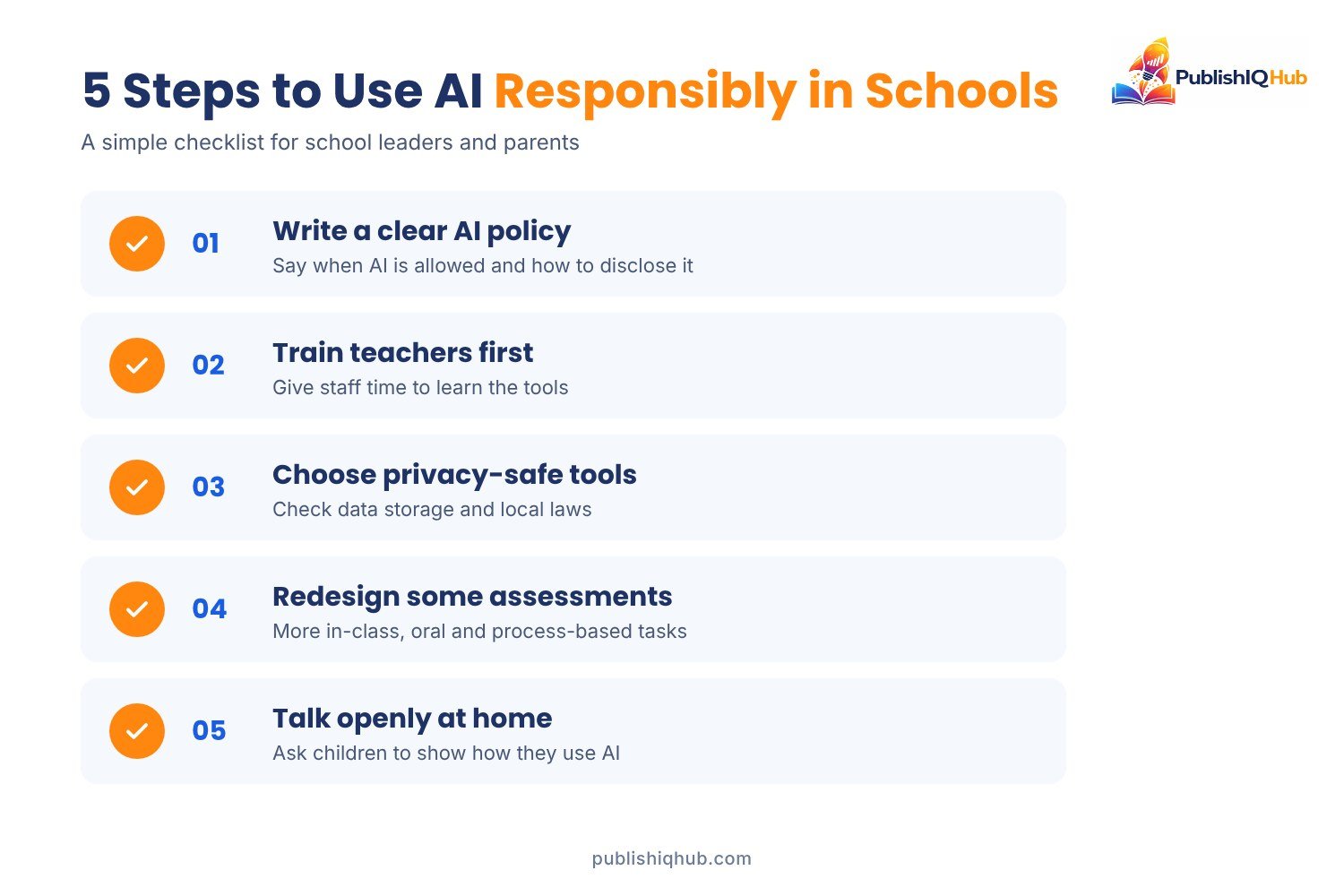
- Write a clear AI policy. Spell out when AI is allowed, when it isn’t, and how students should disclose its use. Gallup’s data suggests that schools with policies get more value from AI.
- Train teachers first. Give staff time and support to learn the tools before expecting them to teach with them.
- Choose privacy-safe tools. Check where data goes, whether it trains public models and whether the tool meets local law.
- Redesign some assessments. Use more in-class writing, oral presentations and process-based tasks that show how a student reached an answer.
- Talk openly at home. Parents can ask children to show how they use AI for homework, and treat it as a conversation rather than a ban.
Popular AI Tools in Education: Quick Comparison
| Tool | Best For | Free/Paid | Age Group |
| Khanmigo (Khan Academy) | Guided tutoring in maths, science and writing | Free for teachers in many regions; low-cost for families | School students |
| Google Gemini for Education | Quizzes, summaries and study help | Free with Google Workspace for Education | Students and teachers (age limits apply) |
| Microsoft Copilot | Lesson drafts, research help, document work | Free and paid tiers | Teens, adults, educators |
| Duolingo Max | AI conversation practice for languages | Paid | Teens and adults |
| MagicSchool AI | Lesson plans, rubrics and worksheets for teachers | Free and paid tiers | Teachers |
| ChatGPT / Claude | Explanations, writing feedback, brainstorming | Free and paid tiers | 13+ with permission, adults |
Pricing and age rules for these AI tools for teachers and students change often, so check each provider’s current terms.
Future of AI in Education: 2027 and Beyond
The future of AI in education points to AI tutors built into school platforms, more teacher training and stricter rules on safety and assessment. Governments are already moving. Teachers name AI as their top professional learning need in TALIS 2024, ahead of every other topic.
Expect three shifts. School-approved tools will replace personal accounts. Exams will lean more on in-person and oral formats. And search itself is changing, with students getting answers from AI summaries instead of links, a shift we unpack in our explainer on what AI Mode in Google means.
Generative AI in education will keep improving. The schools that gain most will pair it with clear goals, trained staff and honest conversations about online AI learning.
Final Thoughts
AI in education is no longer a future trend. It already shapes homework, lesson plans and university assignments worldwide, with clear time savings for teachers alongside real worries about cheating, privacy and fairness. The best results come from balance: use AI to handle routine work and support learning, and keep humans in charge of judgement and care. For more guides on how AI is changing work and daily life, explore the latest articles on PublishIQHub.
Frequently Asked Questions
What is AI in education?
AI in education is the use of artificial intelligence to support teaching, learning and school administration. Common AI uses in education include AI tutors, adaptive practice, automated feedback, lesson planning and text-to-speech. The aim is to save teachers time and personalise help, with humans making the key decisions.
What are the benefits of AI in education?
The benefits of AI in education include faster lesson preparation, instant help at any hour, content adapted to different levels and languages, and early warning when a student struggles. Gallup found US teachers using AI weekly save about 5.9 hours a week.
Is using AI for homework considered cheating?
It depends on the school’s policy and how the tool is used. Using AI to explain a topic is usually acceptable, while submitting AI-written work as your own is usually treated as cheating. Follow your teacher’s rules and disclose AI use when asked.
What are the best free AI tools for students in 2026?
Popular free options include Google Gemini, Microsoft Copilot, the free tiers of ChatGPT and Claude, and Khan Academy’s tools where available. Check age requirements and school rules first, and use them to understand topics, not to produce finished assignments.
How can teachers use AI to save time on lesson planning?
Teachers can ask AI to draft lesson plans, differentiated worksheets and quiz questions, then edit for accuracy and context. Among the uses of AI in education, OECD data shows lesson planning is one of the most common for teachers.
What are the risks of AI in education for student privacy?
AI tools may store what users type, and some use it to train models. Schools should pick tools that comply with GDPR, FERPA or COPPA, and teach students to keep names, addresses and other private details out of chatbots.