
Quick Answer: How is ecommerce changing in 2027?
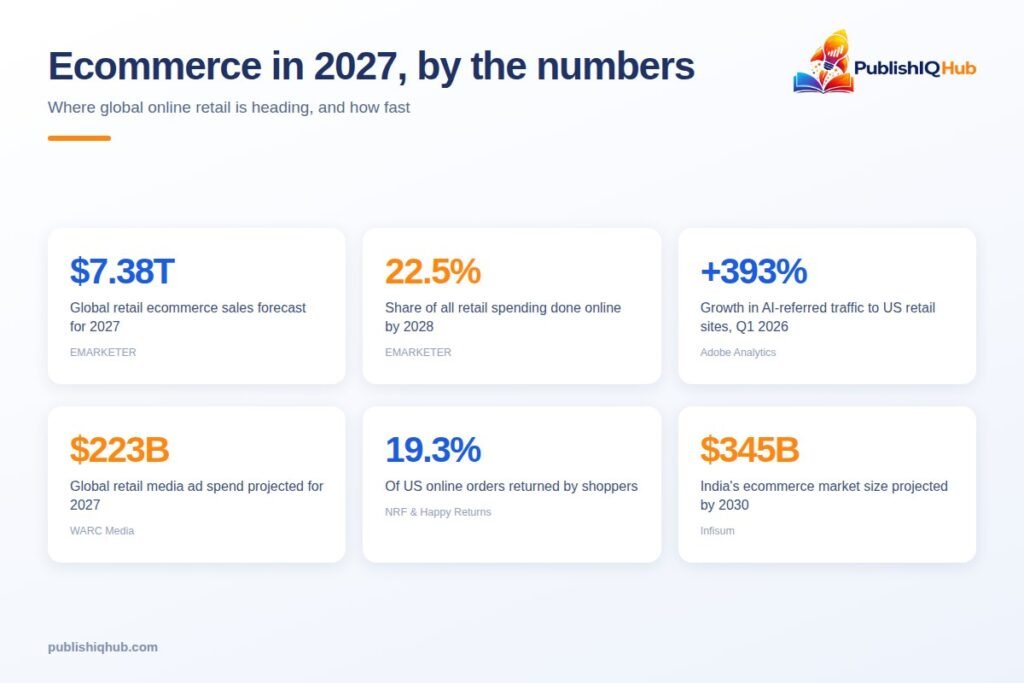
Ecommerce in 2027 is being reshaped by three forces: AI assistants replacing search as the discovery layer, agentic checkout moving the transaction off your website, and margin pressure from returns and delivery speed. Global online sales are forecast to cross $7.3 trillion, but a growing share will be won inside AI answers rather than on product pages.
The shift nobody was ready for
Two years ago the big question in ecommerce was whether to block AI crawlers. That debate is over. Shoppers now arrive from ChatGPT, Gemini, Perplexity and AI Overviews in volumes nobody modelled, and they behave differently once they land.
Most writing about the future of ecommerce is either breathless or defensive. Neither helps when you have a quarterly plan to sign off.
What follows is not a list of predictions. Most of what defines 2027 is already measurable in 2026 data. Some of it is working. A fair amount of it is not, and the gap between the two is where the interesting decisions sit. Below are twelve ecommerce trends 2027 planning should account for, each with a number behind it and one thing to actually do.
Ecommerce in 2027 at a glance
| Metric | Latest figure | 2027 projection | Source |
| Global retail ecommerce sales | $6.88 trillion (2026) | $7.38 trillion | EMARKETER, via Shopify |
| Ecommerce share of total retail | 21.1% (2026) | ~22.5% | EMARKETER, via Shopify |
| Global retail media ad spend | $200.4 billion (2026) | $223.4 billion | WARC Media |
| AI-referred traffic to US retail sites | +393% YoY (Q1 2026) | Still compounding | Adobe Analytics |
| Online return rate (US) | 19.3% of online sales (2025) | Structurally similar | NRF & Happy Returns |
| India ecommerce market | $125 billion (2024) | On track to $345bn by 2030 | Infisum, via Business Standard |
1. How is AI changing ecommerce discovery?
AI assistants have become a top-of-funnel channel that converts better than paid search, which means the first impression of your brand is now written by a model, not by you.
Adobe Analytics, which tracks over a trillion visits to US retail sites, found that AI-driven traffic grew 393% year over year in Q1 2026, building on a 693% surge during the November to December 2025 holiday period. Traffic volume is the boring half of the story. The interesting half is quality. In March 2025, traffic from AI sources converted 38% worse than channels like paid search and email. By March 2026, the same traffic was converting 42% better.
That is roughly an eighty-point swing in twelve months. Nothing else in the history of AI in ecommerce has moved that fast.
It happened because the models got better at recommending the right product, and because shoppers started trusting them. Adobe’s companion survey of more than 5,000 US consumers found 39% had already used AI for online shopping, and 66% believed AI tools give accurate results.
For an ecommerce brand, this changes what “ranking” means. You are no longer competing for a blue link. You are competing to be the product a model names when someone asks it for the best option under ₹5,000 or the most durable one for daily use.
What to do about it: Pull your AI referral traffic into a separate channel group in analytics this quarter. You cannot manage a channel you have not isolated.
2. What is agentic commerce and how does it work?
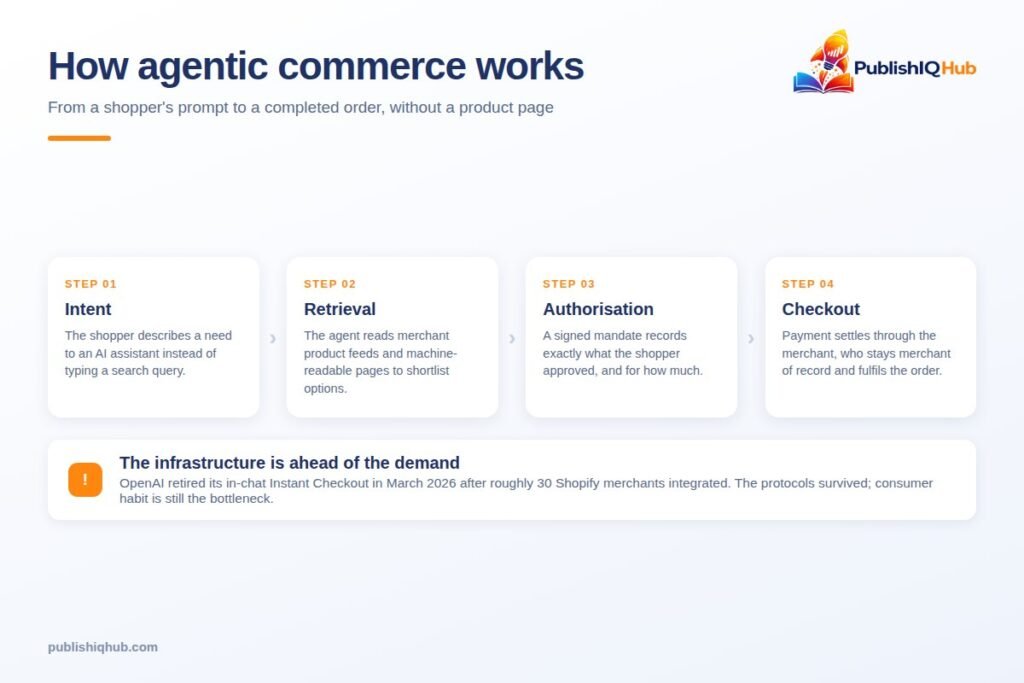
Agentic commerce is an AI agent completing the purchase on the shopper’s behalf, and in 2026 it proved that the plumbing is easier to build than the demand.
Here is the honest version, because most coverage of agentic commerce skips it. OpenAI and Stripe launched Instant Checkout inside ChatGPT in late 2025 on an open standard called the Agentic Commerce Protocol. It let people buy without leaving the chat. OpenAI retired the consumer feature on 5 March 2026 after roughly thirty Shopify merchants had integrated it. The protocol survived. The shopping experience it powered did not, and OpenAI pivoted towards retailer-operated ChatGPT Apps with partners like Walmart, Target and Instacart.
Meanwhile the payment side matured. Google’s Agent Payments Protocol was donated to the FIDO Alliance in April 2026 with contributions from sixty organisations, giving merchants a cryptographically verifiable record of what a user actually authorised.
So the infrastructure is real and the standards are consolidating. Consumer habit is the bottleneck. Anyone telling you agentic commerce will own a large share of transactions by 2027 is extrapolating from protocol announcements rather than from sales.
What to do about it: Treat agentic checkout as a 2027 readiness project, not a 2026 revenue line. Get your product feed clean first. That work pays off either way.
3. Product data is now a marketing asset, not a back-office file
Machine readability decides whether an AI can recommend you at all, and most retail sites are failing that test right now.
Adobe built a diagnostic that scores how much of a page a large language model can actually read. Cosmetics sites scored highest at 63% readable. Electronics managed 56%. Those were the leading categories. Meaning nearly half the content on the best-performing retail pages is invisible to the systems increasingly deciding what gets recommended.
Think about what that costs. A model asked to compare three moisturisers can only reason over the attributes it can parse. If your ingredient list is baked into a lifestyle image and your sizing guidance sits behind a tab that loads on click, you are not in the comparison.
Product feeds have quietly become the highest-leverage asset in the ecommerce stack. Complete titles, full descriptions, correct currency codes, real availability status, structured attributes. Boring work. Very high return.
What to do about it: Audit ten of your top product pages for what renders in plain HTML without JavaScript. Fix the gaps before touching anything else.
4. The click stops being the metric
Search now answers more questions than it refers, so measuring ecommerce visibility by sessions alone will understate your performance and mislead your budget.
SparkToro’s clickstream analysis found the share of Google searches generating at least one click fell 9.51 percentage points between 2024 and 2026, a 22.9% decline. Pew Research Center’s behavioural study of 68,879 real searches found that when an AI Overview is present, users click a traditional result only 8% of the time, against 15% when it is absent.
Ecommerce is less exposed than publishing here, because transactional queries still send clicks. Someone searching for a specific SKU in a specific size wants to buy it. But the research layer above that query, the “best running shoes for flat feet” stage, is being absorbed.
This is where Generative Engine Optimization earns its keep. The goal shifts from ranking to being cited. A brand mentioned inside an AI answer captures intent even when no session is recorded, and the teams still reporting purely on organic sessions will keep presenting declining charts for a business that is actually growing.
What to do about it: Add share-of-voice tracking in AI answers to your reporting alongside rankings. Run your top twenty commercial queries through ChatGPT, Gemini and Google AI Mode monthly and log which brands get named.
5. Retail media grows up and moves off-site
Retail media is becoming the third pillar of digital advertising, but the easy growth has ended and the money is concentrating.
WARC Media forecasts global retail media investment reaching $223.4 billion in 2027, about 15.2% of all worldwide advertising spend. Strip Amazon out and growth falls to 9.8%, the lowest annual rate since WARC began tracking the market. In some categories the channel already dominates. Retail media is expected to account for 55.8% of global media investment by alcoholic drinks brands in 2027.
The practical consequence for mid-sized ecommerce brands is uncomfortable, and it rarely appears in vendor decks. Marketplace ad costs keep climbing while organic marketplace visibility keeps shrinking. Selling through a marketplace increasingly means renting access to your own customers.
What to do about it: Calculate your true blended marketplace cost including ad spend, then compare it against your direct-to-consumer contribution margin. Many brands have not run that comparison in two years.
6. Quick commerce resets what “fast” means
Ten-minute delivery has stopped being a novelty in India and is now the benchmark against which all other ecommerce delivery promises get judged.
India’s quick commerce segment was worth $7-8 billion in FY25 and grew at a 110-130% CAGR between 2021 and 2025, according to IBEF. It is projected to reach $65-70 billion by 2030 and contribute nearly half of all incremental e-retail growth. Blinkit alone processed 900 million orders in FY26.
What makes this a global ecommerce trend rather than an Indian one is the expectation transfer. A shopper who gets shampoo in eight minutes does not mentally reset when ordering a kurta. Two-day delivery now reads as slow in categories where it was premium three years ago.
The economics remain brutal outside dense metros, and plenty of dark-store expansion will be written off. But the consumer expectation is permanent whether or not the current operators survive. This is also where omnichannel retail stops being a slide in a strategy deck and becomes an inventory problem, because a store network that can ship in an hour is worth more than a warehouse that ships in a day. Supply chains built for next-day are being re-planned around micro-fulfilment, and the same logic is pushing manufacturers to localise. Our breakdown of top AI manufacturing companies in the USA covers how that production layer is adapting.
What to do about it: Segment your catalogue by delivery urgency. Not every SKU needs speed, and paying for it uniformly destroys margin.
7. Ecommerce personalization moves from segments to sessions
Personalisation in 2027 means adapting within a single visit rather than assigning shoppers to a cohort built last quarter.
The old model was segment-based. Build audiences, assign rules, serve variants. It worked, modestly, and most ecommerce platforms still ship with it as the default. The new model uses what the shopper is doing right now, including the fact that an AI referral arrived with a specific stated intent already in hand.
Adobe’s data showed shoppers arriving from AI referrals spend 53% more time on retail sites and browse 23% more pages per visit. These are not casual browsers. They have been pre-qualified by a model that already understood their requirement, and treating them identically to someone landing from a display ad wastes the strongest signal you will get all session.
Where ecommerce personalization goes wrong is over-reach, and it goes wrong often. Shoppers notice when a site knows too much, and the creepiness threshold has dropped as AI anxiety has risen. Relevance is welcome. Surveillance is not, and the line between them is thinner than most personalisation vendors admit.
What to do about it: Build one different landing experience for AI-referred traffic. Lead with specifications and comparisons rather than brand storytelling.
8. Returns become a designed-for cost, not an accident
Roughly one in five online orders comes back, and in 2027 returns move from a logistics problem to a product and merchandising problem.
The NRF and Happy Returns put total US returns at $849.9 billion in 2025, with an estimated 19.3% of online sales sent back. Nine percent of all returns were fraudulent. Free returns matter to 82% of consumers when deciding where to buy, up from 76% the year before. Gen Z averaged 7.7 online returns in twelve months, more than any other generation.
Retailers have responded with automation. Eighty-five percent are deploying AI to detect and prevent return fraud.
The cheaper fix sits upstream. Most returns in apparel and footwear are sizing failures, and sizing failures are content failures. Better fit data, more honest photography and accurate measurement tables reduce returns more reliably than tightening the policy, which mostly just reduces conversion.
What to do about it: Pull your return reasons by SKU for the last six months. The top ten offenders usually share one fixable content problem.
9. Social commerce splits into discovery and checkout
Social platforms will keep driving product discovery, but the actual transaction is increasingly moving off-platform, and the two need separate strategies.
Social commerce is forecast to represent around 20% of global ecommerce sales by 2027 according to EMARKETER, though market sizing here varies so wildly between research houses that any single number deserves scepticism. Estimates for the 2025 market range from $1.48 trillion to $1.64 trillion depending on whether informal peer-to-peer selling is counted.
What is not in dispute is the behaviour. Discovery happens in the feed. Purchase happens wherever friction is lowest, which is sometimes in-app and sometimes not. Live commerce works brilliantly in China and Southeast Asia and has repeatedly underperformed in Western markets, and pretending otherwise has cost brands real money.
What to do about it: Measure social as an assisted-conversion channel, not a last-click one. Attribution set to last-click will tell you to cut the budget that is feeding your funnel.
10. Headless becomes a plumbing decision, not a replatform
Composable architecture has stopped being an all-or-nothing rebuild, and by 2027 most stores will run hybrid rather than fully headless setups.
The headless commerce pitch of 2022 was a full decoupling of front end from back end, sold to ecommerce teams as a competitive necessity. Expensive, slow, and frequently abandoned midway. What survived is more pragmatic. Keep the platform’s checkout. Decouple the catalogue and content layer. Expose clean APIs so that feeds, agents and marketplaces can all consume the same product truth without a human copying spreadsheets.
That last point is why this trend matters more now than it did. Agentic commerce and AI-readable product data both require a clean, queryable source of product information. Stores with that already have it are days away from being agent-ready. Stores without it are quarters away.
Most teams underestimate the engineering capacity this needs. If you are weighing build versus partner, our guide to IT outsourcing companies in India covers how mid-market brands are staffing this work.
What to do about it: Map every system that currently holds product data. If the answer is more than three, that is your 2027 project.
11. B2B ecommerce finally catches up
B2B buyers now expect consumer-grade self-serve purchasing, and the vendor shortlist is being formed before anyone contacts sales.
The most useful finding here comes from Bain’s research on AI search: 85% of B2B buyers purchase from their day-one vendor list, formed before any search takes place. When an AI assistant compiles that initial list, being absent from the model’s knowledge is not a ranking problem. It is a disqualification.
India’s B2B online marketplace opportunity alone is estimated at $200 billion by 2030, and B2B ecommerce trends increasingly mirror consumer ones: transparent pricing, real-time stock, self-serve reordering, account-specific catalogues.
The friction is internal. B2B pricing is often negotiated, contract-specific and politically sensitive, which makes publishing it uncomfortable. Firms that solve that discomfort get discovered. Firms that hide everything behind a contact form get summarised inaccurately by an AI, or not at all.
What to do about it: Publish at least indicative pricing bands. Models cannot recommend what they cannot quantify.
12. Conversational commerce becomes the conversion layer
Support and sales are merging, and the assistant answering a pre-purchase question is now doing the job a product page used to do.
Conversational commerce has had a long and mostly mediocre history in ecommerce. Early chatbots were deflection tools dressed up as service. What changed is capability: an assistant that can read the catalogue, check stock, understand a returns policy and compare two SKUs is genuinely useful rather than an obstacle between the shopper and a human.
The economics work when the assistant handles the repetitive eighty percent and escalates cleanly. Getting that escalation right is harder than the AI part, and teams that skip the human layer end up with worse CSAT than they started. Our overview of top Indian BPO companies covers how the hybrid model is typically staffed.
What to do about it: Log every question your assistant fails to answer for a month. That list is your product content roadmap.
Ecommerce 2025 vs 2027
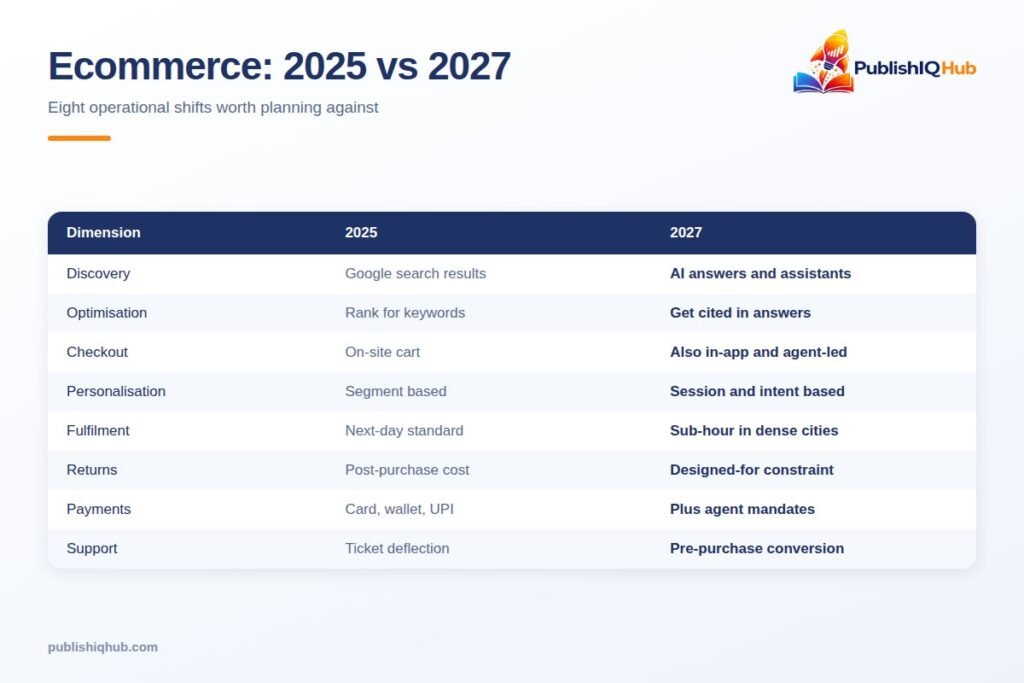
The table below compresses the twelve ecommerce trends above into the eight operational dimensions most likely to appear in a 2027 planning document.
| Dimension | 2025 | 2027 |
| Discovery | Google search results | AI answers, assistants and feeds |
| Search optimisation | Rank for keywords | Get cited in generated answers |
| Checkout | On-site cart and payment | On-site, in-app, and agent-initiated |
| Personalisation | Segment and cohort based | Session and intent based |
| Fulfilment | Next-day standard | Sub-hour in dense urban markets |
| Returns | Post-purchase cost centre | Designed-for product constraint |
| Payments | Card, wallet, UPI | Plus agent-authorised mandates |
| Support | Ticket deflection | Pre-purchase conversion layer |
How to prepare your ecommerce store for 2027
Isolate AI traffic in your ecommerce analytics. Separate channel group, separate conversion reporting, reviewed monthly.
2. Fix machine readability first. Plain-HTML specifications, structured data, no critical content locked behind JavaScript or images.
3. Clean the product feed. Complete titles, full descriptions, accurate stock, correct currency codes, real attributes.
4. Add answer-engine visibility to reporting. Track which brands get named for your top commercial queries.
5. Attack returns at the content layer. Return reasons by SKU, then fix sizing and imagery for the worst offenders.
6. Re-run your marketplace economics. Blended cost including ad spend versus direct contribution margin.
7. Consolidate product data to one source of truth. This is the prerequisite for everything agentic.
8. Segment delivery promises by category. Speed where it converts, standard where it does not.
9. Publish indicative pricing if you sell B2B. Invisible pricing means invisible brand in AI answers.
Where this leaves you
The temptation with a list like this is to treat every item as urgent. It is not. Most of the twelve ecommerce trends above depend on two unglamorous capabilities: product data a machine can read, and measurement that captures visibility rather than only sessions.
That is the least exciting summary of the future of ecommerce you will read this year. It is also the one that survives contact with a budget.
Get those two right and most of the rest becomes configuration work rather than an ecommerce replatform. Get them wrong and you will spend 2027 buying traffic to compensate for being unrecommendable.
The stores that do well will not be the ones that predicted this correctly. They will be the ones that made their catalogue legible to whatever comes next.
Frequently asked questions
What will ecommerce look like in 2027?
Larger but more intermediated. Global online sales are forecast at roughly $7.38 trillion, around 22.5% of all retail. The bigger change is structural: AI assistants sit between shoppers and stores, handling research and sometimes checkout, which reduces the number of shoppers who ever see a homepage.
Which ecommerce trends should I prepare for in 2027?
Prioritise three. Machine-readable product data, because it gates everything else. AI-answer visibility, because that is where discovery has moved. Returns reduction, because it is the fastest available margin recovery. The remaining ecommerce trends matter, but these three compound.
How do I optimise product pages for ChatGPT, Gemini and Google AI Overviews?
Put specifications in plain HTML text rather than images. Use Product and FAQ structured data. Answer comparison questions directly on the page. Keep pricing and availability accurate, since models penalise stale data. Adobe’s readability research suggests most retail pages currently fail on the first point alone.
Is social commerce still growing in 2027?
Yes, though slower than the early forecasts suggested and unevenly by region. Social commerce is projected at around a fifth of global ecommerce sales by 2027. Live shopping remains dominant in China and Southeast Asia and has consistently underperformed expectations in Western markets.
How will AI agents affect ecommerce conversion rates?
Favourably so far, which is the opposite of what most people expected when AI in ecommerce first became a boardroom topic. Adobe recorded AI-referred traffic converting 42% better than non-AI channels in March 2026, reversing a 38% deficit a year earlier. The caveat is volume: this traffic still represents a small share of total sessions for most stores.
What is the future of B2B ecommerce?
Self-serve, transparent and AI-mediated. Buyers build vendor shortlists before contacting sales, and 85% ultimately purchase from that initial list. B2B ecommerce trends now track consumer expectations closely, with pricing transparency the main sticking point.
Where can I find reliable ecommerce growth statistics?
Use primary forecasters rather than aggregator blogs. EMARKETER and Statista for market sizing, Adobe Analytics for channel behaviour, the NRF for returns, WARC for retail media, and IBEF for Indian ecommerce data. Cross-check any figure that appears without a named methodology, because numbers in this category get recycled and inflated quickly.
Should small stores invest in agentic commerce now?
Not directly. Instead invest in the prerequisites, which are clean product feeds and machine-readable pages. Those deliver value through AI search immediately and make agent integration straightforward when consumer adoption catches up with the infrastructure.