
Disclaimer: PublishIQHub and the author are not SEBI-registered investment advisors or research analysts. This article is published for educational and informational purposes only. Nothing in this blog should be construed as a recommendation to buy, sell, or hold any stock or security named here. Please consult a SEBI-registered financial advisor before making any investment decision.
Tata Group is India’s largest and most diversified business conglomerate, operating across more than ten sectors — including IT services, automobiles, steel, power, consumer products, hospitality, and financial services — through Tata Sons, its unlisted principal holding company. As of March 2025, the group counted 26 publicly listed companies with a combined market capitalisation above $328 billion, alongside a cluster of large but privately held businesses such as Air India and Tata Digital. For anyone researching Tata Group companies, its holding structure, or its overall net worth, this guide breaks down exactly how the empire is built — and why Tata Sons itself still isn’t on the stock exchange.
Quick Answer
- Founded: 1868, by Jamsetji Tata
- Holding company: Tata Sons Private Limited (unlisted)
- Listed entities: 26 companies on NSE/BSE (as of March 2025)
- Aggregate listed market cap: $328+ billion (~₹26–28 lakh crore), per Tata Group’s own investor disclosures
- Aggregate group revenue: $180+ billion (FY2024-25)
- Employees: 1 million+ across more than 100 countries
- Ownership: ~66% of Tata Sons’ equity is held by philanthropic Tata Trusts
- Current hot topic: Tata Sons’ possible mandatory stock exchange listing, tied to its RBI Upper Layer NBFC classification
A Quick History of How Tata Group Was Built
Tata Group traces back to 1868, when Jamsetji Tata started a trading firm in Bombay with a modest sum of capital. What followed was a steady, sector-by-sector expansion rather than a single big bet: Tata Steel in 1907, which went on to build India’s first integrated steel plant in Jamshedpur; Tata Power in the 1910s, bringing hydroelectricity to Bombay; Tata Motors in 1945, initially built around locomotive and engineering works before pivoting into commercial and passenger vehicles; and Tata Consultancy Services (TCS) in 1968, launched decades before “IT services” was even a recognisable industry category and now the group’s single largest value driver.
Each subsequent generation of Tata leadership — J.R.D. Tata, Ratan Tata, and current chairman N. Chandrasekaran — added new sectors rather than simply scaling existing ones: chemicals and consumer goods through the mid-20th century, telecom and financial services from the 1990s onward, and most recently semiconductors, electric vehicles, and aviation (via the 2022 acquisition of Air India). Over 150+ years, this expansion pattern has repeated in nearly every major sector of the Indian economy, which is exactly why “what businesses is Tata Group in” is such a broad question to answer today — and why the group is often used as a proxy for the health of Indian industry as a whole.
Types of Businesses Tata Group Is Into
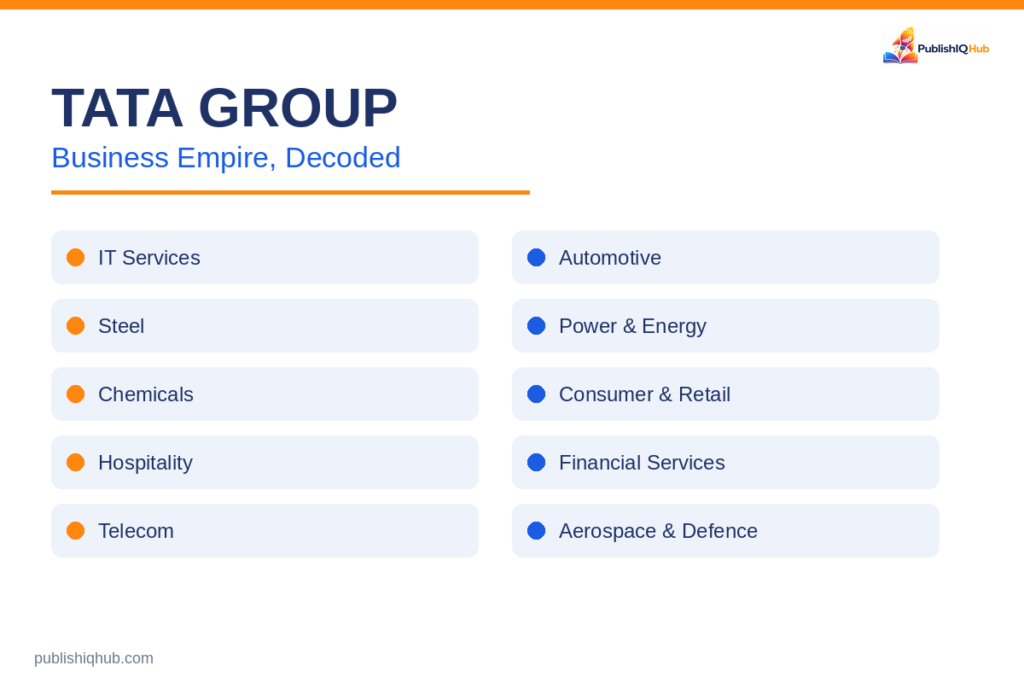
Tata Group’s diversification isn’t incidental — it’s structural. Each operating company runs independently under its own board, but all sit under the same holding umbrella. Here’s the sector-by-sector breakdown.
1. Information Technology
TCS (Tata Consultancy Services) is Tata Group’s crown jewel and one of the world’s largest IT services companies. It alone accounts for roughly a third of the group’s total listed market value and is consistently one of India’s most profitable listed companies. TCS’s scale also makes it a useful benchmark if you’re separately evaluating IT outsourcing companies in India or comparing it against top Indian BPO companies for enterprise services.
2. Automotive
Tata Motors covers passenger vehicles, commercial vehicles, and electric vehicles in India, plus Jaguar Land Rover (JLR) internationally — making it one of the few Indian auto manufacturers with a genuine global luxury and EV footprint.
3. Steel
Tata Steel is among the world’s most geographically diversified steel producers, with an annual production capacity of roughly 33 million tonnes spanning India, Europe, and Southeast Asia. It’s also one of the oldest businesses in the group, tracing back to the founding of the Jamshedpur plant in 1907, and remains a bellwether for how commodity cycles affect Tata Group’s overall earnings.
4. Power and Energy
Tata Power spans thermal, hydro, solar, and wind generation, along with power distribution to millions of consumers across multiple Indian states — positioning it as a key player in India’s renewable energy transition. The company has increasingly shifted capital toward solar manufacturing and rooftop solar installation as India’s clean-energy targets have tightened.
5. Chemicals
Tata Chemicals operates across basic chemicals, specialty products, and agri-inputs, with a global manufacturing base spanning India, the UK, the US, and Kenya. Soda ash — a core input for glass, detergents, and industrial processes — remains one of its largest product lines globally.
6. Consumer Products and Retail
Tata Consumer Products (tea, coffee, salt, and packaged foods) and Trent (Westside, Zudio) represent the group’s fast-growing consumer and retail bets. Trent in particular has been one of the best-performing Tata stocks of the last few years, driven by the rapid expansion of its value-fashion format Zudio across smaller Indian cities.
7. Hospitality and Travel
Indian Hotels Company (Taj Group) runs one of India’s most recognised luxury and business hotel portfolios, spanning the flagship Taj brand alongside Vivanta, SeleQtions, and Ginger hotels for different price segments, plus a legacy stake in AirAsia India and other travel-adjacent ventures.
8. Financial Services
Tata Capital, Tata AIA Life Insurance (a joint venture), and Tata Investment Corporation cover lending, insurance, and investment management — a segment that’s grown significantly as Tata Group has pushed deeper into BFSI (banking, financial services, and insurance) to capture a larger share of India’s financialisation trend. Tata Capital’s own 2025 stock market debut was itself one of the more closely watched Indian IPOs of the year.
9. Telecom and Media
Tata Communications and Tata Play (formerly Tata Sky) anchor the group’s telecom infrastructure and DTH/media distribution businesses, with Tata Communications increasingly positioning itself around enterprise data, cloud connectivity, and cybersecurity services rather than legacy telecom alone.
10. Aerospace and Defence
Tata Advanced Systems and the newer Tata Electronics (semiconductor assembly and Apple component manufacturing) represent Tata Group’s push into high-precision, strategically important manufacturing — an area that has drawn significant government and investor attention as India tries to build a domestic electronics and defence supply chain. This shift mirrors a broader trend also visible among top AI-driven manufacturing companies in the USA, where precision electronics and automation are increasingly intertwined.
11. Trading, Investment, and Aviation
Beyond operating businesses, the group also holds trading and investment arms, and re-entered full-scale aviation through Air India, acquired in 2022 and still privately held. The Air India acquisition, alongside the AirAsia India and Vistara mergers into it, made Tata Group the single largest private player in Indian commercial aviation almost overnight.
Tata Group vs. Other Indian Conglomerates
Investors researching Tata Group often land here while comparing it to Reliance Industries or the Adani Group — India’s other two dominant business houses. The comparison is useful, but the structures aren’t identical. Reliance is anchored heavily around a single listed parent entity with energy, retail, and telecom bundled inside it. Adani Group’s listed entities are more concentrated around infrastructure, energy, and logistics, with cross-holdings between group companies.
Tata Group, by contrast, runs 26 separately listed companies, each with its own board, its own balance sheet, and its own stock, all sitting under one unlisted holding company. That structure is a big part of why “Tata Group net worth” doesn’t collapse into one clean number the way it might for a more centralised conglomerate — you’re really looking at a portfolio of 26+ independent public companies plus a set of large private ones.
Tata Sons: The Holding Company at the Centre
Every business listed above ultimately sits under Tata Sons Private Limited, described by the group itself as the principal investment holding company and promoter of all Tata companies. Tata Sons doesn’t sell steel or write code — its role is to hold controlling or significant equity stakes across the group and set the long-term direction.
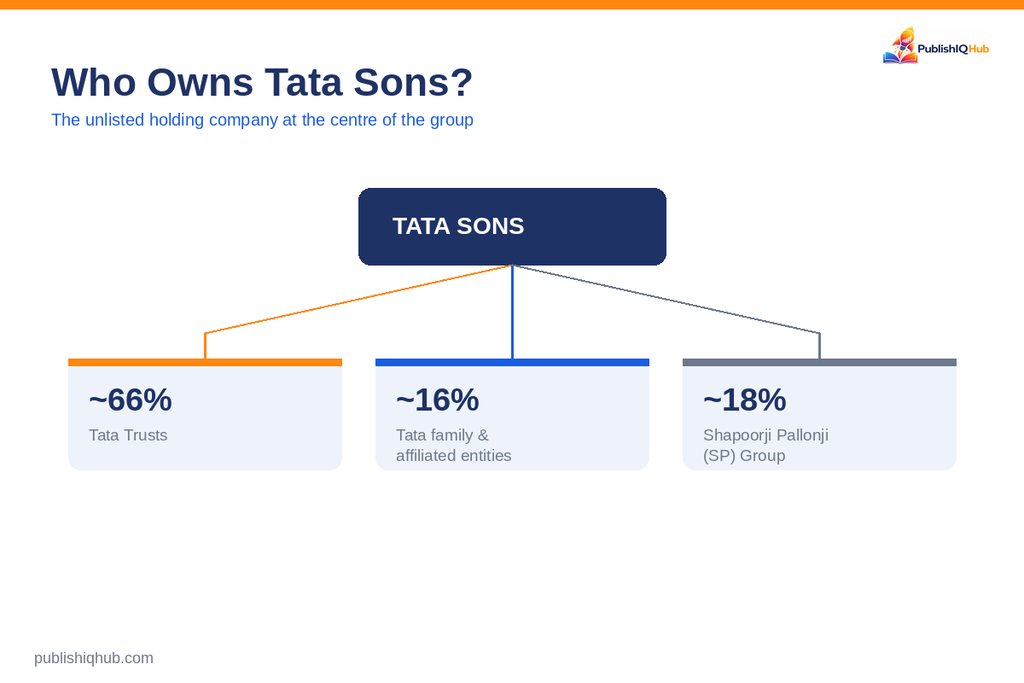
What makes Tata Sons structurally unusual among Indian conglomerates is its ownership: roughly 66% of its equity is held by Tata Trusts, a set of philanthropic trusts that channel dividend income into education, healthcare, livelihood, and arts initiatives. The remaining equity is split largely between the Tata family/Tata-affiliated entities and the Shapoorji Pallonji (SP) Group, which holds close to 18% and has periodically pushed for a Tata Sons listing to unlock the value of its stake.
This philanthropic ownership model is also why Tata Group is frequently described as having a mission beyond shareholder returns. A large share of the dividend income that flows up to Tata Sons from its operating companies is redirected into the Trusts’ social and developmental programs rather than distributed to a small group of private owners — a structure that’s fairly rare among conglomerates of this scale anywhere in the world, and one that continues to shape how the group frames its long-term strategy in investor communications.
Listed vs. Non-Listed Tata Group Entities
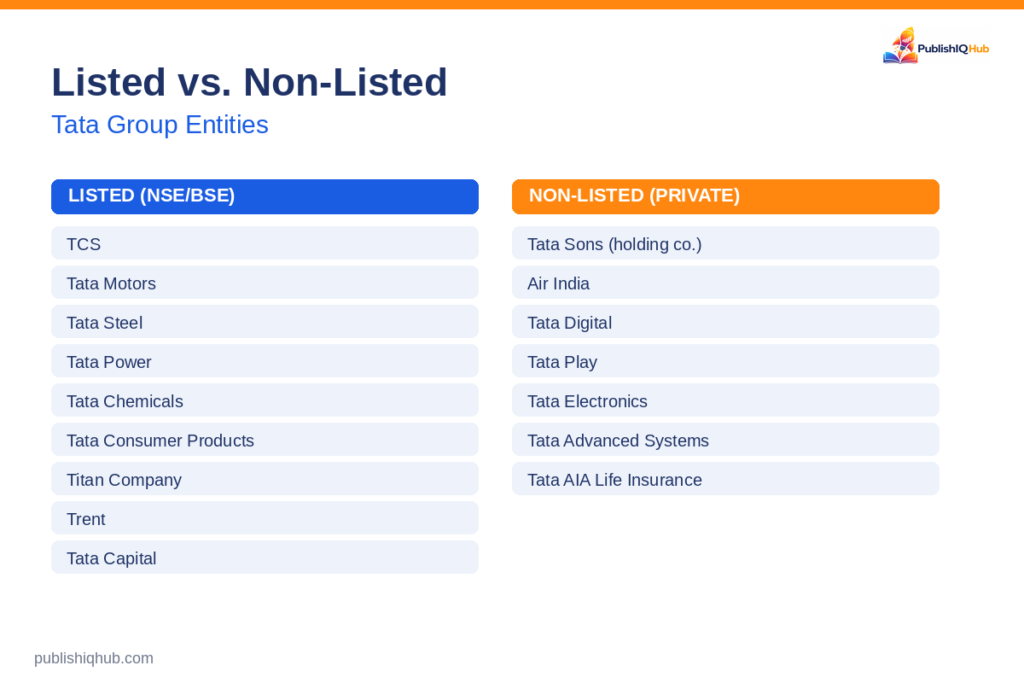
This is where a lot of investor confusion comes from — “Tata Group” and “Tata stocks” are not the same thing. You can only buy shares of the listed operating companies; Tata Sons itself, the entity that actually controls the group, is not on the stock exchange.
Listed Entities (tradable on NSE/BSE)
As of March 2025, Tata Group has 26 publicly listed companies. The major ones by sector include:
| Company | Sector |
| TCS | IT Services |
| Tata Motors | Automotive |
| Tata Steel | Steel |
| Tata Power | Power/Energy |
| Tata Chemicals | Chemicals |
| Tata Consumer Products | FMCG |
| Titan Company | Consumer/Jewellery |
| Trent | Retail |
| Indian Hotels Company | Hospitality |
| Voltas | Consumer Durables |
| Tata Communications | Telecom |
| Tata Investment Corporation | Investment |
| Tata Elxsi | Design/Tech |
| Tata Technologies | Engineering IT |
| Tata Capital | Financial Services |
Non-Listed (Private) Entities
These are large, often well-known Tata businesses that remain privately held under Tata Sons and don’t have publicly traded shares:
| Company | Sector |
| Tata Sons | Holding company |
| Air India | Aviation |
| Tata Digital | E-commerce/Digital |
| Tata Play | Media/DTH |
| Tata Electronics | Semiconductors/Manufacturing |
| Tata Advanced Systems | Aerospace/Defence |
| Tata AIA Life Insurance | Insurance (JV) |
The practical takeaway: retail investors can gain exposure to specific Tata sectors (IT via TCS, autos via Tata Motors, and so on), but there is currently no way to directly invest in Tata Sons itself, or in fast-growing private bets like Air India or Tata Electronics, through the stock market.
Tata Group Net Worth: What the Numbers Actually Say
There’s no single, official “Tata Group net worth” figure the way there is for an individual person’s net worth — and any blog claiming an exact number should be read with caution. What does exist:
- Aggregate listed market capitalisation: More than $328 billion as of March 31, 2025, across the 26 listed companies, according to Tata Group’s own investor page.
- Aggregate group revenue: More than $180 billion in FY2024-25, per the same source.
- Employee base: Over 1 million people across 100+ countries.
- Tata Sons’ standalone asset base: Roughly ₹2 lakh crore as of FY26, per Business Today’s coverage of RBI’s NBFC classification.
- Tata Sons’ investment portfolio value (unlisted): Estimated around ₹13.2 lakh crore as of April 2026 by ratings agency CRISIL, cited in Finnovate’s explainer on the Tata Sons IPO debate.
Any figure you see quoted as “Tata Group’s net worth” — whether ₹18 lakh crore, ₹26 lakh crore, or $140 billion+ — is an analyst estimate built by combining listed market cap with assumptions about the value of private holdings. Treat these as directional, not precise, since they move with daily stock prices and private valuation assumptions.
Why Tata Sons’ Listing Status Is Suddenly a Big Deal for Investors
This is the most actively searched Tata Group topic right now, and it directly affects the “listed vs. non-listed” question above.
Under RBI’s Non-Banking Financial Company (NBFC) rules, any NBFC classified in the “Upper Layer” category is required to list on a public stock exchange within a set window. Tata Sons was placed in this Upper Layer category back in 2022 because of the scale of its investment holdings. Tata Sons has since applied to deregister as a Core Investment Company (CIC) — a move that, if approved, could allow it to avoid the mandatory listing requirement altogether.
As of August 2026, RBI retained Tata Sons in its Upper Layer NBFC list for FY 2026-27, while explicitly clarifying that this inclusion is “without prejudice” to the still-pending deregistration application, according to Outlook Business and BusinessToday. In plain terms: the RBI hasn’t forced an IPO, but it also hasn’t let Tata Sons off the hook — the final outcome still hinges on regulatory approval.
For investors, this matters for a specific reason: if Tata Sons ever lists, it would be one of the largest and most closely watched IPOs in Indian corporate history, since it would put a public market price on the holding company that controls TCS, Tata Motors, Tata Steel, and dozens of other businesses — including the private ones investors currently can’t touch. Until that happens, exposure to “Tata Group” as a whole is only possible through its individual listed subsidiaries, each carrying its own separate valuation, risk profile, and sector cycle.
Tata Group by the Numbers: A Quick Recap
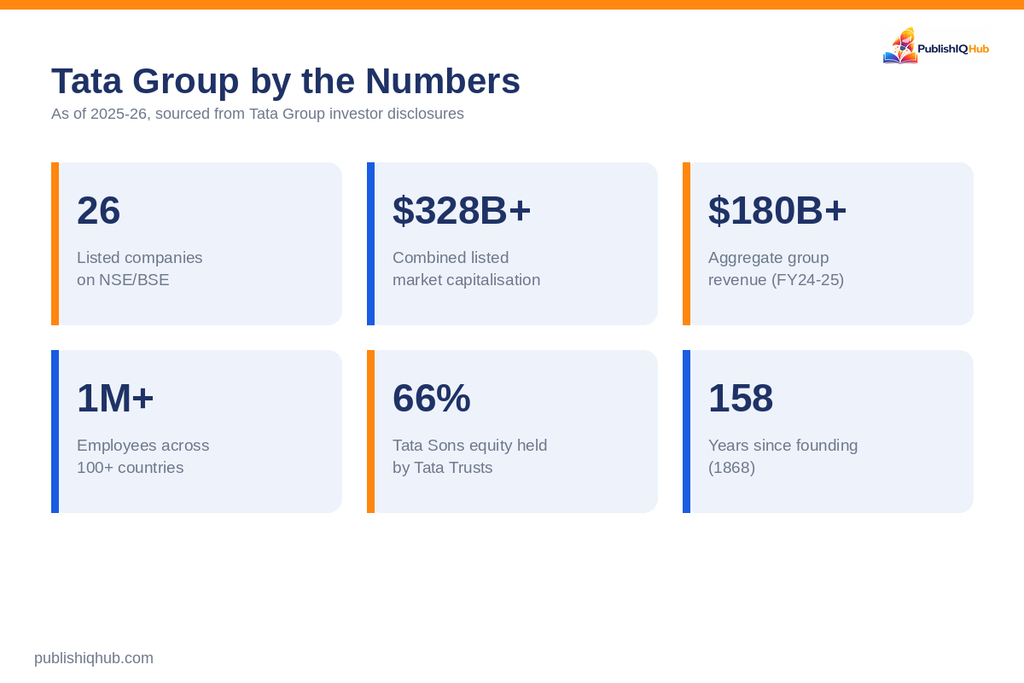
Infographic showing key Tata Group statistics: 26 listed companies, $328 billion combined market capitalisation, $180 billion revenue, 1 million employees, 66% Tata Trusts ownership, and 158 years since founding
- 26 listed companies as of March 2025, spanning more than ten distinct sectors
- $328+ billion in combined listed market capitalisation
- $180+ billion in aggregate annual group revenue
- 1 million+ employees across 100+ countries
- ~66% of Tata Sons owned by philanthropic Tata Trusts
- ~₹2 lakh crore in Tata Sons’ own standalone assets (FY26)
- Still zero direct way for retail investors to buy Tata Sons shares — for now
These figures move constantly as stock prices, exchange rates, and annual filings update, so always check the source directly (linked below) for the latest numbers before quoting them elsewhere.
What This Means for Retail Investors
- You’re investing in a company, not the conglomerate. Buying TCS or Tata Motors shares gives you exposure to that specific business — not a slice of Tata Sons, Air India, or Tata Digital.
- Diversification within Tata stocks is still sector diversification. TCS (IT), Tata Motors (auto/EV), Tata Power (energy), and Tata Consumer Products (FMCG) behave very differently as stocks, even under one parent brand.
- A future Tata Sons listing is a watch-item, not a certainty. Track RBI’s annual Upper Layer NBFC list and the status of the CIC deregistration application rather than acting on speculation.
- “Tata Group net worth” headlines are estimates. For investment decisions, look at each listed company’s own financials, valuation, and analyst coverage rather than group-level net worth claims.
- Dividend and governance track record matters more than brand name alone. Several Tata-listed companies have long dividend histories and relatively strong governance disclosure, which is often cited as a reason investors are willing to pay a premium valuation for the “Tata” name — but premium valuations also mean less margin for error if a specific company’s earnings disappoint.
- Sector rotation affects Tata stocks differently. IT services (TCS) tends to move with global technology spending and currency trends, autos (Tata Motors) with domestic demand and JLR’s international performance, and FMCG/retail (Tata Consumer, Trent) with consumption trends — so a “Tata portfolio” isn’t automatically a low-risk portfolio just because the names share a parent brand.
How to Track or Invest in Tata Group Stocks
Since there’s no single “Tata Group share” to buy, investors researching this space usually take one of two approaches:
- Pick specific listed companies by sector conviction — for example, TCS for IT services exposure, Tata Motors for auto/EV exposure, or Tata Power for renewable energy exposure — through a regular demat and trading account with any SEBI-registered broker.
- Use a themed basket or index product that tracks Tata Group listed companies collectively, where such products are available, to get broad-based exposure without picking individual names.
Either way, each listed Tata company should be evaluated on its own merits — sector outlook, valuation, debt levels, and earnings trend — rather than assumed to perform uniformly just because it carries the Tata name. A conglomerate-wide “halo effect” is a common behavioural bias, and it’s worth checking each company’s standalone fundamentals before deciding anything.
Frequently Asked Questions
What businesses is Tata Group into?
Tata Group operates across IT services, automobiles, steel, power and energy, chemicals, consumer products and retail, hospitality, financial services, telecom, aerospace and defence, and aviation, through a mix of listed and privately held companies under Tata Sons.
What is Tata Sons, and why is it different from other Tata companies?
Tata Sons is the principal investment holding company that owns controlling or significant stakes in all Tata companies. Unlike Tata Motors or TCS, Tata Sons itself is not listed on any stock exchange, and around 66% of its equity is held by the philanthropic Tata Trusts.
How many Tata Group companies are publicly listed?
As of March 2025, Tata Group had 26 publicly listed companies on the NSE and BSE, according to Tata Group’s own investor disclosures.
What are the major non-listed Tata Group companies?
The largest privately held Tata businesses include Tata Sons itself, Air India, Tata Digital, Tata Play, Tata Electronics, and Tata Advanced Systems.
What is Tata Group’s net worth?
There’s no single official figure. The group’s 26 listed companies had a combined market capitalisation above $328 billion as of March 2025, and analyst estimates that also factor in private holdings like Tata Sons’ investment portfolio range considerably higher — but these broader figures are estimates, not audited numbers.
Will Tata Sons ever be listed on the stock market?
It’s uncertain. Tata Sons was classified as an RBI Upper Layer NBFC in 2022, which would normally require a listing, but it has applied to deregister as a Core Investment Company. As of August 2026, RBI retained Tata Sons in the Upper Layer list for FY 2026-27 while the deregistration application remains under review.