
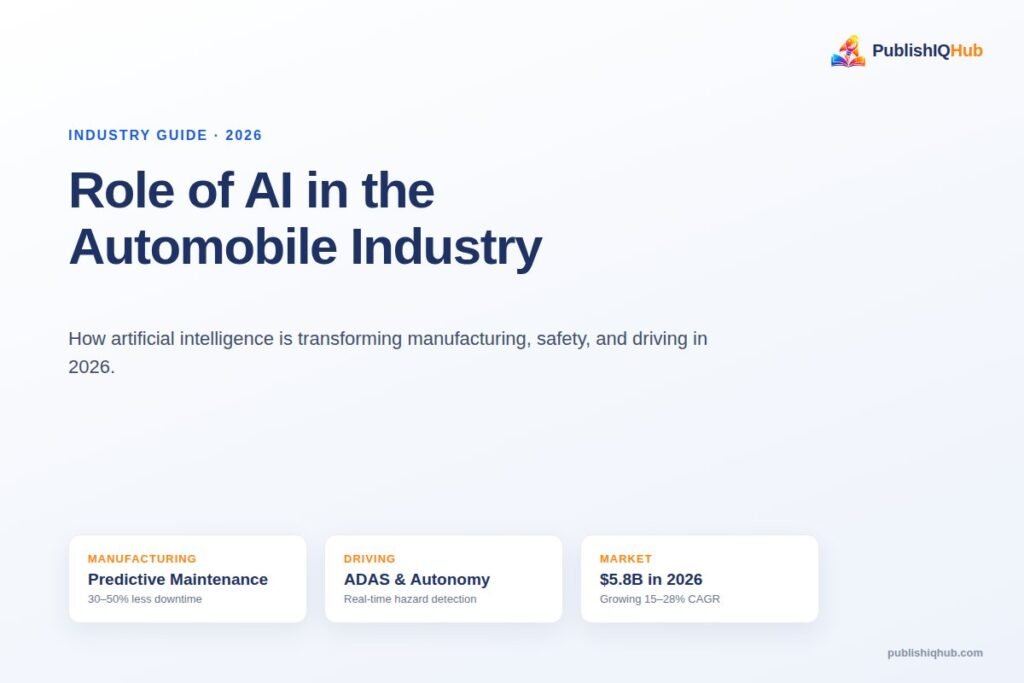
Quick answer: AI in the automobile industry is now embedded across the entire vehicle lifecycle — from AI-assisted design and predictive maintenance on the factory floor, to advanced driver-assistance systems (ADAS) and in-car voice assistants. The global automotive AI market was valued at roughly $4.71–5.12 billion in 2025 and is projected to grow at a compound annual rate above 15% through the early 2030s, according to Precedence Research and Congruence Market Insights, as automakers shift toward software-defined vehicles and AI-native development.
Why AI in the Automobile Industry Matters in 2026
The automotive sector has spent the past two years moving artificial intelligence out of the innovation lab and onto the production line. What used to be a handful of pilot projects — a predictive maintenance sensor here, a driver-monitoring camera there — has become a coordinated shift toward what McKinsey calls software-defined vehicles, where a car’s value increasingly comes from its software and AI capabilities rather than its hardware alone. This matters because AI in industries like automotive doesn’t just change one department; it touches design, manufacturing, supply chain, the in-car experience, and after-sales service simultaneously. If you’re tracking how AI is reshaping manufacturing more broadly, our roundup of top AI manufacturing companies in the USA covers many of the same players building tools for automotive plants.
The scale of investment behind this shift is significant. Precedence Research pegs the global automotive AI market at roughly $5.8 billion in 2026, climbing toward nearly $59 billion by 2035 — a compound annual growth rate above 28% for that period. Separate analysis from Congruence Market Insights, which frames the market slightly differently, still points to double-digit annual growth through the early 2030s. Whichever estimate you use, the direction is the same: AI in the automobile industry is one of the faster-growing corners of enterprise AI spending, and it’s being driven as much by manufacturing efficiency as by headline-grabbing autonomous driving demos.
How Is AI Used in the Automobile Industry?
AI in automobile applications generally fall into six categories: autonomous driving and driver assistance, manufacturing and production, supply chain and inventory management, the in-car digital experience, safety and testing, and marketing and customer service. Each is developing at a different pace, and understanding where a given automaker or supplier sits on that spectrum is a useful way to evaluate real progress versus marketing claims.
AI in Autonomous Driving and Advanced Driver-Assistance Systems (ADAS)
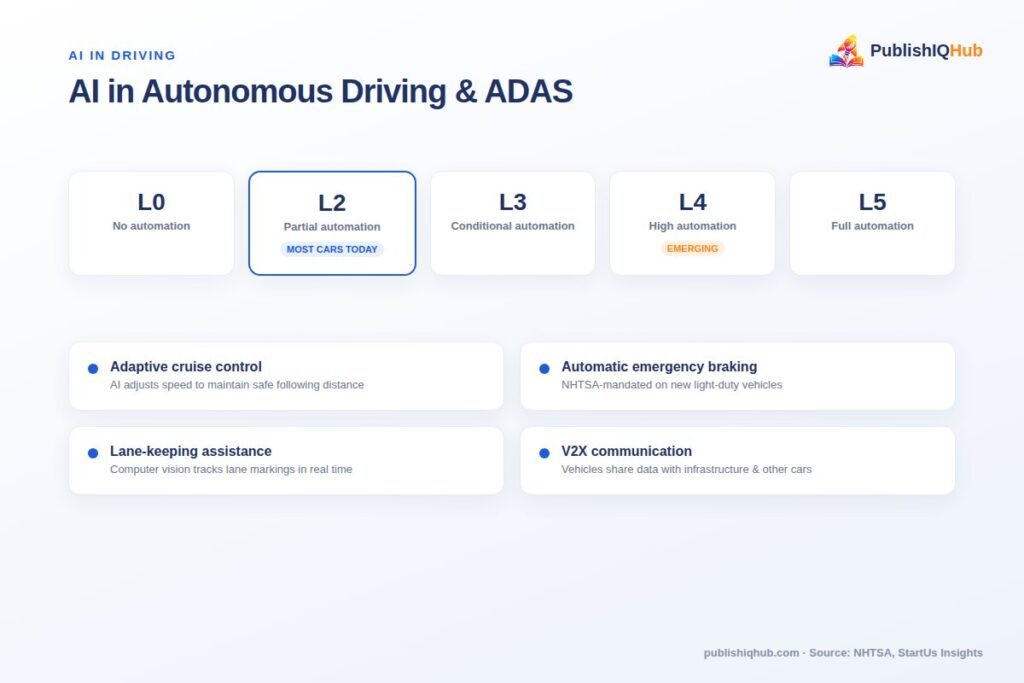
Autonomous driving is the most visible application of AI in the automobile industry, but it’s also the most technically demanding. Modern ADAS features — adaptive cruise control, lane-keeping assistance, automatic emergency braking, and collision avoidance — rely on machine learning models trained on enormous volumes of sensor and camera data to interpret road conditions in real time. StartUs Insights notes that the U.S. National Highway Traffic Safety Administration (NHTSA) has moved to require automatic emergency braking systems in all new light-duty vehicles, a regulatory push that’s accelerating AI adoption across mainstream (not just premium) vehicle lines.
Full self-driving remains a harder problem than driver-assistance features. As Perforce’s automotive engineering research points out, machine learning models can behave unpredictably under identical conditions — a challenge for functional safety standards like ISO 26262, which require deterministic, traceable behavior. That gap between what AI can demonstrate in a controlled pilot and what regulators require for full autonomy is one reason most production vehicles today sit at partial automation (SAE Level 2 or Level 2+) rather than true driverless operation, even as brands like BMW, Mercedes-Benz, and several Chinese OEMs continue investing heavily in end-to-end autonomous-driving architectures.
The validation problem compounds as vehicles take on more decision-making responsibility. A Level 2 system that simply warns a driver is far easier to certify than a Level 4 system that must handle an edge case autonomously, with no human fallback. That’s part of why the industry’s near-term autonomous-driving roadmap increasingly emphasizes highway-specific or geofenced deployments — environments with fewer variables — rather than promising unrestricted, anywhere driving on a fixed near-term timeline.
AI in Automotive Manufacturing and Production
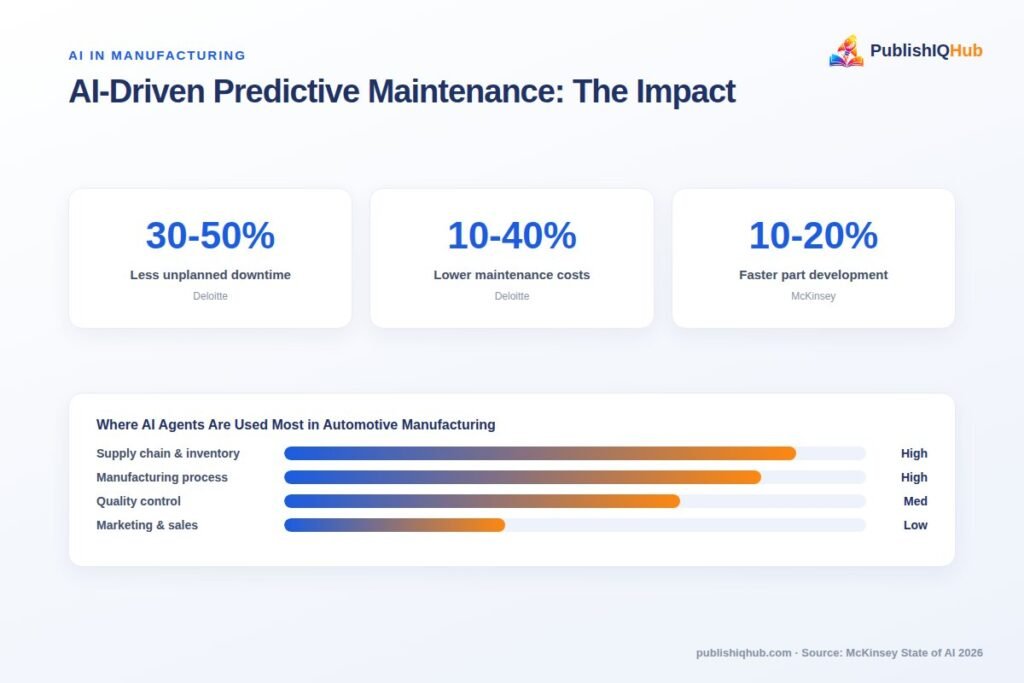
This is where AI in the automobile industry currently delivers the clearest, best-documented returns. Predictive maintenance — using AI models trained on vibration, temperature, and sensor data to flag equipment failures before they happen — has moved from pilot to standard practice on many production lines. Deloitte’s Industry 4.0 research found that predictive maintenance can reduce unplanned downtime by 30–50% and cut maintenance costs by 10–40%, and separate Deloitte case studies have documented deployments delivering a 50% reduction in repair cycle time and six-figure savings on individual production lines. That matters enormously in automotive specifically, where downtime tied to just-in-time production dependencies can exceed $2 million per hour, according to research compiled by SR Analytics.
Beyond maintenance, generative AI is being applied earlier in the process. McKinsey reports that generative AI implementation could reduce development timelines for automobile parts by 10–20%, compressing the design-to-production cycle. On the factory floor itself, AI-powered robotics and computer-vision quality control systems are increasingly handling defect detection that once relied on manual inspection, improving consistency while freeing up skilled workers for higher-value tasks. Companies exploring outsourced or specialized manufacturing partnerships to support this shift may also find our guide to IT outsourcing companies in India useful, since much of the software engineering behind these systems is built by distributed teams.
Digital twins — virtual, continuously updated replicas of a physical production line or vehicle system — are another area where AI is compounding existing gains. By simulating how a change to one part of a production line will ripple through the rest of the process, manufacturers can test adjustments virtually before committing capital to a physical retooling, cutting both cost and risk. Combined with predictive maintenance, digital twins are part of what industry researchers describe as the shift from reactive manufacturing, where problems are fixed after they occur, to anticipatory manufacturing, where AI systems are continuously forecasting where the next issue is likely to emerge.
AI in the Automotive Supply Chain and Inventory Management
Automotive supply chains are enormously complex — a single vehicle can involve thousands of parts from hundreds of suppliers — which makes them a natural fit for AI-driven forecasting and optimization. McKinsey’s 2026 State of AI survey found that companies in advanced manufacturing, including automotive, aerospace, and semiconductor firms, are most commonly using AI agents specifically in supply chain and inventory management and in core manufacturing processes, more so than in other business functions like marketing or HR. AI models can now forecast parts demand, flag potential supplier disruptions earlier, and optimize inventory levels to avoid both stockouts and excess carrying costs — a capability that became especially valuable after the semiconductor shortages of recent years exposed how fragile traditional supply chain planning can be. For an automaker managing relationships with hundreds of tier-1 and tier-2 suppliers across multiple countries, even a small improvement in forecast accuracy can translate into meaningfully lower carrying costs and fewer production-line stoppages caused by a single missing part.
AI in the In-Car Experience
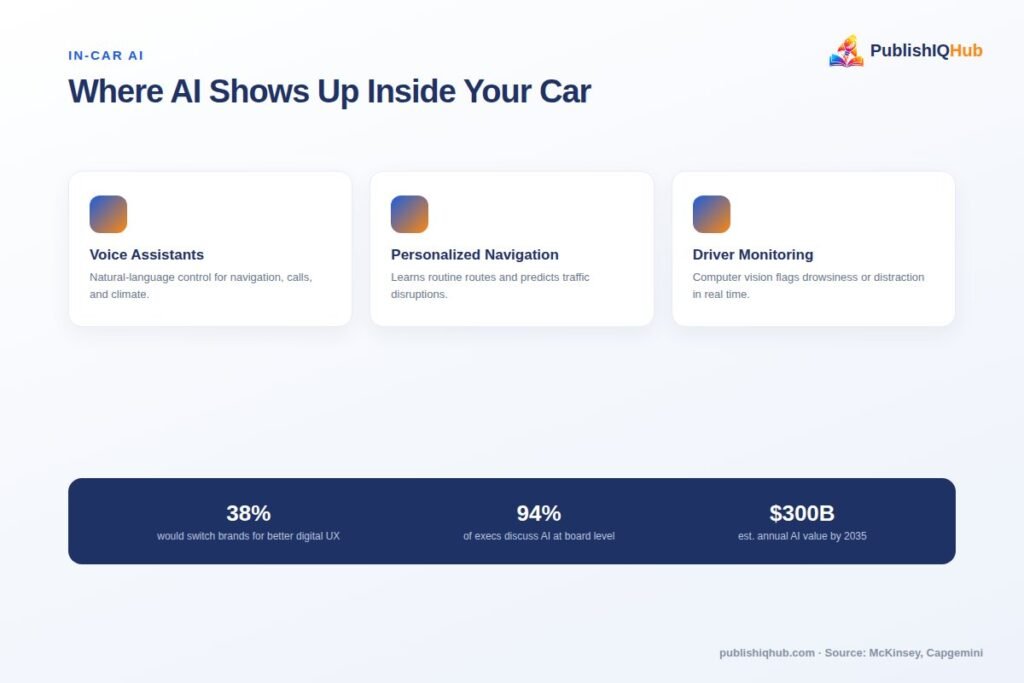
For most consumers, AI in automobile products shows up most directly through the in-car digital experience: voice assistants, personalized navigation, and predictive infotainment. McKinsey’s Mobility Consumer Pulse research found that AI-assisted vehicle research is rising sharply among car buyers, particularly Gen Z and millennials, who increasingly expect the same conversational, personalized experience from a car’s interface that they get from their phone. A related McKinsey consumer survey found that 38% of premium car owners in Germany said they’d consider switching brands if a competitor offered a better digital experience — a signal that in-car AI is becoming a genuine purchase driver, not just a nice-to-have feature.
Automakers are responding by embedding large language models directly into vehicle cockpits. At the 2026 Beijing Auto Show, Chinese OEMs including XPeng, NIO, and BYD showcased in-car large language models alongside advanced driver-assistance hardware, reflecting a broader industry shift where evaluation criteria are moving from brand heritage toward technological capability.
AI in Vehicle Safety and Testing
AI-powered safety systems extend well beyond crash avoidance. Driver-monitoring systems use computer vision to detect drowsiness or distraction, while AI-assisted crash testing and simulation allow engineers to model thousands of collision scenarios digitally before a physical prototype is ever built — shortening validation cycles and catching design flaws earlier. Vehicle-to-everything (V2X) communication, which lets cars share data with infrastructure and other vehicles in real time, is also expanding, according to StartUs Insights’ 2026 automotive trends research, further improving how AI systems anticipate hazards rather than just reacting to them.
That said, testing and validation remain genuine bottlenecks. Because AI models — particularly those built on machine learning rather than fixed rules — don’t always produce identical outputs under identical conditions, proving compliance with safety-critical standards is harder than validating traditional, deterministic software. This is a large part of why regulatory approval for higher levels of autonomy has moved more slowly than some early industry predictions suggested.
AI in Automotive Marketing, Sales, and Customer Service
AI’s role in the automobile industry isn’t limited to engineering. Dealerships and marketers are increasingly optimizing for AI-driven discovery, anticipating that shoppers will ask an AI assistant questions like “what’s the best cold air intake for my 2019 Mustang GT” rather than searching a retailer’s website directly, according to 2026 automotive aftermarket marketing research from Hedges & Company. On the customer service side, AI chatbots and virtual assistants are handling a growing share of routine service scheduling and parts inquiries, while dealerships use AI-driven personalization to match inventory recommendations to individual buyer preferences. Capgemini research cited in industry analysis found that 94% of automotive executives now discuss AI strategy at the board level, underscoring that this is a company-wide priority rather than a single department’s initiative — a trend also visible in adjacent outsourced-services sectors, as covered in our look at top Indian BPO companies supporting customer operations at scale.
Which Car Brands Use AI the Most in 2026?
Adoption isn’t even across the industry. Premium and EV-focused brands have generally moved fastest, partly because their platforms were designed around software and connectivity from the start rather than retrofitted onto legacy architectures. Tesla remains closely associated with AI-driven driver-assistance features, given how much of its public positioning centers on its Full Self-Driving software stack. BMW has partnered with Amazon Web Services to build new driver-assistance systems for its “Neue Klasse” vehicle line, while Mercedes-Benz, Hyundai, Kia, and Volkswagen have all rolled out AI-powered navigation and voice-control features across mainstream trims rather than reserving them for flagship models, according to reporting from Motor1.
Chinese automakers have been especially aggressive. At the 2026 Beijing Auto Show, XPeng, NIO, Xiaomi, and BYD all demonstrated in-car large language models alongside advanced autonomous-driving hardware, part of what industry analysts describe as a broader “AI Plus” national push that’s accelerating domestic chip investment alongside AI feature development. That pace of adoption is part of why technological capability — rather than brand heritage alone — is increasingly what separates premium vehicles from mainstream ones in consumer research.
For legacy automakers with larger existing vehicle fleets and manufacturing footprints, the AI rollout tends to be more gradual, often starting in manufacturing and quality control before extending to the vehicles themselves. That’s a sensible sequencing, too: the ROI on AI in production is already well documented, while consumer-facing AI features are still being refined based on real-world feedback.
Challenges and Risks of AI in the Automobile Industry
Adoption isn’t without friction. A few recurring challenges show up across nearly every serious industry analysis:
- Accountability in AI-driven incidents. When an AI-assisted or autonomous vehicle is involved in a collision, determining liability among the manufacturer, software provider, and driver raises legal and ethical questions that regulators are still working through.
- Data privacy. AI-enabled vehicles collect and process large volumes of sensitive data — location history, driving behavior, even biometric data from in-cabin monitoring — creating meaningful cybersecurity and privacy exposure if that data isn’t properly secured.
- Regulatory and compliance hurdles. Standards like ISO 26262 require full traceability into how safety-critical systems make decisions, but many AI models operate as effective black boxes, complicating certification for high-risk components.
- Workforce disruption. As AI-driven automation takes on more manufacturing and quality-control tasks, the shift is changing the skills the automotive workforce needs, potentially displacing some traditional roles while creating demand for new ones in AI oversight and systems integration.
- Cost and integration complexity. Retrofitting legacy manufacturing equipment and existing vehicle platforms with AI capabilities is not a small undertaking, particularly for suppliers operating on thinner margins than top-tier OEMs.
These challenges aren’t reasons to slow down AI adoption so much as reasons to sequence it carefully. Manufacturers that have seen the strongest returns tend to start with well-bounded, high-ROI applications like predictive maintenance — where the AI model’s job is narrow and its outputs are easy to validate against real outcomes — before expanding into higher-stakes, harder-to-certify areas like full autonomous driving.
What’s Next: AI Trends in the Automobile Industry
A few directions look set to define the next phase of AI in the automobile industry. Software-defined vehicles — where features can be added or upgraded via over-the-air updates rather than requiring new hardware — are becoming the default architecture for new platforms, according to Gartner and McKinsey analysis. On the factory floor, AI agents are increasingly taking on decision-making roles rather than just flagging issues for human review, optimizing production schedules and predicting supply disruptions with less manual oversight. Edge AI — running models directly on in-vehicle hardware rather than relying solely on cloud processing — is also expanding, helping automakers balance the latency, privacy, and cost trade-offs that come with an increasingly AI-dependent cockpit. McKinsey estimates AI could generate roughly $300 billion in annual value for the automotive industry by 2035, spanning everything from manufacturing efficiency to new AI-enabled revenue streams like subscription software features.
Final Thoughts
AI in the automobile industry has moved well past the pilot-project stage, particularly in manufacturing, where predictive maintenance and quality-control applications now have some of the clearest, best-documented ROI in the sector. Autonomous driving continues to advance but remains constrained by regulatory and safety-validation challenges that won’t disappear quickly. For automakers, suppliers, and the businesses that support them, the practical takeaway for 2026 is that AI is no longer a differentiator reserved for premium brands — it’s becoming table stakes across manufacturing, the in-car experience, and customer-facing operations alike. For more on how AI is reshaping specific sectors, explore PublishIQHub’s coverage of AI in Financial Services alongside our automotive and manufacturing research.
Frequently Asked Questions
1. AI in Automotive Marketing, Sales, and Customer Service
AI is used across autonomous driving and driver-assistance systems, manufacturing (especially predictive maintenance and quality control), supply chain forecasting, in-car voice assistants and personalization, safety testing and simulation, and customer-facing marketing and service tools.
2. What is the role of AI in autonomous vehicles?
AI processes real-time sensor and camera data to help vehicles interpret their surroundings, make driving decisions, and respond to hazards. Most production vehicles currently operate at partial automation levels, with full driverless operation still limited by regulatory, safety-validation, and technical challenges.
3. How does AI improve car manufacturing and quality control?
AI-powered computer vision systems can detect manufacturing defects more consistently than manual inspection, while predictive maintenance models flag equipment issues before they cause unplanned downtime — Deloitte research shows this can cut downtime by 30–50% and maintenance costs by 10–40%.
4. What is predictive maintenance in the automotive industry?
Predictive maintenance uses AI models trained on sensor data — vibration, temperature, and performance metrics — to forecast when manufacturing equipment or vehicle components are likely to fail, allowing repairs to happen on a planned schedule instead of after a breakdown.
5. How is AI changing automotive supply chains in 2026?
AI is being used to forecast parts demand, flag potential supplier disruptions earlier, and optimize inventory levels. McKinsey’s 2026 research found supply chain and inventory management is among the most common uses of AI agents in advanced manufacturing sectors like automotive.
6. Will AI replace jobs in the automotive industry?
AI is changing the skills the automotive workforce needs rather than eliminating the industry’s labor needs outright. Roles involving repetitive manual inspection or routine data analysis are most exposed to automation, while demand is growing for workers who can oversee, train, and maintain AI systems.
7. Which car brands use AI the most in 2026?
Tesla, BMW, Mercedes-Benz, and several Chinese automakers including XPeng, NIO, and BYD are among the brands most closely associated with visible AI features, from driver-assistance systems to in-car large language models. Adoption is generally faster among EV-focused and premium brands, though mainstream manufacturers are rolling out AI-powered navigation and voice features as well.
8. What’s the difference between AI in the automobile industry and traditional automotive software?
Traditional automotive software follows fixed, rule-based logic that behaves the same way every time. AI systems, particularly those built on machine learning, are trained on data and can adapt their outputs based on new inputs — which is what enables features like predictive maintenance and driver-assistance systems, but also what makes safety certification more complex.