
Disclaimer: PublishIQHub is not a SEBI-registered investment advisor or research analyst. This article is published for educational and informational purposes only. Nothing here is a recommendation to buy, sell, or hold any stock named below. Stock prices and returns change daily; past performance never guarantees future results. Please consult a SEBI-registered financial advisor and do your own research before making any investment decision.

Quick answer:
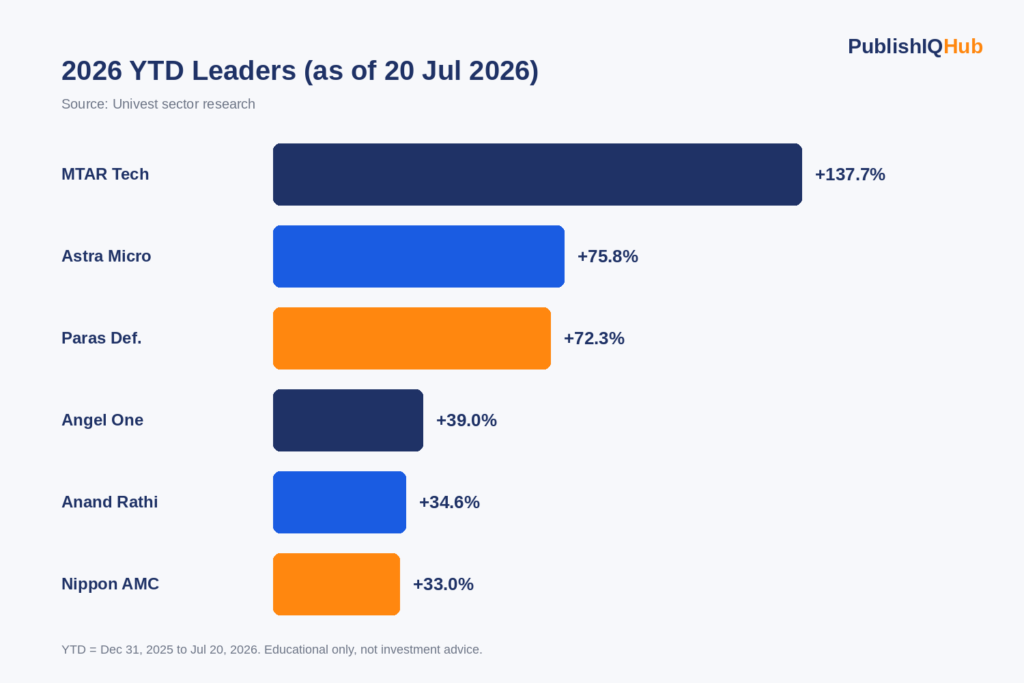
Among individually named stocks with verified year-to-date 2026 data, defence names MTAR Technologies (+137.7%), Astra Microwave Products (+75.8%), and Paras Defence (+72.3%) lead the best performing Indian stocks so far in 2026, followed by capital-markets names Angel One (+39.0%), Anand Rathi Wealth (+34.6%), and Nippon Life India Asset Management (+33.0%), all measured from December 31, 2025 to July 20, 2026. This guide breaks down where these numbers come from, which sectors are driving 2026’s gains, and how to research good performing stocks yourself instead of chasing a list.
Indian equity markets enter the second half of 2026 in a very different mood than they started the year. After a subdued 2025 in which the Nifty 50 and Sensex gained roughly 10.5% and 9.1% respectively — lagging emerging-market peers that rose 27-30% — brokerages turned more constructive on India for 2026, citing improving earnings, RBI rate cuts, and more reasonable valuations.
That backdrop has produced a wide spread of outcomes: some sectors are up double and triple digits, while several Nifty 50 heavyweights are flat or down for the year. This piece looks at the best performing stocks by verified 2026 return, the top performer share by sector, and how a retail investor can realistically use this kind of information.
How Has the Indian Market Performed in 2026 So Far?
A few index-level numbers to set the context, each independently sourced:
- The Nifty 50 hit an all-time closing high of 26,373.20 on January 5, 2026, before pulling back through the year; as of August 22, 2026, it trades around 24,252 (Kotak Neo).
- In calendar year 2025, the Nifty 50 and Sensex advanced about 10.5% and 9.1% respectively — their tenth straight year of annual gains, but a weak showing next to emerging and Asian markets, which rose 27-30% (Reuters, via MarketScreener).
- Brokerage estimates compiled by Reuters put the Nifty at roughly 28,992 by end-2026, an average of 11 forecasts implying about 12% upside from levels seen in late December 2025 (Reuters, via MarketScreener).
- July 2026 alone was a strong month for the broader market: the Nifty 50 closed the month at 24,383.60, up about 2%, with the Nifty IT index surging roughly 17% — its best monthly showing since July 2020 — as foreign investors returned after months of selling (Navia Monthly Wrap).
- Among Nifty 100 stocks in calendar year 2025, Shriram Finance topped the gainers’ list, up almost 62%, followed by TVS Motor, Maruti Suzuki, Eicher Motors, and Canara Bank, each up 50-55% (Business Standard).
That last point matters for anyone researching good performing stocks: a name that topped the charts in 2025 is not automatically this year’s top performer share, and 2026’s leaders have come from a different part of the market — largely mid-cap defence and capital-markets names — rather than the same large-cap winners. It’s also a reminder that “best performing” is always relative to a chosen index and time window: the Nifty 50, Nifty 100, Nifty 500, and individual sector indices like Nifty India Defence or Nifty Capital Markets each have different constituents, so a stock’s rank can shift simply by changing which universe you’re comparing it against.
The 10 Best Performing Indian Stocks in 2026 (By Verified Return)
The table below separates stocks by the specific period each return actually covers, since conflating a one-day move with a year-to-date figure is one of the most common ways “best performing stocks” lists mislead readers.
| Stock | Stock Sector | Return | Period | Source |
| MTAR Technologies | Defence | +137.7% | YTD 2026 (31 Dec ’25–20 Jul ’26) | Univest |
| Astra Microwave Products | Defence | +75.8% | YTD 2026 (31 Dec ’25–20 Jul ’26) | Univest |
| Shriram Finance | NBFC | +82.85% | Trailing 1 year (~Jul ’26) | TradingView |
| Paras Defence | Defence | +72.3% | YTD 2026 (31 Dec ’25–20 Jul ’26) | Univest |
| Angel One | Capital Markets | +39.0% | YTD 2026 (31 Dec ’25–20 Jul ’26) | Univest |
| Anand Rathi Wealth | Capital Markets | +34.6% | YTD 2026 (31 Dec ’25–20 Jul ’26) | Univest |
| Nippon Life India AMC | Asset Mgmt | +33.0% | YTD 2026 (31 Dec ’25–20 Jul ’26) | Univest |
| SBI | PSU Banking | +30.91% | Trailing 1 year | Kotak Neo (via Univest) |
| Hindalco Industries | Metals | Led daily gainers | Session-level, Aug ’26 | HDFCSky |
| HCL Technologies | IT Services | Nifty IT +~17% | Monthly/sector, Jul ’26 | Univest |
1. MTAR Technologies
Defence indigenisation has been the single strongest theme of 2026, and precision-engineering and electronics names have led the Nifty India Defence index. MTAR Technologies rose from a closing price of Rs 2,416.70 on December 31, 2025 to Rs 5,744.00 by July 20, 2026 — a gain of 137.7% — making it the best performing stock in this dataset by a wide margin, on continued government capital outlay toward domestic defence manufacturing.
Source: Univest — Nifty India Defence YTD leaders
2. Astra Microwave Products
Astra Microwave Products gained 75.8% over the same YTD window (December 31, 2025 to July 20, 2026), the second-strongest performer in the Nifty India Defence basket, benefiting from the same wave of defence-indigenisation order flow as MTAR Technologies.
Source: Univest — Nifty India Defence YTD leaders
3. Paras Defence
Paras Defence rounded out the defence trio with a 72.3% YTD gain through July 20, 2026, also riding continued government capital outlay toward domestic defence manufacturing and precision electronics.
Source: Univest — Nifty India Defence YTD leaders
4. Angel One
Rising retail participation and record trading volumes lifted capital-market infrastructure stocks through 2026. Angel One gained 39.0% on the back of strong growth in retail broking accounts, making it the top performer among Nifty Capital Markets names in this dataset.
Source: Univest — Nifty Capital Markets YTD leaders
5. Anand Rathi Wealth
Anand Rathi Wealth added 34.6% over the same YTD window, supported by robust wealth-management AUM growth and strong client additions.
Source: Univest — Nifty Capital Markets YTD leaders
6. Nippon Life India Asset Management
Nippon Life India Asset Management rose 33.0% YTD as mutual fund AUM and yields improved, rounding out the capital-markets trio of 2026 leaders.
Source: Univest — Nifty Capital Markets YTD leaders
7. Shriram Finance
Shriram Finance has been one of the most consistent performers across both the trailing-year and single-session data available — it topped the Nifty 100 gainers’ list for calendar 2025 at nearly 62%, and TradingView data shows it up 82.85% on a trailing one-year basis. It also regularly appears among Univest’s daily “stocks to buy today” picks through mid-2026, citing relative strength in the NBFC space.
Source: TradingView — Nifty 50 constituent data
8. State Bank of India
SBI stands out among PSU banks with a 30.91% one-year return, the strongest among large-cap banking names, while trading at a comparatively low P/E near 11.7 — a combination that has kept it a repeat entrant on daily Nifty 50 gainers’ lists through July and August 2026.
Source: Univest — best banking stocks 2026
9. Hindalco Industries
Hindalco led the Nifty 50 gainers on multiple sessions in August 2026, part of a broader 2026 rally in metals driven by tighter global supply and firm commodity prices. It doesn’t have a single clean YTD figure in the sources reviewed here, but its repeated session-topping performance makes it one of the more consistently mentioned metals names this year.
Source: HDFC Sky — Nifty gainers, Aug 12 2026
10. HCL Technologies
IT was the standout sector in July 2026, with the Nifty IT index surging about 17% — its best month since 2020 — after HCL Technologies alone won a $1.14 billion AI-led digital transformation deal that sent the stock up nearly 6% in a single session and helped power the sector-wide rebound.
Source: Navia Monthly Wrap, July 2026
What Does “Top Performer Share” Actually Mean?
The phrase gets used loosely, so it’s worth being precise. A top performer share is simply a stock whose price return over a stated period ranks near the top of its index, sector, or peer group — it’s a relative, time-bound label, not a permanent quality of the company. A stock can be a top performer share on a one-day basis (like Hindalco’s repeated session-topping moves in August 2026) while being a laggard on a five-year basis, and vice versa.
When you see the phrase in a headline, the first question worth asking is always: top performer over which window, and compared to which benchmark? The table earlier in this article deliberately separates YTD, one-year, and session-level “top performer” claims for exactly this reason — collapsing them into a single unqualified ranking is where most misleading stock lists go wrong.
Where This Data Comes From (and Why That Matters)
Every specific return figure in this article is attributed to a named source with a stated as-of date, for a simple reason: “best performing stocks” content is unusually prone to stale or unsourced numbers being copied from article to article without anyone checking whether the underlying period or price base still matches. A few methodology notes worth flagging:
- The defence and capital-markets YTD figures come from Univest, a SEBI-registered research analyst (Registration No. INH000012449), and are explicitly dated — calculated from the official closing prices of December 31, 2025 to the market price on July 20, 2026, using the NSE’s Nifty India Defence and Nifty Capital Markets index composition as of that date.
- Index-level figures (Nifty 50 levels, calendar-year returns) come from NSE-affiliated or brokerage-affiliated data providers — Kotak Neo, TradingView, and Reuters via MarketScreener — each independently checkable against the exchange’s own published data.
- Because index composition and prices move constantly, any of these figures can be different by the time you’re reading this. Treat every number here as a dated data point, not a live quote, and check the stock’s current price on the NSE, BSE, or your broker’s platform before drawing conclusions.
Risks Worth Keeping in Mind
A list of best performing stocks is, by definition, a look backward. A few risks that apply to every name discussed above, without exception:
- Momentum can reverse quickly. Several of 2026’s biggest gainers — particularly in the defence sector — are trading well above their 52-week lows, and a stock that has already tripled has less room for the same percentage gain to repeat.
- Concentration risk. Defence and capital-markets names that led 2026 gains are a small, thematically concentrated slice of the market; a policy shift, budget reallocation, or regulatory change specific to either sector could affect the whole group at once.
- Small and mid-cap volatility. Several of the top YTD performers, including the defence names, are mid-cap stocks with lower trading liquidity than Nifty 50 constituents, which can mean sharper price swings in both directions.
- Valuation catch-up risk. A stock re-rating on strong order-book growth can run ahead of the earnings actually being delivered; confirm that revenue and profit growth are keeping pace with the price move before treating a rally as durable.
None of the above is a reason to avoid research — it’s a reason to treat any “best performing stocks” list, including this one, as the start of due diligence rather than the end of it.
Which Sectors Are Driving 2026’s Gains?
Reading across all the sourced data above, three sector stories stand out for 2026:
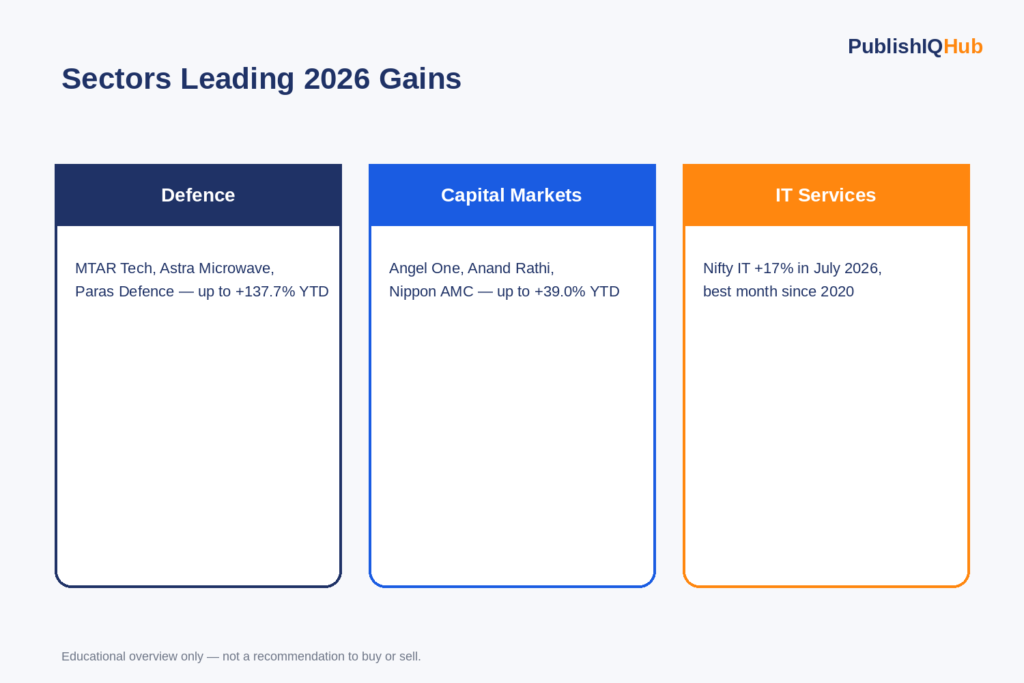
- Defence has been the year’s standout theme, with the Nifty India Defence index’s top constituents delivering triple-digit and near-triple-digit YTD gains, backed by record government defence capital allocation.
- Capital markets and wealth management benefited from rising retail participation in Indian equities, with broking, wealth-advisory, and asset-management names all posting strong double-digit YTD gains.
- IT services staged a sharp comeback in July 2026 after a rough start to the year, with the Nifty IT index’s 17% monthly surge reflecting both large AI-linked deal wins and the return of foreign institutional buying.
Understanding sector rotation like this is often more useful than memorizing a single top-10 list, since leadership can shift within a single quarter — the same Univest data shows IT was lagging for much of the first half before its July rebound.
For readers weighing where AI itself is creating investable trends across Indian finance, PublishIQHub’s coverage of how artificial intelligence in finance is redefining wealth and AI in financial services looks at the same theme from the technology-adoption side.
How to Research Best Performing Indian Stocks Yourself?
A “best performing stocks” list is a starting point for research, not a shopping list. A few practical steps before acting on any name:
- Separate the timeframe. A stock’s one-day, one-month, one-year, and YTD returns tell very different stories — check which period a headline number actually covers, as the table above illustrates.
- Check the valuation, not just the chart. A stock that has already tripled may be pricing in years of future growth; compare its P/E and growth rate against sector peers before assuming the rally continues.
- Read the order book and earnings, not just the price. For defence and capital-markets names in particular, the 2026 rally has been driven by verifiable order wins and AUM growth — confirm those fundamentals are still intact in the latest quarterly results.
- Use an official broker or exchange platform for live data. Prices quoted in any article, including this one, are a snapshot in time; verify current levels on the NSE, BSE, or your broker’s app before transacting.
If you’re setting up an account to track or trade Indian equities, PublishIQHub’s guide to the top stock brokers in India compares pricing, platforms, and account-opening process across the major options.
It’s also worth understanding who is actually allowed to give you personalized stock advice in India. Under SEBI regulations, only a SEBI-registered Investment Adviser (RIA) or Research Analyst (RA) is permitted to recommend specific securities tailored to your financial situation. Content like this article — general, educational, and not tailored to any individual’s finances — falls outside that category by design.
If a source is giving you specific buy/sell calls with price targets, check whether they disclose a SEBI registration number; several of the research sources cited in the table above (Univest) do carry SEBI Research Analyst registration, which is a useful baseline check before trusting any stock-specific recommendation, whether it comes from a blog, a broker, or a social media account.
Trending Questions About Best Performing Indian Stocks
Which Indian stocks gave the highest returns in 2026 so far?
Among individually verified names, MTAR Technologies, Astra Microwave Products, and Paras Defence — all defence stocks — posted the largest year-to-date gains through July 20, 2026, each described above with sourcing.
What is the best performing Nifty 50 stock this year?
Within the Nifty 50 itself (a narrower, large-cap-only universe than the Nifty 500 or sector indices used above), Shriram Finance and Hindalco Industries have been repeatedly cited as trailing 1-year leaders, though neither figure is a clean 2026 calendar-year return in the sources reviewed here.
How do I find good performing stocks before investing, not after?
Screen for sectors with policy tailwinds or earnings momentum before individual names run up, track order-book and AUM growth for early confirmation, and compare a stock’s valuation against its own history and sector peers rather than only looking at the price chart.
Are last year’s best performing stocks likely to repeat in 2026?
Not necessarily. Shriram Finance, Maruti Suzuki, TVS Motor, Eicher Motors, and Canara Bank led CY2025 gains, but 2026’s biggest movers have come mostly from a different part of the market — mid-cap defence and capital-markets stocks — showing how quickly sector leadership can rotate.
Is investing in top performing shares from a list a good strategy?
Buying a stock purely because it appears on a “best performing” list carries real risk, since strong past returns don’t guarantee future performance and momentum can reverse sharply. This article is educational, not a recommendation — consult a SEBI-registered advisor before acting on any of the names discussed.
What’s the difference between YTD return and 1-year return for Indian stocks?
YTD (year-to-date) measures the change from a fixed start date — usually December 31 of the prior year — to today. A 1-year or “trailing” return measures the change over the past 365 days regardless of calendar boundaries, so the two figures for the same stock can differ meaningfully, as seen with Shriram Finance in the table above.
Why did defence stocks outperform every other Indian sector in 2026?
Record government capital allocation toward defence indigenisation, expanding order books at precision-engineering and electronics manufacturers, and continued “Make in India” procurement mandates combined to push Nifty India Defence constituents to the top of the 2026 leaderboard, well ahead of broader large-cap indices.
Do multibagger stocks from earlier years keep delivering multibagger returns?
Not reliably. A multibagger is typically defined as a stock that has more than doubled (100%+ return) over a defined period; several 2026 leaders like MTAR Technologies met that bar on a YTD basis, but sustaining that pace year after year is rare, and past multibagger status is not a predictor of a repeat performance.
This article does not constitute investment, tax, or legal advice. PublishIQHub is not a SEBI-registered investment advisor or research analyst, and nothing in this piece should be read as encouragement to buy or sell any of the stocks named. All figures cited are sourced and dated as noted; verify current prices before making any decision.