
Key Takeaways
- Data enrichment companies fill the gaps in your CRM — adding, correcting, and refreshing contact, firmographic, and intent data your team can’t maintain manually.
- The market splits into three buying categories: self-serve tools, data vendors (APIs and datasets), and managed enrichment services. Most buyers need a mix, not one.
- B2B data decays at roughly 22.5% a year, so enrichment is a recurring discipline, not a one-time cleanup.
- Expect single-vendor match rates of 30–60%; layering sources (“waterfall enrichment”) pushes coverage to 80–95%.
- The 15 companies below span all three categories — including platforms like ZoomInfo and Clay, data vendors like Dun & Bradstreet, and managed service providers like Datamatics Business Solutions.
A quarter of the records in your CRM will be wrong by this time next year.
Not because anyone made a mistake. Because people change jobs, companies merge, phone numbers die, and email domains vanish. B2B contact data decays at roughly 2.1% per month — about 22.5% annually, and that’s the conservative estimate. Some datasets rot far faster.
That decay has a price tag. Gartner puts the average cost of poor data quality at $12.9 million per organisation per year — bounced outreach, misrouted leads, forecasts built on ghosts. Data enrichment companies exist to stop that bleed. The catch? The category is crowded, the vendors look interchangeable on their websites, and the wrong pick wastes a year of budget.
This guide sorts the market into something usable: what these companies actually sell, the 15 names worth evaluating, a comparison block to speed up shortlisting, six questions that separate strong data enrichment vendors from weak ones, and the red flags that should end a demo early.
What Do Data Enrichment Companies Actually Do?
Data enrichment companies enhance your existing customer and prospect records by appending missing information, correcting outdated fields, and verifying what’s already there. Feed them a list of emails or company domains; get back job titles, direct dials, company size, revenue, tech stack, funding events, buying intent — whatever your use case demands.
Under the hood, that breaks into four jobs:
Appending. Adding fields you don’t have — a mobile number for a contact, an industry code for an account.
Cleansing. Fixing what’s wrong — standardizing formats, merging duplicates, flagging dead emails.
Verifying. Confirming what’s right — email deliverability checks, phone validation, company status.
Refreshing. Doing all of the above continuously, because a record enriched in January is already decaying by March.
The demand behind this is not slowing down. The global data enrichment solutions market was valued at $2.37 billion in 2023 and is projected to grow at 10.1% annually through 2030, fueled by AI adoption — models trained on stale data produce confidently wrong outputs, which has turned data quality from a hygiene task into an AI prerequisite.
Tools, Vendors, or Services? Know What You’re Buying First
Here’s the mistake most first-time buyers make: comparing a self-serve tool against a managed service provider as if they’re the same product. They’re not, and the comparison produces nonsense.
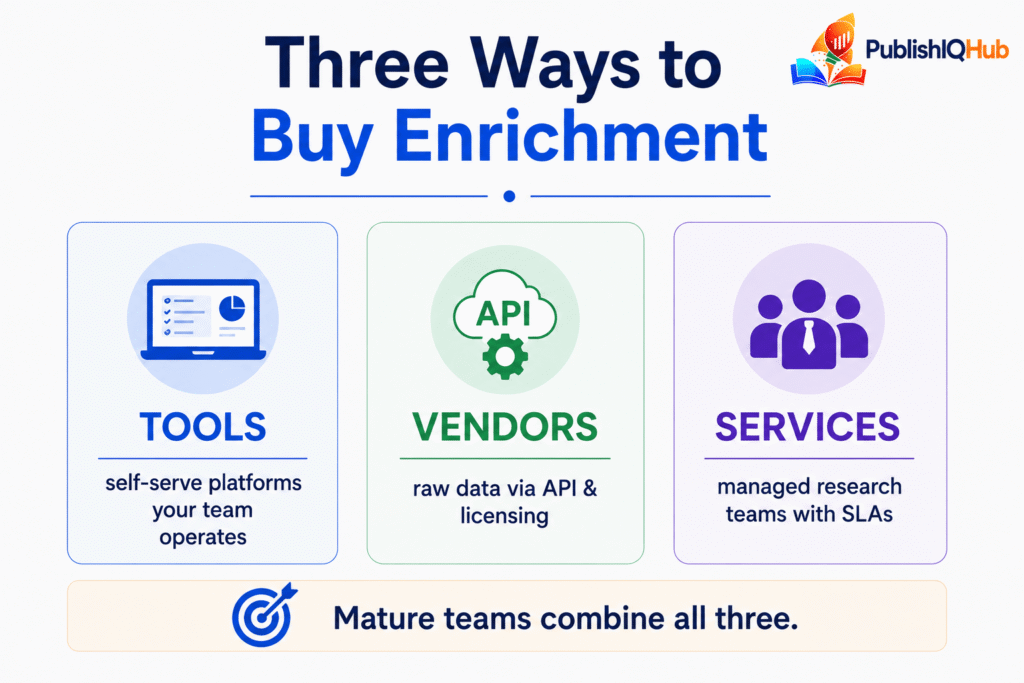
The market splits three ways:
Data enrichment tools are self-serve platforms your sales and ops teams operate directly — browser extensions, CRM plugins, workflow builders. You do the work; the tool supplies the data and automation. Best for teams with RevOps capacity and ongoing, high-volume needs.
Data enrichment vendors sell the data itself — via APIs, flat-file licensing, or native integrations. You bring the engineering; they bring coverage and accuracy. Best for product teams embedding enrichment into an application, or ops teams building custom pipelines.
Data enrichment services are managed providers: human researchers plus technology, working your database as an outsourced function. You define the spec; they deliver enriched, verified records against SLAs. Best for complex, messy, or compliance-sensitive projects where accuracy matters more than instant self-service — and for teams that simply don’t have the bandwidth.
Most mature revenue teams end up with a stack: a tool for daily prospecting, a vendor API for product workflows, and a services partner for periodic deep-cleans or specialized research. Budget accordingly.
The 15 Data Enrichment Companies to Know in 2026
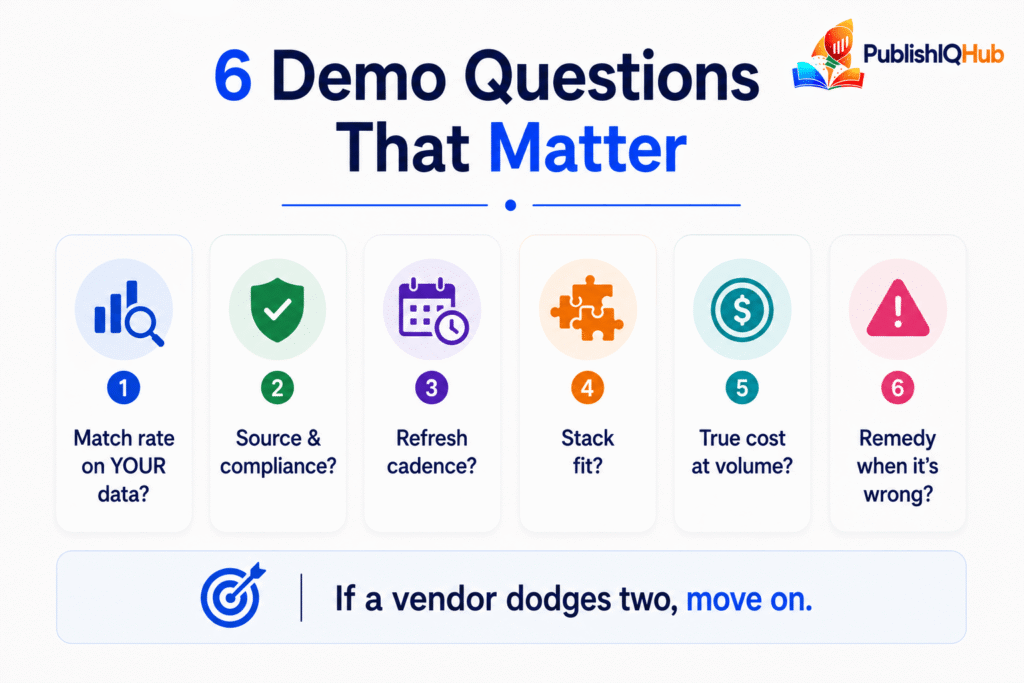
Grouped by category, because that’s how you should be shortlisting.
Sales Intelligence Platforms & Tools
1. ZoomInfo. The heavyweight. Massive B2B contact and company database, intent signals, workflow automation, and deep CRM integrations. Premium pricing to match. The default consideration for mid-market and enterprise sales orgs in North America.
2. Apollo.io. Database plus engagement platform in one — prospecting, enrichment, sequencing, and dialing under a single subscription. Aggressive pricing has made it the volume favorite for startups and SMB sales teams.
3. Cognism. Built for compliance-conscious teams. Phone-verified mobile numbers, strong European coverage, and GDPR-first data practices. The go-to when EMEA markets are in your territory plan.
4. Clay. The workflow layer. Clay doesn’t just supply data — it orchestrates 100+ data sources in waterfall sequences, enriching each record from whichever provider has the answer. Why does that matter? Because a single enrichment vendor typically matches only 30–60% of records, while waterfall approaches push match rates to 80–95%. Loved by technical GTM teams; overkill for simple use cases.
5. Lusha. Simplicity as a feature. Browser extension, clean interface, quick time-to-value for contact-level enrichment. A pragmatic pick for small teams that want results without an implementation project.
Data Vendors & APIs
6. Dun & Bradstreet. The firmographic authority. D-U-N-S numbers, corporate hierarchies, credit and risk signals — the backbone data layer for enterprise master data management and finance-adjacent use cases.
7. People Data Labs. Developer-first. Clean APIs and licensable datasets covering person and company profiles at massive scale. The choice when enrichment lives inside your product rather than your CRM.
8. Clearbit (HubSpot Breeze Intelligence). The pioneer of real-time API enrichment, now folded into HubSpot’s platform. Seamless if you live in HubSpot; a consideration point if you don’t.
9. Experian. Consumer and business data at bureau grade. Strong in identity, credit, and demographic enrichment for B2C marketing, financial services, and risk applications.
10. Melissa. The verification specialist. Address, email, phone, and identity validation across 240+ countries. Less flashy than sales-intelligence brands, indispensable for operations that ship products or verify customers.
Managed Services & Identity Providers
11. Datamatics Business Solutions. A managed data enrichment services provider combining trained research teams with automation — custom B2B contact building, database cleansing, verification, and ongoing enrichment delivered against defined quality SLAs. Where tools return whatever their database holds, a research-driven service like Datamatics fills the records tools can’t match: niche industries, hard-to-find titles, and compliance-sensitive datasets that need human validation. A strong fit for enterprises with messy, high-stakes databases and teams that want enrichment handled end to end.
12. LiveRamp. Identity resolution at enterprise scale. Connects fragmented customer data across platforms and walled gardens — the enrichment layer for advertising and CDP ecosystems rather than sales prospecting.
13. Acxiom. One of the original consumer data companies. Deep demographic, behavioral, and lifestyle datasets powering audience enrichment for large-scale marketing programs.
14. FullContact. Consumer identity resolution with a privacy-forward posture. Turns fragmented identifiers into unified person profiles — useful for media, marketing, and customer-experience teams.
15. Demandbase. Account intelligence for ABM. Enriches accounts with intent, technographic, and engagement signals, then activates them in advertising and sales plays. Best for teams running account-based programs rather than volume prospecting.
Comparison Block: 15 Data Enrichment Companies at a Glance
| Company | Category | Known For | Best Fit |
| ZoomInfo | Platform/Tool | Largest B2B database + intent | Mid-market & enterprise sales orgs |
| Apollo.io | Platform/Tool | Data + engagement, low cost | Startups & SMB sales teams |
| Cognism | Platform/Tool | GDPR-first, verified mobiles | EMEA-focused revenue teams |
| Clay | Platform/Tool | Waterfall enrichment workflows | Technical GTM & RevOps teams |
| Lusha | Platform/Tool | Fast, simple contact data | Small teams, quick adoption |
| Dun & Bradstreet | Data Vendor | Firmographics & hierarchies | Enterprise MDM, finance, risk |
| People Data Labs | Data Vendor | Developer APIs & datasets | Product-embedded enrichment |
| Clearbit (Breeze) | Data Vendor | Real-time API, HubSpot-native | HubSpot-centric stacks |
| Experian | Data Vendor | Bureau-grade consumer data | B2C marketing, fintech, risk |
| Melissa | Data Vendor | Global address/ID verification | Ops, e-commerce, compliance |
| Datamatics Business Solutions | Managed Service | Research-driven custom enrichment | Enterprises with complex databases |
| LiveRamp | Identity/Service | Cross-platform identity resolution | AdTech & CDP ecosystems |
| Acxiom | Identity/Service | Consumer audience data | Large-scale marketing programs |
| FullContact | Identity/Service | Privacy-safe person resolution | Media & CX teams |
| Demandbase | Identity/Service | Account intelligence & intent | ABM-driven organizations |
Six Questions That Separate Good Data Enrichment Vendors From Bad Ones
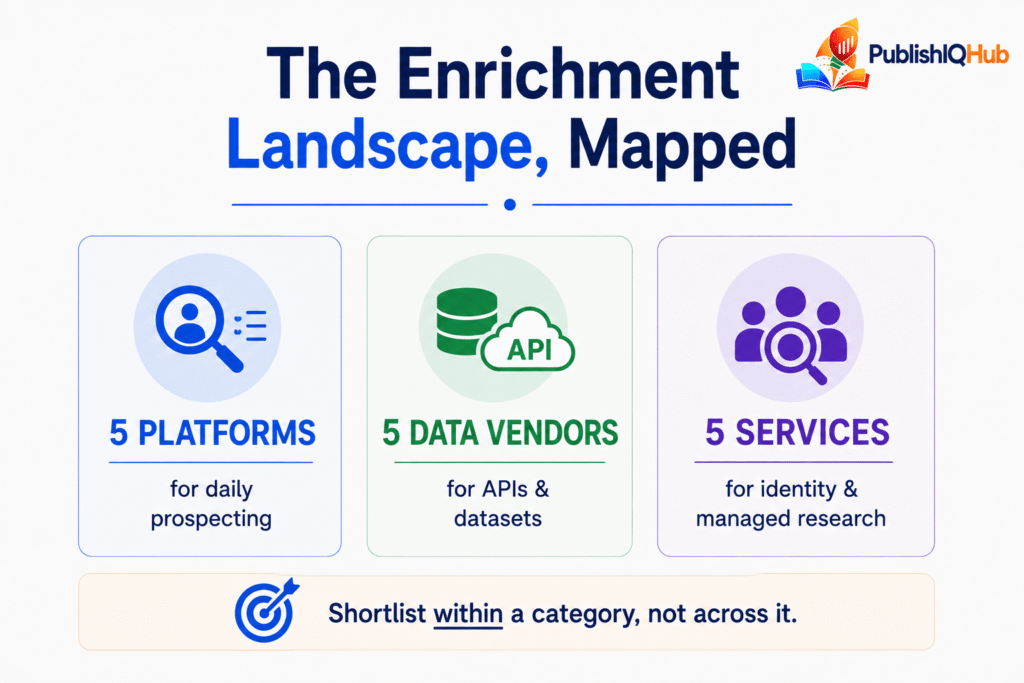
Skip the feature checklists. These six questions surface the differences that matter — ask them in every demo.
1. “What’s your match rate on OUR data?” Not their claimed coverage — their performance on a sample of your actual records. Any serious vendor will run a free match test on 500–1,000 rows. If they won’t, walk. And remember the 30–60% single-source ceiling: no single provider covers everything, so ask what happens to unmatched records.
2. “Where does the data come from, and is it compliant?” GDPR, CCPA, and a growing list of regional laws make provenance a legal question, not a technical one. Ask how data is sourced, how consent and legitimate interest are handled, and whether they’ve survived a customer’s legal review in your jurisdiction.
3. “How fresh is it — and how often is it re-verified?” A database is a snapshot. What you’re really buying is the refresh cycle. Monthly re-verification beats quarterly; continuous beats both. Ask for the honest number, field by field — emails and job titles decay fastest.
4. “How does this fit our stack?” Native CRM sync, API limits, webhook support, dedupe logic on write-back. Enrichment that creates duplicates solves one problem by creating a worse one.
5. “What does pricing look like at our real volume?” Credit systems, per-record fees, seat licenses, and platform minimums produce wildly different totals for the same job. Model your actual annual volume — including re-enrichment — before comparing quotes.
6. “What happens when the data is wrong?” Accuracy SLAs, credit-back policies, dispute processes. Vendors confident in their data put remedies in the contract. Vendors that aren’t, don’t.
What Data Enrichment Actually Costs
Pricing models vary by category, which is another reason not to compare across them:
Tools typically run on per-seat subscriptions plus credit systems — anywhere from roughly $30–$100 per user monthly at the SMB end to six-figure annual contracts for enterprise platforms with intent data.
Vendors price per record, per API call, or via annual data licenses. Per-record enrichment commonly lands between $0.10 and $1.00 depending on fields and volume; large licenses are negotiated.
Services quote per project or per record with volume tiers, and pricing reflects research depth — a human-verified, custom-built record costs more than an API match, and for hard-to-source data it’s often the only way to get one at all.
Two budgeting rules regardless of category. First, budget for recurrence: enrichment is an annuity, not a purchase, because decay never stops. Second, price the alternative honestly — against a seven-figure annual cost of bad data, even premium enrichment spend tends to look cheap.
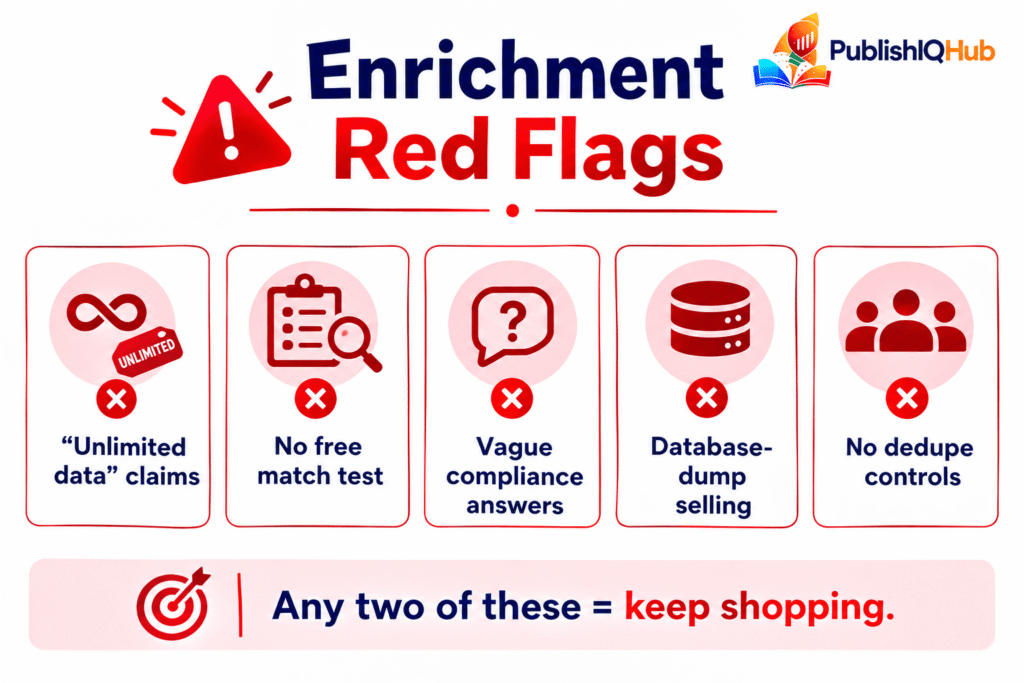
Red Flags Worth Ending a Demo Over
- Unlimited data” claims. Nobody has unlimited accurate data. This phrasing usually means unlimited access to a stale database.
- No sample match test. If they won’t prove performance on your records before you sign, the burden of proof never shifts in your favor afterward.
- Vague compliance answers. “We’re fully compliant” without specifics on sourcing methodology is a sentence, not an answer.
- Pressure to buy the full database. Good vendors sell to your use case. Weak ones sell volume because volume hides accuracy problems.
- No dedupe or write-back controls. Enrichment without merge logic will trash your CRM faster than decay ever could.
Frequently Asked Questions
What are data enrichment companies?
Data enrichment companies enhance existing customer and prospect databases by appending missing fields, correcting outdated information, and verifying accuracy. They deliver this through self-serve tools, data APIs, or managed research services, covering contact details, firmographics, technographics, and intent signals.
What is the difference between data enrichment tools and data enrichment services?
Tools are self-serve software your team operates — you run the enrichment using the provider’s database and automation. Services are managed engagements where the provider’s research team enriches your data for you against agreed quality standards. Tools suit ongoing high-volume prospecting; services suit complex, messy, or compliance-sensitive datasets.
How much does data enrichment cost?
Self-serve tools range from roughly $30–$100 per user per month at the low end to six-figure enterprise contracts. API-based enrichment typically costs $0.10–$1.00 per record depending on fields and volume. Managed services are priced per project or per record based on research depth. Always model your true annual volume, including re-enrichment.
Why is data enrichment necessary every year?
Because B2B data decays at roughly 22.5% annually as people change roles, companies restructure, and contact details expire. A database enriched once and left alone will be about a quarter inaccurate within twelve months, which is why leading teams treat enrichment as a continuous process.
Which data enrichment company is best?
It depends on the category you’re buying in. ZoomInfo and Apollo.io lead self-serve sales intelligence; Dun & Bradstreet and People Data Labs lead data licensing and APIs; providers like Datamatics Business Solutions lead managed, research-driven enrichment. Shortlist within your category and run a match test on your own records before deciding.
What is waterfall enrichment?
Waterfall enrichment queries multiple data providers in sequence, filling each record from whichever source has the answer. Because a single vendor typically matches only 30–60% of records, waterfalling across providers lifts overall match rates to 80–95% — at the cost of managing multiple contracts or using an orchestration tool.
Is data enrichment legal under GDPR?
? It can be, when providers source data lawfully and buyers use it with a valid legal basis such as legitimate interest, with proper notice and opt-out handling. Compliance depends on both the vendor’s sourcing and your usage, so ask vendors for their GDPR documentation and involve your legal team for European data.