
If you are still treating content syndication marketing as a tactical lead-buy, you are operating on a blueprint that is rapidly becoming obsolete. When you compare today’s B2B landscape, the sheer volume of content has created a “noise floor” that traditional organic search and social media struggle to penetrate.
Decision-makers are no longer browsing; they are researching in “dark” channels, private communities, Slack groups, and high-authority industry portals. To succeed in 2026, content syndication must move from a “distribution” line item to a core engine for Answer Engine Optimization (AEO) and buying group orchestration.
The shift in how we distribute information isn’t just about the “where”; it’s about the “how.” We have entered an era where “presence” is secondary to “authority.” Buyers are no longer waiting for a sales rep to reach out; they are actively hunting for deep-dive assets on platforms they already trust.
This transition from “attracting” to “intercepting” enables brands to leverage the editorial credibility of tier-1 industry sites, a critical factor in high-stakes enterprise sales where trust is the primary currency. By placing your proprietary data within these trusted ecosystems, you ensure it is seen by decision-makers at the exact moment their intent is peaking.
Why the Distribution Model has Shifted:
•The 70% Rule: Modern buyers complete 70% of their research before talking to sales. They are self-educating through deep-dive assets found on trusted third-party platforms.
• Intercept vs. Attract: Instead of hoping buyers find your blog, you intercept them on platforms they already trust (like TechTarget or Foundry).
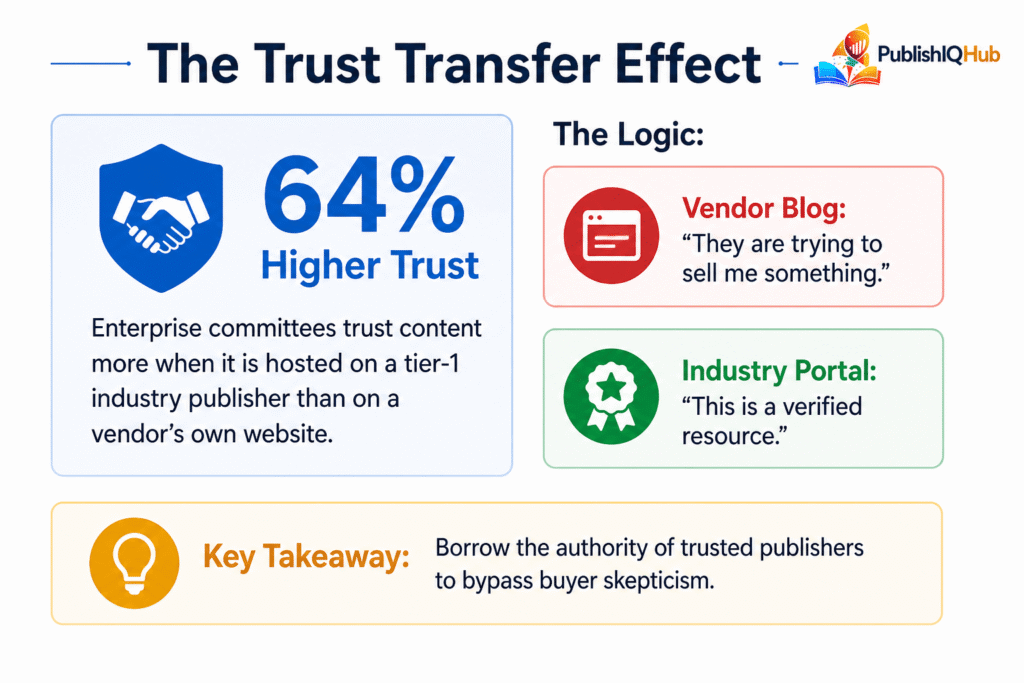
• Borrowed Authority: Publishing on a tier-1 industry site transfers that site’s editorial credibility to your brand, which is critical for high-stakes enterprise sales.
• AI Knowledge Seeding: AI models prioritize information from established publisher networks. Syndication ensures your proprietary data is “ingested” by AI as a primary source.
• Distributed Network of Authority: By utilizing content syndication services, you create a web of brand presence that follows your prospect across the professional internet.
• Data Refreshment: Unlike static lists, active syndication ensures you are capturing contact data at the exact moment of engagement, reducing “data decay.”
According to recent industry benchmarks, AI-powered syndication platforms now deliver 5x higher conversion rates than traditional static distribution methods, as they align content delivery with real-time intent spikes rather than fixed schedules.
A Comparative Analysis of the Top 16 Content Syndication Providers in USA for 2026
Selecting the right partner is about matching a provider’s network and technical capabilities to your specific Ideal Customer Profile (ICP). Here is the 2026 definitive comparison
| Provider | Primary Strategic Strength | Network / Reach | Data & Targeting Capabilities | Best Use Case |
| NetLine | Massive B2B Network Scale | 300+ industry categories | Real-time intent data, self-service platform | Scalable demand generation |
| TechTarget | Deep Technical & IT Intent | 150+ niche IT sites | First-party behavioral intent signals | Enterprise IT buyers |
| Datamatics Business Solutions | High-Precision Demand Gen | Global B2B database | AI + human verification (4C model) | ABM & high-quality leads |
| Demand Science | Predictive Propensity Modeling | Global multi-channel reach | AI-driven predictive intent (PurePredict) | Predictive pipeline building |
| INFUSE | Multi-Channel Orchestration | Email, social, display | Account-based targeting + nurture journeys | Full-funnel engagement |
| Anteriad | Enterprise Data Integrity | Global enterprise coverage | High-compliance data + firmographics | Large-scale global campaigns |
| Only B2B | Niche Verified Leads | Industry-specific segments | Human-verified contacts | Hard-to-reach verticals |
| Foundry (IDG) | Editorial Authority | Premium publications (CIO, Computer world) | Contextual targeting via editorial ecosystems | Brand credibility + awareness |
| Madison Logic | Account-Based Saturation | Cross-channel ABM reach | Intent + display + account targeting | ABM programs |
| Integrate | Lead Governance | Multi-source integrations | Data cleansing, routing, compliance | Martech stack optimization |
| Priority Engine | Active Buyer Identification | Named account intelligence | Real-time engagement tracking | Sales intelligence |
| Ziff Davis Performance | Practitioner-Level Reach | Communities like Spiceworks | Peer-driven engagement insights | Influencing technical users |
| Ciente.io | Leading glob B2B content syndication provider | Millions of engaged senior tech buyers | First-party intent data, ABM, BANT scoring | Precision content syndication for enterprise tech buyers |
| SalesboxAI | Conversational Qualification | AI-led interactions | AI chat agents for qualification | Lead-to-MQL acceleration |
| Pipeline360 | Brand-to-Demand Integration | Integrated publisher network | Unified awareness + demand tracking | Full journey campaigns |
| MentionAgent | Agentic Link Building & Outreach | AI prospecting of relevant blogs and editors | Personalised pitches, editorial backlinks earned | Self-serve, from $99/mo |
How to Identify High-Value Buying Signals
To maximize the ROI of your content syndication marketing, you must move beyond simple keyword tracking. High-definition intent discovery involves understanding the context, velocity, and technical environment of the researcher.
When you layer these signals, you can distinguish between a student doing homework and a director building a shortlist for a million-dollar procurement.
The Five Pillars of Intent Mapping
1. Topic-Based Intent Analysis: Tracking when a user consumes content related to specific high-value keywords such as “Generative AI” or “Zero Trust Architecture.”
2. Contextual Authority Mapping: Ensuring whitepapers are consumed within high-authority sites that match the user’s professional persona and job function.
3. Engagement Velocity Tracking: Measuring the frequency and density of content consumption to identify prospects in an active, high-heat buying cycle.
4. Technographic Intent Intelligence: Identifying when a company researches solutions that either complement or compete with their existing software stack.
5. Firmographic Intent Filtering: Using company size, revenue, and location data to ensure intent signals align with your sales team’s target territories.
Orchestrating the Enterprise Decision Committee
Enterprise purchases involve committees of 6 to 10 stakeholders, meaning modern syndication has evolved to track these groups rather than just isolated individuals.
If your syndication strategy only looks at the person who filled out the form, you are missing 90% of the account context. Recognizing “cluster” behaviorwhere multiple stakeholders from IT, Finance, and Legal engage with content simultaneouslyis the strongest predictor of a purchase.
The Five Mechanics of Buying Group Mapping
• Account-Level Engagement Density: Identifying when multiple departments engage with your brand content simultaneously to signal a formal project.
• Cluster Intent Signaling: Moving beyond individual lead tracking to treat “cluster” behavior as a high-priority indicator of an active organizational purchase.
• Multi-Threaded Sales Outreach: Equipping sales teams to address the unique pain points of different committee members based on their specific content consumption.
• The Elimination of Information Silos: Bridging the gap between disparate departments within a target account that are researching the same solution independently.
• Champion vs. Blocker Identification: Analyzing asset consumption patterns to distinguish the internal advocate from the stakeholder focused on security or budget barriers.
In 2026, 94% of B2B buying groups have already ranked their preferred vendors before they ever make first contact with a sales representative.
Measuring Invisible Influence and Internal Advocacy
The concept of “Dark Social” refers to the invisible shares that happen in private channels like Slack, WhatsApp, or private LinkedIn groups. While you can’t always track the specific link, you can track the “echo” of that engagement by monitoring corporate IP activity.
If a whitepaper is downloaded once but accessed twenty times from a single company’s network, that asset is being socialized internally. This “echo effect” is a massive indicator of influence.
The Five Ways to Measure Dark Social Echo
1. Private Channel Advocacy Recognition: Understanding that the most valuable peer-to-peer sharing happens in private Slack or professional groups.
2. Corporate IP Depth Tracking: Monitoring corporate network ranges to see how many unique users within one firm are reading your asset after the initial download.
3. The Internal Echo Effect: Prioritizing accounts that show high internal content socialization, as this typically precedes a formal Request for Proposal (RFP).
4. Peer-to-Peer Influence Networks: Leveraging syndication partners that include forums where buyers seek unbiased, un-gated opinions on vendor solutions.
5. Shadow Research Monitoring: Identifying “silent” accounts that consume your expertise through third-party publishers without ever visiting your primary brand website.
Answer Engine Optimization (AEO): Future-Proofing Content for AI Search Citation
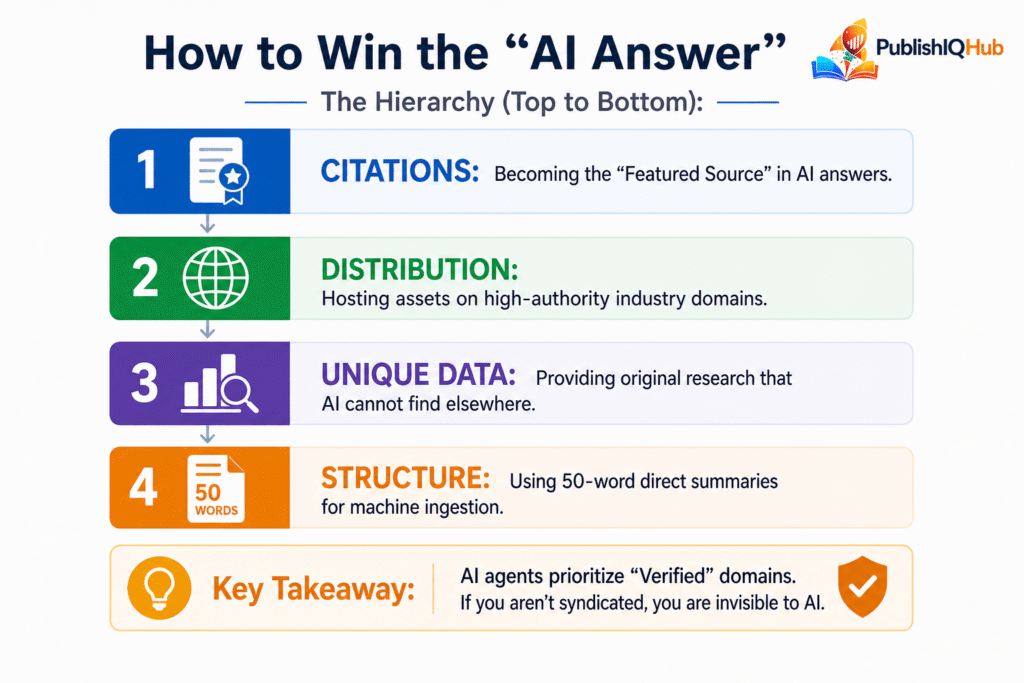
As search engines transform into generative AI “Answer Engines,” your content structure must cater to machine ingestion as much as human reading. Content syndication is no longer just for leads; it is for knowledge base seeding.
AI models prioritize content from verified industry domains over solo brand blogs. By strategically placing assets across high-trust networks, you are essentially training the web’s AI models to associate your brand with specific industry solutions.
The Five Requirements for Citation Authority
• Proprietary Information Gain: Creating unique data, original research reports, or industry benchmarks that AI models cannot find elsewhere on the web.
• Direct Answer Architecture: Implementing concise, 50-word summaries at the top of every asset to facilitate easy ingestion by AI agents.
• Semantic Entity Linking: Consistently connecting your brand name to high-value industry keywords across reputable provider networks.
• Machine-Readable Metadata Hierarchy: Utilizing clear H1-H4 structures and schema markup so AI models can accurately categorize your brand’s expertise.
• Multimodal Data Distribution: Syndicating videos, infographics, and structured FAQs that AI agents can parse for various user query formats (voice vs. text).
The Strategic Funnel-Aligned Asset Strategy: Delivering the Right Content at the Right Time
To achieve the best results, you must align your assets with the specific stages of the buyer’s journey. Top-of-funnel (TOFU) content should focus on broad industry trends and benchmarks to capture wide interest.
As the prospect moves to the middle of the funnel (MOFU), the content should shift toward comparison guides and implementation checklists. Finally, bottom-of-funnel (BOFU) content needs to provide the hard proof, ROI calculators, and case studies that the buying committee needs to finalize a decision.
The Five Requirements for Citation Authority
1. TOFU (Awareness): Deploying original research and “State of the Industry” reports to establish category authority and broad thought leadership.
2. MOFU (Consideration): Using technical comparison guides, implementation checklists, and expert webinars to solve specific organizational pain points.
3. BOFU (Decision): Providing localized case studies, ROI calculators, and compliance documentation to give the buying committee a final push toward purchase.
4. Customer Retention & Expansion: Syndicating product roadmaps and advanced implementation guides to existing customers through niche practitioner communities.
Turning Syndication Downloads into Sales Pipeline
The biggest mistake in content syndication is treating a download as a “done deal.” The Nurture Bridge is where the actual ROI is manufactured.
Modern orchestration platforms now allow for real-time lead delivery, ensuring that your first nurture email hits the prospect’s inbox while they are still reading the downloaded asset. This “strike while the iron is hot” approach is the difference between a lead that goes cold and a lead that converts.
The Five Pillars of the Nurture Bridge
• Instant Value Fulfillment: Delivering requested assets within seconds and using real-time API connectors to instantly update CRM records with fresh lead data.
• Contextual Engagement Enrichment: Following an initial download with a “sequel” asset, such as a role-specific case study or an invitation to a deep-dive webinar.
• Automated Behavioral Scoring: Tracking “Readiness Signals,” including pricing page visits or repetitive downloads, to determine when a lead is sales-ready.
• Role-Based Personalized Sequencing: Tailoring the follow-up cadence and messaging based on the specific industry, seniority, or job function of the prospect.
• Human-Verified Lead Qualification: Utilizing conversational AI or manual verification to confirm intent and budget before a sales representative initiates a call.
Navigating Regional Differences in Content Syndication
A one-size-fits-all approach to global syndication is a recipe for failure because different regions prioritize different values. For example, North America is highly volume-driven, whereas Europe is strictly focused on data residency and compliance. Ignoring these regional nuances results in wasted budget and missed opportunities in high-growth territories.
The Four Regional Strategic Nuances
1. North American Market Scale: Focusing on high-volume distribution and maximum “Information Gain” to cut through the noise of a crowded B2B landscape.
2. EMEA Privacy-First Compliance: Prioritizing GDPR compliance, data residency, and localized messaging that resonates with specific European business cultures.
3. APAC Relationship-Driven Engagement: Utilizing interactive, high-dwell-time formats and professional communities to build trust before the first sales touchpoint.
4. LATAM Digital Transformation Focus: Deploying educational “How-To” content that helps organizations navigate the adoption of new enterprise technologies.
Operational Excellence and Data Ethics: Maintaining Lead Standards in 2026
In 2026, data privacy is not a suggestion; it is a prerequisite for survival. Marketing leaders who prioritize “Lead Hygiene” over “Lead Volume” are the ones consistently seeing higher LTV and lower churn in their sales pipelines. Permission-based sourcing and global compliance protect your sender reputation and ensure you are building a database of genuine, high-intent prospects.
The Five Standards of Operational Excellence
• Explicit Permission-Based Sourcing: Ensuring every lead has opted in to receive brand communications through clear, compliant, and transparent form structures.
• Global Regulatory Compliance: Adhering to GDPR, CCPA, and evolving global privacy laws through certified and audited syndication partners.
• Rigorous Lead Hygiene Standards: Automatically filtering out personal or invalid email addresses to maintain a high-quality database.
• Closed-Loop Revenue Attribution: Measuring the full marketing journey from the initial third-party download to the final “Closed-Won” status.
• Technographic Account Enrichment: Appending lead records with data about the prospect’s current tech stack to provide sales with a competitive edge.
Conclusion
As we look toward the final quarters of 2026, the mandate for B2B marketers is clear: stop collecting contact cards and start orchestrating buying groups. The era of “random acts of content” has been replaced by a sophisticated, intent-driven ecosystem where distribution is as vital as the data itself.
By aligning your syndication strategy with Answer Engine Optimization (AEO), navigating the nuances of “Dark Social,” and prioritizing lead hygiene over raw volume, you transform marketing from a cost center into a high-precision revenue engine.
Success in this new landscape requires a shift in perspective. You are no longer just a content creator; you are a data architect and a trust builder. Whether you are leveraging the massive scale of a global network or the high-precision targeting of a niche practitioner community, your goal remains the same: to be present, authoritative, and helpful at the exact moment a prospect is ready to solve a problem.
The future of B2B growth belongs to those who can master this balance of human-centric storytelling and machine-ready distribution.
Stay ahead of the rapidly changing B2B landscape. To see how technology is reshaping the way businesses connect with their customers and accelerate their pipeline, keep reading our blog for the latest playbooks on demand generation and marketing technology.
Frequently Asked Questions
How does content syndication help with AEO?
By hosting on high-trust sites, you signal authority to AI models, increasing your chances of being a featured answer in AI search results.
What is the difference between CPL and LTV?
CPL is the immediate cost of the lead, while LTV (Lifetime Value) is the total revenue that lead eventually generates for the business.
Can I target by tech stack?
Yes, advanced content syndication services allow for “Technographic” targeting based on the specific software a company currently uses.
Why is human verification still important?
It ensures you are paying for real people in real roles with current titles, filtering out “ghost” profiles and outdated data.
What content assets perform best?
Original research, industry benchmark reports, and “State of the Industry” trends typically see 40% higher engagement than standard brochures.
How often should I refresh assets?
In fast-moving sectors, a content refresh every 6 months is recommended to maintain relevance for AI models and human readers.