
The global financial landscape has undergone a tectonic shift. Today, we have moved beyond the initial shock of digital banking and entered the era of the “Autonomous Ledger.” Today, Artificial Intelligence in Finance is no longer a futuristic concept being tested in innovation labs; it is the core operating system for global markets, personal banking, and corporate treasury.
From the way institutional portfolios are hedged against climate volatility to the microseconds it takes to approve a small business loan, AI has become the primary driver of efficiency, security, and growth. In this definitive guide, we explore how AI in financial services is reshaping the world, the companies leading the charge, and the tangible ROI driving this revolution.
AI in Financial Services: From Advisory to Autonomous
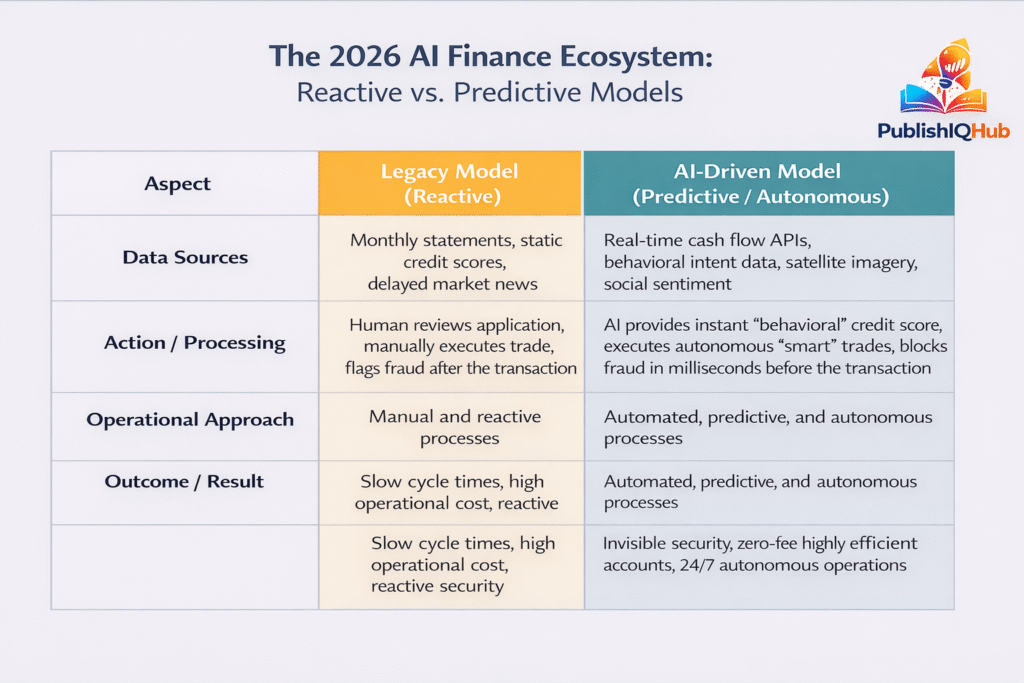
Historically, financial services were reactive. You checked your statement after a purchase; a bank reviewed your credit after you applied for a loan. In 2026, the model has flipped. AI in financial services is now a proactive workforce layer that anticipates needs before they are expressed.
- Hyper-Personalized Wealth Management: Traditional robo-advisors have been replaced by “Financial CoBots”- collaborative AI assistants that monitor every aspect of a user’s digital life. These systems don’t just suggest investments; they adjust portfolios in real-time based on live tax law changes, sentiment shifts in news cycles, and the user’s personal spending velocity.
- Autonomous Credit Underwriting: The FICO score is no longer the sole arbiter of creditworthiness. AI now analyzes “behavioral intent” data—such as a user’s consistent bill-paying habits and career trajectory—to provide instant loan approvals for the “unbanked,” fostering global financial inclusion.
- Algorithmic RegTech: Compliance is now a strategic accelerant. AI systems monitor global regulatory updates across 160+ countries, automatically mapping new laws to internal controls. This allows banks to launch new products in days rather than months, with zero-hallucination guardrails ensuring 100% compliance.
Top AI Finance Companies Leading the 2026 Market
The 2026 market is defined by a mix of established tech titans and agile fintech pioneers who have successfully moved AI from “experimental pilots” to “operational infrastructure.”
The Enterprise Orchestrators
- Intellectyx & RTS Labs: These firms have emerged as leaders in developing “agentic” ecosystems for banks—AI that doesn’t just talk but moves money and routes workflows at machine speed.
- Oracle & Deloitte (Zora AI): These giants provide the backbone for Tier-1 institutions. By integrating AI agents directly into core banking environments, they allow global firms to scale automated auditing and risk assessment across thousands of branches.
The Domain Specialists
- Zest AI (formerly ZestFinance): A pioneer in AI-driven lending, Zest AI helps lenders reduce default rates by up to 25% by utilizing thousands of non-traditional data points to find “invisible” creditworthy borrowers.
- Feedzai & Darktrace: These companies provide the “immune system” for the financial world. Using self-learning AI, they detect account takeovers and complex money laundering schemes in real-time, protecting billions in assets every hour.
- Azilen Technologies: Specialized in fintech AI architecture, Azilen builds the secure pipelines that allow banks to use their own data to train private, high-fidelity models without risking exposure to the public web.
The Financial Value Chain of 2026
- Ingestion: Real-time data from satellite imagery (predicting retail sales), social sentiment, and IoT supply chain logs.
- Processing: Neural networks performing real-time risk modeling and predictive forecasting.
- Execution: Autonomous smart contracts triggering trades, restocks, or loan disbursements.
- Governance: Continuous AI-led auditing to ensure ethics and compliance.
The Core Benefits of AI in Finance
The adoption of AI isn’t just a technical upgrade; it’s a fundamental improvement in the quality of the financial experience. In 2026, the benefits of AI in finance are measured in both human impact and hard ROI.
Operational Excellence
- Efficiency Gains: According to McKinsey and Gartner, over 90% of finance functions have deployed at least one AI solution. This has led to an average 35% ROI on AI investments, with some institutions reporting an 80% reduction in cycle times for tasks like accounts payable and invoice matching.
- Cost Avoidance: AI is projected to save the industry up to $340 billion annually. By automating routine inquiries and back-office reconciliations, banks have lowered their “cost-to-serve,” allowing for the return of high-yield consumer accounts with zero fees.
Security and Resilience
- Invisible Fraud Prevention: 2026 fraud detection uses “Biometric Behavioral Recognition.” It monitors the micro-patterns of how you type or hold your device. If a bad actor tries to access your account, the AI blocks the transaction in milliseconds, often before the user even knows an attempt was made.
- Real-Time Risk Management: AI models now run hundreds of “black swan” scenarios every minute, adapting a bank’s capital reserves and risk appetite as global conditions change.
Consumer Empowerment
- Financial Health Advocacy: AI doesn’t just track your money; it negotiates on your behalf. Modern apps autonomously find lower insurance premiums, negotiate subscriptions, and move idle cash into high-yield instruments the second it becomes available.
- Ethical Lending: By removing the “human bias” from the initial underwriting phase, AI-driven lenders are providing fairer access to capital for small businesses and first-time homeowners.
The Future of AI in Risk and DeFi
As we move deeper into 2026, the convergence of AI and Decentralized Finance (DeFi) is creating a more transparent and liquid market.
- AI-Enhanced Risk Management
Risk management has evolved from a “safety net” to a “growth accelerant.” AI systems now provide “Resilient Intelligence,” embedding security and governance into the very logic of every transaction. This allows institutions to take calculated risks at a speed that was previously impossible.
- The Rise of “Smart” DeFi
In 2026, AI-driven analytics dashboards are standard for both retail and institutional crypto trading.
- Intelligent Liquidity Engines: AI algorithms dynamically adjust spreads and manage market-making strategies in real-time, ensuring stable trading environments even during periods of high volatility.
- Programmable CBDCs: Central Bank Digital Currencies are now being deployed with AI-managed conditional logic, allowing for instant, 24/7 cross-border settlements without the traditional T+2 delays
Conclusion: The Path to Financial Resilient Intelligence
The integration of Artificial Intelligence in Finance has turned the “dismal science” of economics into a proactive tool for human growth. We have reached an inflection point where the divide between “AI-enabled” and “legacy-bound” institutions is no longer just a matter of efficiency- it is a matter of survival.
If you want to be successful, you need “Resilient Intelligence”- smart systems that are fast and innovative, but still super secure and compliant. For the consumer, this means a world where your money works as hard as you do, protected by the most advanced technology ever created.
The financial world is moving faster than ever. To ensure you’re always ahead of the curve and protecting your assets, keep following us for the latest deep dives into the tools and trends shaping our digital world.
Frequently Asked Questions (FAQs)
Is AI in finance safe for my personal data?
Yes, in 2026, Tier-1 institutions use “Zero-Retention” AI firewalls. Your personal financial data is processed within a secure perimeter to provide insights, but it is never used to train the general, public AI models.
Will AI replace my financial advisor?
AI is not replacing advisors; it is elevating them. Advisors now use “CoBots” to handle the data-heavy research, allowing them to spend 100% of their time on high-level strategy and helping you navigate complex life transitions.
How does AI detect fraud better than a human?
AI can analyze millions of data points across the entire global banking network simultaneously- detecting “pattern clusters” that are invisible to the human eye, all in less than a tenth of a second.
Can small businesses benefit from AI in finance?
Absolutely. AI-driven accounting tools like Kontofy and Casca provide small businesses with the “CFO-level” insights and automated loan assistance that were once only available to large corporations.