
Disclaimer
This article is for educational and informational purposes only. It does not constitute investment advice, financial advice, or a recommendation to buy or sell any securities. The author and the publisher (PublishIQHub) are not SEBI-registered investment advisors.
Investments in securities markets are subject to market risks; read all related documents carefully before investing. Brokerage charges, plans, and features mentioned are as of the publication date (July 2026) and may change without notice — verify all charges with the broker’s official website before opening an account. Please consult a qualified, SEBI-registered financial advisor before making any investment decisions.
Here’s the thing. India now has 345 stock brokers registered with NSE as of February 2026, and the top stock brokers control more than half the market between them. The gap between a good choice and a lazy one is real money — a full-service broker can cost you 10 to 15 times more per trade than a discount broker on the exact same order.
We’ve personally run accounts with six of the brokers on this list. By the end of this guide, you’ll know exactly which of the top stock brokers fits your style — whether you’re a first-time SIP investor, an intraday trader, or someone parking ₹50 lakh for the long haul.
Quick note: this is an educational comparison, not investment advice.
How We Evaluated the Top Stock Brokers
Every “best broker” list on the internet ranks whoever pays the highest affiliate commission. We wanted to do this differently, so we scored the best brokerage companies on six things that actually affect your money:
- Brokerage charges — delivery, intraday, F&O, and the sneaky ones (DP charges, call-and-trade fees, AMC)
- Platform stability — does the app survive a Budget-day crash or a big F&O expiry?
- Margin and leverage — capped by SEBI at roughly 5x for intraday cash, but execution differs
- Research and tools — charting, screeners, advisory, education
- Customer support — ticket resolution speed and complaint volumes
- SEBI registration and complaint data — every broker here is among the best SEBI registered brokers; we checked registration status on sebi.gov.in and complaint ratios on NSE’s investor services data
Charges were verified from each broker’s official pricing page in early July 2026. Active client figures come from NSE’s monthly disclosure of active clients, compiled via NSE and BSE exchange data.
Charges were verified from each broker’s official pricing page in early July 2026. Active client figures come from NSE’s monthly disclosure of active clients, compiled via NSE and BSE exchange data.
Quick Comparison: Top Stock Brokers at a Glance
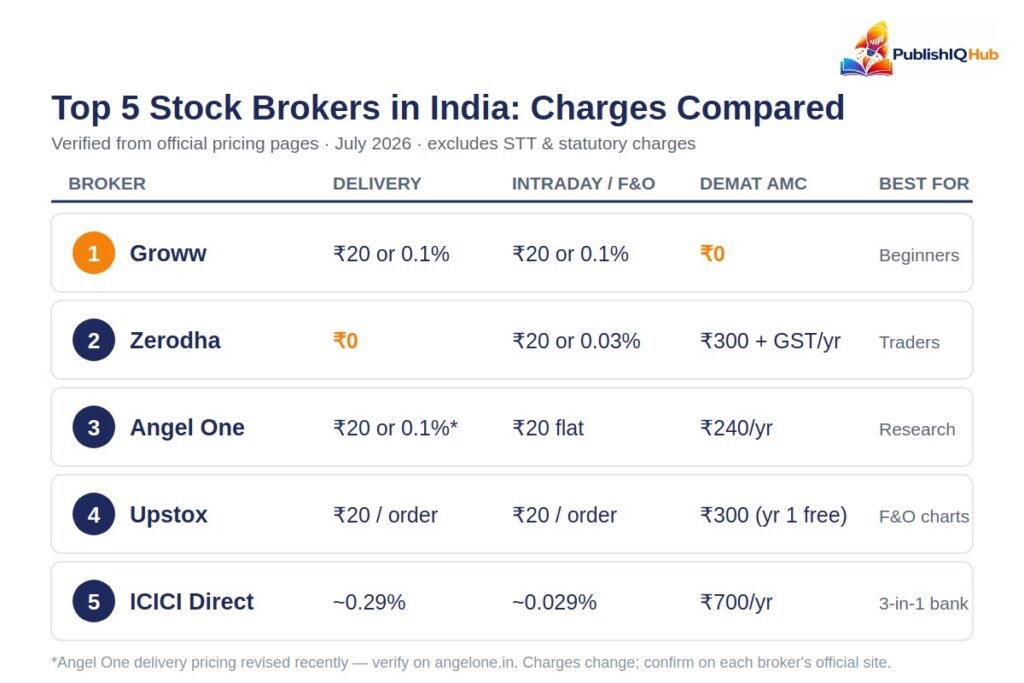
| Sr.No | Broker | Account Opening | Demat AMC | Delivery | Intraday/F&O | Best For |
| 1 | Groww | Free | ₹0 | ₹20 or 0.1% (lower) | ₹20 or 0.1% | Absolute beginners, SIPs |
| 2 | Zerodha | Free | ₹300 + GST/yr | ₹0 | ₹20 or 0.03% | Serious traders, long-term investors |
| 3 | Angel One | Free | ₹240/yr | ₹20 or 0.1%* | ₹20 flat | Research + low-cost hybrid |
| 4 | Upstox | Free (promo) | ₹300/yr (1st yr free) | ₹20/order | ₹20/order | F&O traders who want TradingView charts |
| 5 | ICICI Direct | Free | ₹700/yr | ~0.29% (MoneySaver) | ~0.029% | 3-in-1 banking convenience |
| 6 | Dhan | Free | ₹0 | ₹0 | ₹20/order | Options traders, zero-AMC seekers |
| 7 | HDFC Securities | ₹999 (HDFC Sec) | ₹750/yr | 0.32% | 0.032% | HDFC Bank loyalists |
| 8 | Kotak Neo (Kotak Securities) | Free | Plan-based | Plan-based | ₹20-tier plans | Young investors (age-based plans) |
| 9 | Paytm Money | Free | Low/nil | ₹20-level | ₹20-level | Casual mobile-first investors |
| 10 | Fyers | Free | Low | ₹0-₹20 tier | ₹20/order | Chart-heavy technical traders |
| 11 | 5paisa | Free | Low | Flat-fee | ₹20/order | Budget traders |
| 12 | m.Stock (Mirae) | One-time fee plans | Plan-based | Zero-brokerage plan | Zero-brokerage plan | High-volume traders |
| 13 | INDmoney | Free | ₹0 | ₹0 | Low flat fee | US stocks + Indian stocks in one app |
| 14 | Motilal Oswal | Free | Standard | % based | % based | Research-driven investors |
| 15 | Sharekhan (Mirae Asset) | Standard | Standard | % based | % based | Offline branch support |
| 16 | SBI Securities | Standard | Standard | % based | % based | SBI account holders, PSU trust |
| 17 | Axis Direct | Standard | Standard | % based | % based | Axis Bank 3-in-1 users |
| 18 | HDFC Sky | Free | Low | Flat ₹20-style | Flat ₹20-style | HDFC’s discount-app answer |
| 19 | IIFL Securities | Standard | Standard | % based | % based | Advisory + wealth products |
| 20 | Geojit | Standard | Standard | % based | % based | South India branch network |
Angel One revised its delivery pricing after years of free delivery — confirm the current slab on angelone.in before opening an account. For brokers 11–20, charges vary by plan; treat the table as a directional guide and verify on each broker’s official pricing page.
Charges above exclude statutory levies — STT, exchange transaction charges, SEBI turnover fees, GST, and stamp duty — which are identical across brokers because the government sets them. On a delivery trade, STT alone is 0.1% on both buy and sell, which often exceeds the brokerage itself.
Detailed Reviews: The 10 Best Brokerage Companies in India
1. Groww — Best Stock Trading Platform for Beginners
Groww is now the largest of the top stock brokers in India by active clients, having overtaken Zerodha, according to NSE active client data compiled by IPO Central (February 2026). That didn’t happen by accident. The app strips investing down to its essentials: search a stock or fund, tap buy, done. Account opening runs on UPI and Aadhaar and takes under fifteen minutes.
The pricing is honest but not the cheapest. Delivery costs ₹20 or 0.1% per order, whichever is lower — so unlike Zerodha, delivery isn’t free. What Groww gives back is zero AMC, forever, as per its official pricing page. For a small portfolio, that matters. A ₹354 annual demat fee on a ₹10,000 portfolio is a 3.5% drag before you’ve earned a rupee.
Pros: Zero AMC, cleanest onboarding in the industry, mutual funds and stocks in one app, huge community.
Cons: Delivery brokerage isn’t free, charting is basic, no commodity trading, support gets slow at peak times.
Verdict: The best investing platform for someone opening their first demat account or running SIPs. Traders will outgrow it within a year.
2. Zerodha — Best Trading Platform for Indian Stocks Overall
Zerodha built the discount broking category in India, and its pricing hasn’t moved since 2010: ₹0 on equity delivery, flat ₹20 or 0.03% (whichever is lower) on intraday and futures, flat ₹20 on options — all per its official charges page at zerodha.com/charges. AMC is ₹300 plus GST per year for a regular account.
Two things keep us paying that AMC happily. First, Kite. It is the most stable trading platform we’ve used through Budget days and messy F&O expiries, when other apps throw error screens. Second, the ecosystem — Console for reporting, Coin for direct mutual funds at zero commission, Varsity for genuinely excellent free education.
The weak spot? Support. Everything routes through tickets. There’s no relationship manager, no branch to walk into, and when something breaks you wait. Zerodha’s support is slow, and that’s putting it politely.
Pros: Free delivery, lowest intraday percentage rate (0.03%), rock-solid Kite platform, Varsity, transparent pricing.
Cons: ₹300 AMC, ticket-only support, no advisory or stock tips, DP charge of ₹15.34 per stock per day on sells.
Verdict: If you’ll hold stocks for years and trade occasionally, this is the best trading platform for Indian stocks, full stop.
3. Angel One — Best Hybrid of Research and Discount Pricing
Angel One is the odd one out: a broker founded in 1987 that reinvented itself as a flat-fee app. You get ₹20-per-order pricing with full-service extras — ARQ AI-driven recommendations, research reports, and around 900 branches across India per Chittorgarh’s broker data. AMC is ₹240 a year, lower than Zerodha’s.
One caution. Angel One ended its free-delivery era and now charges on delivery trades (₹20 or 0.1%, lower of the two, with periodic promotional waivers). Several comparison sites still show delivery as free — they’re outdated. Check angelone.in/pricing before you commit.
Pros: Research and advisory at discount-broker prices, branch network, ₹240 AMC, strong Super App.
Cons: Delivery no longer free, app pushes cross-sell notifications hard, advisory quality is hit-or-miss.
Verdict: Best for investors who want someone to tell them what to buy without paying full-service brokerage.
4. Upstox — Best for F&O Traders on a Budget
Upstox charges ₹20 per order across delivery and intraday, with AMC of ₹300 a year that’s waived in year one, per InvestorGain’s comparison data. What you’re really buying is the charting: TradingView is built into Upstox Pro at no extra cost, with 100-plus indicators. For options traders, the option chain is fast and clean.
The platform stumbled on stability a few years ago but has improved meaningfully since 2023. It’s now a legitimate Zerodha alternative for active derivatives traders.
Pros: TradingView charts free, clean options chain, fast execution, competitive flat fees.
Cons: Delivery isn’t free, no NRI accounts, ecosystem thinner than Zerodha’s.
Verdict: The best trading app for intraday trading in India if charts drive your decisions.
5. ICICI Direct — Best Full-Service Broker
ICICI Direct serves over 50 lakh customers and is the largest full-service broker among the best SEBI registered brokers, per Chittorgarh’s NSE-data rankings. The headline feature is the 3-in-1 account: bank, trading, and demat linked, so funds move instantly and settlement money lands straight in your savings account.
Pricing is where it stings. The default MoneySaver plan charges around 0.29% on delivery — that’s ₹290 on a ₹1 lakh trade where Zerodha charges zero. Prime plans (₹999, ₹4,999, ₹9,999 a year) cut those rates significantly, and the iValue add-on (₹299 lifetime) drops AMC to ₹300 from the standard ₹700.
Pros: True 3-in-1 convenience, strong research desk, branch support, trusted ICICI brand.
Cons: Expensive default plan, plan structure is genuinely confusing, app feels dated next to Kite.
Verdict: Worth it if you bank with ICICI, value hand-holding, and trade infrequently in large sizes.
6. Dhan — Best Zero-Cost Structure for Options Traders
Dhan is the youngest broker in our top tier and the most aggressive on pricing: ₹0 delivery brokerage, ₹0 AMC, ₹20 per order on intraday and F&O. Even its DP charge (₹12.5 plus GST per sell) undercuts Zerodha’s ₹15.34, as noted in CompareShareBrokers’ fee breakdown. Built by the team behind Paytm Money’s early product, it ships trader-focused features — options strategy builders, TradingView integration, draggable orders on charts — faster than anyone.
Pros: Free delivery and zero AMC (rare combination), superb options tooling, fast-moving product team.
Cons: Smaller community, limited research, shorter track record than the giants.
Verdict: Best broker for options trading in India with low charges — and a serious Zerodha rival for buy-and-hold investors who resent AMC.
7. HDFC Securities & HDFC Sky — Best for HDFC Bank Loyalists
HDFC Securities is the classic full-service arm: roughly 0.32% delivery and 0.032% intraday, ₹750 AMC, and a ₹999 account opening fee per Chittorgarh’s comparison data. It’s expensive, but you get 270-plus branches and a 3-in-1 with HDFC Bank.
HDFC Sky is the group’s answer to discount brokers — a flat-fee app with modern UI. If you want the HDFC name without full-service pricing, Sky is the one to evaluate; confirm its current slab on hdfcsky.com since promotional pricing changes often.
Pros: Bank-grade trust, branch access, research quality.
Cons: Among the costliest default pricing in this list; two confusing parallel offerings.
Verdict: Choose Sky, not the legacy platform, unless you specifically need relationship-manager service.
8. Kotak Neo — Best for Investors Under 30
Kotak Securities runs age-based and subscription plans on its Neo platform — its youth-focused plan has historically offered zero brokerage across segments for investors under 30, with flat-fee plans for everyone else. Plan terms have changed more than once, so verify the current structure on kotaksecurities.com.
Pros: Aggressive plans for young investors, Kotak 3-in-1 banking, improving Neo app.
Cons: Plan churn creates confusion, app still maturing versus Kite.
Verdict: If you’re under 30 and the zero-brokerage plan is live, the maths is hard to beat.
9. Paytm Money — Best for Casual, Mobile-First Investors
Paytm Money leans on the distribution of the Paytm app: flat low-fee broking, strong mutual fund flows, and an interface built for people who’ve never seen a candlestick. It’s a fine second account for casual investing, though serious traders will find the toolkit thin.
Pros: Familiar brand, simple UX, low flat fees, easy SIPs.
Cons: Limited advanced tools, parent-company headlines occasionally spook users (your shares sit safely with CDSL/NSDL regardless).
Verdict: Good enough for small, casual portfolios. Not a trading platform.
10. Fyers — Best Charting-First Platform for Technical Traders
Fyers is a trader’s broker: TradingView-powered charts, a capable API, and flat ₹20 pricing with promotional zero-delivery offers that come and go. Its active client base is a fraction of Groww’s, which cuts both ways — support is more personal, but community resources are thinner.
Pros: Excellent charts, good API for algo traders, trader-centric features.
Cons: Small ecosystem, pricing promos change frequently.
Verdict: A specialist pick for technical analysts who live inside charts.
Discount Broker vs Full-Service Broker: Which Should I Choose?
Short answer: discount, unless you specifically need advice or branch service.
A discount broker (Zerodha, Groww, Upstox, Dhan) charges a flat fee — typically ₹20 per order — no matter how big the trade. A full-service broker (ICICI Direct, HDFC Securities, Motilal Oswal) charges a percentage, usually 0.3% to 0.5% per side, and bundles in research, advisory, relationship managers, and branches.
Run the numbers on a ₹2 lakh delivery purchase. A discount broker charges ₹0 to ₹20. A full-service broker at 0.3% charges ₹600 — on the buy alone. Do that twenty times a year and you’ve paid ₹24,000 for the privilege of a phone number to call.
Full-service still makes sense in three cases: you want curated research and stock recommendations, you’re an NRI or senior investor who values in-person service, or you want the settlement convenience of a 3-in-1 bank-linked account. Everyone else is subsidising branches they’ll never visit.
How to Verify a SEBI Registered Broker (Step-by-Step)
Never skip this, especially with smaller brokers advertising on Telegram or Instagram. Here’s how to check if a broker is SEBI registered:
- Go to sebi.gov.in → “Intermediaries/Market Infrastructure Institutions” → “Recognised Intermediaries”
- Select “Stock Broker” and search by the broker’s registered name (the legal entity, which may differ from the brand — e.g., Groww operates as Groww Invest Tech Pvt Ltd)
- Confirm the SEBI registration number (format: INZ000031633-style) matches what’s printed in the broker’s website footer
- Cross-check on nseindia.com → “Invest” → “Find a Stock Broker” to confirm active NSE membership
- Read the broker’s Investor Charter (mandatory disclosure) and check its complaint data — every registered broker must publish monthly complaint disclosures
- Confirm your demat is held with CDSL or NSDL, not with the broker itself — this is why your shares stay safe even if a broker shuts down
If a “broker” asks you to transfer money to a personal UPI ID or promises assured returns, walk away. SEBI registered brokers can do neither.
Conclusion: Which of the Top Stock Brokers Should You Pick?
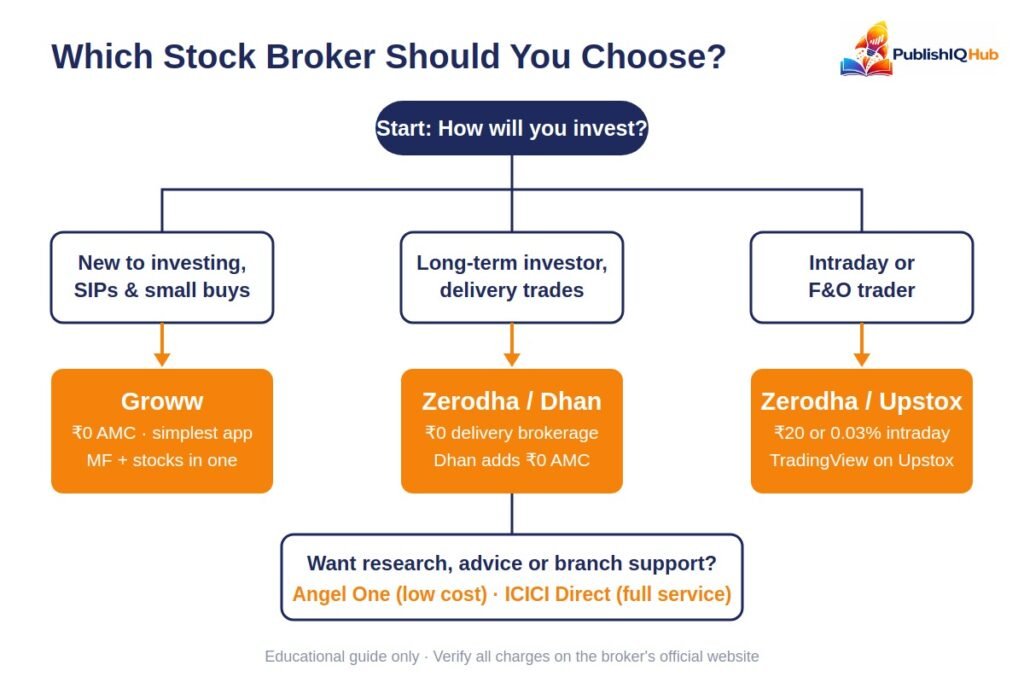
After running accounts across the top stock brokers and crunching the fee tables, here’s our recommendation matrix:
- Best for beginners: Groww — zero AMC, gentlest learning curve among the best investing platforms
- Best for active traders: Zerodha — lowest intraday rate, Kite’s stability, with Upstox as the charts-first alternative
- Best for long-term investors: Zerodha or Dhan — free delivery is the single biggest cost saver over a decade
- Best full-service option: ICICI Direct on a Prime plan — the 3-in-1 convenience is genuinely useful if you already bank there
- Best for options specialists: Dhan — zero AMC plus purpose-built strategy tools
There is no single best stock trading platform — there’s the best one for your trading pattern. A SIP investor and an expiry-day options scalper need different things, and both are well served in 2026. Open the account that matches how you’ll actually invest, not how you imagine you might someday.
And whichever of the best brokerage companies you pick — verify it on SEBI’s website first. Two minutes of checking beats years of regret.
FAQ: What People Ask ChatGPT, Claude, and Gemini About the Top Stock Brokers
Which stock broker is best for beginers in India?
Groww, for its zero AMC and simplest interface, with Zerodha a close second thanks to Varsity’s free education. Beginners should prioritise ease of use and low fixed costs over advanced tools they won’t use in year one.
Which broker has the lowest brokerage charges in India?
For delivery, Zerodha and Dhan charge ₹0. For intraday, Zerodha’s ₹20-or-0.03% formula is the lowest percentage rate among major brokers; on small orders the flat ₹20 is identical almost everywhere. Dhan also wins on the hidden stuff — zero AMC and lower DP charges.
Is Zerodha better than Groww for long-term investing?
? For pure long-term stock investing, yes — Zerodha’s ₹0 delivery brokerage beats Groww’s ₹20-per-order once you make 15-plus trades a year, which covers the ₹354 AMC. If you invest mainly through mutual fund SIPs with occasional stock buys, Groww’s zero AMC makes it cheaper.
What is the safest stock broker in India for large investments?
Safety is about regulation, not size: shares sit with CDSL/NSDL either way. That said, large investors often prefer bank-backed 3-in-1 brokers (ICICI Direct, HDFC, Kotak) or Zerodha, all with long compliance records. Check the broker’s complaint ratio on NSE before parking serious money.
Which demat account has zero AMC charges?
Groww, Dhan, and INDmoney offer lifetime-zero AMC. Zerodha offers ₹0 AMC only on BSDA accounts (small holdings under regulatory limits). Upstox waives the first year only.
Best trading app for intraday trading in India?
Zerodha Kite for stability and the lowest percentage rate; Upstox for built-in TradingView charts; Dhan for options-specific tooling. Pick based on whether reliability, charting, or strategy tools matter most to your style.
Zerodha Kite for stability and the lowest percentage rate; Upstox for built-in TradingView charts; Dhan for options-specific tooling. Pick based on whether reliability, charting, or strategy tools matter most to your style.