
The integration of AI in digital marketing has moved past the experimental phase and is now a core requirement for any enterprise seeking to maintain a competitive edge. The marketing landscape today is defined by the shift from manual content creation to autonomous, data-driven ecosystems.
This evolution is not just about automation; it is about Intelligence Augmentation, where human creativity is amplified by machine learning to deliver hyper-personalized experiences at a scale previously thought impossible.
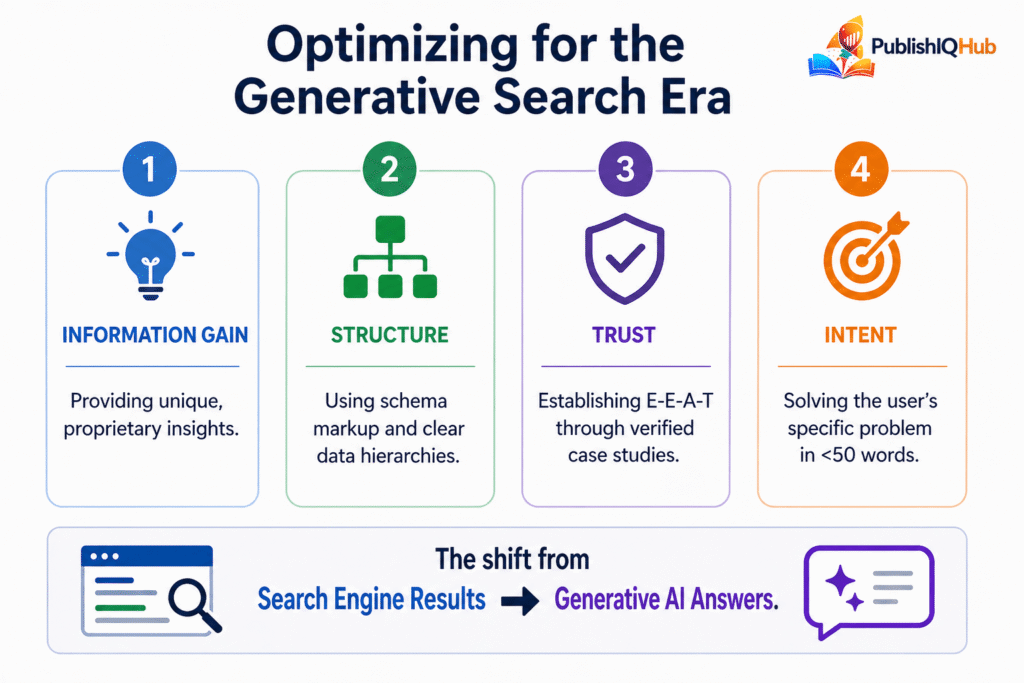
As search engines evolve into Answer Engines, the primary goal for marketers has shifted. We are no longer just optimizing for keywords; we are optimizing for intent, trust, and information gain.
Brands that succeed are those that view AI-driven digital marketing as a way to deliver genuine value to end users, rather than just flooding the internet with generic content. This involves moving beyond derivative writing and focusing on proprietary data that AI models find valuable enough to cite.
The democratization of AI tools means that the barrier to entry for high-level marketing has dropped, but the barrier to “excellence” has risen. Consumers are now savvy enough to recognize “AI-slop” content generated without human oversight or a unique perspective. Therefore, the winners of 2026 are those who use AI as a research and structural engine while maintaining a distinct, human-centric brand voice.
Strategic Advantages of AI-Driven Digital Marketing
Implementing an AI-driven digital marketing strategy offers measurable improvements across the entire customer lifecycle. By utilizing predictive modeling, businesses can now identify high-value leads before they even express a direct interest in a product. This proactive approach reduces the cost per acquisition and ensures that marketing budgets are allocated toward the most promising segments.
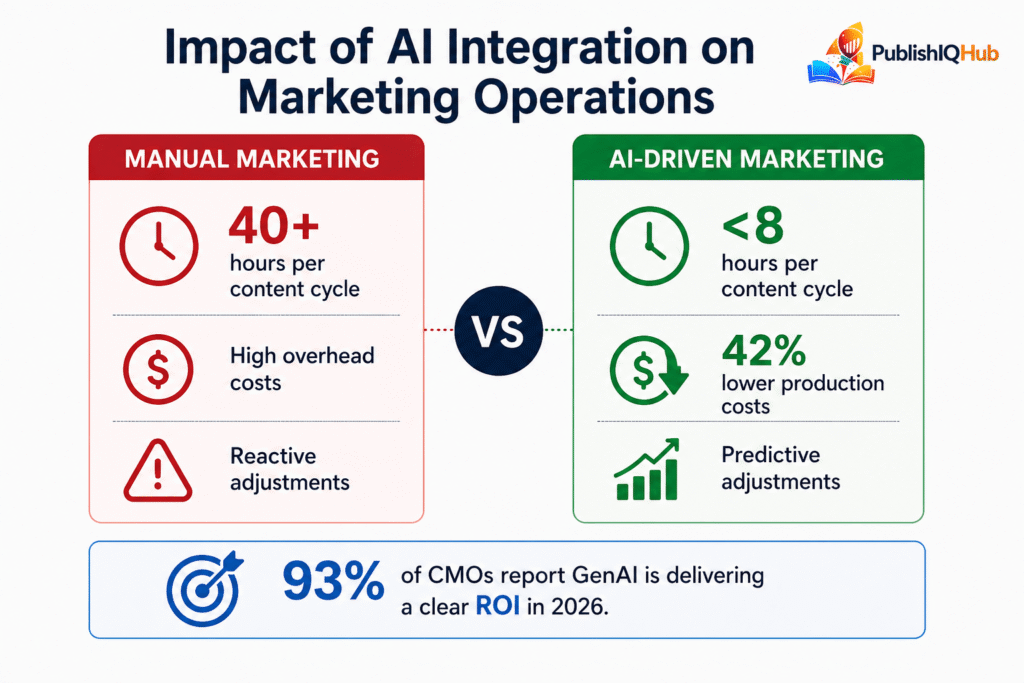
1. High-Velocity Content Production: AI tools now allow teams to move from two blog posts a month to twelve or more, while simultaneously reducing the cost of production by up to 67 percent. This allows brands to cover a wider range of niche topics that were previously too expensive to target.
2. Predictive Lead Scoring: Instead of relying on historical data, AI predicts future behavior by analyzing subtle signals across social media, browsing history, and real-time interactions. By the time a lead hits your CRM, the AI has already assigned it a probability score for conversion.
3. Automated Creative Testing: AI platforms can now run thousands of multivariate tests on ad copy and imagery in the time it used to take a human to set up a single A/B test. This ensures that every dollar of ad spend is backed by data-driven creative choices.
In fact, by 2026, generative AI is expected to unlock between $0.8 trillion and $1.2 trillion in annual value across sales and marketing globally through incremental productivity and revenue gains.
ROI Benchmarks for AI-Based Digital Marketing
When evaluating AI-based digital marketing systems, the return on investment is often seen in both time saved and revenue generated. For many mid-sized enterprises, the adoption of AI has led to a 3.5x higher ROI on personalized campaigns compared to traditional static ones.
The ability to pivot campaigns in real-time based on live performance data means that underperforming ads are cut immediately, and winning creatives are scaled instantly.
Predictive Analytics: Moving from Reactive to Proactive Marketing
One of the most transformative elements of AI-driven digital marketing is the shift from descriptive analytics (what happened) to predictive analytics (what will happen). In the traditional marketing model, teams would spend weeks analyzing the previous month’s performance to make adjustments for the next.
Nowadays, AI models analyze real-time signals to forecast consumer behavior with up to 85% accuracy.
Predictive modeling allows for “Pre-Emptive Lead Nurturing.” By identifying “intent clusters”, groups of behaviors that typically precede a purchase, the AI can trigger a personalized intervention before the customer even begins looking at a competitor.
For example, if a user’s engagement with your technical whitepapers increases while their time on-site for pricing pages decreases, the AI might identify this as a “research phase” and serve them an educational video via a targeted ad.
This proactive stance extends to “Churn Prediction” as well. AI-based digital marketing systems can flag accounts that show a drop in engagement intensity, allowing your customer success team (or an automated AI agent) to reach out with a loyalty offer before the user decides to cancel.
By the time a human marketer sees a trend, the AI has already executed a solution, effectively turning your marketing department into a 24/7 revenue-protection engine.
Role of the AI Conversational Chatbot in Modern Lead Funnels
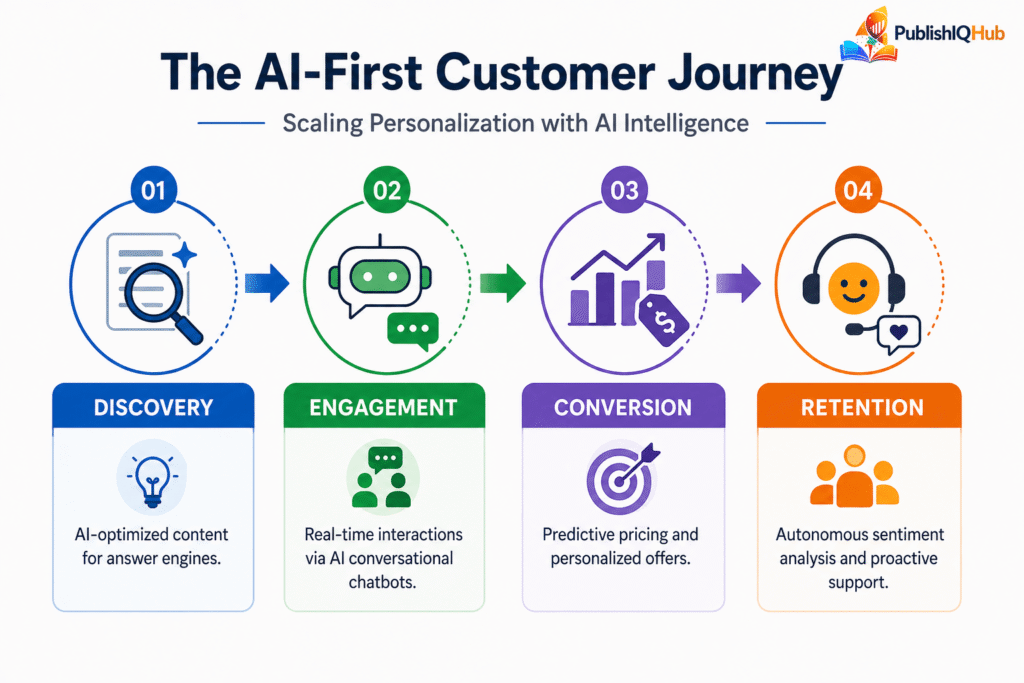
The AI conversational chatbot has become the frontline representative for most digital brands. These are no longer simple “if/then” scripts. Modern chatbots are Agentic, meaning they can access your CRM, check inventory, and even process basic transactions without human intervention. This shift from informative bots to functional agents has fundamentally changed the sales cycle.
For lead generation, the AI conversational chatbot provides a frictionless entry point. It can qualify a lead by asking three to five strategic questions and immediately book a meeting in the appropriate salesperson’s calendar. This reduces the lead decay that occurs when a prospect has to wait hours or days for a human response.
Furthermore, because these bots are multimodal, they can process screenshots of problems or voice notes from customers, providing a level of service that was previously impossible without a massive support staff. In a B2B context, the chatbot acts as a research assistant for the prospect, pulling up relevant case studies or technical whitepapers based on the specific industry mentioned during the chat.
Implementation Strategy for AI-Based Digital Marketing
To successfully deploy an AI-based digital marketing framework, organizations should follow a modular implementation plan that prioritizes high-impact areas first. Attempting to overhaul the entire marketing department overnight often leads to technical friction and data silos.
Phase 1: The Data Foundation. Before implementing AI, your data must be clean and structured. AI is only as good as the information it processes. Ensure your CRM and website analytics are properly integrated and that you have a clear strategy for data hygiene. Without a clean data layer, your AI will generate “hallucinations” or incorrect audience segments.
Phase 2: Integrating the AI Conversational Chatbot. Deploying a bot is the fastest way to see immediate ROI. It improves customer satisfaction scores and acts as a data collection engine that informs your broader content strategy by highlighting exactly what your customers are searching for in their own words.
Phase 3: Transitioning to AEO (Answer Engine Optimization). Review your top-performing content and reformat it for AI models. This means adding Direct Answer sections, using clear hierarchies, and ensuring all images and tables have machine-readable metadata.
Technical Integration: Scaling the AI-Native Marketing Stack
The transition to AI-based digital marketing is not merely a tactical change; it is a fundamental infrastructure upgrade. In 2026, the most successful brands are those that have moved away from “bolted-on” AI tools toward an AI-native marketing stack. This requires a centralized data lake where information from your website, social media, and AI conversational chatbot can be processed in a unified environment.
The primary technical challenge for modern marketers is the elimination of data silos. When your email marketing AI cannot communicate with your ad-buying AI, you lose the ability to create a seamless customer journey.
Integration allows for “Closed-Loop Attribution,” where the system understands that a customer who interacted with a chatbot on Monday is the same individual who saw a personalized LinkedIn ad on Wednesday. This connectivity is what enables the high-level predictive accuracy that drives a superior ROI.
Furthermore, a well-integrated stack supports the deployment of “Custom GPTs” or private LLMs (Large Language Models) trained on your brand’s specific historical data. This ensures that every piece of content generated, whether a social post or a response from an AI conversational chatbot, remains 100% aligned with your unique brand voice and proprietary knowledge base.
Data Privacy and Transparency in AI-Driven Digital Marketing
As AI takes a larger role, the ethical use of data has become a primary consumer concern. Today, transparency is a brand differentiator. Consumers are more likely to trust a brand that clearly explains how AI is being used to improve their experience. This includes being open about the use of an AI conversational chatbot and providing users with easy options to escalate to a human agent if preferred.
With the sunsetting of traditional cookies, AI has become the primary tool for “Privacy-Safe” targeting. Instead of tracking individuals, AI uses cohort analysis to understand groups without compromising personal identity. Brands that lean into this “Privacy-First” AI model are seeing higher engagement rates because users feel more secure in their digital interactions.
Recent studies indicate that 88% of organizations now use AI in at least one business function, yet consumer trust remains tied to transparency, with 70% of users favoring brands that prioritize AI data security.
Ethical AI: The Necessity of a Human-in-the-Loop
The greatest risk of AI in digital marketing is the loss of brand soul. While an AI can mimic a brand’s tone, it cannot understand the deep emotional nuances of a target audience. Therefore, the concept of “Human-in-the-Loop” (HITL) has become the gold standard for high-performing marketing teams.
Marketers are moving away from “Set and Forget” automation. Instead, they use AI to generate five different creative directions, which are then vetted by a human creative director for emotional resonance and cultural sensitivity.
This ensures that the speed of AI is balanced by the wisdom of human experience. Brands that skip this step often find themselves mired in “Brand Dilution,” where their content looks and feels exactly like their competitors.
Ethical AI: The Necessity of a Human-in-the-Loop
The greatest risk of AI in digital marketing is the loss of brand soul. While an AI can mimic a brand’s tone, it cannot understand the deep emotional nuances of a target audience. Therefore, the concept of “Human-in-the-Loop” (HITL) has become the gold standard for high-performing marketing teams.
Marketers are moving away from “Set and Forget” automation. Instead, they use AI to generate five different creative directions, which are then vetted by a human creative director for emotional resonance and cultural sensitivity.
This ensures that the speed of AI is balanced by the wisdom of human experience. Brands that skip this step often find themselves mired in “Brand Dilution,” where their content looks and feels exactly like their competitors.
Emerging Trends: Generative Media and Predictive Social Commerce
As we look toward 2027, the next major trend is the rise of generative video and predictive social commerce. Social media platforms are increasingly using AI to not just show you what you like, but to predict what you will want to buy three days from now.
- AI-Generated Video Personalization: Imagine receiving a video message from a brand where the spokesperson addresses you by name and speaks about the specific product you left in your cart. This technology is now moving from “creepy” to “helpful” as the quality of AI-generated video becomes indistinguishable from real footage.
- Social Listening 2.0: AI-driven digital marketing now includes “Sentiment Forecasting.” By analyzing the mood of the internet across millions of social posts, brands can predict upcoming trends or potential PR crises before they go viral. This allows for a proactive marketing stance that was never possible in the era of manual monitoring.
Conclusion: Securing Your Brand in an AI-Dominated Market
The shift to AI in digital marketing is the most significant change in the industry since the invention of the search engine. By embracing AI-based digital marketing and optimizing for the new world of AI conversational chatbots and Answer Engines, brands can build a future-proof marketing stack that is resilient, efficient, and deeply human-centric. The winners will not be those who replace their marketing teams with AI, but those who empower their teams to use AI as a high-speed engine for growth.
The technology is ready, the data is available, and the consumers are waiting for more intelligent, personalized experiences. The only question remains: is your brand’s infrastructure ready to support an AI-first future?
Stay ahead of the rapidly changing digital landscape. To learn more about how technology is reshaping business operations, keep reading our blog for the latest insights on marketing technology, data hygiene, and enterprise automation.
Frequently Asked Questions
Is the difference between SEO and AEO?
SEO (Search Engine Optimization) focuses on ranking in a list of web links on a search results page. AEO (Answer Engine Optimization) focuses on being the direct, cited answer provided by an AI model like Gemini, ChatGPT, or Perplexity.
How does an AI conversational chatbot help with SEO/AEO?
Chatbots increase “dwell time” and reduce bounce rates, which are positive signals to search engines. Furthermore, they identify the exact natural-language questions users are asking, allowing you to create content that directly answers those queries for AEO.
Is AI driven digital marketing safe for brand voice?
Yes, provided you use a Human-in-the-Loop approach. AI should be used for data analysis and initial drafting, while human editors provide the final brand-voice and ethical check to ensure the content remains authentic.
Can small businesses afford AI-based digital marketing?
Absolutely, AI is no longer a luxury. Many powerful AI features are integrated directly into affordable platforms like Canva, Mailchimp, and HubSpot, making advanced tools available to small businesses at a fraction of the traditional cost.
What is Information Gain in content marketing?
Information gain refers to the unique value your content adds that isn’t found elsewhere on the web. AI models prioritize original research, unique case studies, and proprietary data over derivative “copycat” content. If your content is identical to five other sites, the AI will not cite you.
Why is AEO important?
As more users get their information directly from AI summaries and voice assistants, being the “cited source” is the only way to maintain organic visibility and drive high-intent traffic to your site.
How does AI help with ad spend efficiency?
AI uses predictive modeling to identify which users are most likely to convert based on real-time behavior. This allows you to focus your budget on high-value leads and avoid wasting money on “curiosity clicks” that never lead to a sale.
What is a Multimodal AI chatbot?
A multimodal bot can understand and respond to more than just text. It can analyze images (like a photo of a broken part), listen to voice notes, and review PDF documents shared by the user to provide more accurate and contextual help.
Does AI marketing require a technical background?
While a technical understanding helps, many modern AI marketing tools are designed with “no-code” or “low-code” interfaces. This allows creative marketers to leverage advanced technology and build complex automations without writing a single line of code.
What is the best way to start with AI in digital marketing?
The best way is to identify your most time-consuming manual task, such as lead qualification, social media drafting, or ad optimization, and implement a specific AI tool to solve that problem first before scaling to other areas.
What is GEO (Generative Engine Optimization)?
GEO is the specific practice of optimizing your website’s content so that generative AI models include your brand in their generated responses. It is a subset of AEO that focuses on the “generative” aspect of modern search.