
In the current economic climate, the old adage of “saving for a rainy day” has been replaced by a more aggressive mandate: “investing for a digital decade.” With global inflation settling into a new normal and technology cycles accelerating at an unprecedented pace, leaving capital idle is no longer just a missed opportunity- it is a slow, silent erosion of purchasing power.
For the modern professional, business owner, or institutional treasurer, the challenge in 2026 isn’t a lack of opportunity; it’s the sheer volume of various investment options available. We have moved from a world of simple “stocks and bonds” to a complex ecosystem of digital infrastructure, green energy credits, and thematic equities.
Success in this environment requires moving beyond simple “stock picking” toward a sophisticated understanding of various types of investment options and how they interact within a resilient, high-performance portfolio.
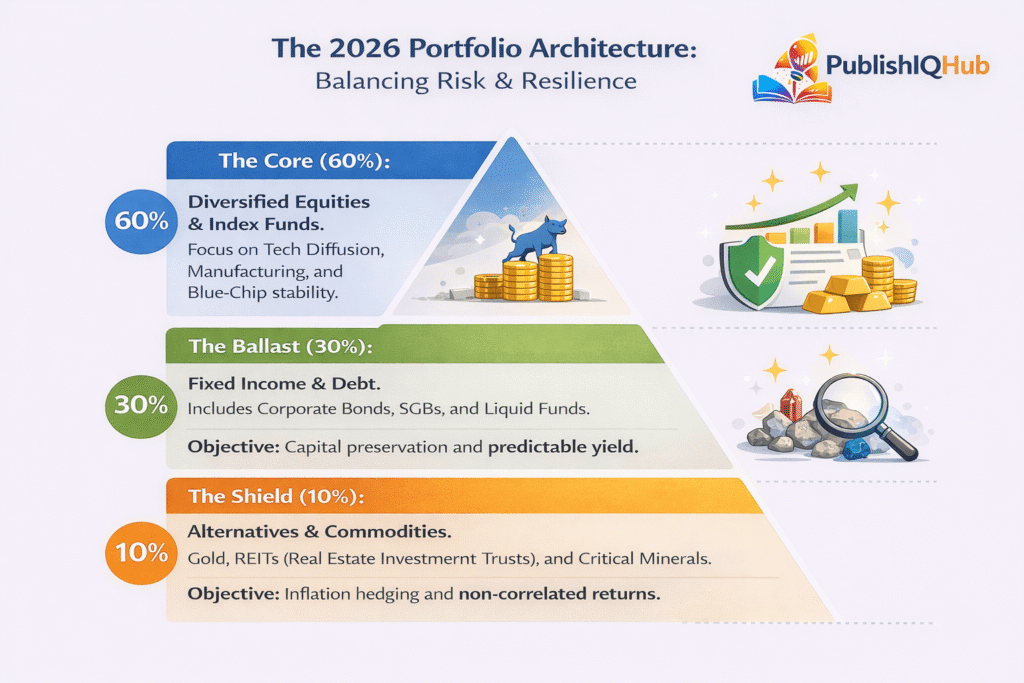
The Growth Engine: Equity and Thematic Diversification
Equities remain the primary driver of long-term wealth creation. However, the “buy and hold” strategies of the past are being refined by a focus on thematic tailwinds. In the current market, smart capital is moving toward sectors with structural, non-cyclical growth.
The AI Infrastructure Play
As Artificial Intelligence moves from a speculative buzzword to a functional layer in every industry, the focus has shifted from the “model makers” to the “picks and shovels” providers. This includes:
- Data Centers & Specialized REITs: The physical housing for the world’s compute power.
- Semiconductor Value Chains: Beyond just the chip designers, the companies providing the etching chemicals and cooling systems are seeing massive inflows.
- Edge Computing: The hardware that allows AI to process data locally in factories and hospitals.
The Manufacturing Renaissance (China + 1)
Driven by global supply chain diversification, manufacturing has re-emerged as a strategic play. Countries like India, Vietnam, and Mexico are seeing unprecedented institutional investment in electronics, IT hardware, and automobile manufacturing. Investing in the companies leading this shift provides exposure to the “real economy” growth of emerging markets.
Small-Cap Agility
While large-caps provide the “floor” for a portfolio, the real alpha in 2026 is being found in small-cap firms. These companies are often agile enough to adopt new generative technologies 12-18 months faster than their enterprise peers, allowing them to capture market share in fragmented industries like specialized logistics and boutique finance.
The Ballast: Debt and Fixed-Income Instruments
If equity is the engine of your portfolio, debt is the braking system—it provides the control and stability necessary to navigate market volatility. Various investment products in the fixed-income space offer the predictable returns required for risk-averse capital or near-term goals.
Corporate Bond Funds and Private Credit
Medium-term corporate bonds are currently offering attractive yields as companies shore up their balance sheets for the next phase of expansion. Furthermore, “Private Credit” lending directly to mid-sized companies has become a mainstream way for individual investors to capture yields that were previously reserved for big banks.
Sovereign Gold Bonds (SGBs) & Treasury Bills
For those seeking the ultimate safety net, government-backed instruments remain the gold standard. SGBs, in particular, offer a dual benefit: the price appreciation of physical gold plus a fixed annual interest rate (typically around 2.5%). This makes them a premier hedge against currency devaluation while providing a semi-annual “coupon” payment.
Fixed Deposits (FDs) and “Liquidity Laddering”
Traditional FDs have seen a resurgence as interest rates have stabilized at higher levels. The sophisticated approach today is “Laddering”- dividing your capital into FDs with varying tenures (e.g., 6 months, 1 year, 3 years). This ensures that a portion of your cash is always becoming available for reinvestment or emergencies without sacrificing the higher yields of long-term lock-ins.
The Defensive Layer: Commodities and Inflation Hedges
In a “Multipolar” world where geopolitics can shift overnight, physical assets provide a necessary layer of protection that digital or paper assets sometimes cannot.
Gold as a Strategic Reserve
Gold is no longer just a “crisis asset”; it is a foundational portfolio component. Central bank buying remains at historic highs, supporting the floor price of the metal globally. It acts as the ultimate stabilizer when the historical “negative correlation” between equities and bonds breaks down.
Critical Minerals: The New Oil
As the world shifts toward “The Future of Energy,” minerals like lithium, copper, cobalt, and rare earth elements have become high-stakes investment targets. These are the essential building blocks for the batteries, turbines, and hardware of the next industrial era. Investing in the mining and processing of these minerals is a direct bet on the global energy transition.
Real Estate Investment Trusts (REITs)
Instead of the high-friction, low-liquidity process of buying physical property, REITs allow you to invest in high-grade commercial real estate with the click of a button. In 2026, the focus has shifted from traditional “Office Space” to “Industrial Logistics” (warehouses for e-commerce) and “Healthcare Real Estate” (clinics and labs).
Modernizing the Small Business Investment Portfolio
For small business owners and self-employed professionals, the distinction between “business capital” and “personal wealth” is often blurred. Various types of investment options for this segment focus on maximum tax efficiency and high liquidity.
Tax-Advantaged Vehicles (PPF & VPF)
The Public Provident Fund (PPF) remains one of the most powerful tools for Indian investors. Its “EEE” status- Exempt on investment, Exempt on interest, and Exempt on maturity makes it an unbeatable long-term wealth generator. For those with a higher risk tolerance, the Voluntary Provident Fund (VPF) allows for additional contributions into the same high-interest, tax-free bucket.
Infrastructure Investment Trusts (InvITs)
Similar to REITs, InvITs offer a way to participate in the massive infrastructure projects- toll roads, power grids, and fiber networks that are currently being built out. These products typically offer high payout ratios, making them ideal for investors seeking regular dividend income to supplement their primary business earnings.
Mutual Funds and SIPs: The Power of Rupee Cost Averaging
Systematic Investment Plans (SIPs) remain the most effective way to manage market volatility. By investing a fixed amount every month into various investment products, you buy more units when prices are low and fewer when they are high. This removes the “emotional trap” of trying to time the market—a strategy that fails 90% of the time.
The Psychology of Investing in 2026
Technical knowledge of various investment options is useless without the psychological discipline to stay the course. The biggest threat to your portfolio in 2026 isn’t a market crash; it’s “Information Overload.”
- Tune Out the “Finfluencer” Noise: Social media is designed to trigger FOMO (Fear Of Missing Out). A boring, consistent strategy almost always outperforms a “trendy” one over a 10-year period.
- The “Sleep Test”: If you are checking your portfolio more than once a week, or if a 5% market dip keeps you awake at night, you are over-leveraged. Rebalance your various types of investment options toward the “Ballast” layer until you can sleep soundly.
- Automation is Your Best Friend: The more “human intervention” an investment requires, the more likely it is to be sabotaged by fear or greed. Automate your SIPs, your FD renewals, and your rebalancing triggers.
Conclusion: The Discipline of Consistency
The most successful investors in the current era aren’t those who find a “magic” product; they are those who maintain the best habits. Whether you are exploring various investment options for personal wealth or corporate reserves, the principles of diversification, tax optimization, and long-term thinking remain the only true “guarantees” in finance.
The market rewards patience and punishes impulsivity. By constructing a portfolio from various types of investment options that complement each other, you aren’t just saving money- you are building a resilient engine for future prosperity.
To keep your strategy sharp in this rapidly evolving financial landscape, keep following us for more in-depth perspectives on the tools and trends defining our world.
Frequently Asked Questions (FAQs)
How do I choose between various investment products?
Selection should be driven by “Time Horizon” and “Risk Capacity.” If you need the capital in less than 3 years (e.g., for a house down payment), avoid equities. If your goal is retirement (15+ years away), your biggest risk isn’t volatility- it’s not having enough equity exposure to beat inflation.
Is it safe to invest in AI and Tech right now?
The “Tech Diffusion” theme is maturing. The key in 2026 is to look for “AI Adopters”- traditional companies in sectors like Finance, Agriculture, or Healthcare that are using AI to radically increase their margins
rather than just chasing the “AI Builders.”
What is the role of Gold in a modern portfolio?
Gold should represent 5% to 10% of your total assets. Its job isn’t to make you rich; its job is to ensure that if the rest of the market crashes or currency devalues, you have a liquid asset that retains its purchasing power.
Are Fixed Deposits still relevant in a high-growth world?
Absolutely. In a volatile market, having a “Cash Bucket” in FDs or high-yield savings provides the psychological and financial breathing room to stay invested in equities during a downturn. It’s your “dry powder” for when the market goes on sale.
How often should I rebalance my various investment options?
A semi-annual or annual review is the industry standard. This ensures that if one asset class (like stocks) has a massive run, you sell a bit of the “high” to buy more of the “low” (like bonds or gold), effectively forcing you to “buy low and sell high” automatically.
What is the biggest mistake investors make with various types of investment options?
Chasing Performance.” Many investors see an asset class that did 30% last year and move all their money into it, only to be hit when that sector mean-reverts. True wealth is built through Asset Allocation, not “product picking.”