
The B2B landscape today has moved far beyond the simplistic “lead gen” tactics of the past decade. The buyer’s journey is no longer a linear path through a funnel; it is a complex, multi-touch exploration that happens largely in the “dark”- on social platforms, in private communities, and through peer-to-peer recommendations. For modern organizations, Demand Generation Services have become the primary engine for navigating this complexity and building a predictable, scalable revenue stream.
Success in this environment requires a fundamental shift in mindset. It is no longer about finding people to sell to; it is about creating an environment where people want to buy. In this comprehensive guide, we explore the strategic architecture of 2026 demand generation and how a B2B Demand Generation Agency can transform your growth trajectory.
What is Demand Generation?
Before we can master the strategy, we must clearly define the term. What is Demand Generation?
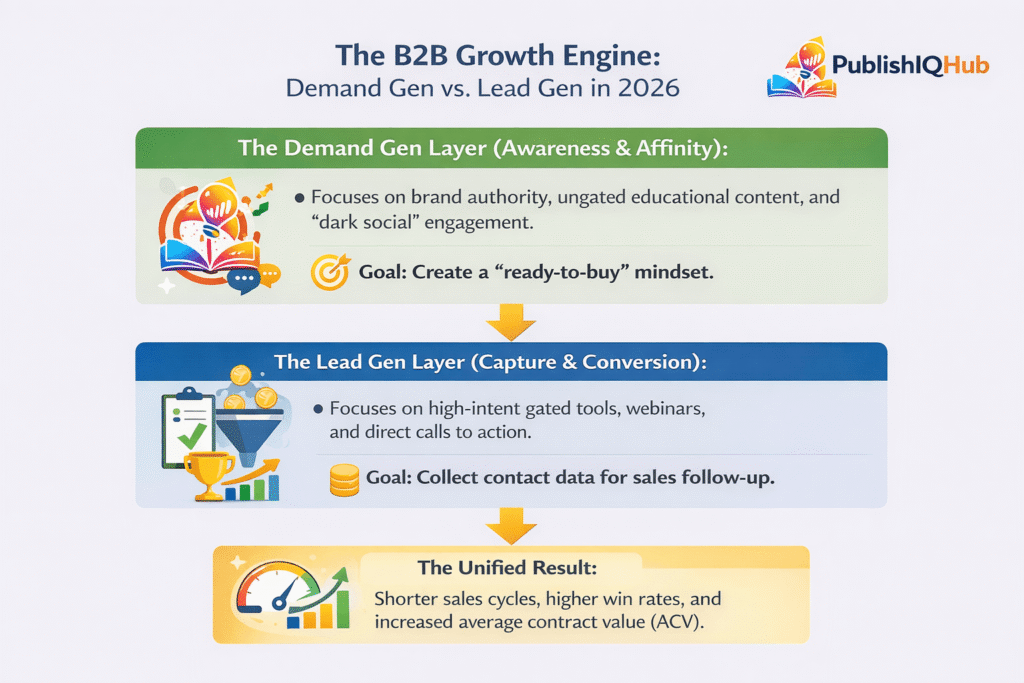
At its core, demand generation is the holistic, data-driven effort to create awareness and genuine interest in your company’s products or services. While many conflate it with lead generation, the two are distinct. Lead generation is a transactional capture of contact data—the “hand-raiser” who fills out a form. Demand generation is the “top-of-funnel” and “middle-of-funnel” heavy lifting that builds brand authority, educates the market on a specific problem, and nurtures prospects long before they are ready to engage with a sales representative.
Demand generation is defined by relevance. It is the art of showing up in the right place, with the right message, at the exact moment a prospect is feeling the pain point your solution solves. It is about “capturing demand” that already exists while simultaneously “creating demand” by highlighting inefficiencies a prospect didn’t know they had.
Core Demand Generation Strategies for 2026
To build a resilient pipeline, organizations must deploy a mix of evergreen tactics and cutting-edge Demand Generation Strategies.
Account-Based Orchestration (ABO)
ABM (Account-Based Marketing) has evolved; we now use Orchestration. This involves using AI to coordinate personalized touchpoints across multiple channels—LinkedIn, email, direct mail, and programmatic display—for high-value accounts simultaneously. Instead of just sending an email, ABO ensures that when a key stakeholder at a target account visits LinkedIn, they see a relevant case study; when they check their industry news, they see your expert commentary.
Content as an Intellectual Product
Modern demand generation relies on high-signal content. In an age of AI-generated noise, value is the only currency that matters. This includes:
- Interactive Tools: Self-assessment quizzes and cost-savings calculators that provide immediate, personalized value.
- Proprietary Research: Original data reports that the industry cites, positioning your brand as the primary source of truth.
- Podcast & Video Series: Building a “media-first” brand that people subscribe to because they find it genuinely valuable, not just because they want a whitepaper.
The Rise of “Dark Social” Engagement
Dark social refers to the invisible shares and conversations happening in Slack groups, Discord servers, and private DMs. Demand generation services focus on “seeding” these communities by empowering internal subject matter experts to engage authentically, rather than just pushing corporate links.
Why Partner with a B2B Demand Generation Agency?
Building a high-performance growth engine in-house is an expensive and time-consuming endeavor. The technology stack alone required to compete- intent platforms (like 6sense or Demandbase), marketing automation, CRM, and AI analytics can cost six figures annually. This is why more firms are turning to a specialized B2B Demand Generation Agency.
The “Full-Stack” Advantage
A specialized agency provides access to a “Fractional Growth Team.” This typically includes:
- A Strategist: To align marketing goals with actual revenue targets.
- A Content Architect: To build the educational assets that drive trust.
- A Data Scientist: To analyze intent signals and determine which accounts are actually in a buying window.
- An Ad Ops Specialist: To ensure technical precision in cross-channel distribution.
Attempting to hire these roles individually often leads to “siloed” marketing; an agency offers a unified approach where every dollar spent is tracked back to pipeline impact.
The Shift Toward Outsourced Demand Generation
For mid-market and enterprise firms, Outsourced Demand Generation is a strategic move to gain agility. In a market where buyer preferences change monthly, an outsourced partner acts as a laboratory for your brand.
- Speed to Value: An agency can typically stand up a complex, multi-channel campaign in 4 weeks. Internal teams, hampered by departmental silos and bureaucratic approvals, often take months to achieve the same result.
- Objective Auditing: An external partner can objectively identify “leaks” in your sales process- such as a misalignment between marketing’s definition of a “lead” and what sales actually wants.
- Tech Stack Arbitrage: Agencies spread the cost of elite software across multiple clients, giving you access to $500k worth of tech for a fraction of the cost.
Top 5 Benefits of Demand Generation Services
Investing in professional Demand Generation Services delivers a measurable impact that goes far beyond simple “brand awareness.”
- Increased Pipeline Velocity: By educating prospects before they talk to sales, the “closed-won” cycle is significantly shortened. Prospects enter the conversation already knowing your value.
- Higher Sales/Marketing Alignment: These services bridge the gap. Marketing stops focusing on “MQLs” (which sales often ignore) and starts focusing on “Sales Qualified Opportunities” (SQOs).
- Lower Cost Per Acquisition (CPA): Targeting only high-intent accounts means you stop wasting budget on prospects who will never buy.
- Sustainable Category Authority: Consistent demand gen makes you the “default” choice in your category. You don’t just compete in the market; you define it.
- Predictable Revenue Scaling: With a data-backed engine, you can accurately predict how much pipeline a specific investment will generate, removing the guesswork from budget planning.
Integrating Intent Data: The Secret Weapon
You cannot afford to treat all traffic equally. Modern demand generation services prioritize Intent Data. By identifying which companies are searching for your keywords or visiting your competitors’ pricing pages, you can focus 80% of your effort on the 20% of the market that is actively looking for a solution. This “surgical” approach to marketing ensures that your brand is top-of-mind exactly when a decision is being made.
Conclusion: Building Your Growth Engine
The era of “spray and pray” marketing is dead. Today, the winners are those who view Demand Generation Services not as a luxury but as the core infrastructure of their business. By moving from a “lead-first” to a “demand-first” model, you respect the intelligence of the modern buyer and build a brand that lasts.
Whether you build this capability internally or partner with a B2B Demand Generation Agency, the goal remains the same: creating a predictable, scalable path to revenue that reflects the reality of how people buy today.
Is your pipeline ready for the rest of 2026? Keep following us for the latest deep dives into the tools and trends shaping our digital world.
Frequently Asked Questions (FAQs)
How long does it take to see results?
While lead gen can provide contacts overnight, true demand generation usually shows a significant uptick in high-quality pipeline within 3 to 6 months. This is the time required to build the “trust equity” necessary for B2B buyers to move.
Should we stop doing lead generation entirely?
No. Lead generation (like webinars or gated tools) still has a place for capturing intent; it should only account for about 20% of your effort. Demand gen does the heavy lifting so that your lead gen is 10x more effective.
How do we measure ROI?
The primary metric is Pipeline Contribution. We track how many opportunities were influenced by demand generation touchpoints and the “velocity” of those deals. We also look at “Customer Acquisition Cost” (CAC) vs. “Lifetime Value” (LTV).
Is demand generation only for large enterprises?
Absolutely not. Small-to-mid-sized businesses benefit greatly as it allows them to appear much more authoritative than their size suggests. It’s the ultimate equalizer in a crowded market.
What is the most important channel in 2026?
LinkedIn Orchestration. Combining professional graph data with your own first-party data creates the most powerful signal-to-noise ratio in B2B marketing today.