
This year marks the official end of the “experimentation era” for artificial intelligence. We have moved beyond the initial shock of generative text into a grounded, high-velocity period of AI Automation. For modern enterprises, the question is no longer about whether to adopt these tools, but how deeply to weave them into the fabric of daily operations.
Today, AI Automation is the invisible nervous system of the global economy. It is the force that allows a small startup to out-maneuver a legacy corporation and the engine that enables Fortune 500 companies to maintain personalization across billions of interactions. In this definitive guide, we explore the core pillars of automation- from marketing and sales to the complex world of commerce, and why these systems are the key to enterprise resilience in 2026.
AI Marketing Automation: The Shift from Persona to Individual
Marketing used to be a game of broad strokes and “lookalike” audiences. In 2026, AI Marketing Automation has turned the funnel into a hyper-responsive, living ecosystem.
- Dynamic Creative Orchestration: Traditional automation could swap a name in an email. Modern AI now generates the entire visual asset, the subject line, and the offer in real-time based on the user’s immediate psychological state. By analyzing browsing velocity, historical preferences, and current sentiment, the system crafts a unique message that resonates in the moment.
- Predictive Customer Journeys: Rather than following a static “If/Then” logic, AI now predicts the next best action. If a user is likely to churn, the system autonomously triggers a loyalty-focused experience before the user even considers leaving. This proactive approach has redefined customer retention, moving from reactive damage control to preemptive relationship building.
- Zero-Latency Campaign Optimization: Marketing teams no longer wait for “weekly reports.” AI monitors ad performance across 50+ channels simultaneously, shifting budgets in milliseconds to the highest-performing placements without human oversight. This ensures that every dollar spent is optimized for the highest possible ROI in real-time.
- Hyper-Localized Content Delivery: Even without specific geography-based targeting, AI can detect regional cultural nuances and linguistic shifts, adjusting campaign imagery and tone to fit local “vibes” automatically. This allows global brands to feel local everywhere without massive localized marketing teams.
AI Sales Automation: Scaling High-Intensity Relationships
Sales has always been the most “human” department, but in 2026, the human element is being supercharged. AI Sales Automation allows a single representative to manage the pipeline of what used to require an entire department.
- Revenue Intelligence & Call Coaching: Sales leaders no longer listen to recordings manually. AI analyzes every sales call in real-time, providing “whisper coaching” to the rep and automatically updating the CRM with structured data, sentiment analysis, and confirmed follow-up dates. This reduces administrative overhead by nearly 40% for top-tier sales organizations.
- Hyper-Personalized Prospecting: AI now performs deep-dive research on prospects by scanning SEC filings, social media, and industry news. It drafts 1:1 outreach that references specific pain points, reducing the time spent on manual research by over 80%. This ensures that when a salesperson finally picks up the phone, they are armed with unparalleled context.
- Intent-Based Lead Prioritization: By connecting to the broader digital ecosystem, AI identifies “dark social” signals—when a prospect is researching a solution but hasn’t filled out a form yet—allowing sales teams to strike while the iron is hot. Lead scoring is no longer about clicks; it’s about demonstrated professional intent.
- Automated Contract Negotiation: Modern sales platforms use AI to handle the first few rounds of contract redlining. By comparing a prospect’s requested changes against the legal department’s “safe” parameters, the system can autonomously approve or counter standard clauses, accelerating the closing cycle by days.
AI Process Automation: The Modern System of Action
For decades, the ERP (Enterprise Resource Planning) was a “system of record.” In 2026, AI Process Automation has transformed it into a “system of action.” It is no longer about storing data; it’s about what the data does next.
- Cognitive Document Processing: AI can now “read” and comprehend unstructured text in contracts, handwritten invoices, and legacy files. It extracts the necessary data, validates it against compliance rules, and triggers the next step in the workflow automatically. This has essentially eliminated the “manual data entry” role in modern finance departments.
- Intelligent Supply Chain Reconciliation: When a global shipping delay occurs, AI doesn’t just alert a manager. It cross-references current inventory, predicts the impact on production, and autonomously negotiates with alternative suppliers to bridge the gap. It balances cost, speed, and quality in seconds—tasks that used to take human procurement teams hours of phone calls.
- Financial Anomaly Detection: Instead of end-of-quarter audits, AI performs “continuous auditing.” It monitors every transaction in real-time, instantly flagging non-compliant spending or potential fraud before the funds ever leave the account. This proactive oversight has led to a 60% decrease in corporate financial leakage globally.
- Automated IT Infrastructure Management: AI monitors network health and server loads, automatically provisioning new resources or patching vulnerabilities before they can be exploited. This shift to self-healing infrastructure has significantly reduced downtime for digital-first enterprises.
AI Automation for Commerce: The 24/7 Contextual Storefront
In the world of retail and B2B trade, AI Automation for Commerce has bridged the gap between the physical and digital worlds.
- Conversational Product Discovery: The search bar is becoming obsolete. Customers now speak or type complex needs: “I need a complete hiking outfit for a rainy trip to a temperate rainforest in October”, and the AI assembles a custom bundle based on real-time stock and weather forecasts. This “Guided Selling” increases average order value by nearly 25%.
- Post-Purchase Excellence: WISMO (“Where is my order?”) queries are now a thing of the past. AI proactively communicates delays, offers compensation before the customer asks, and handles returns via automated QR codes and home-pickup scheduling. By treating the return as a new sales opportunity, AI turns potential frustration into a positive brand touchpoint.
- Dynamic Pricing & Elasticity: AI adjusts prices thousands of times a day based on local demand, competitor stock levels, and customer loyalty. This ensures maximum margin without sacrificing volume, allowing businesses to remain profitable even in highly volatile market conditions.
Automated Visual Merchandising: For digital storefronts, AI reorganizes the layout of the homepage for every individual visitor. If a user has been browsing for outdoor gear, the entire site shifts its aesthetic and featured items to match that interest, effectively creating a “store of one.”
The Top 6 Benefits of AI Automation in 2026
Businesses that successfully implement these systems aren’t just faster; they are fundamentally different organizations. Here are the core benefits of AI automation seen by 2026’s market leaders:
- Infinite Scalability: Companies can now scale revenue by 10x while only increasing headcount by 10%. The AI absorbs the linear growth of support tickets, data entry, and lead generation, allowing the core team to focus on high-impact creativity.
- Elimination of “Decision Fatigue”: By automating the 80% of routine choices, human leaders are free to focus on the 20% of high-stakes strategy that requires true human intuition and empathy.
- Proactive Risk Mitigation: AI identifies patterns of failure- whether in a supply chain or a customer relationship, weeks before they manifest, moving the company from a reactive to a proactive stance.
- Operational Consistency: AI doesn’t have “bad days.” It applies compliance rules, brand voice guidelines, and technical standards with 100% consistency, 24 hours a day, 365 days a year.
- Hyper-Personalization at Scale: For the first time, it is possible to treat a million customers as individuals, remembering every past interaction and tailoring every future one to their specific needs.
- Drastic Reduction in Cycle Times: From loan approvals to employee onboarding, processes that used to take days now take seconds, dramatically increasing the “velocity” of the entire business and improving the bottom line.
Conclusion: The Automation Roadmap
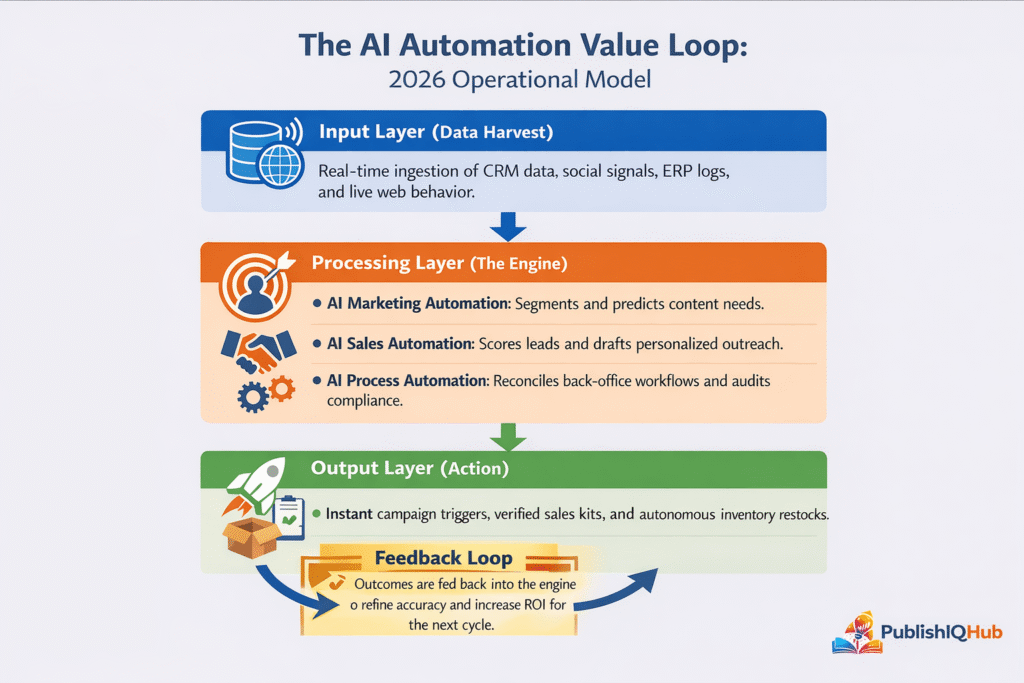
The transition to an AI-first operating model is the single greatest competitive advantage of our time. By integrating AI Marketing Automation, AI Sales Automation, and AI Process Automation, you are not just “buying software”- you are building a self-learning organization that grows smarter with every interaction.
Today, the winners are those who use automation to remove the friction of the mundane, allowing human talent to focus on innovation. Don’t miss a beat as we explore the future of efficiency. Keep following us for essential insights into the AI revolution.
Frequently Asked Questions: AI Automation in 2026
What is the difference between traditional RPA and 2026’s AI Automation?
Traditional Robotic Process Automation (RPA) is “rule-based,” meaning it follows a strict script and breaks if a step changes. 2026-era AI Automation is “intent-based”—it uses machine learning to understand unstructured data (like messy invoices or ambiguous emails) and can adapt its workflow dynamically without needing a human to hard-code every exception.
Does AI Marketing Automation risk making our brand feel “robotic”?
Actually, the opposite is happening. Because AI can now analyze real-time sentiment and years of customer context in milliseconds, it eliminates the “one-size-fits-all” templates of the past. It allows for Hyper-Personalization at Scale, ensuring every interaction feels like a 1:1 conversation rather than a mass-market blast.
How does AI Sales Automation impact the role of human sales reps?
It doesn’t replace them; it acts as a “Force Multiplier.” AI handles the 80% of “low-value” tasks—such as prospecting research, CRM data entry, and meeting transcription. This allows human reps to focus 100% of their energy on high-value activities like complex negotiations, emotional intelligence, and relationship building.
Is our proprietary data safe when using AI Process Automation?
In 2026, enterprise-grade AI Process Automation uses “Private LLM” architectures. This means your data is processed within a secure, “Zero-Retention” firewall. Your company’s sensitive information is used to trigger your specific workflows but is never leaked into public models or used to train a competitor’s AI.
What is the fastest way to see ROI from AI Automation for Commerce?
The most immediate ROI typically comes from Post-Purchase Automation. By using AI to handle “Where is my order?” (WISMO) queries and automated returns, businesses can reduce support ticket volume by up to 70% almost instantly, while simultaneously increasing customer lifetime value through proactive communication.