
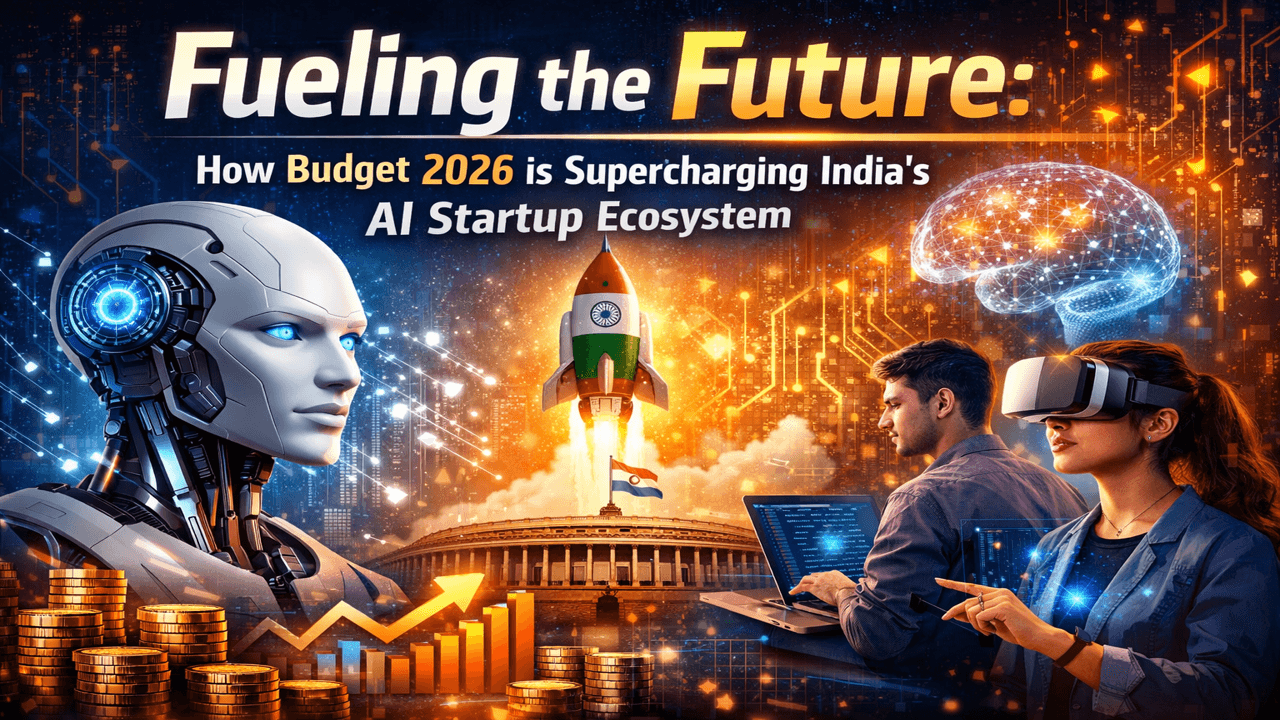
The Union Budget 2026-27 has sent a clear message to the world: India isn’t just looking to use Artificial Intelligence; it’s looking to own the infrastructure behind it. For the thousands of founders in the AI and Deep-Tech space, this budget marks a transition from “hopeful support” to “hard-coded infrastructure.”
If you’re building an AI startup in India, here is a deep dive into the provisions that will likely define your roadmap for the next decade.
1. Solving the “Compute” Crisis: The IndiaAI Mission
The biggest barrier for AI startups has always been the cost of high-performance computing (GPUs). Developing a Large Language Model (LLM) or complex computer vision system requires massive processing power that most early-stage startups cannot afford.
- The Provision: The Budget has reinforced the IndiaAI Mission with an allocation of ₹1,000 crore for the current fiscal year.
- The Impact: This fund is specifically designed to provide startups with subsidized access to GPU clusters. Currently, the mission aims to offer compute at rates as low as ₹65/hour, effectively democratizing the ability to train complex models without needing a Silicon Valley-sized VC round.
2. The ₹1 Lakh Crore RDI Fund: Patient Capital for Deep-Tech
AI development is rarely a “quick win.” It requires long-term R&D, which traditional venture capital—often looking for 3-year exits—sometimes avoids.
- The Provision: Under the Anusandhan National Research Foundation (ANRF), the government has operationalized a ₹1 Lakh Crore Research, Development, and Innovation (RDI) Fund.
- The Impact: This fund provides long-term, low-interest (or interest-free) financing. For an AI startup working on “hard problems” like climate modeling, drug discovery, or Indic-language LLMs, this offers the “patient capital” needed to innovate without the immediate pressure of hyper-growth.
3. Tax Reforms: A Breath of Fresh Air for Exits
Budget 2026 has addressed some of the most persistent “alphabet soup” tax hurdles that have plagued the tech sector for years.
- Buyback Taxation: Starting April 1, 2026, the tax on share buybacks has shifted from the company to the shareholder, now treated as Capital Gains.
- Why it matters: This makes it significantly easier and more tax-efficient for founders and early investors to find liquidity.
- Safe Harbour for IT Services: The safe harbour margin for IT and R&D services has been consolidated at 15.5%, with the eligibility threshold jumping from ₹300 crore to ₹2,000 crore.
- Why it matters: This dramatically reduces the risk of “Transfer Pricing” disputes for startups providing AI services to global parent companies or clients.
4. Infrastructure: Data Sovereignty and 2047 Vision
To support the “AI layer,” India needs a “Physical layer.”
- Data Center Tax Holiday: In a bold move, the government announced a tax holiday until 2047 for foreign entities building data centers in India.
- The Benefit: For local startups, this means more localized cloud options, lower latency, and easier compliance with data residency laws. It positions India as the “Back-end Office” for global AI workloads.
The AI Startup Cheat Sheet: Budget 2026
| Strategic Pillar | Budget Action | Founder Takeaway |
| Compute Power | IndiaAI GPU Clusters | Build models at 1/10th the global cost. |
| R&D Capital | ₹1 Lakh Cr RDI Fund | Access low-cost debt for long-term innovation. |
| Exit Strategy | Buyback Tax Reform | Easier to reward early employees and investors. |
| Hardware | ISM 2.0 (₹40k Cr) | Opportunity for Edge-AI and IoT startups. |
The Verdict
Budget 2026 isn’t just about throwing money at the problem; it’s about building a full-stack AI nation. By focusing on subsidized compute, patient R&D capital, and tax clarity, the government is attempting to move Indian AI from the “wrapper” stage (using others’ APIs) to the “foundational” stage (building our own IPs).
For founders, the message is clear: Stop building just for the consumer—start building for the infrastructure.