
Quick Answer
The strongest cybersecurity companies for US businesses in 2026 combine round-the-clock monitoring, smart automated detection, and compliance expertise. Leaders include CrowdStrike, Palo Alto Networks, Microsoft Security, and Arctic Wolf for enterprise coverage, plus Rapid7 and Huntress for growing mid-market teams that need a trusted outside partner without an in-house security operations center.
A rough year for US cyber defense
Ask any CISO how 2025 went, and you’ll likely get a tired laugh before an answer. Attackers moved faster, budgets stretched thinner, and boards started asking sharper questions about vendor risk. The numbers back up the mood.
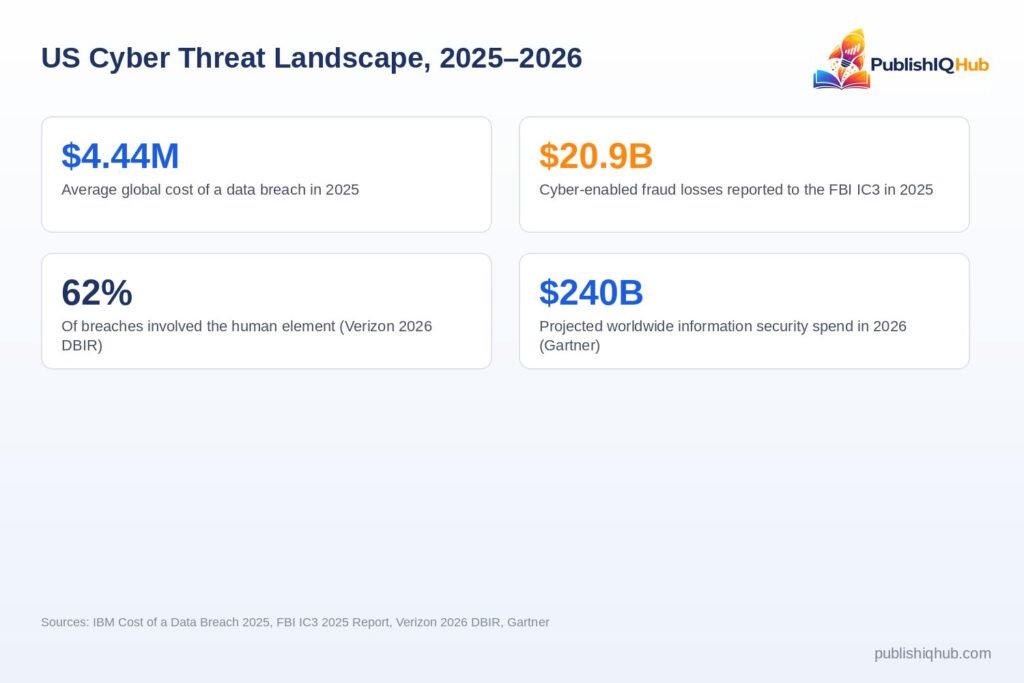
The global average cost of a data breach actually dropped to $4.44 million in 2025, down 9% from $4.88 million the year before, according to IBM’s 2025 Cost of a Data Breach Report. That sounds like good news until you read further: among organizations that suffered an AI-related security incident, 97% said they lacked proper AI access controls, and 63% had no AI governance policy at all. Shadow AI usage alone tacked an extra $670,000 onto the average breach cost.
Fraud losses tell a similarly rough story. The FBI’s Internet Crime Complaint Center reported that cyber-enabled fraud cost Americans nearly $21 billion in 2025, with investment fraud and cryptocurrency scams driving much of the increase, per the FBI’s 2025 Internet Crime Report. Meanwhile, Verizon’s latest research found that 62% of breaches involved the human element and 48% involved a third party in some capacity, a 60% jump year over year, according to the Verizon 2026 Data Breach Investigations Report.
Put those together and the picture is clear: attackers are exploiting vendor relationships and AI blind spots faster than most internal teams can patch them. That’s exactly why demand for outside security vendors keeps climbing.
What these providers actually do
“Cybersecurity company” gets used loosely, so it helps to separate the categories before comparing vendors.
- Managed security service providers (MSSPs) run day-to-day monitoring, firewall management, and incident response on a subscription basis. They’re the closest thing to hiring an outsourced security department.
- Managed detection and response (MDR) providers go a step further, pairing round-the-clock human analysts with endpoint and network telemetry to hunt for threats actively, not just log them. For a healthcare group in the Midwest that can’t staff a round-the-clock SOC, an MDR contract is often the difference between catching ransomware in hour one versus finding out from a ransom note.
- Cybersecurity consulting firms handle risk assessments, compliance audits, and incident response retainers — useful when a company needs a one-time gap analysis rather than ongoing monitoring.
- AI-native security vendors build the detection engines underneath all of the above: behavioral analytics, anomaly detection, and automated response that can act in seconds instead of the hours a human analyst would need.
Most complete security stacks today blend all four — a platform for detection, a managed layer for monitoring, and a consulting relationship for the audits regulators expect to see. The strongest enterprise cybersecurity solutions tie every layer into one coordinated system instead of a patchwork of disconnected tools.
How to choose the right cyber security partner
Picking a vendor isn’t just a pricing exercise. A few criteria separate a genuine long-term fit from a logo on a comparison chart.
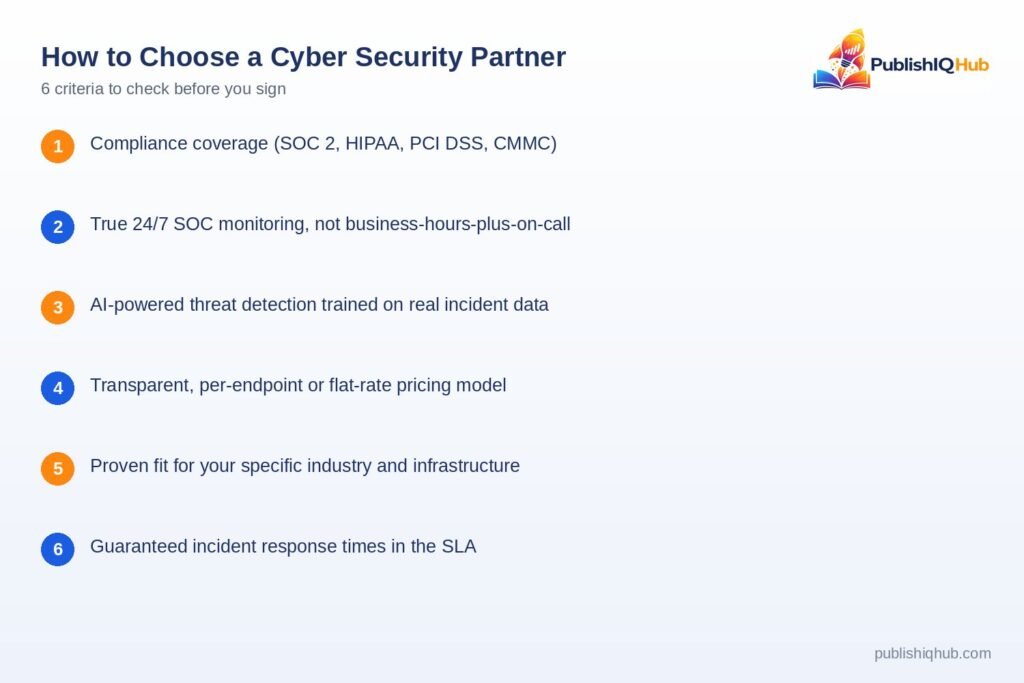
- Compliance coverage. Confirm the provider can support the frameworks that matter to the business — SOC 2, HIPAA, PCI DSS, or CMMC for defense contractors. A vendor without direct experience in the relevant framework will slow down audits, not speed them up.
- 24/7 SOC as a service. Attacks don’t wait for business hours. Ask whether monitoring is truly around the clock or “business hours plus on-call,” which is a meaningfully different service level.
- AI-powered threat detection. Look for evidence the AI models are trained on real incident data, not just marketing slides. Ask for a sample detection report from a past engagement.
- Pricing model. Contracts are typically priced per endpoint, per user, or as a flat monthly retainer. Get the pricing structure in writing before scoping expands mid-contract.
- Industry fit. A firm that specializes in financial services compliance may not be the right computer security firm for a manufacturing plant worried about operational technology (OT) risk.
- Incident response guarantees. Check the service-level agreement for guaranteed response times, not just detection times — the gap between “we saw it” and “we stopped it” is where damage happens.
Leading providers serving the US market in 2026
This roundup of top cybersecurity companies 2026 has to offer mixes enterprise security platforms, MSSP/MDR specialists, and AI-native firms. Confirm current service tiers directly with each vendor, since offerings shift quickly in this market.
1. CrowdStrike — Austin, Texas. Known for its Falcon endpoint protection platform, CrowdStrike built its reputation on cloud-native AI threat detection and has expanded into identity protection and cloud workload security. Best for mid-size to large enterprises that want a single platform instead of stitching together point products.
2. Palo Alto Networks — Santa Clara, California. One of the broadest platforms on the market, spanning network security, cloud security (Prisma Cloud), and its Cortex XSIAM AI security operations layer. Best for large enterprises consolidating multiple security vendors into one stack.
3. Microsoft Security — Redmond, Washington. Microsoft Defender, Sentinel, and Purview form a security suite that’s tightly integrated with Microsoft 365 and Azure. Best for organizations already deep into the Microsoft ecosystem that want fewer integration headaches.
4. Fortinet — Sunnyvale, California. Best known for its FortiGate firewalls and the Security Fabric architecture connecting network, endpoint, and cloud protection. Best for mid-market companies wanting strong network security at a lower total cost of ownership.
5. Zscaler — San Jose, California. One of the best-known access-security platforms on the market, Zscaler routes traffic through a cloud security platform instead of relying on traditional network perimeters. Best for distributed or remote-first workforces that need consistent policy enforcement everywhere.
6. SentinelOne — Mountain View, California. An AI-driven endpoint and cloud security platform with autonomous response capabilities that can roll back ransomware damage automatically. Best for teams that want detection and remediation to happen without waiting on an analyst.
7. Arctic Wolf — Eden Prairie, Minnesota. One of the larger MDR-focused firms in North America, Arctic Wolf pairs its Concierge Security model with a dedicated team assigned to each customer. Best for mid-market businesses that want a hands-on relationship built in, not just a dashboard.
8. Rapid7 — Boston, Massachusetts. Combines vulnerability management (InsightVM) with detection and response (InsightIDR) under one roof. Best for security teams that want vulnerability scanning and threat detection from a single vendor rather than two contracts.
9. Okta — San Francisco, California. The dominant identity and access management (IAM) provider, central to identity-first security strategies built around verifying every login rather than trusting the network. Best for companies whose biggest risk is compromised credentials, not malware.
10. Cisco Security — San Jose, California. Cisco’s security portfolio (Duo, Umbrella, XDR) benefits from deep integration with its networking hardware, which many US enterprises already run. Best for organizations standardized on Cisco infrastructure.
11. IBM Security — Armonk, New York. Combines consulting depth (IBM X-Force) with the QRadar detection platform, and produces the annual data breach cost research cited earlier in this article. Best for large enterprises needing both product depth and a strategic consulting arm.
12. Huntress — Ellicott City, Maryland. A threat-hunting specialist built specifically for small and mid-size businesses, priced and packaged to be approachable without an internal security team. Best for smaller teams that want dependable MDR coverage without enterprise-level pricing.
Comparison table: leading providers at a glance
| Company | Specialty | Best For | AI Capability | Ideal Company Size |
| CrowdStrike | Endpoint & cloud protection | Consolidated security platform | Strong | Mid-market to enterprise |
| Palo Alto Networks | Network, cloud & SecOps | Vendor consolidation | Strong (Cortex XSIAM) | Enterprise |
| Microsoft Security | Integrated security suite | Microsoft-centric orgs | Strong (Copilot for Security) | All sizes |
| Fortinet | Network security fabric | Cost-conscious network protection | Moderate | SMB to mid-market |
| Zscaler | Zero trust access | Remote/distributed workforces | Moderate | Mid-market to enterprise |
| SentinelOne | Autonomous endpoint response | Automated remediation | Strong | Mid-market to enterprise |
| Arctic Wolf | MDR with dedicated team | Hands-on managed security | Moderate | Mid-market |
| Rapid7 | Vulnerability + detection | Combined VM and XDR | Moderate | Mid-market to enterprise |
| Okta | Identity & access management | Credential-risk reduction | Moderate | All sizes |
| Cisco Security | Network-integrated security (Duo, Umbrella, XDR) | Cisco-standardized infrastructure | Moderate | Mid-market to enterprise |
| IBM Security | Consulting + QRadar detection platform | Enterprises needing consulting depth | Strong | Enterprise |
| Huntress | MDR for small business | Budget-friendly MDR | Moderate | Small business |
The rise of cybersecurity AI companies
This kind of AI-driven monitoring isn’t a buzzword anymore; it’s become the baseline expectation. Traditional signature-based tools flag what they already recognize. AI models instead learn what “normal” looks like across a network and flag deviations — a login from an unusual location, a file transfer at 3 a.m., a service account suddenly querying a database it’s never touched.
That shift matters because attackers have started using AI too. Automated phishing kits, deepfake voice calls to help desks, and AI-generated malware variants are showing up in incident reports across the industry. Vendors like SentinelOne, CrowdStrike, and Darktrace built their detection engines specifically to catch these novel patterns rather than matching against known threat signatures.
Are AI cybersecurity tools better than traditional security? Not as a replacement — as a force multiplier. AI shortens the time between an anomaly appearing and a human analyst getting an alert, but it still needs an experienced team interpreting those alerts. A platform that flags 500 anomalies a day with no triage isn’t protection; it’s noise with a subscription fee.
Typical pricing for outside security coverage
Pricing varies widely by company size, industry, and scope, but a few patterns hold across the market. Small businesses working with a firm like Huntress or a similar-tier vendor typically pay in the range of $1,000–$5,000 per month depending on endpoint count. Mid-market companies contracting a full MSSP relationship — monitoring, firewall management, and incident response — often land between $5,000 and $25,000 per month. Enterprise engagements involving round-the-clock monitoring, threat hunting, and dedicated analysts can run well past $50,000 per month once compliance reporting and custom integrations are included.
None of these figures are fixed. Get a scoped quote based on the specific environment — the number of endpoints, cloud workloads, and compliance frameworks in play changes the math considerably.
MSSP vs MDR: which is right for my company?
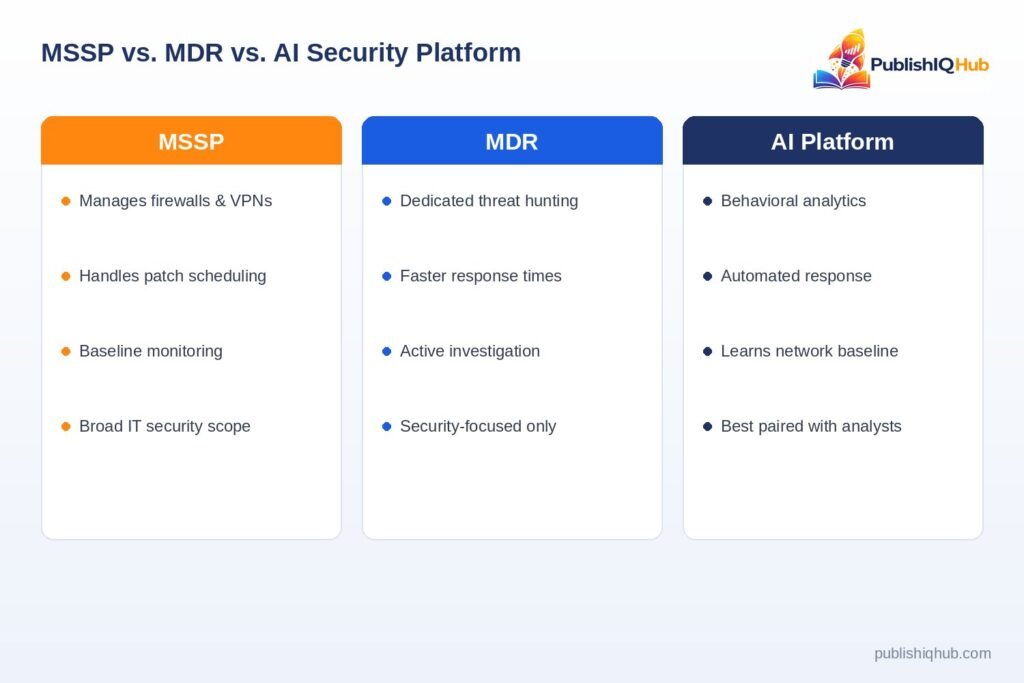
An MSSP typically manages infrastructure — firewalls, VPNs, patching schedules — alongside baseline monitoring. An MDR provider is narrower and deeper: dedicated threat hunting, faster response times, and analysts actively investigating alerts rather than just routing them. A company that needs someone managing its network devices day to day usually fits better with an MSSP. A company that already has IT staff but lacks dedicated security expertise usually gets more value from that specialized layer on top.
Choosing a partner that fits, not just a name on a list
The best cyber security services aren’t necessarily the biggest brand — they’re the ones that match a company’s size, industry, and compliance load. A regional healthcare network has different needs than a fintech startup or a manufacturing plant running legacy OT systems. Before signing anywhere, get a scoped proposal, check references from similarly sized clients, and confirm the response-time guarantees in writing.
For businesses building out their broader technology and outsourcing strategy alongside security, PublishIQHub’s guide to IT outsourcing companies in India and its breakdown of top BPO companies for business cover adjacent vendor-selection questions worth reading alongside this one. Companies evaluating AI vendors more broadly may also find the roundup of top AI manufacturing companies in the USA useful for context on how AI vendors get evaluated outside security specifically, and the guide to AI HR software shows how the same AI-vendor-vetting questions apply across departments.
Teams weighing outsourced data work alongside security controls can also review the list of best data enrichment companies for a related vendor category. Security budgets aren’t shrinking. Gartner forecasts worldwide information security spending will climb to $240 billion in 2026, up from $213 billion in 2025, a 12.5% year-over-year increase, according to Gartner’s information security spending forecast. That spending has to go somewhere — and picking the right vendor now is cheaper than cleaning up after the wrong one.
What does a managed security service provider do?
A managed security service provider (MSSP) monitors networks and endpoints, manages firewalls and security tools, and responds to incidents on behalf of a client, usually under a monthly subscription. Most MSSPs offer tiered service levels ranging from basic monitoring to full incident response.
How do I choose a cybersecurity company for my business?
Start with compliance requirements, then evaluate 24/7 monitoring coverage, AI detection capabilities, and pricing transparency. Ask for references from companies of a similar size and industry, and request a sample incident report before signing.
What are the best cybersecurity companies for small businesses in the US?
Huntress, Arctic Wolf, and several regional MSSPs specifically package MDR services for small and mid-size businesses without requiring enterprise-level budgets or an in-house SOC.
How much do managed security services cost per month?
Costs generally range from $1,000–$5,000 monthly for small businesses to $50,000 or more for enterprise-grade coverage, depending on endpoint count, compliance scope, and response-time guarantees.
Are AI cybersecurity tools better than traditional security tools?
AI tools are faster at spotting unusual behavior and reduce the time between detection and alerting, but they work best alongside experienced analysts rather than as a standalone replacement for human judgment.
What’s the difference between an MSSP and MDR?
An MSSP typically manages broader IT security infrastructure, while the latter focuses specifically on threat detection and active response, often with more specialized analysts.
Do zero trust security companies replace firewalls?
Not entirely. This model changes how access is verified — continuously, rather than once at the network edge — but most enterprises still run firewalls alongside it as part of a layered defense.